Heavy-Duty Bike Rack for Car: Top E-Bike & Fat-Tire Picks
For e-bikes and fat-tire bikes on a 2-inch hitch, pick a wheel-support hitch rack with a 60- to 80-lb per-bike rating, a long wheelbase tray, and ratcheting arms or straps rated for oversized tires. A tray that is too short, weak tilt hardware, or flimsy anti-wobble parts can damage bikes, strain receivers, and make loading unsafe. This guide compares heavy-duty racks by how they load, tire fit, ramp use, fold-up storage, and transport stability.
Quick picks by use case


The best heavy-duty rack is the one that fits your widest tire, longest wheelbase, and hardest loading setup. A two-bike e-bike setup on a 2-inch hitch usually needs more than raw capacity; tray length, ramp access, and rear clearance matter just as much.
| Use case | Rack to consider | Key spec to verify | Why it fits the job |
|---|---|---|---|
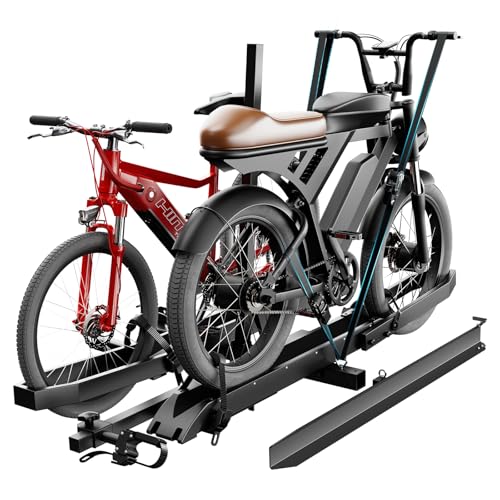
| Two heavy e-bikes | Young Electric E-Bike Rack with Ramp | 200 pounds total; up to 5-inch tires | Built for heavier bikes and easier roll-on loading |
| Long wheelbase fat-tire bikes | Young 200 Lbs. 2 Bike Rack | 200 pounds total; wheelbases up to 58 inches | Better fit when the bike is long as well as wide |
| Daily loading with less lift | TrailV2 Plus Hitch 2 Ebike Rack | 46-inch ramp; up to 5-inch tires | Useful for step-through frames and taller bikes |
| Cars, SUVs, and lighter two-bike loads | PacificCrest Bike Rack for Car & SUV | 160 pounds total | Fits the lower end of heavy-duty use without chasing maximum weight |
Young Electric E-Bike rack with ramp
This is the clearest pick if you want a ramp and enough headroom for a pair of heavy e-bikes. It supports up to 200 pounds total and accepts tires up to 5 inches wide, which makes it a practical match for many modern commuter e-bikes and fat-tire bikes.
The ramp matters when the bike is heavy or the frame is step-through. A ramp cuts the dead lift at the hitch, which is where many riders feel the strain first. Check the manufacturer’s listing for your exact bike length and wheelbase, because tire width alone does not guarantee fit.
Young 200 Lbs. 2 bike rack
This option suits riders who need more tray length than a basic carrier provides. It is rated for up to 200 pounds total capacity and supports wheelbases up to 58 inches, which is useful for longer trail bikes and stretched e-bike frames that do not sit well on short trays.
Long-wheelbase bikes create force at the hitch. If the trays are too short, the rear wheel may sit awkwardly and the rack can feel more stressed over bumps. This kind of fit issue shows up on rough roads, not in a parking-lot install.
TrailV2 plus Hitch 2 ebike rack
This is the strongest choice when loading access matters as much as capacity. It includes a 46-inch ramp and supports fat tires up to 5 inches wide, which helps when the bike is heavy enough that lifting onto a platform tray feels like the hard part.
A ramp is especially helpful on sloped driveways, where pushing a heavy bike up and onto the rack can get awkward fast. If your garage sits lower than the driveway apron, a longer ramp can cut the angle and reduce the chance of a stalled push halfway up.
PacificCrest bike rack for car & SUV
This is the lighter-duty end of the heavy-duty group. It is rated for up to 160 pounds and makes sense when you are carrying two bikes that do not push the upper end of the e-bike category. It still belongs in the 2-inch hitch class used by cars, SUVs, trucks, minivans, and RVs.
That lower ceiling matters because total capacity is not just a headline number. Two heavy bikes should be placed with load distribution in mind, with both trays loaded evenly and nothing hanging farther out on one side than the other. Uneven placement raises stress at the receiver and on the rack arms.
Which heavy-duty rack fits your bike?
The right rack starts with the bike, not the brochure. Match the rack to your heaviest bike, widest tire, and longest wheelbase, then decide whether you need a ramp or rear access more than you need the lowest possible price. A 2-inch hitch is a common fitment for many heavy-duty e-bike racks on cars, SUVs, trucks, minivans, and RVs.
Match rack capacity to e-bike weight and two-bike total
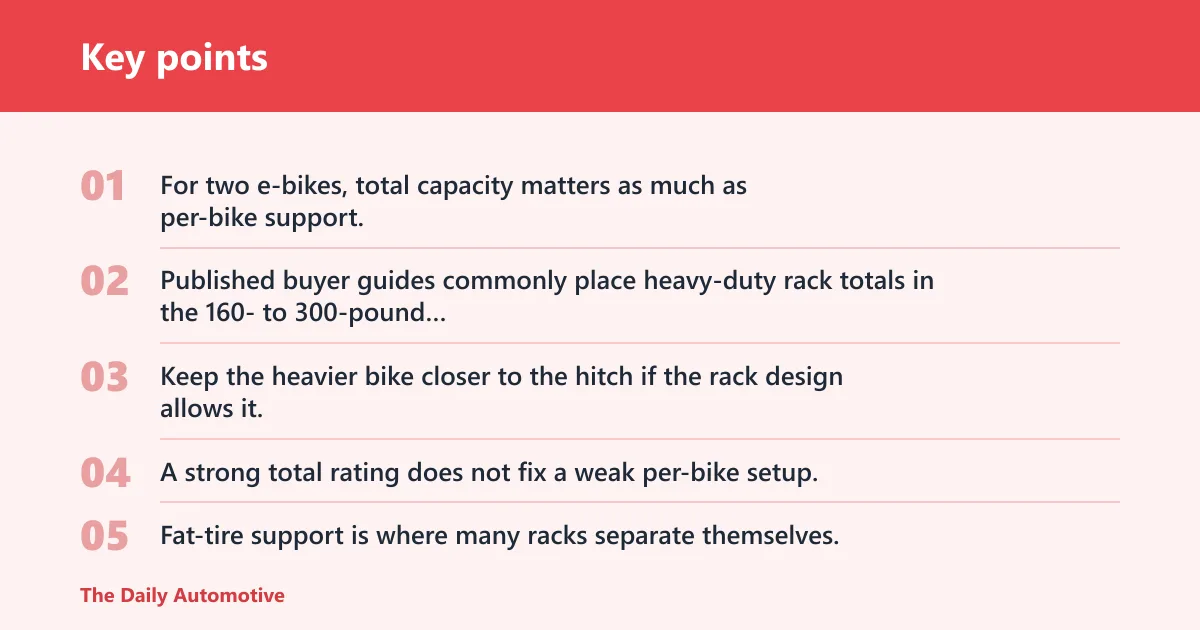
For two e-bikes, total capacity matters as much as per-bike support. Published buyer guides commonly place heavy-duty rack totals in the 160- to 300-pound range, and that spread exists for a reason: one heavy bike plus one lighter bike is a very different load from two full-size fat-tire e-bikes.
Load distribution matters too. Keep the heavier bike closer to the hitch if the rack design allows it, and check whether the arms or wheel trays are rated for the bike’s weight rather than only the rack’s headline total. A strong total rating does not fix a weak per-bike setup.
Check tire width and wheelbase before buying
Fat-tire support is where many racks separate themselves. Five-inch tire clearance is common, but some racks go to 5.5 inches. Wheelbase support on many mainstream trays often tops out at about 48 inches or 50 inches, while a few models extend to about 58 inches. Measure the widest tire and the full wheelbase of the longest bike in the garage.
Say your bike has 5-inch tires and a 57-inch wheelbase. A rack that stops at 48 inches may technically carry the weight, but it will not solve the fit problem. The tray length and wheel cradles need to match the bike’s shape, not just its mass.
Choose tilt-away or fold-flat if you need rear access
If you use the cargo area often, tilt-away or fold-flat hardware becomes more than a convenience feature. It lets you open a hatch or tailgate without taking the bikes off first, and a fold-flat frame is easier to store in a garage when the rack is not on the vehicle.
That matters most for daily drivers and minivans. A rack that blocks access every time can turn a useful carrier into a nuisance, especially if the bike is going on and off several times a week.
Heavy-duty e-bike rack options
Platform-style racks suit most heavy e-bikes because they hold the wheels from below and reduce frame contact. Ramp-assisted racks go further by taking some of the lift out of the process, which helps with step-through frames and bikes that are too heavy to muscle onto a tray comfortably.
Platform racks for stable transport
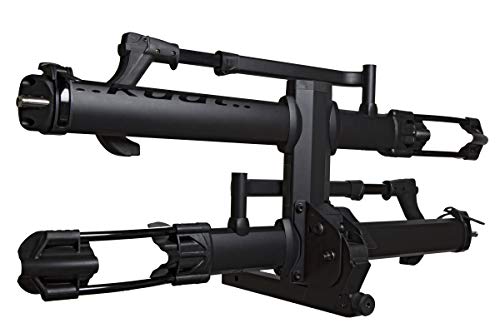
Platform racks are the safer default for heavy bikes on rough pavement because the wheel cradles keep the bike planted and the contact points are predictable. Look for padded clamps, soft padding, ratchet straps, and wheel locks or straps that keep the tire from shifting against the tray.
Anti-wobble hardware matters here too. A hitch tightener or anti-wobble cradle cuts side-to-side movement and helps keep the rack from rocking in the receiver. Pair that with a locking hitch pin if the rack will stay on the vehicle between rides.
Ramp-assisted racks for step-through frames
Ramp racks are a better match when the lifting motion is the problem. Step-through e-bikes, heavier battery-assisted commuter bikes, and riders who do not want to dead-lift a bike onto a tray can all benefit from a built-in ramp.
A ramp does add storage and handling complexity. The rack itself can be heavier, and the ramp needs somewhere to live when the bike is attached. If garage space is tight, check how the ramp stows and whether the rack folds flat against the vehicle.
When a higher-capacity rack makes sense
Buy more capacity when the load is close to the limit, not just because a bigger number looks safer.
That does not mean more capacity fixes poor fit. A heavier rack with short trays still fails the wrong bike. Capacity, wheelbase, tire width, and loading method all need to line up.
Fat-tire rack options
Fat-tire bikes need tray width, wheel support, and enough cradle room to keep the tire seated correctly. A rack that handles a 5-inch tire can still fall short if the bike has a long wheelbase or if the arms do not close securely around the tire profile.
Up to 5-inch tire support
Five-inch tire support covers many fat-tire e-bikes. The Young Electric E-Bike Rack with Ramp and the TrailV2 Plus Hitch 2 Ebike Rack both support tires up to 5 inches wide, which gives you a workable ceiling for many trail and utility bikes.
Do not assume all fat tires are equal. A 5-inch tire on a short frame is easier to place than the same tire on a stretched frame with a cargo rack or long rear triangle.
When 5.5-inch clearance matters
If the bike uses a wider-than-average tire, 5.5-inch clearance becomes important. Some racks fit that extra width, and it can be the difference between a secure wheel cradle and a tire that rides too tightly against the side supports.
That extra half-inch is not about convenience only. If the tire sits too snugly, installation gets slower and the tire can be harder to center during loading.
Wheelbase limits for longer trail and fat-tire bikes
Long-wheelbase bikes are common among cargo e-bikes and larger trail bikes. A rack rated to 48 inches or 50 inches may work for shorter frames, but 58 inches gives more room for bikes with stretched geometry and rear accessories.
When in doubt, measure from axle to axle. Wheelbase is the number that tells you whether the bike will sit properly on the tray, not just whether the tire fits in the hoop.
Loading ramp and access options
A built-in ramp is worth paying for when the bike is heavy, the rider loads alone, or the driveway adds an uphill push. Tilt-away hardware solves a different problem: rear access. A good rack may need both if you drive a minivan, SUV, or RV and use the cargo area often.
When a built-in ramp is worth it
Choose a ramp when the bike is heavy enough that lifting becomes the weak link in the setup. The ramp cuts the load on your back and shoulders and can make solo loading realistic for a step-through e-bike or a bike with a high battery pack.
It also helps keep the rack from becoming a two-person job every time the bike comes off the vehicle. That matters for commuting, where speed and repeatability matter more than feature count.
Why a 46-inch ramp matters on sloped driveways
A 46-inch ramp gives more room to roll the bike up with less abrupt angle change than a short ramp. On a sloped driveway, that extra length can cut the point where the bike feels like it wants to roll backward before it reaches the tray.
Picture a heavy step-through e-bike on a driveway that tilts away from the garage. A short ramp can force a steep push angle right at the hitch. A longer ramp keeps the load smoother and makes alignment easier.
Tilt-away and fold-flat features for daily use
Tilt-away lets you reach the hatch or tailgate without removing the bikes. Fold-flat storage keeps the rack closer to the vehicle when not in use, which helps with parking, garage clearance, and daily driving.
These features are most useful on vehicles that do more than weekend duty. If the rack stays on the car through the week, a fold-flat shape is easier to live with than a bulky fixed carrier.
Heavy-duty bike rack decision matrix
This matrix ties the rider profile to the minimum rack spec worth buying. It focuses on the real transport problem: weight, tire width, wheelbase, loading method, rear access, RV use, and how hard the rack is to install alone.
| Use case | Minimum spec to buy | Feature to prioritize | Why it matters |
|---|---|---|---|
| Two commuter e-bikes, 45 to 60 lb each | 200 pounds total, 2-inch hitch | Anti-wobble hardware | Controls movement on rough roads and keeps the load planted |
| Fat-tire bike with 5-inch tires | 5-inch tire support, long tray | Wheel cradle width | Prevents pinch points and awkward tire seating |
| Long-wheelbase cargo or trail bike | Wheelbase up to 58 inches | Tray length | Short trays create fit and balance problems |
| Step-through e-bike loaded solo | Ramp-equipped rack | 46-inch or longer ramp | Reduces lift height and loading strain |
| Minivan or SUV with frequent cargo access | Tilt-away or fold-flat design | Rear access clearance | Lets you open the hatch without unloading the bikes |
| RV travel or rough-road towing | Heavy-duty hitch rack with anti-wobble cradle | Locking hitch pin plus cradle | Stability matters more as vibration and road flex increase |
| Small garage and solo storage | Fold-flat rack with manageable weight | Storage footprint | Some heavier racks are awkward to lift off and store |
Solo-install difficulty is easy to overlook. A rack that is simple on paper can still be a pain to lift onto a 2-inch receiver if it is bulky or heavy. If you will remove it often, check the rack’s storage shape, not just its road rating.
How do you choose the right hitch rack?
Start with the hitch, then match the bike. A 2-inch receiver is the standard fitment for most heavy-duty e-bike racks and is used across cars, SUVs, trucks, minivans, and RVs. After that, check tire width, wheelbase, loading method, and whether the rack blocks your hatch or tailgate.
Why 2-inch hitch fitment matters
The 2-inch receiver is the key compatibility point for most heavy-duty hitch racks. Smaller receivers are not the normal target for heavy e-bike carriers, and the larger tray loads used by fat-tire bikes belong on the stronger hitch class.
Never exceed the vehicle’s hitch, tow, or payload rating in the owner’s manual. That limit matters as much as the rack’s own label.
What anti-wobble hardware does on rough roads
Anti-wobble hardware cuts movement between the rack and the receiver. That can mean a hitch tightener, an anti-wobble cradle, or a locking hitch pin used with a rack designed to clamp tightly to the receiver.
On rough pavement, the goal is not silence alone. It is to keep the load from rocking and multiplying stress at the hitch interface. Published buyer feedback often flags wobble before any other complaint.
Which security features matter most in real use?
Start with a locking hitch pin, then look for a keyed hitch lock, lockable padded clamps, and wheel locks if the bike will sit unattended. Security hardware does not make a rack theft-proof, but it raises the effort required to remove either the rack or the bikes.
For transport stability, padded clamps and soft padding matter as much as the lock. A secure bike that gets scratched on the way home is still a poor setup.
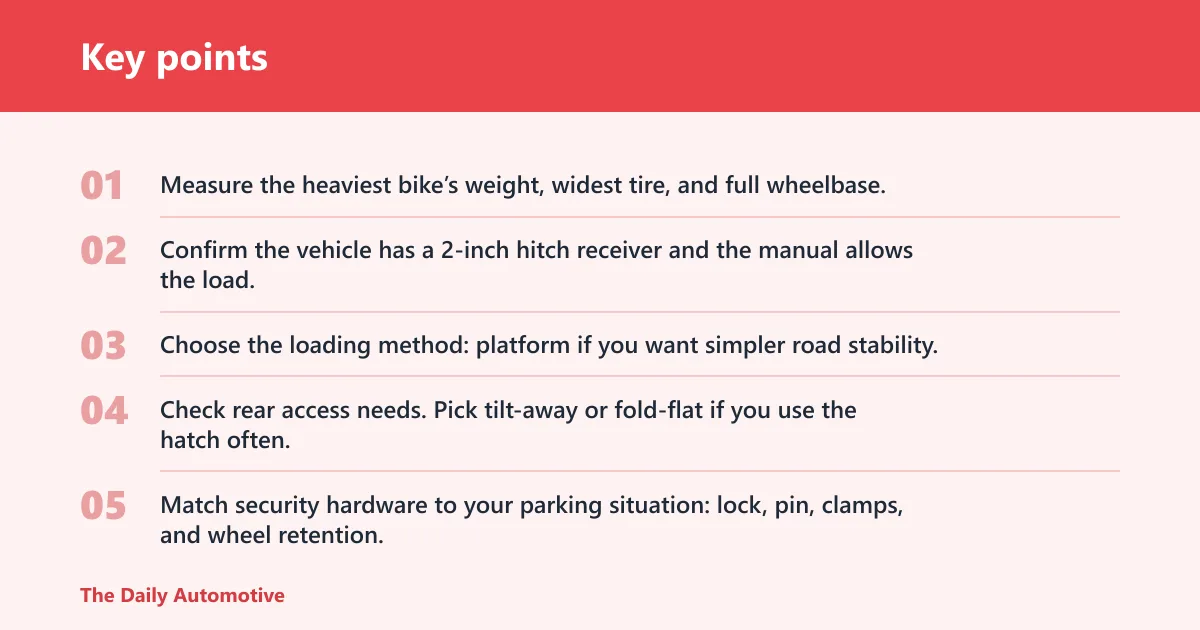
- Measure the heaviest bike’s weight, widest tire, and full wheelbase.
- Confirm the vehicle has a 2-inch hitch receiver and the manual allows the load.
- Choose the loading method: platform if you want simpler road stability, ramp if you want less lifting.
- Check rear access needs. Pick tilt-away or fold-flat if you use the hatch often.
- Match security hardware to your parking situation: lock, pin, clamps, and wheel retention.
Common first-timer mistake: buying for weight alone and ignoring wheelbase. A 200-pound rack can still be the wrong choice if the longest bike needs 58 inches of tray room and the rack only supports shorter frames.
Frequently asked questions
What heavy-duty bike rack fits two e-bikes on a 2-inch hitch?
Look for a 2-inch hitch rack with a total rating around 200 pounds, long wheelbase trays, and wheel-secure cradles. For a two-bike load, the rack should also support the widest tire in the pair and keep the bikes separated enough that the bars and pedals do not clash.
How much total weight can a heavy-duty bike rack carry?
Heavy-duty hitch racks commonly land between 160 and 300 pounds total, but the right number depends on the bikes, not just the rack. Two heavy e-bikes can quickly use up the total rating, so check both the overall capacity and the per-bike layout before buying.
Will a bike rack fit 5-inch fat tires and long wheelbases?
Yes, if the rack is built for both dimensions. Five-inch tire support is common on better heavy-duty racks, while some models handle wheelbases up to 58 inches. You need both numbers to line up, because a wide tire on a short tray still creates fit problems.
Do I need a bike rack with a loading ramp for heavy e-bikes?
If the bikes are heavy enough that lifting them onto a platform rack is awkward, a ramp is worth it. It helps most with step-through frames, solo loading, and sloped driveways. A 46-inch ramp gives more forgiving loading than a short, steep one.
Which bike racks allow trunk access without removing the bikes?
Tilt-away racks are the answer here. They let you open a hatch or tailgate while the bikes stay mounted. Fold-flat designs help with storage, but tilt-away hardware is the feature that protects cargo access during daily use.
What anti-wobble features matter on rough roads?
Look for a hitch tightener, an anti-wobble cradle, or a rack that includes a locking hitch pin and a receiver clamp system. The goal is to reduce movement at the hitch, since vibration on rough roads can magnify stress and make the rack feel unstable.
Are there heavy-duty bike racks approved for RV use?
Some heavy-duty racks are marketed for RV use, but you still need to check the rack’s listing and the RV manual. Road vibration and rear overhang can be harder on racks than normal driving, so anti-wobble hardware and secure wheel retention matter more than usual.
How do I choose between a platform rack and a ramp rack?
Choose a platform rack if you want the simplest stable transport setup and can lift the bike onto the trays. Choose a ramp rack if loading effort is the main problem. For heavy e-bikes, the ramp often solves more real-world friction than extra capacity alone.
What security features should I look for on an e-bike rack?
Start with a locking hitch pin, then add a keyed hitch lock if the rack stays on the vehicle. Lockable padded clamps, wheel locks, and straps help keep the bikes secure and reduce movement. Theft deterrence and transport stability are related, but they are not the same thing.
Method note: This guide is based on manufacturer specs, listing details, and published buyer feedback.
Products related to this article
Sponsored / affiliate links. As an Amazon Associate I earn from qualifying purchases. I may earn additional commission from eligible campaigns.
 MEEVIZ Bike Rack Hitch for Car - 200 Lbs Capacity Heavy Duty 2-Ebike Rack, Smart Tilting Foldable Platform Bicycle Racks with 2" Receiver for Cars, SUVs, Trucks, Vans, Fits Up to 5" Fat Tire
 Heavy Duty Steel Car Ramp Set - 8 Inch Lift Height - 8,000 lbs Capacity - Reflective Safety Stickers for Truck and SUV Repair, 2 Pack - Red