Car Rack for Wheelchair: Hitch Carriers & Weight Limits
Byline: Reviewed by an automotive accessory editor familiar with receiver hitches, mobility-device transport, and rear-cargo compliance.
Methodology: This guide compares vehicle owner-manual limits, hitch and carrier listings, and wheelchair transport instructions before any fit decision. It emphasizes the lowest applicable rating, rear-cargo derating where specified, and a physical fit check for clearance, lighting, and securement. When a setup cannot be verified against the manuals, it should be treated as a no-go.
Wheelchair carrier decision table
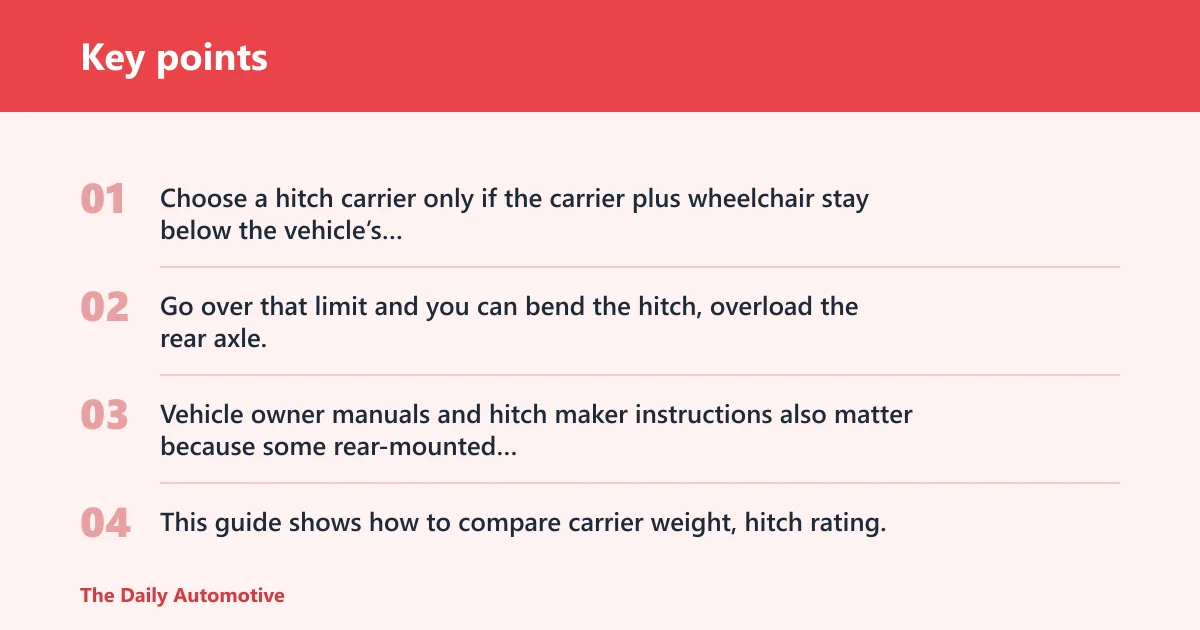


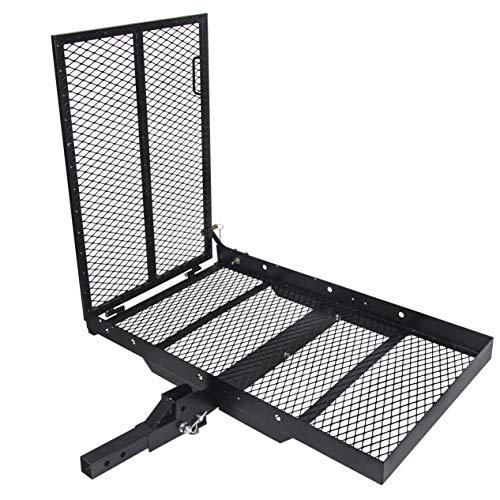
Choose a hitch carrier only if the carrier plus wheelchair stay below the vehicle’s tongue-weight rating, with about a 10% margin for tie-downs and ramps. Go over that limit and you can bend the hitch, overload the rear axle, and make the setup unstable. Vehicle owner manuals and hitch maker instructions also matter because some rear-mounted cargo setups require a lower limit than the hitch sticker alone suggests. This guide shows how to compare carrier weight, hitch rating, and wheelchair dimensions before you buy.
| Hitch tongue weight | Carrier weight | Wheelchair weight | Battery weight | Total loaded weight | Rear-door clearance | Ramp need | Go/no-go result |
|---|---|---|---|---|---|---|---|
| Listed tongue-weight rating, then derated if the vehicle manual requires it for rear cargo | Model listing only; include any folding, tilting, or swing-away hardware | Manual chair, folding chair, or power chair total mass as configured | Battery installed or removed per the wheelchair manual | Carrier + wheelchair + battery + securement hardware | Rear hatch, trunk, or liftgate must open or tilt away without contact | Needed when the chair cannot be lifted safely or the approach angle is too steep | Go only if every limit clears with margin; otherwise no-go |
| Below rating after any vehicle-specific cargo derating | Light enough to leave room for payload and straps | Within carrier payload limit and securement footprint | Within the wheelchair maker’s transport instructions | Below the lowest applicable vehicle, hitch, and carrier limit | Clear with no interference to lamps, plate, or rear view | Ramp stows safely and does not block access | Go |
| At or above the effective limit | Too heavy once mounted behind the receiver | Exceeds carrier payload or tie-down envelope | Raises the total beyond limit or violates the chair manual | Any over-limit condition | Hatch or liftgate contacts the carrier | Ramp makes loading unsafe or too steep | No-go |
Can a hitch carrier hold a wheelchair?
A hitch carrier can hold a wheelchair only if the vehicle, hitch, and carrier all allow the load, and the wheelchair fits inside the carrier’s platform, securement, and access limits. The safest approach is to start with the vehicle owner’s manual, then the hitch label, then the carrier listing, and finally the wheelchair transport instructions. If any one of those disallows the setup, it should not be used.
What the receiver hitch must support
The receiver-style trailer hitch has to match the carrier mount and support the vertical load at the rear of the vehicle. That means the receiver size, pin setup, and load rating all matter. Hitch-mounted cargo guidance from vehicle and hitch manufacturers typically treats the published limit as an installed-system limit, not a generic promise that every rear attachment is allowed.
Do not treat a tow rating as the answer for rear cargo. The number that matters is the vehicle’s hitch or tongue-weight limit for cargo behind the receiver, plus any separate cargo-carrier restriction in the owner’s manual. A number of automakers also warn that rear-mounted accessories can require a lower allowance than trailer towing because the load sits farther from the axle and affects leverage, lights, and rear access differently.
Why carrier position changes the load check
A wheelchair carrier sits behind the receiver, so the load acts with more force than a centered load at the hitch pin. That rearward distance can reduce the effective capacity even when the raw tongue-weight number appears adequate. If the carrier folds, tilts, or swings away, the extra hardware can increase that distance and change the loading math again.
Suppose a folded manual chair looks light enough on paper, but the carrier extends the load far behind the bumper and the rear hatch can no longer open. That is a no-go even before you consider the exact weight, because access, clearance, and force all fail together. In practice, the first failure case is often not weight alone but interference at the hatch, plate, or taillamps.
When the setup fails the first screening
If the carrier plus wheelchair already meets or exceeds the vehicle’s effective rear-cargo limit, stop. If the chair’s folded width, length, or battery placement prevents secure four-point restraint, stop. If the carrier blocks the plate, lamps, or rear view, stop. Safety depends on the hitch rating, carrier weight, wheelchair weight, battery weight, and clearance checks all at once.
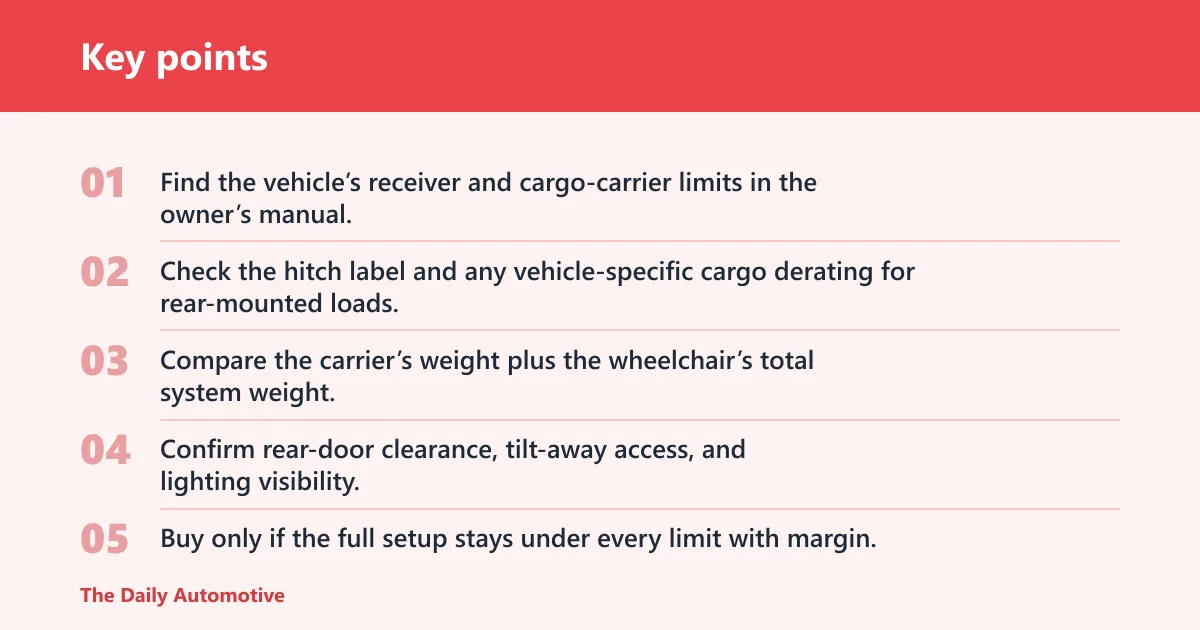
- Find the vehicle’s receiver and cargo-carrier limits in the owner’s manual, including any rear-cargo derating.
- Check the hitch label and any vehicle-specific cargo derating for rear-mounted loads.
- Compare the carrier’s weight plus the wheelchair’s total system weight.
- Confirm rear-door clearance, tilt-away access, and lighting visibility.
- Buy only if the full setup stays under every limit with margin.
Wheelchair load checklist
Use this checklist before you shop. The key question is not whether the carrier fits a receiver, but whether the combined load stays under the lowest applicable rating and still leaves room for secure tie-downs, a ramp, and rear access. Follow the vehicle and product manual; never work under a vehicle supported only by a jack, use jack stands on level ground; do not exceed the vehicle’s roof, hitch, tow, or payload rating in the owner’s manual; and check local laws for plate, light, and visibility rules. In many regions, rear lights and the license plate must remain visible or be properly relayed when obscured, so legality is part of the fit check, not an afterthought.

What to total before you buy
Count the carrier weight, wheelchair weight, battery weight, and any accessories that stay on the chair during transport. For a power wheelchair, many manufacturers allow transport with batteries installed unless the chair manual says otherwise, so do not assume the batteries must come off. For a folding chair, include footrests, headrests, trays, and anything else that changes the transport mass or footprint. Manufacturer transport instructions should govern battery handling, orientation, and restraint points.
How to use the checklist
Rear-door clearance matters because a carrier that blocks a hatch or liftgate can make the vehicle unusable after loading. Ramp need matters because some chairs cannot be lifted safely or rolled up a steep approach angle. If the chair cannot roll on and the ramp is too short, the setup is a no-go. A good fit check is physical, not just numeric: the chair should load, clear, latch, and remain visible enough to satisfy local rules.
Use the table as a pass-fail screen, not as a substitute for the manufacturer’s listing. If any field is unknown, check the vehicle manual, carrier manual, or wheelchair manual before purchase. If the license plate or rear lamps are blocked, a legal visibility issue may also make the setup unusable even if the weights look acceptable.
- Hitch tongue weight: use the lowest stated rear-cargo limit that applies.
- Carrier weight: count the platform, tray, fold mechanism, and stabilizer hardware.
- Wheelchair weight: use the chair’s transport weight, not a guessed chair weight.
- Battery weight: include installed batteries unless the chair manual says otherwise.
- Total loaded weight: carrier plus chair plus battery plus securement gear.
- Rear-door clearance: confirm hatch, trunk, or liftgate movement.
- Ramp need: decide whether a ramp is required for safe loading.
- Go/no-go result: only go when every check passes.
How to check hitch and vehicle ratings
Start with the receiver-style trailer hitch, then confirm the vehicle manual’s rear-cargo limits. The hitch sticker alone is not enough, because some vehicles and hitch makers require derating when the load sits on a carrier behind the receiver. Use the lowest applicable rating, not the highest number you can find.
Lock, pin, and anti-rattle compatibility
The carrier has to match the receiver size and the locking hardware. A hitch pin keeps the mount in place; a lock deters theft; and an anti-rattle stabilizer clamp reduces wobble, clanking, and fore-aft movement. Several hitch manufacturers publish anti-rattle guidance for receiver-mounted accessories, and the key point is always the same: a stabilizer improves fit and motion control, but it does not change the hitch’s rated capacity.
That clamp does not fix overload. It only improves fit and motion control. If the vehicle or carrier limit is exceeded, the setup is still unsafe even with a tight mount.
Why cargo behind the hitch may need derating
Rear-mounted cargo sits farther from the axle than a ball-mounted trailer tongue load. That extra force can make the same weight harder on the hitch and vehicle structure. Some owners discover the problem only after the carrier is installed and the rear sags, the hatch binds, or the lamps are partly blocked. Those are warning signs, not minor annoyances. If the owner’s manual or hitch documentation calls for a lower rear-cargo figure, that lower figure controls.
Hitch carrier versus towbar bike rack: what changes?
A wheelchair carrier needs a different buying decision than a towbar bike rack. Towbar bike carriers are described as ideal for transporting e-bikes and as a secure solution for heavier or oddly sized bikes, and rear bike racks do not require roof rack bars and attach to the rear hatch. That does not automatically make them suitable for wheelchair transport, because wheelchairs need different support, different restraint points, and often different access clearance.
Why bike-rack ratings do not transfer cleanly
Bike racks are shaped around bicycle frames, wheel trays, and wheel clamps. A wheelchair may need a broader platform, different tie-down points, and a different center of mass. Some bike-rack brands publish ramp or foldaway accessories for bicycles, but those specifications do not verify wheelchair suitability unless the maker explicitly says the rack is approved for mobility devices and lists the wheelchair load case.
There is a common first-timer mistake here: a buyer sees a platform rack rated for heavy bikes and assumes the same rating covers a power chair. It may not. Wheelchairs can sit lower, roll differently, and demand more tie-down control around the frame and wheels. A bike rack can be strong enough in pounds and still be wrong in geometry.
When a bike-rack platform is not a wheelchair carrier
If the rack has narrow wheel trays, fixed cradles, or a shape that prevents four-point restraint, it is not the right tool. If the carrier lacks secure frame-safe tie points, it is also a poor fit. A wheelchair carrier should be judged on wheelchair geometry, loading method, and securement, not on bike-rack marketing language. The safest comparison is not brand to brand, but use case to use case.
Will your wheelchair fit and stay secure?
A chair can pass the weight check and still fail the fit check. Manual wheelchairs, folding chairs, transit chairs, and power wheelchairs all carry different risks. The right answer depends on total system weight, folded dimensions, wheelbase, and whether the carrier gives you safe tie-down points for movement control during braking and cornering. Manufacturer transport instructions for the chair should always govern battery handling and restraint.
Manual versus power wheelchair weight
Manual chairs are often lighter and easier to place on a carrier, but they still need securement. Power wheelchairs usually weigh more once batteries and accessories are included, so the full transport weight matters more than the frame alone. Do not remove batteries unless the wheelchair manual tells you to do so.
Picture a power chair with batteries installed, a joystick, and a rear tray. If the carrier is sized for the chair frame alone, the accessory load can push the setup over the limit or block the strap path. That is why the total system weight matters, not just the base chair.
Folded dimensions and turning clearance
Measure folded length, width, and height, then compare them with the carrier tray and the space around the bumper. A folding wheelchair may fit the platform but still strike the hatch when the carrier tilts or swings. Transit chairs can also have awkward protrusions that interfere with the carrier rails or ramp. A practical fit check should include the fully loaded, closed, and latched position, not just the chair’s folded size on paper.
Tie-down points and four-point restraint
Use frame-safe attachment points and follow the carrier and wheelchair manufacturer instructions for securement. Ratchet straps or wheel straps should prevent forward, rearward, and side-to-side movement. Four-point restraint is commonly considered the safer target because it helps control motion during braking. Do not improvise with random anchor points that could crush tubing or fold hardware.
Battery and accessory considerations
Accessory weight counts. So do oxygen holders, trays, cushions that stay attached, and any removable items the manufacturer expects to be removed for transport. If the chair manual allows batteries to remain installed, count them in the total loaded weight. If the manual requires removal, follow that instruction exactly. That is especially important for powered chairs where battery handling can alter both weight and transport instructions.
Do you need a loading ramp?
A loading ramp is needed when the wheelchair cannot be lifted safely onto the carrier or when the approach angle is too steep for controlled rolling. A ramp is especially useful for heavier or non-liftable loads, but it also adds weight, storage bulk, and one more piece to secure. That extra gear still counts against the overall limit, so ramp choice is part of the rating check, not separate from it.
Ramp length and approach angle
Longer ramps usually reduce the slope, which helps with heavy chairs and reduces the chance of dragging the footplates or battery box. Manufacturer ramp guidance commonly ties safe loading to approach angle and platform height, not just to the ramp’s presence. Check the angle created by your bumper height, because a short ramp can make the climb too steep for safe loading.
A ramp that is too steep can cause wheel spin, tipping, or hard contact at the transition point. If the chair’s front casters or drive wheels bottom out before the carrier platform, the ramp is the wrong match.
Stowage and handling after loading
The ramp also needs a home after use. If it rides on the carrier, confirm that it does not block straps, lights, or rear access. If it stows separately, make sure it cannot shift into the chair during travel. The safest ramp is the one you can deploy, load, secure, and stow without changing the carrier’s stability.
How to reduce wobble and rear-access problems
Wobble, hatch interference, and visibility problems are common failure points. An anti-rattle stabilizer clamp can reduce noise and motion, but it should be paired with the right carrier geometry and the right hitch rating. Tilt-away access matters when the hatch or trunk must still open after the chair is loaded, and the load must not create a plate- or lamp-visibility violation.
Tilt-away access and hatch clearance
Check whether the carrier tilts enough to let the rear door open. If the chair, ramp, or straps stop the tilt before the hatch clears, the setup fails. A carrier that fits the receiver can still block the cargo opening once loaded, especially on vehicles with short rear overhang or steep liftgate motion. The practical test is simple: the rear door must open and close without forcing, scraping, or requiring unsafe unloading.
Rear visibility, plate, and light obstruction
Do not ignore the driver’s view, the license plate, or rear lamps. A wheelchair carrier can hide all three, and some vehicles are particularly sensitive to that obstruction. Check local laws before you buy, and make sure the loaded carrier does not keep the plate or lights hidden. If visibility or illumination is obscured, legal compliance may require a relocation kit, auxiliary lights, or a different transport method.
For a hitch-mounted wheelchair carrier, the safest purchase is the one that clears the vehicle manual, the hitch limits, the carrier payload, and the chair’s own transport instructions. If any one of those fails, choose a different carrier or a different transport method.
Frequently asked questions
Can you use a hitch car rack for a wheelchair?
Yes, but only if the rack is designed and rated for the wheelchair’s total system weight, fits the receiver-style trailer hitch, and allows proper securement. A bike rack or general cargo platform is not automatically suitable. Check the vehicle, hitch, carrier, and wheelchair manuals before buying.
How much weight can a hitch-mounted wheelchair carrier hold?
The correct limit is the lowest applicable rating among the vehicle’s rear-cargo limit, the hitch’s rating as installed on that vehicle, and the carrier’s own payload limit. Do not use tow rating alone. Because rearward force matters, some setups need derating even before the stated limit is reached.
What is the difference between a hitch carrier and a bike rack?
A hitch carrier for a wheelchair needs broader support, safer tie-down points, and clearance for a different shape and center of mass. Bike racks are built around bicycle frames and wheel trays. Bike-rack features for e-bikes do not automatically transfer to wheelchair transport unless the manufacturer explicitly approves that use.
Do you need a loading ramp for a wheelchair hitch carrier?
Not always, but many chairs are safer to load with one. A ramp helps when the chair is heavy, awkward, or not meant to be lifted. Check the ramp length, approach angle, and storage method. Ramp guidance from carrier makers is usually tied to safe angle and clearance, not just convenience.
How do you check if your car hitch is rated for a wheelchair carrier?
Read the vehicle owner’s manual first, then the hitch label and carrier listing. Look for the rear-cargo or tongue-weight limit that applies to a load behind the receiver, and watch for any cargo-carrier derating. If the manual is silent, do not assume the setup is allowed.
Will a hitch carrier work for a folding wheelchair or power wheelchair?
It can, if the folded size fits the platform and the total loaded weight stays under every limit. Power wheelchairs need special attention because batteries and accessories add weight, and the chair manual may have transport rules. Folding chairs still need frame-safe, four-point securement.
What should you check before buying a wheelchair carrier for a tow hitch?
Check receiver size, hitch and vehicle limits, carrier payload, wheelchair total weight, battery rules, folded dimensions, tie-down points, rear-door clearance, ramp need, and visibility. If the setup blocks the hatch, plate, or lights, or if any limit is unclear, choose a different carrier or transport method.
Products related to this article
Sponsored / affiliate links. As an Amazon Associate I earn from qualifying purchases. I may earn additional commission from eligible campaigns.