Where to Buy Cars: Essential NFS Heat Guide
You can buy cars in Need for Speed Heat at any Gas Station or your Garage in the game. Visit these locations to access the dealership and expand your vehicle collection.
Hey there, fellow gearheads! Md Meraj here, ready to help you navigate the exciting world of Need for Speed Heat. Getting your hands on the perfect ride is one of the most thrilling parts of the game, but figuring out exactly where to start can feel a little overwhelming, especially when you’re just getting your street racing career going. Don’t worry, I’ve got your back! We’ll break down exactly where to snag those sweet rides so you can hit the streets in style. Get ready to explore the options and find your dream machine!
Your First Steps to a New Ride in NFS Heat
Starting out in Need for Speed Heat, your initial selection of cars is pretty limited. This is by design, as the game wants you to earn your way to the more exotic and powerful machines. Think of it like a real-life beginner driver; you start with something reliable, and as you gain experience and resources, you upgrade. The good news is that the game makes it super clear where you can go to expand your garage. You won’t be wandering around the map aimlessly for hours!
The Garage: Your Personal Automotive Hub
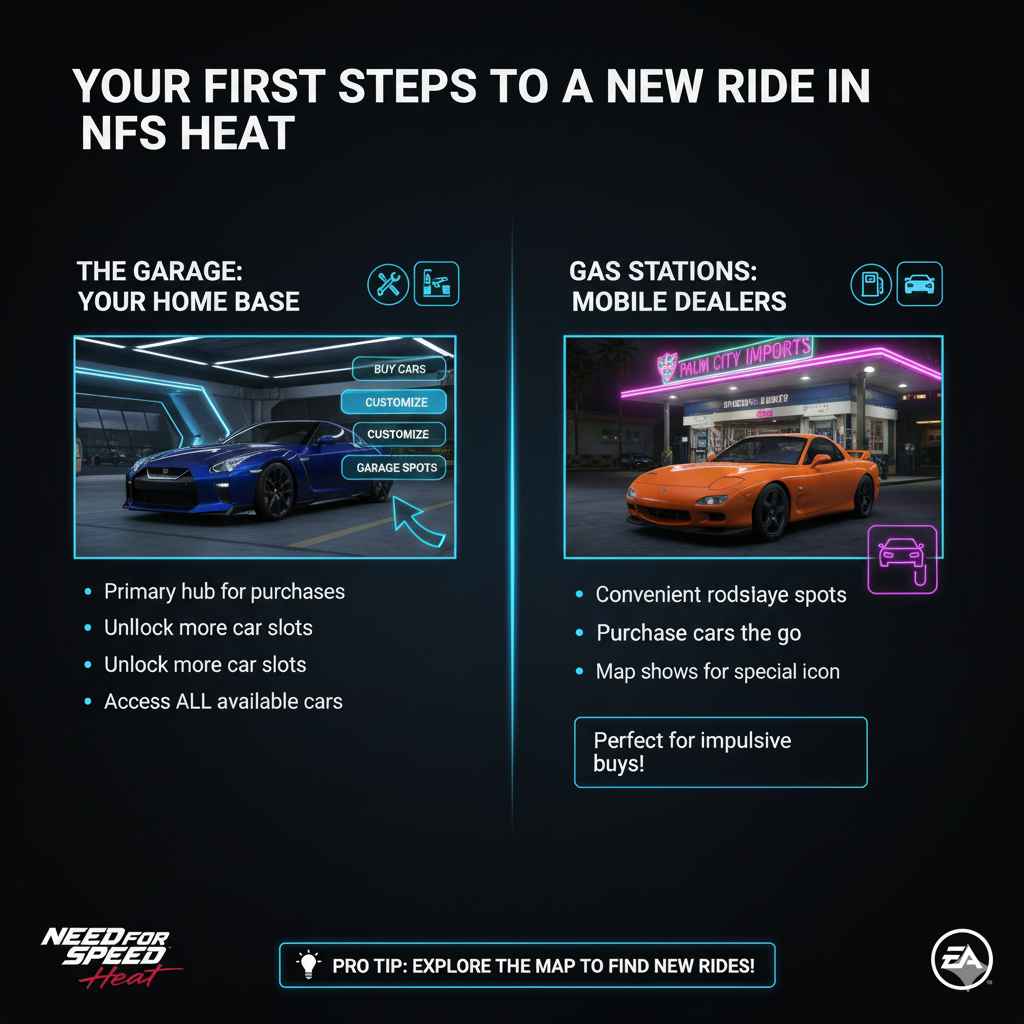
Your Garage isn’t just a place to stash your current cars and customize them; it’s also your primary gateway to purchasing new ones. When you first start the game, your Garage is your starting point. As you progress through the story, you’ll unlock more Garage spots, allowing you to house a larger collection of vehicles. Think of your Garage as your home base for everything car-related – from picking out your next purchase to tuning your current favorites.
Accessing the dealership from your Garage is straightforward. When you’re inside, you’ll see various options on the menu, including ‘Buy Cars.’ Selecting this will take you to the dealership screen, where you can browse all the available vehicles you’ve unlocked or can afford.
Gas Stations: Mobile Dealerships on the Go
Beyond your main Garage, Need for Speed Heat introduces Gas Stations as mobile dealerships sprinkled across the map. These aren’t just for refueling your virtual tank; they serve as convenient spots to purchase new cars when you’re out and about exploring Palm City. This is incredibly useful because it means you don’t always have to backtrack to your main Garage to make a new acquisition. If you’re cruising around, discover a cool car at a Gas Station, and have the cash, you can drive away in it immediately.
The map will clearly mark these Gas Station locations with a specific icon. Keep an eye out for them as you drive around. They blend into the environment, so learning their typical locations will make your car-hunting expeditions much more efficient. Using these Gas Stations is a smart way to make impulsive purchases or to quickly grab a vehicle that might be particularly suited for an upcoming event.
Understanding the Car Dealership in NFS Heat
When you head to the ‘Buy Cars’ section, whether from your Garage or a Gas Station, you’ll be presented with the game’s car dealership. This is where the magic—and the decision-making—happens. The dealership is organized, usually by manufacturer or car class, making it easier to find what you’re looking for. You’ll see a catalog of vehicles, each with its own set of stats, price, and performance potential.
It’s important to understand that not all cars are available from the start. Your progression in the game, specifically your ‘Heat Level’ and the number of races you’ve completed, unlocks new tiers of vehicles. So, don’t be discouraged if that high-end supercar isn’t available when you’re just beginning. The thrill of unlocking them is part of the NFS Heat experience!
Navigating the Dealership Interface
The dealership interface is designed to be user-friendly. Here’s what you can typically expect:
- Car Previews: You’ll see detailed 3D models of the cars. You can usually rotate them and get a good look from all angles.
-
Stats and Performance Data: Each car will have key performance indicators (KPIs) displayed. These often include:
- Top Speed: How fast the car can go.
- Acceleration: How quickly the car can reach its top speed.
- Braking: How effectively the car can slow down.
- Handling: How well the car can steer and corner.
- Drift: The car’s propensity for drifting.
- Price: The in-game currency (Banks) cost to purchase the vehicle.
- Class: Cars are often categorized into different classes (e.g., Classic Muscle, Tuner, Exotic) that indicate their general performance type and suitability for specific race types.
- Locked Vehicles: Some cars will be marked as locked, indicating requirements you need to meet before they become available for purchase.
Making Your First Purchase: What to Consider
For your very first car purchase, especially early in the game, it’s wise to opt for something balanced. You want a car that has decent acceleration and handling, as these will serve you well in most of the early races. Avoid cars that are only focused on top speed, as you’ll likely struggle with controlling them on tighter tracks.
Consider the type of races you’ll be participating in most frequently. If you anticipate a lot of tight, winding courses, a car with superior handling will be more beneficial than one with blistering acceleration. Conversely, for straight-line sprints, acceleration and top speed become more critical.
Understanding In-Game Currency: Banks
The currency you use to buy cars in Need for Speed Heat is called ‘Banks.’ You earn Banks by participating in and winning races, completing challenges, and generally performing well in the game. The more daring you are and the higher risk you take (like driving at night and evading the police), the more Banks you can potentially earn.
It’s a good idea to save up for a particular car you have your eye on rather than spending your Banks on every cheaper car you can afford. This strategic saving allows you to acquire a more capable vehicle sooner, which will in turn help you win more races and earn even more Banks.
Car Acquisition by Heat Level
One of the most significant factors determining which cars are available to you is your current ‘Heat Level’ in the game. As you drive around at night and evade the police, your Heat Level increases. This isn’t just a risk meter; it also acts as a progression lock for unlocking new car tiers. Higher Heat Levels mean the police are more aggressive and harder to escape, but they also unlock better cars at the dealerships.
Here’s a general idea of how car availability might tie into your Heat Level progression:
| Heat Level Range | Typical Car Availability | Focus |
|---|---|---|
| 0-2 | Entry-level compacts, older sedans, entry sports cars | Learning the ropes, basic races |
| 3-5 | Mid-tier sports cars, some older muscle cars, tuner cars | More competitive street racing, introduction to different car types |
| 6-8 | Performance sports cars, modern muscle cars, capable tuner machines | Challenging races, higher stakes events |
| 9-10 | High-performance exotics, supercars, track-focused vehicles | Elite racing, demanding challenges, prestigious events |
Please note: This table is a general guideline. The specific cars available at each Heat Level can vary, and your progression through story missions also plays a crucial role in unlocking new vehicles. Some story progression might unlock specific cars earlier than your Heat Level might suggest.
The Importance of Off-Road vs. On-Road Performance
As you play NFS Heat, you’ll notice that some cars feel more at home on the pavement, while others can handle rougher terrain. This is a vital distinction, especially as you explore the map and encounter different types of races. Cars with a focus on ‘Grip’ handling are generally better for tight circuits and smooth tarmac. Cars with a more ‘Drift’ oriented setup might be better for controlled slides around corners, which is essential in some racing disciplines.
When you’re browsing the dealership, pay attention to any hints or stats that suggest how a car will perform off-road or on various surfaces. For instance, some vehicles might have higher ‘Off-Road’ or ‘All-Terrain’ ratings (though these aren’t explicitly listed as stats but rather implied by car type and handling characteristics). If you’re planning to tackle races that veer off the main roads, you’ll want to consider vehicles that can manage various terrains. A good all-around performer early on can be invaluable for this flexibility.
Tips for Smart Car Buying in NFS Heat
Buying cars is a core part of the NFS Heat experience, and making smart choices can significantly speed up your progress and enjoyment. Here are some tips to help you spend your hard-earned Banks wisely:
- Don’t Rush Your First Buy: While tempting, resist buying the cheapest car just to have something. Save a little longer for a car that offers a better balance of speed, acceleration, and, most importantly, handling. A solid starter car can help you win more races to earn Banks faster.
- Research Your Ride: Before committing, take a moment to check reviews or community discussions about specific cars. Some cars just perform better than others in their class, even if they look similar. Understanding which cars are well-regarded for their stock performance can save you a lot of frustration.
- Consider the ‘Tier’ System: As mentioned, cars are unlocked by your Heat Level and story progression. High-tier cars are expensive and powerful, but you need to earn them. Don’t get discouraged if you can’t afford them early on; focus on building a solid lineup of mid-tier vehicles first.
- Think About Different Race Types: Do you enjoy circuit races, sprints, drift events, or off-road challenges? Different cars excel in different disciplines. If you find yourself struggling in drift events, perhaps invest in a new car with better drift stats or one that can be tuned for drifting effectively.
- Upgrade Potential: Remember that any car can be significantly improved with upgrades. A decent mid-tier car that you invest in with performance parts can often outperform a poorly chosen, more expensive car.
- Look at the Stats, But Drive With Your Gut: The numbers (Top Speed, Acceleration, etc.) are important, but how a car feels to drive is crucial. Test drive if possible (through races), pay attention to how it handles corners and brakes.
Can I Sell Cars in NFS Heat?
This is a common question for players looking to clear out their garages or recoup some lost Banks. Unfortunately, in Need for Speed Heat, you cannot directly sell cars once purchased. This means you need to be thoughtful about your purchases, especially early in the game. Each car you decide to acquire should ideally serve a purpose, whether it’s for a specific race type, a class requirement, or simply because you love its style.
Think of your garage as an investment. While you can’t sell them, each car collection grows your potential to tackle different challenges and earn rewards. If you find yourself with too many cars you don’t use, focus on using them to earn more Banks through races, which can then be put towards a better, more versatile vehicle.
Understanding Car Classes and Their Impact
Need for Speed Heat categorizes cars into distinct classes. These classes aren’t just for flavor; they usually indicate the car’s intended performance profile and, importantly, which types of events it’s best suited for. Understanding these classes can help you make better purchasing decisions:
| Car Class | Typical Characteristics | Best For |
|---|---|---|
| Classic Muscle | High acceleration, top speed, often struggle with handling | Sprints, drag races, open roads |
| Tuner | Good acceleration, balanced handling, often upgradable for drift | Circuit races, drift events, technical tracks |
| Sports | Well-rounded performance, good balance of speed and handling | Most race types, good all-around choice |
| Super | Very high top speeds and acceleration, can be demanding to handle | High-speed circuits, open roads |
| Hyper | Extreme performance, top-tier speed and acceleration, requires skilled driving | Elite challenges, specific high-performance events |
| Exotic | Luxurious, high-performance vehicles, often with unique styling | Showcase events, high-stakes races |
When you’re at the dealership, take note of these classifications. If you’re consistently failing drift events, and your current car is a ‘Classic Muscle,’ it might be time to invest in a ‘Tuner’ or a ‘Sports’ car that has better agility.
Where Are the Dealerships Located on the Map?
The dealerships in Need for Speed Heat are primarily found in two forms: your player-owned Garages and the scattered Gas Stations. There aren’t separate, dedicated dealership buildings to visit. Your Garage, which you start with and can expand, acts as your primary dealership. As you explore Palm City, you’ll also spot Gas Stations marked on your map. These Gas Stations are essentially pop-up dealerships, offering a convenient way to buy cars without returning to your main base.
To find these locations, simply open your map. The Gas Stations are usually represented by a gas pump icon. Your Garages are also marked on the map, often with a house or a garage door icon, and they serve as your main hub for car purchases and customization. Keeping an eye on your map for these icons is key to efficient car acquisition.
The Role of the Black Market and Special Cars
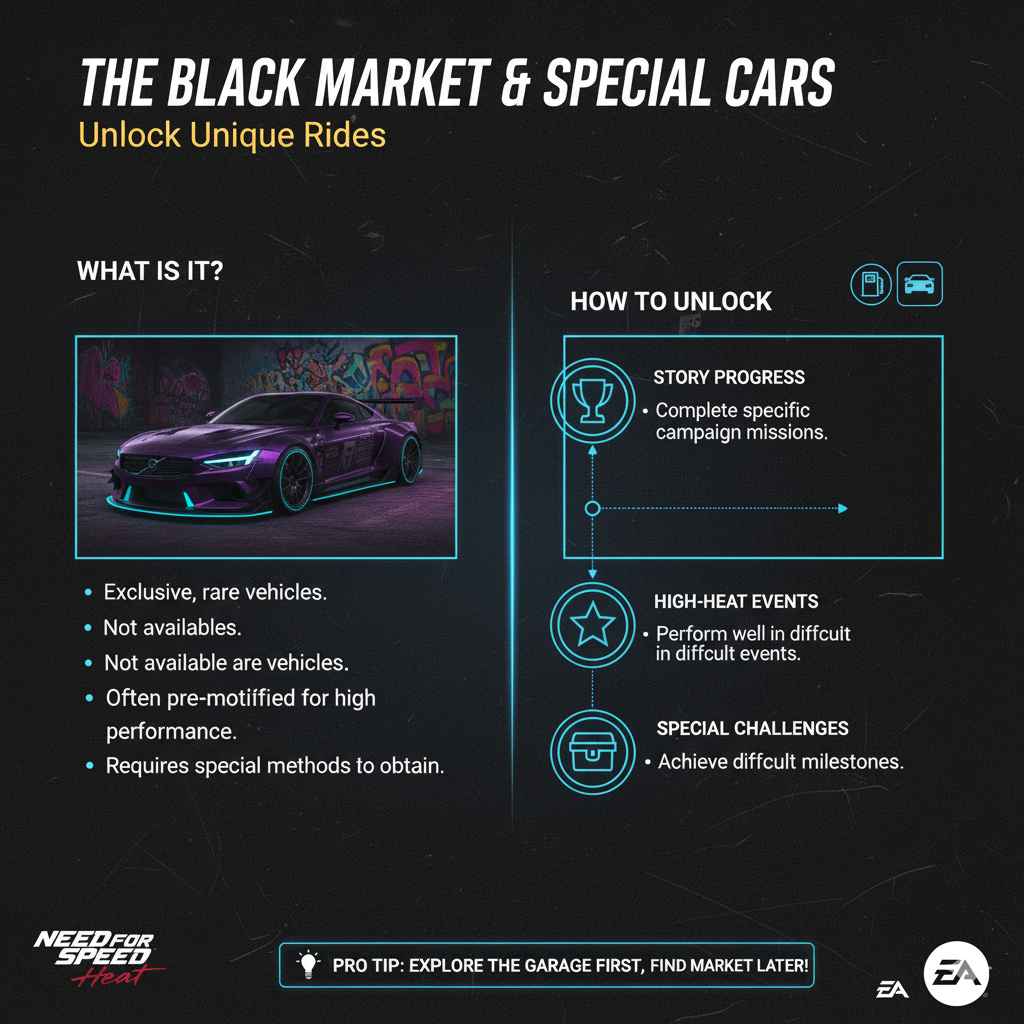
While not a place to buy standard cars like at the dealership, it’s worth mentioning that NFS Heat also features rare or unique ways to acquire certain vehicles, often through special events or via the Black Market. The Black Market in NFS Heat isn’t a physical location in the traditional sense but rather refers to specific, often illicit or high-tier vehicles that can be obtained through unique means or challenges. These are usually unlocked through story progression or by completing specific difficult tasks. They are not purchased with standard Banks from a dealership.
For beginner players, it’s best to focus on the main dealership via Garages and Gas Stations. As you get further into the game and understand its mechanics, you can start looking into how to unlock these more specialized rides. These often come with their own pre-set performance modifications.
Frequently Asked Questions (FAQ)
Q1: How do I unlock new cars in Need for Speed Heat?
New cars are unlocked primarily by increasing your ‘Heat Level’ and progressing through the game’s story missions. As your Heat Level goes up, new tiers of vehicles become available at the dealerships (Garages and Gas Stations).
Q2: Where can I find a list of all available cars?
You can see all currently available cars by visiting your Garage and selecting ‘Buy Cars,’ or by interacting with any Gas Station icon on the map. The game will show you what you can afford and what’s locked and why.
Q3: Can I buy cars with real money in NFS Heat?
No, Need for Speed Heat does not offer any in-game cars for purchase with real money. All cars must be earned and bought using the in-game currency, Banks, which you acquire by winning races and completing events.
Q4: What is the best car to buy first in NFS Heat?
For your very first purchase, prioritize a car with a good balance of acceleration and handling. The Ford Mustang GT is often a solid, affordable choice early on that offers good customization options and performance for its class. However, always check what’s available and within your budget based on your current progress in the game.
Q5: Do I need to buy a new car to win every race?
Not necessarily! While new cars are important, significantly upgrading your current vehicle with performance parts can often make it competitive enough to win races. Focus on improving your driving skills and wisely investing in upgrades for a car you enjoy driving.
Q6: How do I perform better in off-road races?
For off-road races, you’ll want cars with good suspension and tire grip that can handle uneven terrain. Cars in the ‘Sports’ or some ‘Tuner’ classes might perform better off-road than pure ‘Classic Muscle’ or ‘Hyper’ cars. Look for handling stats and consider purchasing a set of off-road tires when you start customizing.