Why Does My Car Click but Not Start When It Is Cold?
A car that clicks but will not start in cold weather usually has a weak battery, a loose or corroded cable connection, or a failing starter; one loud click points toward starter or connection trouble, while rapid clicking usually means low voltage. Ignoring it can leave you stranded and can waste money on the wrong part. This guide shows a cold-morning decision tree, the exact sounds to listen for, and the first five-minute checks for battery, cables, relay, starter, and sensor faults.
This guide is part of our Winter Car Care: The Complete Cold-Weather Guide series.
Why cold mornings trigger a click-no-start
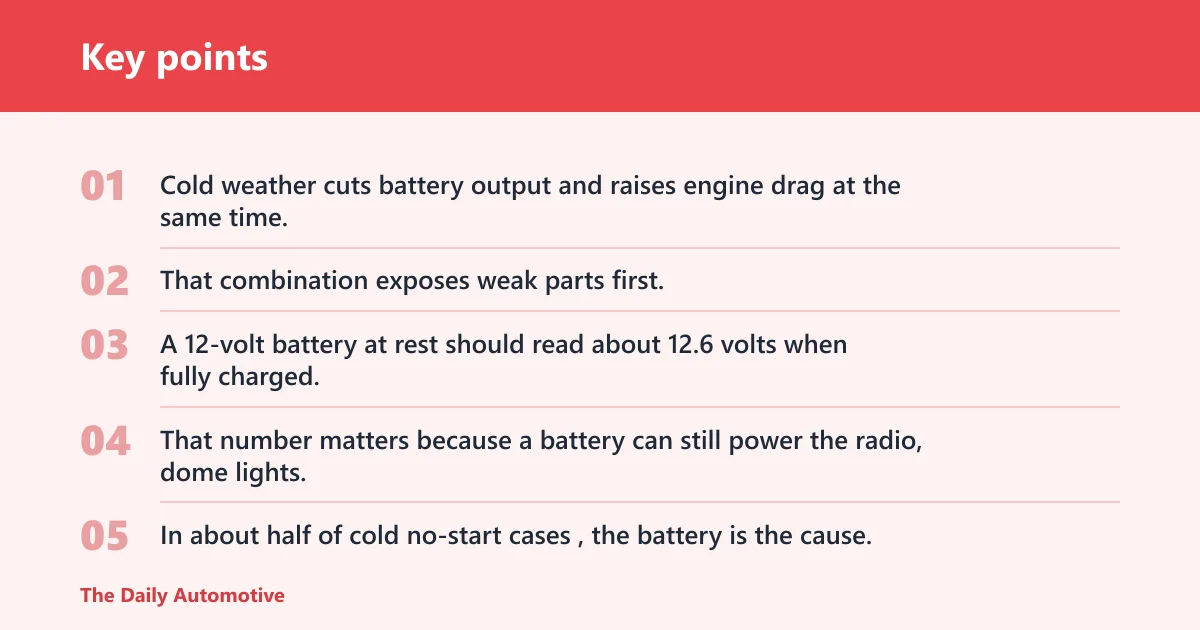

Cold weather cuts battery output and raises engine drag at the same time. That combination exposes weak parts first, which is why a car may start on a mild afternoon and then click on the first freezing morning.
A 12-volt battery at rest should read about 12.6 volts when fully charged. That number matters because a battery can still power the radio, dome lights, or dash and yet fail when the starter asks for much more current.
In about half of cold no-start cases, the battery is the cause. Most remaining cases are tied to the starter motor, thick oil, or a faulty sensor. Cold batteries can lose as much as half their capacity, so a battery that seemed “fine yesterday” may not have enough reserve today.
Why a weak battery may still power accessories
Accessories draw far less current than the starter. So yes, a weak battery can still turn on the radio and lights while failing to crank the engine. That is why dash power alone does not clear the battery.
Headlights are more useful than the radio for diagnosis. If they dim sharply when you turn the key, the battery or a high-resistance connection may be getting pulled down under load. If they stay bright and you get only a click, the fault shifts toward the starter circuit, relay, or control side.
How thick oil makes the starter work harder
Cold oil thickens and adds drag. The engine turns more slowly, the starter works harder, and a borderline battery or worn starter shows the problem sooner on colder mornings.
That is why a car may crank slowly but still fire later in the day. The warmer engine, thinner oil, and slightly recovered battery load can hide a weakness that shows up only at dawn.
What does the click sound tell you?
The pattern matters. Rapid clicking usually points to a battery too weak to turn the starter. One heavy click with no crank leans more toward the starter motor or solenoid. No click at all shifts attention to the relay, switch circuit, or power supply to the starter control side.
Rapid clicking
Rapid clicking is the classic low-voltage sound. The relay or solenoid pulls in, voltage collapses, and it drops out again. That repeats fast until you stop the key.
If the headlights dim hard at the same time, the battery or cable path is the leading suspect. If the lights stay bright, suspect a bad connection, relay issue, or starter that is not drawing current the way it should.
One heavy click
One heavy click with no start is a starter-motor clue rather than a battery clue. The solenoid may engage, but the motor does not spin the engine. Worn brushes, high internal resistance, or a failing solenoid can do that.
Heat-soak failures fit this pattern too. A starter that is tired may work after a cool-down, then fail again when hot or after short stop-and-go driving.
No click at all
No click usually means the starter is not being told to operate, or power is not reaching the circuit. That is where the relay, park/neutral switch, clutch switch, fuse, or ignition-control path comes in.
If the lights work and the battery test looks good, a no-click complaint deserves a control-circuit check, not just a battery swap.
Slow crank versus no crank
A slow crank is different from a no-crank click. Slow crank means the starter is turning the engine, but too slowly because of battery weakness, bad cables, poor grounds, or heavy oil. A click with no crank means the starter is not completing the job.
Do not mix those up. The fix path is different.
Cold no-start decision table
| Symptom pattern | Likely fault | One-minute check | Next action |
|---|---|---|---|
| Rapid clicking, dim headlights | Weak battery or poor battery connection | Measure battery at rest; check if voltage is near 12.6 volts or clearly low | Charge or jump-test the battery, then retest |
| One heavy click, bright headlights | Starter motor or solenoid | Try once in neutral or park; listen for the same single click | Book starter current-draw testing |
| No click, no crank | Relay, switch, fuse, or control fault | Try park then neutral; on a manual, press the clutch fully and retry | Check starter relay and interlock circuit |
| Cranks normally but will not fire | Sensor, fuel, or ignition issue | Read coolant temperature on OBD2 and compare it to ambient within a few degrees | Inspect coolant sensor, fuel delivery, and ignition data |
| Starts after a jump, fails again later | Battery weak, cable loss, or charging problem | Check terminal tightness and corrosion, then test charging voltage | Do not assume the battery alone is the fault |
What should you check first?
Check the battery first, then the terminals and cable path. Those checks take minutes and catch the most common winter faults before you start replacing parts.
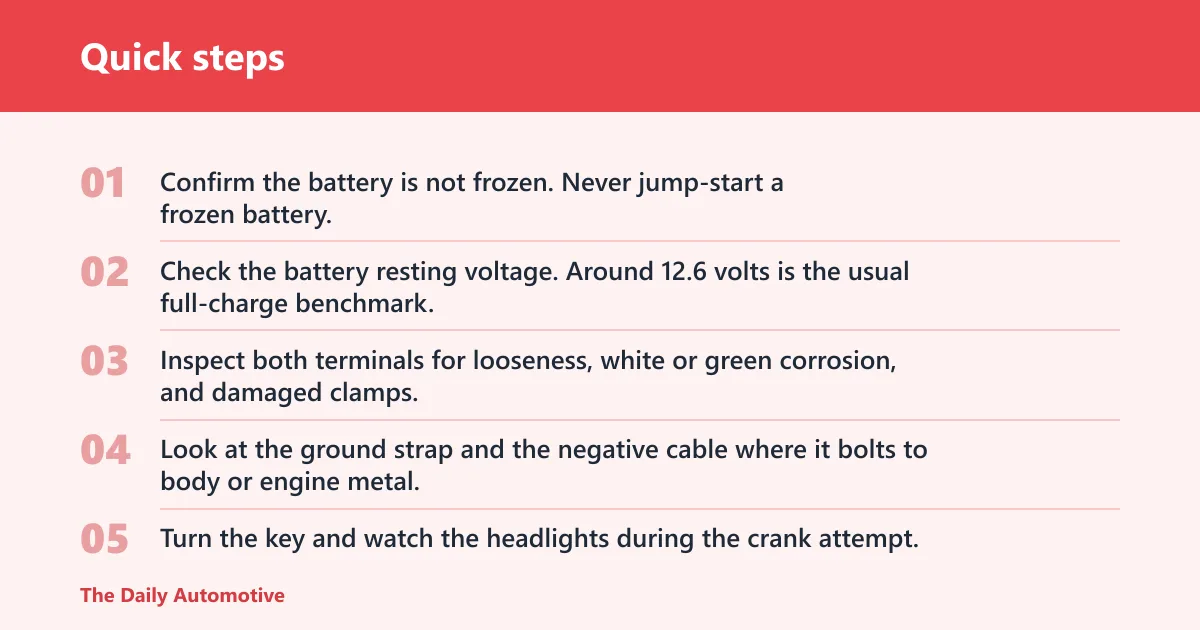
- Confirm the battery is not frozen. Never jump-start a frozen battery.
- Check the battery resting voltage. Around 12.6 volts is the usual full-charge benchmark.
- Inspect both terminals for looseness, white or green corrosion, and damaged clamps.
- Look at the ground strap and the negative cable where it bolts to body or engine metal.
- Turn the key and watch the headlights during the crank attempt.
- Try park and then neutral. On a manual, fully depress the clutch and retry.
Terminal tightness and corrosion
A loose terminal can mimic a dead battery. Corrosion adds resistance, and that voltage drop can starve the starter even when the battery itself is not fully dead.
Picture a compact sedan that clicks fast on a freezing morning. The battery tests only moderately low, but the positive clamp can be twisted by hand. Tightening and cleaning the terminal restores normal crank speed without any part replacement.
Ground strap importance
The ground strap matters as much as the positive cable. If the engine ground is loose, corroded, or cracked, current cannot return cleanly to the battery. That can produce a click, a slow crank, or an intermittent no-start that shows up only in cold weather.
A voltage-drop problem often looks like a bad battery from the driver’s seat. The starter asks for current, the weak connection wastes it, and the engine never gets enough turning force.
Headlights during a crank attempt
Bright headlights with a click suggest the battery may not be collapsing under load, so the problem points more toward the starter, relay, or control circuit. Dimming headlights point back toward battery strength, cable resistance, or a poor ground.
Say your headlights stay bright, the dash stays lit, and you get one solid click every time you turn the key. That pattern is much less like a simple dead battery and much more like a starter or solenoid that is not turning the engine.
When is the starter or relay to blame?
The starter relay sends the control signal that lets the solenoid engage. If that control path works but the starter still does not spin, the problem may be in the solenoid or the starter motor itself.
Starter relay and solenoid function
The relay is the switch that feeds the starter control circuit. The solenoid is the part on the starter that moves the gear into place and closes the high-current circuit. A click can come from either one, which is why sound alone does not settle the diagnosis.
If the key produces a click but the engine does not turn, and battery voltage is good, the next step is not guesswork. It is current-draw testing and voltage-drop testing at the starter and cables.
Single-click failure pattern
One heavy click with no crank is a strong starter clue. That pattern often appears when the solenoid is engaging but the motor windings, brushes, or internal contacts are worn.
Repeated cranking can overheat the starter. The guide limit is five seconds for each attempt, one minute of rest between attempts, and three tries maximum.
Heat-soak and wear symptoms
A starter can fail more often after a short stop because heat raises resistance in a tired unit. That is why some cars start fine after sitting all night, then click after a warm restart attempt later in the day.
When that happens, a shop should verify starter current draw, not just replace the battery again.
Could a sensor or switch stop cold starts?
Yes. If the engine cranks normally but will not fire, a sensor or switch can be the real problem. The coolant temperature sensor is a key cold-start input, and the neutral safety switch or clutch switch can block cranking entirely.
Coolant temperature sensor live-data check
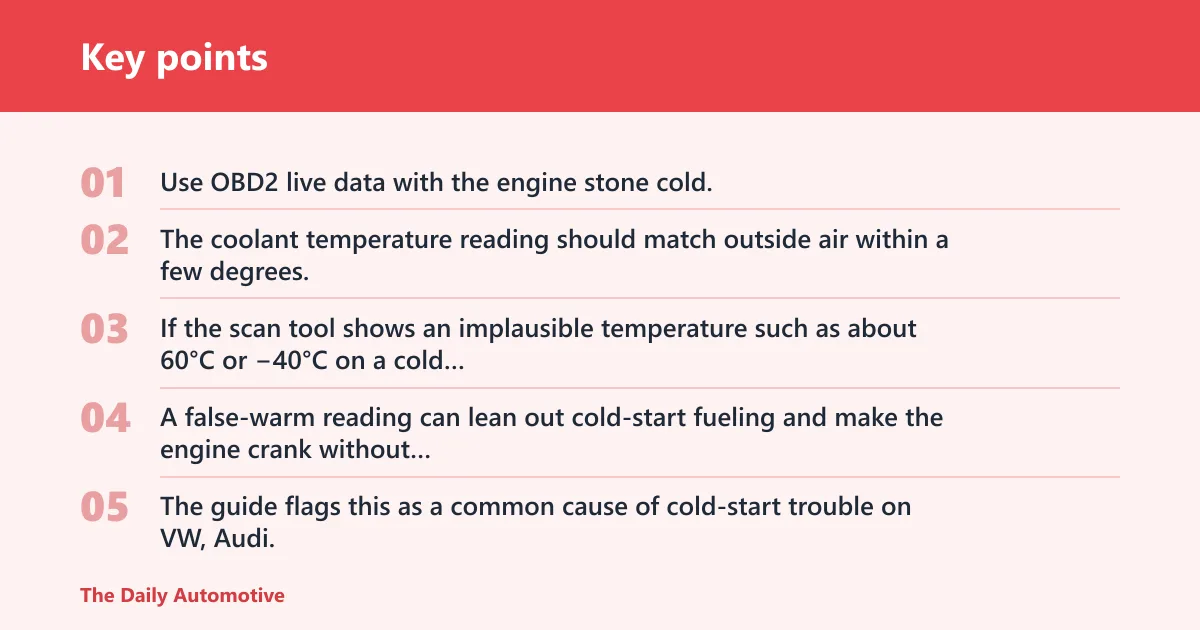
Use OBD2 live data with the engine stone cold. The coolant temperature reading should match outside air within a few degrees. If the scan tool shows an implausible temperature such as about 60°C or −40°C on a cold morning, the sensor or its wiring is suspect.
A false-warm reading can lean out cold-start fueling and make the engine crank without firing. The guide flags this as a common cause of cold-start trouble on VW, Audi, and Skoda models.
Neutral safety switch and clutch switch test
If the car clicks only in one gear position, try park and then neutral. On a manual transmission, press the clutch fully and see whether the starter responds. That simple test can expose an intermittent interlock switch fault.
A no-click complaint with strong battery power often ends here, especially when the fault comes and goes with shifter position or clutch pedal travel.
What to expect from OBD2 readings
Cold coolant reading close to ambient is normal. A reading that is far off ambient, especially when the engine has sat overnight, points to a sensor problem rather than a fuel pump or starter issue.
If the engine cranks normally but will not fire, do not treat that as the same problem as a click-no-start. The diagnostic path changes at once.
When should you stop DIY checks?
Stop after the basic checks if the car still clicks, especially if the battery is over a few years old, the terminals are clean and tight, and the headlights do not point to an obvious low-voltage problem. At that stage, a voltage-drop test or starter current-draw test is the right next step.
Never keep hammering the key. Five seconds is the maximum cranking attempt before resting, with one minute between attempts and three tries maximum. More than that can overheat the starter and mask the real fault.
Jump-starting is a test, not a cure. If the car starts with a jump and then fails again later, the battery may be weak, but the cables, ground strap, charging system, or starter may still be at fault.
A cold battery can lose roughly half its capacity, so winter failures become more likely when the battery is aging. If the battery is near the end of its life, a load test tells you more than a resting-voltage check alone.
Frequently asked questions
Why does my car just click when I try to start it in the cold?
A cold-weather click usually means the battery cannot deliver enough current, the cables are losing voltage, or the starter is not turning even though the solenoid is engaging. Rapid clicking favors low battery power; one heavy click points more toward the starter or solenoid circuit.
Is a rapid clicking sound more likely a battery or starter problem?
Rapid clicking is more likely a battery or connection problem. The relay or solenoid is pulling in, voltage collapses, and it repeats. If the headlights dim hard too, the battery, terminals, or ground path move to the top of the list.
Why does my car make one click and then nothing in cold weather?
One click and then nothing often means the starter solenoid is engaging but the motor is not spinning the engine. That can come from worn starter parts, high current draw, or a bad cable connection that still lets the click happen but not the crank.
Can a weak battery still turn on the radio but not start the car?
Yes. Accessories need much less current than the starter motor. A battery can still run the radio, dash lights, and locks while failing under starter load, especially in cold weather when battery capacity drops and engine drag rises.
How do I tell if cold weather battery failure or starter failure is causing the click?
Watch the headlights, check battery voltage, and try park then neutral or the clutch switch. Dim headlights and rapid clicking point to battery or connection loss. Bright headlights with one solid click point more toward the starter, solenoid, or its control circuit.
Could a bad coolant temperature sensor cause a cold no-start?
Yes. If the engine cranks normally but will not fire, compare OBD2 coolant temperature to outside air when the engine is cold. It should match within a few degrees. A false-warm reading such as 60°C or −40°C can upset cold-start fueling.
Products related to this article
Sponsored / affiliate links. As an Amazon Associate I earn from qualifying purchases. I may earn additional commission from eligible campaigns.