Die Cut Magnets for Cars: Best Custom Magnetic Signs Compared
Die-cut car magnets work best when you want removable branding that follows a vehicle’s shape, but a standard rectangle usually gives you more usable print area and better street visibility. Choose die-cut only if fit and brand shape matter more than raw exposure. Poor sizing can make magnets peel at speed, hide text, or fail to cover enough door space. This guide compares die-cut magnets with standard and custom magnetic sign formats by fit, durability, and visibility.
Die-cut car magnets vs other shapes

The trade-off is plain: die-cut magnets can match the vehicle and the logo, while rectangle, oval, and round magnets usually give you cleaner copy space and fewer edge problems. For many small businesses, shape should follow the panel first and the brand second.
| Shape | Best for | Visibility | Edge behavior | Customization | Road-use fit |
|---|---|---|---|---|---|
| Die-cut | Logos, mascots, contour-based branding | Strong when the shape itself supports the brand | More edge variation, so lift risk depends on the outline | Highest shape flexibility | Best on flatter steel areas with clean edges |
| Rectangle | Services, phone numbers, URLs, stacked copy | Usually the most usable print area | Rounded corners help reduce flagging | Moderate; simplest layout control | Often the easiest to place on a door panel |
| Oval | Simple brand marks and shorter text | Balanced, but less copy space than a rectangle | Fewer sharp corners than a square or plain rectangle | Moderate | Good when you want a softer look without a custom contour |
| Round | Small logos, seals, limited copy | Works best with minimal text | Low corner lift risk because there are no corners | Lower for text-heavy layouts | Best for compact branding, not full service messaging |
What each shape does best for visibility and fit
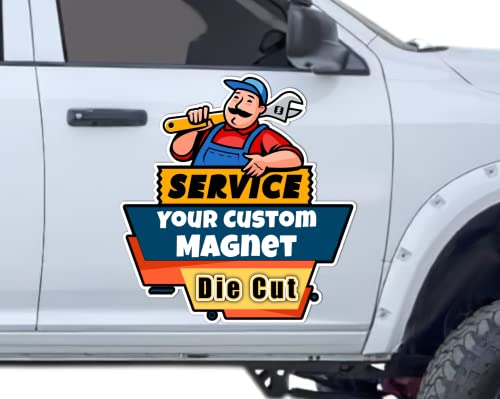
Die-cut car magnets are the strongest visual match when the brand mark itself is the message. A bakery logo, pest-control mascot, or trades logo can look more deliberate in a contour-cut form than in a box.
Rectangle car door magnets usually win on practical exposure. More flat area means larger letters, clearer phone numbers, and fewer layout compromises on a small door panel.
Oval and round magnets are easier to keep visually tidy, but they leave less room for copy. That makes them better for simple branding than for a full sales message.
Main trade-offs: corner lift, panel coverage, and customization
Die-cut magnets often lose to rectangles in one place: edge control. When the outline creates narrow points or thin extensions, those areas are the first to flag up in wind and wash water.
Rectangle magnets cover more of a door in one piece. That helps with visibility and can make placement simpler on a flat steel panel, especially when the business wants a clean, readable block of information.
Shape also affects maintenance. A custom contour may need more careful cleaning around the edges, while a rectangle with rounded corners usually wipes down faster and is less likely to collect grime at the border.
What you get from this buyer checklist
This checklist separates looks from road-safe performance. Use it to decide if a magnet fits a vehicle panel, not only if it looks good in a product photo.
| Criterion | What to check before ordering | Why it matters |
|---|---|---|
| Road hold | Magnet thickness, panel flatness, and edge shape | Helps reduce movement in wind and at highway speeds |
| Corner lift risk | Rounded corners, narrow points, and seams in the panel | Reduces flagging and water entry at the edges |
| Visibility and print legibility | Copy size, contrast, and whether the shape leaves enough room for text | Determines whether a passing driver can read the message quickly |
| Surface compatibility | Steel-only vehicle panel, no aluminum, fiberglass, or plastic | Magnets need magnetic metal to hold |
| Weather resistance and UV resistance | UV-resistant ink and a protective top layer | Helps outdoor readability last longer in sun and weather |
| Reusability and maintenance burden | How often you will remove, clean, and reset both surfaces | Dirty panels and dirty backs reduce contact and increase wear |
One practical rule: if a magnet looks good but leaves too little flat space for your phone number, it is the wrong size. If it fits well but the panel is curved or interrupted by seams, it may still be the wrong choice.
Why 30 mil matters for car magnets
For vehicle branding, 30 mil is the practical baseline to compare first. Custom die cut magnets are printed on durable 30 mil magnetic material, and 30 mil is widely framed as the industry standard for vehicle magnets. It sits between easier pricing and stronger road hold.
Thickness matters because wind load, panel shape, and road vibration all push on the sign at once. A magnet that is too thin may be more prone to edge lift, especially on curved doors or at the corners of a large sign.
20 mil vs 30 mil vs 40 mil
20 mil is cheaper but significantly weaker, so it is the first option to question for highway use or frequent outdoor driving. It can still suit short-term parking lot use or light promotional work, but it deserves extra caution on a moving vehicle.
30 mil is the sensible starting point for most business vehicles. It balances flexibility, holding power, and everyday use on steel panels without moving into bulky territory.
40 mil is the thicker option to ask about when the vehicle sees more road time, the panel is large and flat, or the magnet will stay on for longer stretches. Check the manufacturer’s listing for your exact model, because shape and panel contact matter as much as thickness.
What thickness means for road use
Thickness does not override bad fit. A thicker magnet still needs a clean steel panel and a shape that sits flat; otherwise, the edge can work loose in rain, dust, or wind.
Suppose a contractor wants a 6 x 6 inch logo badge on a slightly curved van door. A 30 mil piece may hold better than a thinner option, but a rectangle with rounded corners will often be easier to keep flat than a narrow custom contour with points.
When to ask the manufacturer for model-specific guidance
Ask for model-specific guidance whenever the panel is curved, includes seams, or sits near trim pieces. The same thickness can behave differently on a truck door, a sedan panel, and a cargo van side.
Also ask if the sign will cover a large area or carry dense text. A bigger sign increases the importance of fit, cleaning, and edge design, even when the material is 30 mil.
What shape works best for your vehicle?
Shape choice should start with the panel and the message. Die-cut works best when the branding itself depends on contour, while rectangle, oval, and round magnets tend to work better when the ad needs maximum readability from a distance.
Die-cut for custom branding
Choose die-cut when the logo is the main visual and the contour supports recognition. This works well for brands with a distinct icon, a mascot, or a shape that customers already associate with the company.
Die-cut also makes sense when the magnet needs to fit around a handle, a trim line, or a door feature and you want the sign to look intentional rather than boxed in.
Rectangle for maximum copy space
Choose a rectangle when the business name, phone number, and service list need to be read quickly. A custom car door magnet with a flat layout is usually the easiest format for stacking text without crowding.
Picture a mobile detailer using a 12 x 18 inch rectangle on both front doors. The layout can hold the name, service line, and contact number with fewer compromises than a tight contour shape.
Oval and round for simpler layouts
Oval and round magnets suit simpler messages and compact branding. They work well when you want a cleaner look and do not need much copy, such as a logo, short slogan, or small promotional mark.
They are less useful when the goal is direct-response advertising. If the customer needs a phone number or service description at a glance, a round format usually gives up too much room.
Will it stick to your vehicle panel?
Magnets only stick to steel, not aluminum, fiberglass, or plastic. That means the first compatibility check matters more than the shape choice, because even the best magnet will fail on the wrong surface.
Steel panel check
A steel vehicle panel is the required surface for magnetic signs. Before ordering, use a fridge magnet to test the target spot; if it does not stick, the panel is not a candidate for a car magnet.
This check is helpful, but it has limits. It confirms magnetic response, not whether the panel is flat enough, clean enough, or free of contours that could cause edge lift.
Why aluminum, fiberglass, and plastic are a problem
Aluminum, fiberglass, and plastic do not hold a magnetic sign the way steel does. That means SUVs, trucks, and vans can have mixed body materials, so one door may work while another panel will not.
A common first-timer mistake is assuming that any exterior door is fair game. That can leave a sign on a non-magnetic panel, or worse, on a section with poor contact that collects water behind the magnet.
The fridge-magnet test and its limits
The fridge-magnet test is a quick screen, not a final fit check. It tells you whether the area can attract a magnet, but it does not tell you how the sign will behave at speed or after rain.
For a real order, compare the test result with the vehicle’s panel shape, the size of the sign, and the thickness you plan to use. Those three factors decide whether the magnet behaves like useful branding or a maintenance problem.
How do finish and print choices affect durability?
Outdoor vehicle signs need more than magnetic pull. UV-resistant ink, a gloss laminate, and rounded corners all affect how long the message stays readable and how likely the edges are to stay down.
UV-resistant ink for outdoor readability
UV-resistant ink fades slower in sunlight, which matters on doors, tailgates, and fenders that sit outside for long periods. Slower fade means the lettering stays easier to read, especially on high-contrast designs.
It does not make the sign permanent. Outdoor use still needs care, because dirt, abrasion, and weather exposure can shorten the useful life of any printed magnetic sign.
Gloss laminate as a protective top layer
Gloss laminate adds a protective top layer that may improve weather and scratch resistance. It also changes the finish, which may make colors appear sharper or more reflective depending on the lighting.
If the brand needs a cleaner, more polished look, gloss is often the more visible choice. If glare is a concern, check the listing carefully before ordering, because finish affects appearance on the road.
Why rounded corners help reduce edge flagging
Rounded corners reduce lifting at the edges. They also help keep water and air from getting under the sign, which is why custom car door magnets often use rounded-corner design instead of sharp corners.
Car Stickers notes that large magnet corners can “flag up” over time. That is a useful warning: the bigger the sign and the sharper the corner, the more attention the edge needs.
Choose die-cut magnets if… / Choose rectangle magnets if…
Choose die-cut magnets if your logo shape is the brand, the door area is flat enough, and you want the sign to feel custom rather than generic. Choose rectangle magnets if your main goal is readable service copy, cleaner panel coverage, and lower edge-management hassle.
Choose die-cut magnets if…
Choose die-cut magnets if you need a contour that follows the brand mark, especially for a mascot or icon-based company. They also make sense when the sign must fit around a panel feature and you care more about shape match than maximum text area.
They are also a fit for businesses that use smaller, visual-first signs. Popular die-cut magnet sizes from 3 x 2 inches to 6 x 6 inches show that these products often work best as compact branding pieces, not oversized ad boards.
Choose rectangle magnets if…
Choose rectangle magnets if your business needs the strongest balance of copy space and straightforward placement. Service companies, home-repair contractors, cleaners, and local delivery firms often need the address, number, or service list to read clearly from a distance.
Choose them if maintenance needs to stay low. A flat rectangle with rounded corners is easier to align, remove, wipe, and reinstall than a custom outline with thin sections or tight curves.
Best use cases for each format
Die-cut magnets suit brand-led businesses that want a custom look and modest copy. Rectangle magnets suit businesses that treat the sign as a moving ad panel. Oval and round magnets suit shorter messages, simpler logos, and compact promotional use.
If a sign is likely to ride through repeated bad weather, parking-lot grime, and highway use, favor the format that gives the cleanest contact patch. Shape matters, but road hold and panel fit matter more.
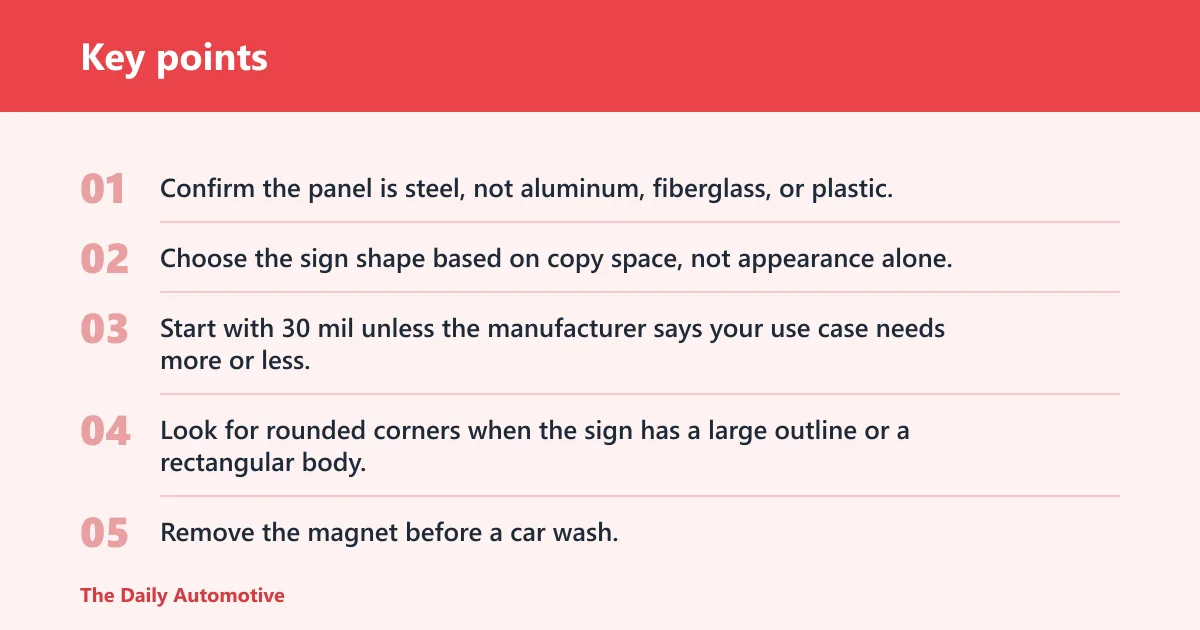
- Confirm the panel is steel, not aluminum, fiberglass, or plastic.
- Choose the sign shape based on copy space, not appearance alone.
- Start with 30 mil unless the manufacturer says your use case needs more or less.
- Look for rounded corners when the sign has a large outline or a rectangular body.
- Remove the magnet before a car wash.
- Clean both the panel and the back of the magnet before reapplying.
The same source says car magnets are removable and reusable with no adhesive residue, but that benefit depends on clean surfaces. If grit builds up between the magnet and the panel, the sign can mark the paint and lose grip more quickly.
Clean the magnet and the vehicle panel often enough to keep dust from turning into abrasion. For a work vehicle that sits outside daily, that usually means checking both surfaces before reapplying after a short while.ain, a dusty route, or a wash cycle.
Frequently asked questions
What are the best custom magnetic signs for cars?
The best custom magnetic signs for cars are the ones that fit the panel, hold on steel, and leave enough room for the message. For many businesses, a 30 mil custom car door magnet with UV-resistant ink, rounded corners, and a readable layout is the safest starting point.
Are die cut magnets better than rectangular car door magnets?
Die cut magnets are better when brand shape matters more than copy space. Rectangular car door magnets are better when you want more usable print area, easier legibility, and simpler edge management. For most service businesses, rectangle usually wins on practicality.
What thickness should car magnets be for highway driving?
For highway driving, 30 mil is the practical baseline, and 40 mil is worth asking about if the sign will stay on long-term or sees heavier road exposure. 20 mil is cheaper but significantly weaker, so it is the first option to question for faster driving or frequent outdoor use.
Will car magnets stick to aluminum or fiberglass?
No. Magnets only stick to steel, not aluminum, fiberglass, or plastic. If you are unsure about a panel, use a fridge magnet to test the spot first, then confirm that the surface is flat enough and free of seams or trim that could weaken contact.
Are die cut magnets safe to use on a car door?
They can be safe on a clean steel door panel when the size, thickness, and shape suit the surface. Safety depends on fit and care. Keep the panel clean, remove the magnet before washing, and avoid placing it on curved or incompatible body materials.
Should car magnets be removed before a car wash?
Yes. The same source recommends removing car door magnets before entering a car wash. Brush contact and pressure can lift the edges, trap grit, or shift the sign, so removal is the safer choice before both automatic brush washes and high-pressure cleaning.
How do I stop car magnets from lifting at the corners?
Use rounded corners, keep the panel and magnet clean, and avoid placing the sign across seams or curves. Larger magnets are more likely to flag up over time, so a flatter layout and regular cleaning are the best ways to reduce edge lift.
Products related to this article
Sponsored / affiliate links. As an Amazon Associate I earn from qualifying purchases. I may earn additional commission from eligible campaigns.