Why Does My Remote Start Keep Shutting Off?
A remote start that shuts off often points to a trigger fault that aborts the start, an immediate safety shutoff after firing, or a normal timeout of about 10 to 15 minutes. Miss the difference, and you can replace the wrong part or keep fighting a cold-weather no-start. This guide shows how to spot each failure mode fast and check the common causes.
This guide is part of our Winter Car Care: The Complete Cold-Weather Guide series.
Remote start diagnosis matrix


Start with timing. That single clue tells you whether the command never reached the vehicle, the engine fired and then the system killed it, or the run ended on schedule. Climate control preconditioning only helps confirm success if the engine actually started, so do not treat cabin air as proof by itself.
| Symptom timing | Likely cause category | Next check |
|---|---|---|
| Won’t start at all | Trigger fault, signal loss, or vehicle condition block | Verify the vehicle is locked, then check the hood, doors, fob range, fob battery, and any cluster message |
| Starts then dies in seconds | Safety interlock, spare key detection, or vehicle-side fault | Check for an open-door or hood status, a detected spare fob, or a “condition not met” message |
| Runs full timer | Normal automatic shutdown | Confirm the model’s programmed runtime and whether the app or fob issued only one command |
A remote start system can be triggered by a key fob or an app, and it may shut the engine off automatically if a required condition is not met. Many vehicles also use climate control preconditioning once the engine is running, so cabin heat or A/C can be part of normal operation rather than a separate fault clue.
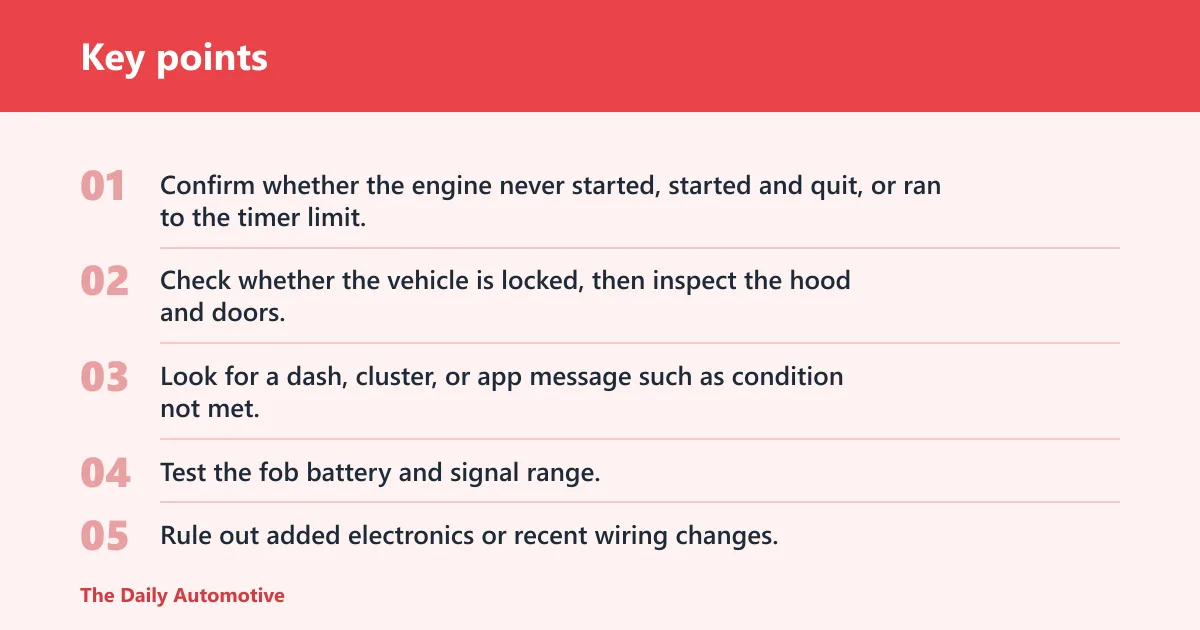
- Confirm whether the engine never started, started and quit, or ran to the timer limit.
- Check whether the vehicle is locked, then inspect the hood and doors.
- Look for a dash, cluster, or app message such as condition not met.
- Test the fob battery and signal range.
- Rule out added electronics or recent wiring changes.
Why does my remote start keep shutting off?
If the engine fires and then stops, the system is usually reacting to a safety check or a control logic problem, not simply “bad remote start.” The fastest split is this: a shutoff in seconds points to an interlock or vehicle-side condition, while a shutoff after the full run time is often normal behavior.
Safety interlocks that cancel the command
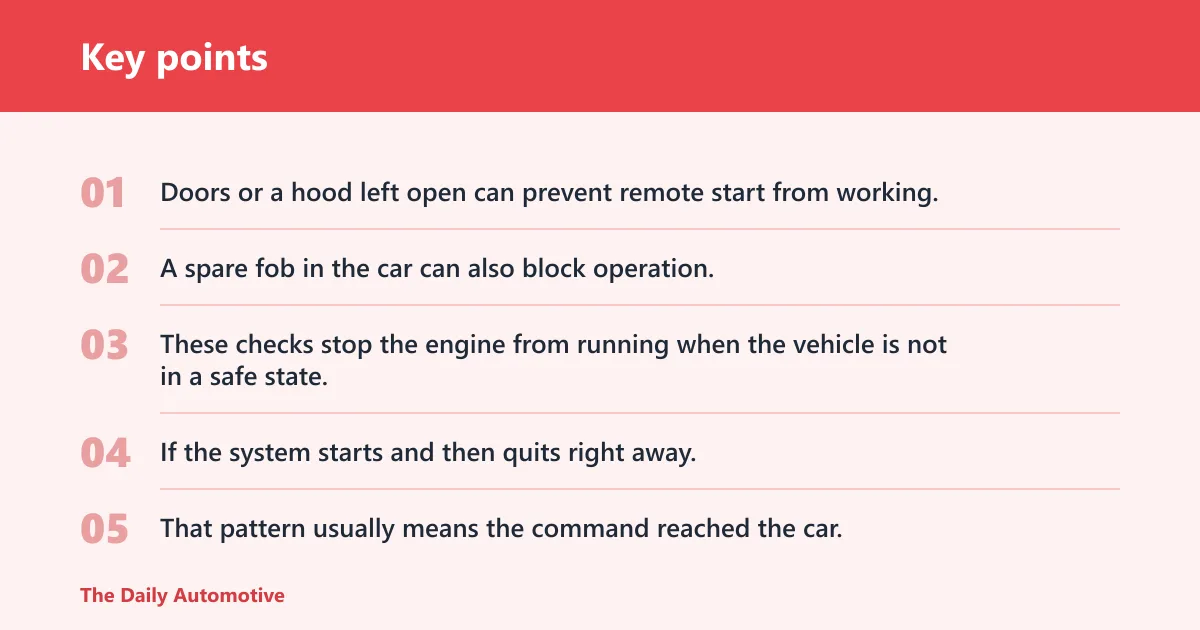
Doors or a hood left open can prevent remote start from working, and some vehicles also require the vehicle to be fully locked before the command is accepted. A spare fob in the car can also block operation, because the vehicle may treat that as an unauthorized condition.
These checks stop the engine from running when the vehicle is not in a safe state. If the system starts and then quits right away, the vehicle may have accepted the signal but then found a condition it did not like during its follow-up check.
When the system starts, then stops right away
That pattern usually means the command reached the car, but one of the vehicle-side checks failed after ignition. Open-door status, hood status, spare-key detection, or another condition can cause a quick kill after the engine catches. If the failure is repeatable, the car is often leaving a code or message behind.
Picture a sedan that remote-starts once, idles for two seconds, and dies before the cabin fan comes up. That is different from a ten-minute run that ends on its own. The first points to a blocked condition; the second may be normal timer behavior.
How to tell a normal timeout from a fault
Some vehicles shut off after a preset time even when everything works. BMW remote start often runs for 15 minutes by default. Honda Civic remote start typically has a maximum runtime of ten minutes, and Honda owners may see a maximum run time before shutdown.
If the engine runs cleanly for that full period and stops without a warning, it is often reasonable to treat it as normal automatic behavior first. If it stops early, repeats failed attempts, or shows a condition message, move away from the timer and toward a fault check.
Why does my remote start turn off after a few seconds?
A shutdown within a few seconds usually means the vehicle saw an unsafe or invalid condition after the start request. The most common culprits are an open hood, an open door, an unlocked state, a detected spare key, or another vehicle condition that blocks remote operation. A short run is not the same as a normal timer end.
Open hood, open door, or unlock state checks
Doors or hood ajar can prevent remote start from working, and many vehicles also require the doors to be locked before they will accept the command. If the car starts and quits almost immediately, recheck every latch rather than assuming the fob failed.
That matters in cold weather, when thick gloves or snow can make a door look shut without fully latching. A half-latched hood after topping off washer fluid can do the same thing.
Spare key detection and vehicle condition checks
A spare fob in the car can cause remote start problems. So can any condition the vehicle interprets as unsafe, such as a door sensor reading open or a security state that does not match the command. Some systems also refuse remote start if they detect certain vehicle faults.
If the car behaves differently with a second key nearby, that is a strong clue. Move the spare well away from the vehicle and try again before you blame the starter motor or the app.
Dash messages that point to the blocked condition
Dashboard messages and cluster warnings matter because they often name the blocked condition. A condition not met message, or a similar dealer diagnostic code, can point directly to the reason the start was rejected or cut short.
If the message names doors, hood, hood ajar, or another system state, treat that as the next check. The vehicle is telling you where the logic failed.
Remote start runtime limits
Some shutdowns are normal. Remote start systems often include a preset runtime limit, and model-specific behavior determines how long the engine stays on before automatic shutoff. That is why one vehicle may stop at ten minutes and another at 15 without any fault being present.
Preset run timers and model-specific shutdowns
BMW remote start can be activated by pressing the lock button three times in a row, although some BMW models need a hold action instead of triple-pressing. BMW remote start often runs for 15 minutes by default. Honda Civic remote start typically has a maximum runtime of ten minutes, and Honda remote start range is described as approximately 100 feet.
Those values are not universal. The point is to check the vehicle’s own timing rule before treating a clean shutoff as a failure.
What repeated restarts can mean
If the car shuts off on schedule every time, then responds again to a second command, the system may be working as designed. If it needs repeated tries before it finally starts, that shifts suspicion toward signal strength, interference, low voltage, or an intermittent vehicle-side fault.
A common first-timer mistake is to press the button again immediately after a clean timed shutoff and assume the second response proves the first one was wrong. In many vehicles, both behaviors can be normal.
Fob, app, or vehicle fault
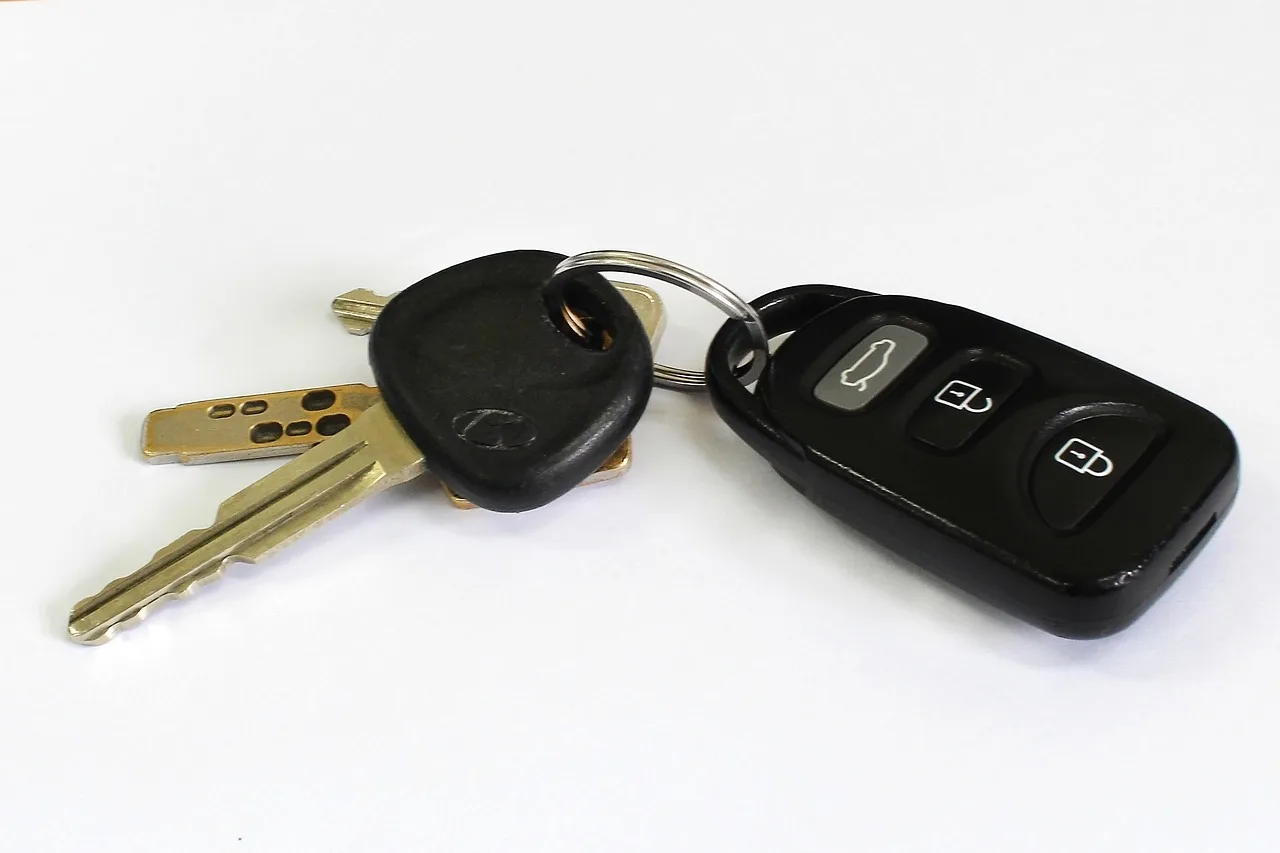
Split the problem by control path. If the key fob fails but the app works, the issue is likely signal strength, fob battery, or range. If both fail, the car itself or its wiring is a better suspect. If the app behaves oddly while the fob works, look at the phone, account, or network side.
| Source | Observable clues | Escalation step |
|---|---|---|
| Key fob | Intermittent response, shorter range, needs repeated presses | Replace the fob battery and retest near the vehicle |
| App or phone command | App shows a sent command, but car does not react; phone data or account issues | Retry with a stronger connection and confirm the app is paired to the correct vehicle |
| Vehicle-side issue | Both fob and app fail, or the cluster shows condition not met | Scan for stored codes and inspect interlocks, modules, and added wiring |
Clues that point to a weak key fob battery
A low key fob battery can reduce signal strength, and it can cause intermittent remote start failure. F6 notes this is the most common culprit. If the range seems shorter than usual or the car responds only when you stand near it, start there.
Because the fob battery can still work for door unlocks while failing under a heavier remote-start signal load, do not dismiss it just because the lock button still works. Replace the battery before chasing deeper faults.
Clues that point to app or phone-command problems
Remote start through an app adds another layer of failure points: the phone, account status, vehicle subscription state, and cellular or data connection. If the fob works but the app does not, the problem may be in the app path rather than the car.
That does not mean the app can override vehicle safety interlocks. A phone command still cannot force a start through an open hood or a blocked condition.
Clues that point to a vehicle-side issue
If both the app and the fob fail, the vehicle is the stronger suspect. Look for door, hood, or lock-state issues, spare-key detection, stored fault codes, and any changes made after service or accessory installation. Dealer diagnostic codes can help separate a command problem from a blocked condition.
Radio frequency interference can disrupt communication between the key fob and the car, and range limits are real. Parking near other electronics, metal structures, or areas with heavy interference can make a borderline system fail more often.
Why does my remote start not stay on in cold weather?
Cold weather often exposes weak links in the system. Low battery voltage, thicker oil, added accessory load, and weaker charging reserve can make a marginal vehicle refuse remote start or shut down early. A system that works in mild weather may fail once the battery is stressed by temperature.
Low battery voltage and cold-start strain
Cold temperatures can reduce battery output, and that matters when the vehicle has to crank, run the cabin fan, and power control modules at the same time. If the battery voltage is weak, the remote start may abort or shut off after a short run to protect the vehicle.
This is one of the clearest cold-weather clues: the same vehicle may start normally by key, but remote start fails because the added logic and accessory load push it over the edge.
Accessory load, short trips, and weak charging reserve
Heated seats, rear defrost, blower motors, and other winter loads draw more from the charging system. If the vehicle already makes only short trips, the battery may never recover fully. That leaves less reserve for a remote-start event.
Suppose a car has been used for five-minute errands all week and then refuses remote start on a 20-degree morning. That pattern points more toward voltage reserve than toward a pure command failure.
Why cold weather can expose marginal faults
Cold weather does not create every problem, but it can make weak ones easier to see. A borderline fob battery, a marginal vehicle battery, a loose hood switch, or a noisy electrical add-on may all behave worse when temperatures drop.
That is why a remote start that only fails in winter deserves a full check of battery condition, interlocks, and added electronics rather than a guess.
Aftermarket changes that can interrupt remote start
Aftermarket electrical modifications can interfere with remote start operation, and they can create unpredictable shutdown behavior. That includes remote-start and alarm add-ons, starter interrupts, bypass modules, and altered wiring that changes how the vehicle sees lock, hood, ignition, or security status.
Remote start and alarm add-ons
If symptoms began after an accessory install, the timing matters. A new alarm, starter disable, or security add-on can change how the car verifies its state before allowing remote start. Problems may show up as repeat no-starts, short run times, or a condition message.
Tuned wiring, bypass modules, and starter interrupts
Bypass modules and starter-interrupt circuits can be useful, but they also add failure points. A loose connection, incorrect program, or poor splice can make the system reject a start or shut down unexpectedly.
Do not treat those faults as rare. If the problem started after a modification, that is a credible lead.
When to suspect an installer or electrical issue
If the vehicle started failing after a remote-start install, alarm work, battery service, or wiring repair, the installer path deserves attention. A dealer scan may show which condition blocked the start, while the installer can verify whether added modules are communicating correctly.
Dealership or service visits may be needed if the issue persists, especially when the system logs a code or the same shutdown happens across both fob and app commands.
Frequently asked questions
Why does my remote start not stay on?
If it starts but will not stay on, compare the run time to the vehicle’s programmed limit first. Some systems are designed to stop after ten or 15 minutes. If it quits far earlier, inspect the hood, doors, lock state, battery voltage, and any aftermarket wiring that could interrupt the run.
Does remote start turn off automatically?
Yes. Many vehicles shut the engine off after a preset time, and that is normal behavior. BMW remote start often runs for 15 minutes by default, while Honda Civic remote start typically has a maximum runtime of ten minutes. A clean stop at the limit is not the same as a fault.
Why does my remote start keep shutting off in cold weather?
Cold weather can lower battery voltage, increase accessory load, and expose weak fob batteries or wiring faults. That makes a marginal system fail more easily. If the problem appears only in winter, check the vehicle battery, the key fob battery, and any recent electrical changes before assuming the starter is bad.
Why does my auto start keep shutting off?
“Auto start” systems shut off for the same basic reasons as remote start: a safety interlock, a blocked condition, a weak signal, or a normal timer. Focus on the exact timing. A shutdown in seconds is a different problem from a shutdown after the programmed run period ends.
Products related to this article
Sponsored / affiliate links. As an Amazon Associate I earn from qualifying purchases. I may earn additional commission from eligible campaigns.