Why Does My Car Heater Take So Long to Warm Up?
A car heater that takes more than about 10 to 15 minutes to blow warm air usually points to slow engine warm-up or an HVAC fault rather than normal cabin behavior alone. Ignore it, and you can end up with fogged glass, a cold cabin, and a coolant problem that may lead to overheating. This guide helps you separate normal cold-weather delay from thermostat, coolant, blend-door, or fan faults and choose the next safe check.
This guide is part of our Winter Car Care: The Complete Cold-Weather Guide series.
Telling engine warm-up from a heater fault

- Reads and clears engine fault codes
- Shows live sensor data in graphs
Slow cabin heat usually means the engine is not reaching usable coolant temperature quickly enough, or the HVAC system is not moving that heat into the cabin. Those are different problems. The temperature gauge helps sort them out, because a cold gauge with cold vents points toward engine warm-up, while a normal gauge with cold vents points toward the heater side.
How engine warm-up and cabin heat differ
The cabin heater does not create heat on its own. Engine combustion makes heat, coolant carries that heat away, and the heater core transfers it to cabin air. If the coolant is cold, low, aerated, or not circulating well, the vents stay cool. If the coolant is warm but the vents are still cold, look at the HVAC side first.
Modern engines can be driven within seconds of starting, and idling for multiple minutes wastes fuel. A brief idle can be enough before you drive off; one guide says 30 seconds achieves the same goal without excessive fuel consumption, and another says it can take two minutes to warm a modern vehicle via idling. That is engine warm-up, not a promise of hot cabin air.
Picture a compact car on a frosty morning with the fan on low and the temperature set to full hot. If the gauge barely moves after several minutes of driving, the problem is likely on the engine side. If the gauge reaches normal but the air stays cool, the heater core, blend door, airflow, or coolant level deserves attention.
What counts as normal warm-up?
Normal warm-up depends on outside temperature, trip length, engine type, and how you drive. A short stop-and-go run in cold weather can leave the cabin lukewarm even when nothing is broken. Gentle driving usually warms the engine more effectively than idling alone, but very short trips may end before full cabin heat arrives.
Why outside temperature and trip length matter
In cold weather, the engine and coolant start farther from operating temperature, so the heater core has less heat to work with at first. A five-minute commute may never let the system fully settle, especially with defrost selected and a high fan speed. Longer trips give the coolant time to stabilize and the heater to catch up.
Diesels, hybrids, and remote-start use can change the pattern. Some diesel engines shed heat differently at low load, so slow cabin heat may be normal for a while. Hybrids may shut the engine off during stops, which can slow heat output. Remote start can warm the engine some, but it does not guarantee fast cabin heat once you get in.
Suppose a midsize sedan idles in the driveway for several minutes, then drives only one mile to school. The heater may still feel weak at the end of the trip even if the system is healthy. That short run does not prove a fault. It may only show that the trip was too brief for full heat.
Why idling, gentle driving, diesel engines, hybrids, and remote start can change the timing
Idling alone is not the quickest or cleanest way to warm a car. Gentle driving usually loads the engine enough to build heat sooner than a long idle, while still avoiding hard throttle on a cold engine. For cold-climate comparison, a block heater is meant to preheat the engine, not to guarantee immediate cabin heat; some cord ends are marked with brightly colored tape so they are easier to find.
Is the engine warming up slowly?
If the temperature gauge stays low, the engine may be the part that is slow to warm. That can happen with a thermostat stuck open, weak water-pump flow, low coolant, or trapped air. A thermostat stuck closed is different: it can cause overheating and poor circulation instead of a cold-running engine.
Temperature gauge stays low
A gauge that remains below its normal operating range after several minutes of driving is one of the clearest clues that the engine itself is not warming as expected. That does not automatically prove a thermostat fault, but it makes HVAC-only causes less likely. The next check is the coolant level, then the symptom pattern while driving.
A thermostat that sticks open can send coolant through the radiator too soon, which delays engine coolant reaching the temperature needed for good cabin heat. A thermostat that sticks closed can trap heat in the engine and lead to overheating. Either failure can affect heater performance, but the gauge behavior is often different.
Thermostat, water pump, and cold-running clues
A weak water pump can reduce coolant flow through the engine and heater circuit. That can delay cabin heat and, in some cases, contribute to overheating. A cold-running engine may also point to a thermostat that is not closing when it should. If the gauge never reaches the middle and the vents stay tepid, the engine side deserves priority.
Follow the vehicle and product manual; never work under a vehicle supported only by a jack, use jack stands on level ground, never exceed the vehicle’s roof, hitch, tow, or payload rating in the owner’s manual, keep dash and windshield items out of airbag zones and the driver’s view, and check local laws.
Slow heater warm-up triage
This table gives a quick, practical way to sort the most common patterns before you pay for diagnosis. Start with the symptom you can see, then match it to the likely cause and the safest next check. If the car is losing coolant, overheating, or smells sweet inside, stop guessing and get a professional inspection.
| Symptom | Likely cause | Quick check | Next step |
|---|---|---|---|
| Temp gauge stays low | Thermostat stuck open or engine warming slowly | Watch whether the gauge rises only after a long drive | Check thermostat operation and coolant level |
| Engine warms but vents stay cold | Low coolant, air pocket, heater core restriction, or blend door fault | Compare gauge position with vent air temperature | Check coolant when cold, then inspect HVAC side |
| Heat returns while driving | Low coolant or trapped air, sometimes weak circulation | Notice whether heat fades at idle and returns on the road | Check for coolant loss and air in the system |
| One side hot, one side cold | Blend door problem or restricted heater core | Compare left and right vents with the temperature set to full hot | Inspect cabin-side controls and heater-core flow |
| Fogging plus coolant smell | Heater-core leak or cooling-system leak | Look for oily film on glass and a sweet smell | Stop and have the system checked |
| Heat improves after topping up coolant | Low coolant level or small leak | See whether the level drops again after a few drives | Find the leak before it worsens |
| Weak airflow from vents | Cabin blower motor issue or clogged cabin filter | Switch through fan speeds and compare output | Check airflow before blaming coolant |
| Intermittent heat after coolant service | Air pocket in the cooling system | Watch for changing heat output as the engine warms | Have the system bled according to the manual |
What can stop heat from reaching the cabin?
Once the engine is warm, the next question is whether heat can get from the coolant to the cabin air. Low coolant, trapped air, a pressure-cap problem, a clogged heater core, a blend door fault, or weak blower airflow can all block the path. These faults can create similar symptoms, so pattern matters.
Low coolant, trapped air, or a pressure-cap problem
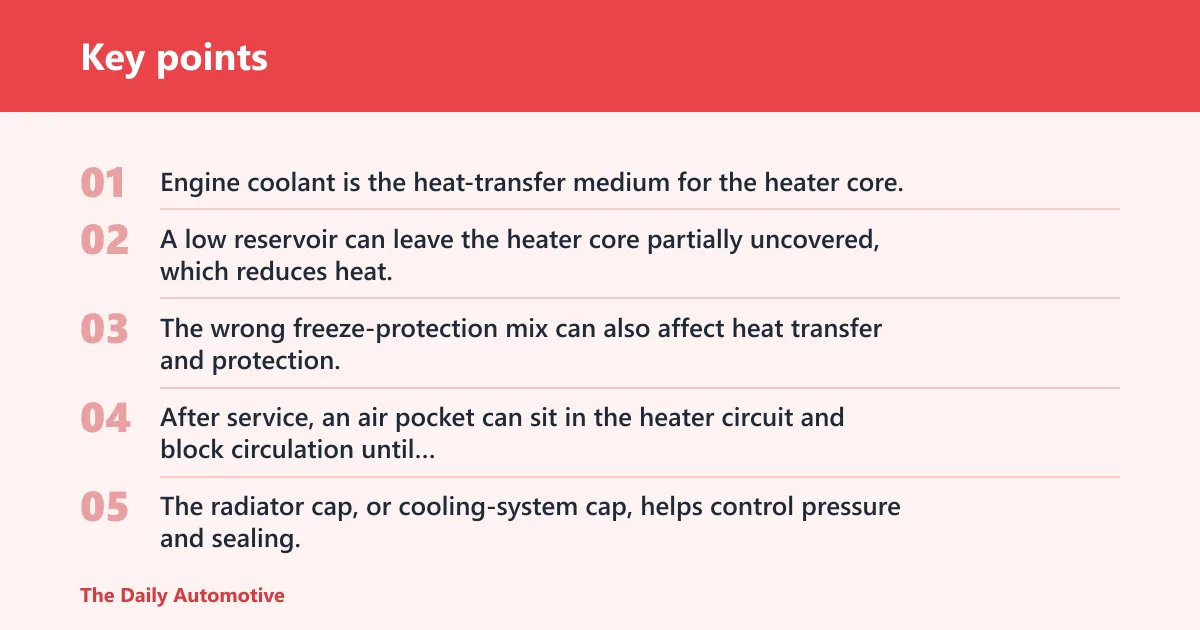
Engine coolant is the heat-transfer medium for the heater core, so the level and condition of that coolant matter. A low reservoir can leave the heater core partially uncovered, which reduces heat. The wrong freeze-protection mix can also affect heat transfer and protection. After service, an air pocket can sit in the heater circuit and block circulation until it is bled out.
The radiator cap, or cooling-system cap, helps control pressure and sealing. If it does not hold pressure correctly, the system can behave unpredictably, especially while bleeding air. A cap issue does not create every no-heat complaint, but it belongs in the check list when coolant loss or intermittent heat shows up.
Heater core restriction, blend door fault, or weak blower airflow
The heater core is a small radiator in the dash. If it clogs or restricts flow, the engine may warm normally while the vents stay cool. Radman notes that no heat while the engine is warm often points to a clogged heater core, and a sweet coolant smell, foggy windows, or uneven cabin temperature can go with that fault. Replacement can cost $1,500 to $3,000+ depending on vehicle.
A blend door can mimic a no-heat complaint because it directs air through the heater core or around it. If the door sticks or the actuator fails, hot coolant may still be present but the cabin never gets it. Weak blower output can do something similar in a different way: the heater core may be hot, but too little air crosses it to feel warm at the vents.
How do you tell which part is failing?
Start with coolant-side clues, then move to cabin-side clues. That order keeps you from replacing HVAC parts when the real issue is low coolant or air in the system. If the gauge reads normal and the engine bay hoses are warm, the problem is more likely in the heater core, blend door, or blower path than in the thermostat.
Coolant-side clues
Check the reservoir only when the engine is cold. If the level is below the marked range, top-up may help reveal a leak, but it is not the fix. Also watch for coolant smell, low heat that comes and goes, and whether the heater improves after driving. Those signs point toward coolant-side faults more than control-side faults.
Low coolant can reduce or eliminate cabin heat, and air pockets after coolant work can block circulation. A thermostat stuck open can delay warm-up without overheating, while a stuck-closed thermostat can cause overheating and poor circulation. A weak water pump can sit between those two problems by reducing flow without fully blocking it.
Cabin-side clues
If the engine temperature looks normal and the hoses are hot but the cabin still feels wrong, the HVAC side needs attention. Weak blower output, a sticking blend door, or a clogged cabin filter can all make a healthy heater seem bad. Uneven left-right temperatures also fit a cabin-side fault, especially when the heater core is not fully restricted.
Follow the vehicle and product manual for any cooling-system or electrical work; fuel, coolant, and electrical work need ventilation, no sparks, and the battery disconnected. If the car overheats, loses coolant, fogs the windows with a sweet smell, or stays cold after basic checks, stop there and get it diagnosed. A clogged heater core may need a flush or replacement, but the right repair depends on which side of the system failed.
Frequently asked questions
Why does my car heater take so long to warm up?
Usually the delay comes from slow engine warm-up or a problem moving heat into the cabin. A low gauge, a stuck-open thermostat, low coolant, trapped air, a clogged heater core, or a blend door fault are common paths. The temperature gauge and vent behavior tell you which side to check first.
Why is my car heater taking so long to warm up?
If the engine itself is slow to warm, look at the thermostat, water pump, coolant level, and outside temperature. If the engine reaches normal but the vents stay cool, the HVAC side is more likely. Weak blower airflow can also make heat feel late even when the coolant is ready.
Why does my car take so long to heat up in winter?
Cold ambient air delays engine and coolant warm-up, and short trips may end before the heater can catch up. Idling can help a little, but long idling wastes fuel. Gentle driving often warms the engine more effectively than sitting still, though trip length still matters a lot.
Does my car take so long to heat up because of the thermostat?
It could. A thermostat stuck open can delay warm-up without causing overheating, while a thermostat stuck closed can cause overheating and poor circulation. If the gauge stays low for too long, the thermostat moves up the list. If the gauge looks normal, the heater core or blend door is more likely.
Why does my car take so long to heat up when idling?
Idling often warms the engine more slowly than light driving, so cabin heat arrives later. 30 seconds is enough before driving off, and another says modern vehicles may take two minutes to warm via idling. That is normal warm-up behavior, not necessarily a fault.
Why does my car take so long to heat up inside?
Inside heat depends on hot coolant reaching the heater core and then enough airflow crossing it. Low coolant, air pockets, a restricted heater core, a blend door fault, or weak blower output can all slow that process. A sweet smell or foggy windows makes a heater-core problem more likely.
Products related to this article
Sponsored / affiliate links. As an Amazon Associate I earn from qualifying purchases. I may earn additional commission from eligible campaigns.