Adam’s Leather Care Kit Review
Adam’s Leather Care Kit is worth buying if you want an all-in-one cleaner-and-conditioner setup for routine seat care, but it will not revive cracked, dry, or peeling leather. Use the wrong product and grime can stay in the grain, shine can draw dust, and money can go toward a kit that cannot fix wear. Here’s what is in the kit, how the two-step workflow works, and where separate products make more sense.
Verdict on adam’s leather care kit
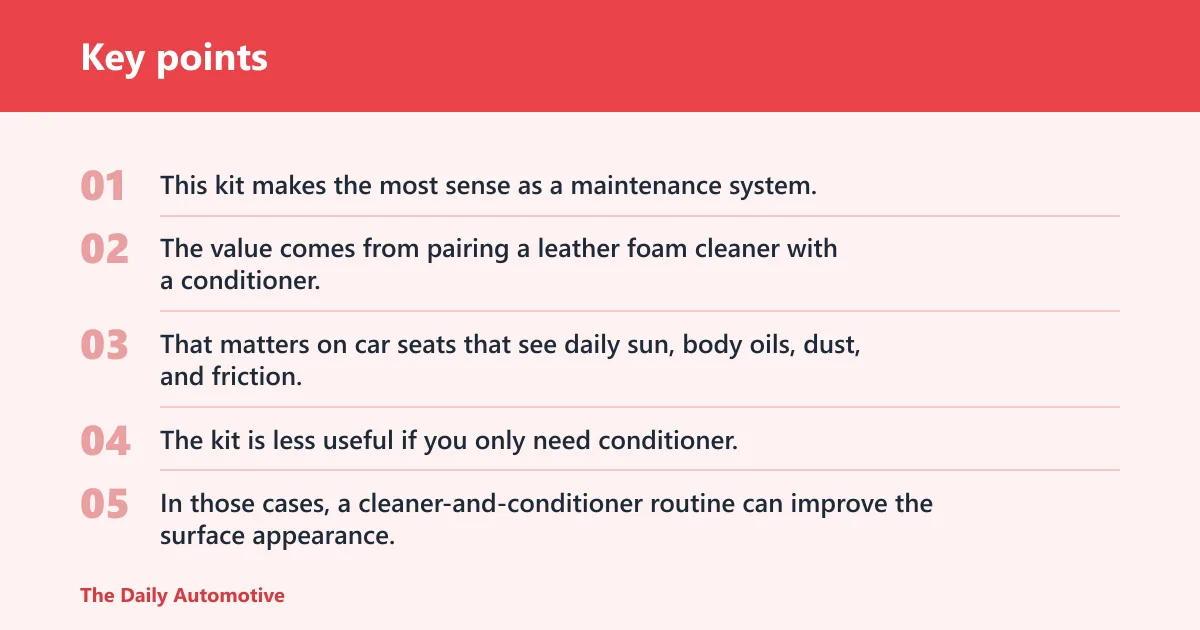


This kit makes the most sense as a maintenance system. The value comes from pairing a leather foam cleaner with a conditioner, so you clean first and then leave a controlled finish instead of loading product onto dirty seats.
That matters on car seats that see daily sun, body oils, dust, and friction. The kit is less useful if you only need conditioner, or if the leather is already cracked, peeling, or heavily dried out. In those cases, a cleaner-and-conditioner routine can improve the surface appearance, but it cannot restore damaged material.
Best for routine leather maintenance
Use this kit when the goal is keeping seats, dashboards, and door panels in shape before they turn rough. Adam’s Polishes Leather Conditioner is listed as a 16 oz product with a non-greasy satin finish, and it is designed for leather, vinyl, and plastic surfaces. The formula includes mink oil and moisturizers, plus SPF 65 UV protection and a fresh fine leather scent.
Where the kit falls short
The limits show up fast on neglected leather. A cleaner can remove ordinary dirt and stains, but it will not rebuild cracked surfaces or undo peeling. If you want a deep cosmetic reset on worn seats, set expectations low and treat this as upkeep, not repair.
Pros and cons
- Pros: cleaner-plus-conditioner workflow keeps the process orderly and reduces the chance of conditioning over dirt.
- Pros: the conditioner is described as non-greasy with a satin finish, which is easier to live with on glossy interiors than a wet-looking dressing.
- Pros: SPF 65 UV protection adds a useful layer of interior sun protection for seats, dashboards, and door panels.
- Cons: it is maintenance, not repair, so cracked or peeling leather needs a different plan.
- Cons: over-application can leave residue, especially on glossy leather, coated leather, or perforated panels.
- Cons: if you already own separate cleaner, conditioner, and microfiber towels, the kit may duplicate items you do not need.
Who should buy it?
This kit fits drivers who want a straightforward routine for leather car seats, especially if the interior sees sun exposure and regular use. It is a practical choice for people who want one product path for cleaning, conditioning, and light UV support.
It is less useful for someone trying to rescue old, cracked, or peeling upholstery. It is also not the best fit if you already prefer buying a stronger cleaner or a conditioner-only product separately. If your seats are specialty leather, coated leather, or perforated, check the manufacturer’s listing for your exact model before you commit.
New-car leather owners
For newer interiors, the cleaner-plus-conditioner workflow is easy to justify. A light cleaning removes dust and transfer from clothing, then a thin conditioner layer helps keep the surface from drying out under daily sun exposure. This is the use case where a kit feels most complete.
Daily-driver seat care
For seats that see people, groceries, spills, and repeated entry and exit, the cleaner is doing real work first. That matters because conditioning a dirty surface can trap grime and leave the finish uneven. A common first-timer mistake is applying conditioner straight onto a dry-looking but dirty seat, then wondering why the grain still feels tacky.
Who should skip it?
Skip it if you need actual leather restoration. If the surface is cracked, flaking, or structurally worn, a maintenance kit cannot reverse that damage. Skip it too if you want only one product and already own a cleaner that works well on your interior materials.
What comes in the kit?
A complete leather care kit should separate cleaning from conditioning, and that is the main value here. The workflow uses a leather foam cleaner first, then a balm or conditioner second. The listing details for Adam’s Polishes Leather Conditioner describe a 16 oz bottle, non-greasy satin finish, leather/vinyl/plastic compatibility, mink oil and moisturizers, SPF 65 UV protection, fresh fine leather scent, and a spot-test requirement before full use.
Cleaner first, conditioner second
The cleaner step is for ordinary dirt and stains. Use it before any conditioner so you are not sealing grime into the surface. The conditioner step follows after the leather is clean and ready for a thin coat.
Included application tools
Kit bundles often include a brush, applicator, and microfiber cloth. Those tools matter because they support controlled application and buffing after absorption. A microfiber towel is especially useful when you want to remove excess product without rubbing the finish shiny.
What to check on the listing
Do not assume every kit has the same contents. Check the manufacturer’s listing for the exact set in front of you, especially if you want towels, a brush, or a specific cleaner size. If the listing does not spell out the material compatibility for your seats, verify it before applying anything.
Leather care kit decision table
| Use case | Exact sequence | Expected finish | Main failure risk |
|---|---|---|---|
| New car maintenance | Vacuum, spot-test, light foam clean, thin conditioner layer, buff with microfiber | Controlled satin, low residue if applied lightly | Over-application that leaves slick spots or dust-attracting residue |
| Dirty daily-driver seats | Vacuum thoroughly, foam clean with brush or cloth, let surface dry, then apply conditioner sparingly | Even satin finish after dirt removal | Trapped grime, uneven color, or shine where the cleaner was not worked in fully |
| Older dry seats | Clean gently, wait for full dry time, use a very thin conditioner layer, buff off excess | Supple-looking satin, not a repair finish | Expecting crack repair, or using too much product on thirsty leather |
How do you use it on car seats?
Start with vacuuming and cleaning, then move to a thin conditioner layer only after the leather is free of loose dirt. That sequence is the safest way to treat car seats because conditioner works best on a clean surface. On daily-driver interiors, the cleaner matters as much as the conditioner.
Vacuum and clean first
Remove grit from seams and stitching before any liquid goes down. That cuts down on rubbing dirt deeper into the grain. On heavily used seats, this step matters more than the conditioner itself because it determines whether the finish looks even.
Apply the cleaner with a brush or cloth
Use the leather foam cleaner with a brush or cloth to work on ordinary dirt and stains. Keep the motion controlled and avoid soaking the surface. On perforated leather, apply lightly so product does not collect in the holes.
Use a thin conditioner layer
Apply the balm or conditioner in a thin layer, not a heavy coat. Let it absorb before wiping off the excess. That is how you get a satiny finish instead of a greasy film. Suppose a seat bolster in a hot sedan has gone dull from sun exposure; a light coat can refresh the look, but piling on more product only raises residue risk.
Buff after absorption
Use a buffing microfiber after the conditioner has had time to absorb. The point is to remove what the leather did not take in. That step controls shine and keeps the final feel closer to satin than glossy.
Does it protect against UV damage?
Yes, the conditioner lists SPF 65 UV protection, so it is aimed at reducing interior sun damage on leather, vinyl, and plastic surfaces. That matters because seats and dashboards take steady exposure through glass, and heat plus light can accelerate fading and drying.
What UV inhibitors do
UV inhibitors help slow the breakdown that comes from sun exposure. They are a maintenance aid, not armor. The practical benefit is better support for seats, dashboards, and door panels that see repeated sunlight.
Why sun exposure matters
Heat and light dry interior materials over time, especially on parked vehicles and daily commuters. A conditioner with UV support can help keep the surface from looking tired as quickly. It still needs regular cleaning, because dirt and body oils can shorten the useful life of any finish.
Where protection has limits
UV protection does not reverse fading that already happened. It also does not fix brittle leather or peeled surfaces. Think of it as part of a preventive routine, not a cure.
Is it safe on perforated or old leather?
It can be used carefully on perforated leather, but that surface needs a lighter touch. Coated, specialty, or unknown leather deserves extra caution, and the spot-test recommendation should not be skipped. Old or cracked leather needs realistic expectations: cleaning and conditioning may improve appearance, but they will not repair damage.
Perforated seat caution
Perforated seats are easy to over-wet. Product can settle in the holes and leave residue where you do not want it. Use minimal product and a lightly damp applicator rather than flooding the panel.
Coated and specialty leather caution
Some automotive interiors are finished differently from plain leather, and compatibility is not something to guess at. If the listing does not clearly match your seat type, check the manufacturer’s listing for your exact model. A hidden-area spot-test is the safest first step.
Old or cracked leather expectations
Older leather often needs more than a conditioner. If the seat is dry, the product can help soften the look and leave a controlled finish, but cracked material will still be cracked. A common first-timer mistake is expecting a maintenance product to erase wear that is already structural.
Frequently asked questions
Is Adam’s Leather Care Kit worth it for car seats?
Yes, if your goal is routine seat care rather than restoration. The cleaner-plus-conditioner workflow is the main reason to buy it, because it handles dirt first and then adds a controlled satin finish with UV support. It is a weaker choice if your seats are cracked or peeling.
What comes in Adam’s leather care kit?
A complete kit should include a cleaner step, a conditioner step, and basic application tools. The referenced product details for Adam’s Polishes Leather Conditioner list a 16 oz bottle, non-greasy satin finish, leather/vinyl/plastic compatibility, mink oil and moisturizers, SPF 65 UV protection, and a fresh fine leather scent.
Does Adam’s leather care kit clean and condition leather?
Yes, that is the point of the system. The foam cleaner removes ordinary dirt and stains first, then the conditioner is applied in a thin layer and buffed after absorption. That sequence gives you better control than conditioning a dirty seat.
Is Adam’s leather care kit safe on perforated leather seats?
Use extra caution on perforated seats. Light application is important because excess product can collect in the holes and leave residue. A hidden-area spot-test is the safest way to check how your specific leather reacts before full application.
Will Adam’s leather care kit leave a greasy finish?
The conditioner is described as non-greasy with a satin finish, so greasy output is not the target. The risk rises if you apply too much or fail to buff off the extra product. Thin coats are the best way to keep the finish controlled.
Is Adam’s leather care kit good for old or cracked leather?
It can help with maintenance, but it is not a repair product. Old leather may look cleaner and feel less dry after treatment, yet cracked, peeling, or structurally worn material will not be restored by a conditioner. Set expectations accordingly before buying.
Products related to this article
Sponsored / affiliate links. As an Amazon Associate I earn from qualifying purchases. I may earn additional commission from eligible campaigns.