Best Safety Gear for Daily Commuters (2026): we compared
The best car safety equipment for daily commuters is a tire-pressure monitor, dash cam, and blind-spot aid, ranked by the crash risk each one cuts most on a normal commute. Ignore them, and small mistakes turn into preventable collisions, higher repair bills, and missed work. This guide ranks affordable commuter safety gear by the risk it addresses, so you can buy in the right order.
This guide is part of our Car safety features: types, functions and legal basics series.
Quick comparison
| Product | Badge | Best for | Price | ||
|---|---|---|---|---|---|
 |
4K Dual Dash Cam Front and Rear,Starlight Night Vision GTQZNK | Our pick | 4K dual front/rear + ADAS + GPS | $89.59
Price as of 5 Oct 2026
|
View |
 |
AstroAI AIRUN H Tire Inflator Portable Air Compressor, 12VAstroAI | Budget pick | 12V portable inflator with auto shut-off | $31.99
Price as of 5 Oct 2026
|
View |
For commuting, the right order is about risk, not gadget appeal. A dash cam helps document rear-end hits and parking lot damage, while TPMS and an inflator attack the slow failures that strand drivers on ordinary weekdays.
How we chose
This ranking focuses on four things: the daily risk reduced, how easily the item fits into a normal car, the upkeep burden after purchase, and the failure points that make cheap accessories useless. Convenience gear stays out unless it also cuts crash or injury risk.
That means a phone mount is only safety-relevant when it keeps navigation visible without blocking airbags or pulling a driver’s eyes away from traffic. A trunk organizer is not in this list.
Dash cam: best for crash evidence and parking hits
This is the first purchase for most commuters because it addresses the messiest daily risk: someone taps your bumper, cuts across your lane, or bumps the car in a parking lot and drives off. Based on the spec sheet and owner feedback, front-and-rear coverage is the right call if the commute includes heavy traffic, apartment parking, or curbside stops.
What stands out is the combination of 4K front and rear recording, loop recording, and parking mode support. Those are the features that matter when the incident is fast and nobody wants to admit fault. Good night visibility matters too, because commuting damage happens after work as often as before it.
The drawback is simple: a dash cam only helps if it is powered correctly and aimed cleanly. Poor mounting, bad cable routing, or a camera that blocks the driver’s view turns a safety tool into clutter. ADAS alerts can also become noise if the camera is installed too high, too low, or in a car with a noisy windshield.
What should I buy first on a budget?
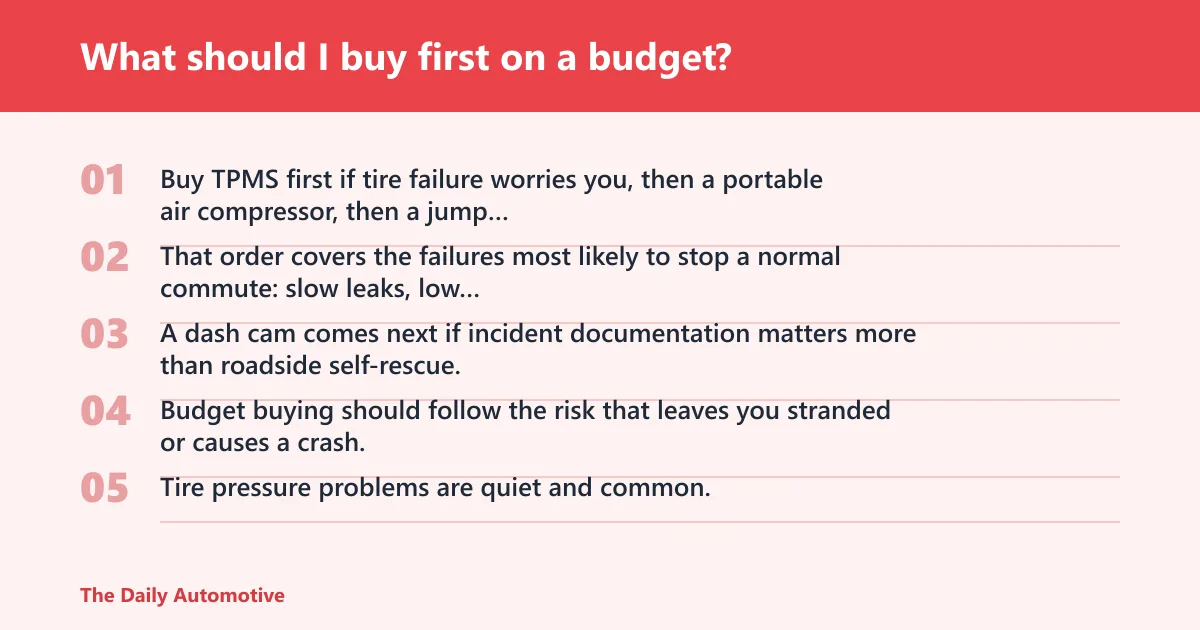
Buy TPMS first if tire failure worries you, then a portable air compressor, then a jump starter pack. That order covers the failures most likely to stop a normal commute: slow leaks, low pressure, and a dead battery. A dash cam comes next if incident documentation matters more than roadside self-rescue.
Budget buying should follow the risk that leaves you stranded or causes a crash. Tire pressure problems are quiet and common. Dead batteries are less common, but they hit at the worst possible time.
Tire pressure monitoring system: best for tire-related risk
TPMS belongs near the top because underinflation can affect braking, cornering, and tire wear before a driver notices much wrong. A good system gives real-time pressure readings and low-pressure alerts, which is exactly what commuter tires need when the car is used hard every weekday and checked too late on weekends.
For daily driving, the useful PSI range is the manufacturer’s recommended passenger-car range on the door jamb, not a random “safe enough” number. Sensor type matters too: clamp-on external units are easier to add, while internal sensors are tidier but usually mean more service work and a battery or service interval to track.
The drawback is maintenance overhead. Sensors can die, caps can leak, and some systems create more worry than help if their readings drift or the app is ignored. TPMS is only valuable if the driver responds to alerts with actual pressure checks.
Portable air compressor: best for slow leaks
A portable air compressor is the practical follow-up to TPMS because it fixes the low-pressure alert instead of just warning about it. For commuters, the key spec is enough PSI output for car tires, auto shutoff to prevent overinflation, and a power source that matches the car: 12V corded or cordless.
It should also work on bikes if the household uses one tool for more than one job, and it should inflate fast enough that a minor leak does not turn into a long driveway project. The AstroAI inflator fits the commuter role well on paper because it is 12V, has auto shut-off, includes an LED light, and is rated for quick inflation at 35L/min.
The drawback is that it is a repair aid, not a fix for punctures or damaged valves. If the tire is losing air fast, an inflator only buys time. It also does nothing if the power cord is inaccessible or the battery is already flat.
Jump starter pack: best for dead battery backup
A jump starter pack is worth buying when parking leaves the car vulnerable to short trips, cold snaps, or accessory drain. The right unit uses a lithium battery chemistry, has safety clamp protection, includes USB charging ports, and lists enough peak amps for the engine size it needs to wake up.
Number of starts per charge matters more than flashy extras. A commuter pack should be able to give multiple starts between recharges, because the point is to get to work and back without waiting for roadside help. It is especially useful when the car sits overnight in exposed parking.
The drawback is predictable: jump packs age, lose charge if neglected, and can be dead when needed most. They also do nothing for a failing alternator or a battery that keeps dying every week. At that point, the car needs repair, not another accessory.
Blind spot mirror: best for lane changes in tight traffic
This is a low-cost safety add-on for dense traffic, especially for commuters who spend a lot of time merging, squeezing into tight lanes, or backing out of crowded parking spots. A convex blind spot mirror gives a wider view of adjacent lanes, and that can reduce the small but common lane-change mistake that causes avoidable side-swipes.
What stands out is how little effort it takes to install. Adhesive mounting works, and the mirror can be aimed to fit a small car or an SUV. Proper placement matters more than price: set it to cover the lane you cannot see, not to duplicate the main mirror.
The drawback is false confidence. A blind spot mirror is a helper, not a substitute for shoulder checks and mirror discipline. If it is stuck on crooked, too low, or vibrating, it becomes another distraction instead of a safety aid.
Which one should you buy for city driving versus highway driving?
City drivers should favor blind-spot mirrors, a dash cam with parking mode, and a phone mount that does not block airbags. Highway commuters should put more money into dash cam coverage, TPMS, a compressor, and headlight clarity, because lane speed, tire failure, and night visibility matter more there.
Older commuter cars need the basics first: visibility, tire monitoring, and battery backup. Newer cars with built-in driver aids can skip some add-ons, but only if the factory systems still work well and the commute does not create blind spots, parking damage, or low-light driving problems.
City commute picks
City traffic creates more close-range conflict than speed-related conflict. A dash cam helps with stop-and-go rear-end claims and parking lot taps, while a blind spot mirror helps in crowded lanes and during curbside merges.
A phone mount belongs here only if it keeps navigation visible without touching the airbag zone or forcing a driver to look down. A vent mount can be fine, but only if it stays stable on rough streets and does not fall into the controls.
Highway commute picks
Highway commuters should think about fatigue, weather, and breakdowns. TPMS and a compressor are high value because tire pressure drift becomes more serious at speed. A jump starter matters more when the car is parked far from help and the battery gets cold-soaked.
Headlight output becomes more important after nightfall, and older lenses can quietly erase that margin. For long dark drives, a headlight restoration kit belongs higher on the list than extra convenience accessories.
Older commuter car picks
Older cars benefit from the simplest upgrades first: headlight restoration, TPMS, a compressor, a jump starter, and a dash cam. That sequence fixes the safety losses that age creates, especially dim lights, soft tires, and batteries that do not hold charge the way they used to.
Blind spot mirrors are also useful on older cars because many of them have thicker pillars and smaller mirrors than newer models. Skip anything that adds clutter near the windshield if the car already has a tight cabin.
Commuter risk-to-gear matrix
This matrix is the decision tool most buying guides leave out. It separates commuter risk by type, so readers can see what to buy first, what to skip, and what only matters in specific conditions.
| Daily hazard | Single best purchase | Buy-first order | When to skip |
|---|---|---|---|
| Rear-end traffic and parking lot damage | Dash cam | 1 | Skip only if the car never parks in public and incident evidence is already covered |
| Blind spots and lane changes | Blind spot mirror | 2 | Skip if the vehicle already has excellent factory blind-spot coverage and the mirror adds clutter |
| Low visibility and headlight wear | Headlight restoration kit | 3 | Skip on vehicles with clear plastic lenses and strong night output |
| Dead battery, tire failure, and roadside stops | Jump starter pack | 4 | Skip if roadside service is always close and the car is new enough that battery issues are rare |
| Slow leaks and underinflation | TPMS | 5 | Skip only if the vehicle already gives reliable pressure data and the driver checks tires often |
| Emergency escape after a crash | Seat belt cutter/window breaker | 6 | Skip if there is no secure storage spot or the car already carries a better-mounted escape tool |
| Weather-related roadside inflation needs | Portable air compressor | 7 | Skip if the car is never far from help and tire pressure is checked at service visits without fail |
That matrix is intentional. It puts crash evidence above convenience, then tire health, then roadside rescue. It also keeps emergency escape separate from everyday driving aids, because a window breaker is there for a rare event, not a commute habit.
How to choose a car safety accessory for city driving versus highway driving
City driving rewards compact tools with quick access: dash cam, blind spot mirror, and a phone mount that stays out of the airbag path. Highway driving rewards preparedness: TPMS, compressor, jump starter, and headlight repair if the commute includes dark roads or fogged lenses.
Weather changes the order. Rain and winter make tire pressure and lighting more important. Heavy parking exposure makes parking mode and incident recording matter more than extra convenience features.
Failure cases matter as much as the product itself. A dash cam with poor night video is much less useful than one with decent low-light capture. A phone mount that blocks the dash or the passenger airbag should be rejected immediately.
Dash cam power, mounting, and feature checklist
Before buying a dash cam, check four things: front or front-and-rear coverage, loop recording, parking mode, and a power source that fits the car without ugly cable runs. If the camera is easy to power but hard to position, it will age badly.
- Choose front-only only if the commute is calm and parking lot risk is low.
- Choose front-and-rear coverage if traffic is heavy or rear impacts are common.
- Look for good night visibility if the drive home happens after dark.
- Mount it where it sees the road but does not interfere with the driver’s sightline.
- Use parking mode only if the car’s power setup supports it reliably.
Headlight restoration and visibility degradation
Headlight clarity is a safety item, not a cosmetic one. MotorTrend says headlights become more important after nightfall, recommends a Cerakote headlight restoration kit for fogged lenses, and describes it as restoring headlights to their original glory. That fits older commuter cars especially well.
A decent restoration kit should remove haze, add UV protection, improve night driving visibility, and work on plastic lenses with a DIY application time that does not require a whole weekend. If the lights are yellowed or cloudy, this is higher value than most add-on gadgets.
What emergency gear should every commuter keep in the car?
Every commuter should keep a roadside kit that is actually usable in the dark and in traffic. The best minimum set includes a reflective triangle or flares, first aid supplies, gloves, a blanket, and a multi-tool. That combination handles warning, minor injury, warmth, and basic work around the car.
A seat belt cutter/window breaker belongs in the emergency category too. Look for a blade safety cover, a hardened tip, and storage that keeps it reachable, whether in a keychain slot or console tray. It should be used only in emergencies.
Frequently asked questions
What car safety equipment is worth it for daily commuting?
The most useful gear is the kind that cuts the most common daily risks: a dash cam for traffic disputes and parking hits, TPMS for tire-related trouble, a blind spot mirror for lane changes, and a jump starter or compressor for breakdown backup. Skip convenience items unless they also cut risk.
Which car safety devices actually prevent accidents on the commute?
Devices that support the driver’s awareness do the most work: blind spot mirrors, TPMS, and a clear dash cam setup can all reduce avoidable mistakes or document them quickly. None of them replaces attention, but they can help catch problems before they become contact.
Do I need a dash cam for commuting every day?
If the route includes busy traffic, parking lots, apartment garages, or frequent lane changes, yes. A dash cam does not stop a crash, but it can settle fault disputes and document hit-and-run damage. For a quiet rural commute with safe parking, it is less urgent than tire and battery gear.
Are blind spot mirrors and tire pressure monitors worth it for commuters?
Yes, especially in small cars, older vehicles, and dense traffic. Blind spot mirrors help with lane changes and parking lot movement, while TPMS catches slow leaks before they become a blowout risk or a fuel-wasting underinflation problem. They are inexpensive compared with one bad repair bill.
What emergency gear should every commuter keep in the car?
Keep a roadside kit, a jump starter, and a small escape tool. Add gloves and a blanket if the commute includes cold weather or long highway stretches. The goal is not to turn the car into a supply closet; it is to handle the first 15 minutes of a problem safely.
What are the best safety upgrades for older commuter cars?
Start with headlight restoration, then TPMS, a compressor, and a jump starter. Older commuter cars lose safety through wear: dim lights, weak tires, and batteries that fail without much warning. A dash cam and blind spot mirrors are still smart follow-ups if the car sees heavy traffic.
Products related to this article
Sponsored / affiliate links. As an Amazon Associate I earn from qualifying purchases. I may earn additional commission from eligible campaigns.