Best Compression Testers for Cars (2026): We Compared
For most DIY gasoline engines, the best compression tester is the one with a screw-in hose, a dependable bleed valve, and M10, M12, and M14 adapters; the top two picks are the kits that read the same way twice and fit tight spark plug wells. A poor tester wastes time, shows false low numbers, and can send you after the wrong fault. This guide compares two compression testers by seal quality, adapter coverage, and access in crowded engine bays.
Quick comparison
| Product | Badge | Best for | Price | ||
|---|---|---|---|---|---|
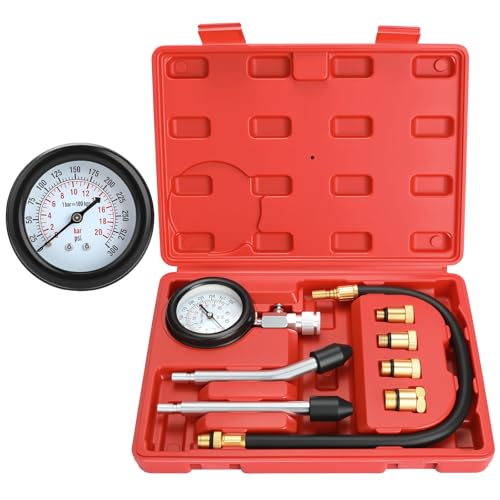 |
BETOOLL HW0130 8pcs Petrol Engine Cylinder CompressionBETOOLL | Our pick | 0-300 PSI · 3-inch Gauge · 4 Adapter Sizes | $17.99
Price as of 21 Oct 2026
|
View |
 |
AZUNO Compression Tester Automotive, Digital CompressionAZUNO | Also great | $27.99
Price as of 21 Oct 2026
|
View | |
 |
DISEN 14PCS Compression Tester 0-300 PSI Gauge 5 AdaptersDISEN | Also great | $35.99
Price as of 21 Oct 2026
|
View | |
 |
OTC 5605-DG Deluxe Digital Compression Tester Kit withOTC | Upgrade pick | 0-300 PSI · Digital Gauge · 2.5-inch Display | $188.99
Price as of 21 Oct 2026
|
View |
The core trade-off is simple: the OTC 5605 fits most gasoline-engine jobs more easily, while the Mityvac MV5530 is the better pick when repeatability and frequent use matter more than kit convenience. Both use a 0-300 PSI gauge range, but they solve different failure modes.
How we chose
The comparison below focuses on where compression testing goes wrong. That means adapter fit, hose reach, reading visibility, and how well the tester seals without creating false low numbers.
We also separated occasional DIY needs from repeated shop use. A good kit for an occasional misfire check is not always the best kit for ten tests a day on mixed engines.
Finally, we weighed the thread coverage that matters most on gasoline engines: 10mm, 12mm, 14mm, 16mm, and 18mm adapters, plus whether the hose and couplers are practical in recessed plug wells.
OTC 5605 deluxe compression Tester kit: best for DIY use
The OTC 5605 fits most home-mechanic jobs because it pairs a 2-1/2-inch dual-scale gauge with an extra-long flex hose and multiple adapters. That makes it a better match for tight engine bays than a short, basic gauge kit, especially when the plug wells are recessed or the engine sits transverse.
Its gasoline-engine focus matters. The included adapters and storage case make it easier to keep the right parts together, and the extra-long flex hose helps you keep the gauge where you can actually see it while the hose seals at the plug hole.
The drawback is cost. Compared with budget kits, it asks more up front, and it is not the cheapest answer if you only need a quick check once in a while. It also stays within gasoline-engine territory, so it is not the universal answer for every compression-testing task.
Why it fits most gasoline engines
The OTC 5605 lines up with the reality of modern cars: deep plug wells, crowded intake plumbing, and awkward access around coils and covers. The 2-1/2-inch dual-scale gauge is large enough to read without squinting, and the long flex hose reduces the chance that you are forcing the gauge into a blind corner.
That matters because poor visibility creates its own diagnostic error. If you cannot read the gauge cleanly, you tend to over-handle the hose, disturb the seal, and invite low readings that look like engine damage when they are really setup problems.
Where the hose and adapters help
The included extra-long flex hose is the main reason this kit stands out for DIY use. Car And Truck lists the hose assembly at 25 inches, which is the kind of reach that helps when the spark plug sits down in a recessed well or when the fender and battery leave little room to work.
Multiple adapters help avoid the common fit failure: the hose seals, but the adapter does not. That problem shows up often on mixed fleets, especially when one vehicle uses a 14mm plug and another needs an 18mm thread or a deep-well connector.
Limits to watch
The OTC kit is still a consumer tool, not a bench-standard shop instrument. If you are comparing cylinders all day, the gauge layout and accessory set are good, but not as purpose-built for constant repeatability as a professional tester.
It is also less attractive if you need the broadest possible adapter menu for unusual applications. The kit is strong for typical gasoline engines, but not every oddball thread or access problem will be covered cleanly by a general-purpose box.
Mityvac MV5530 Professional Compression Tester: best for shop use
The Mityvac MV5530 is the better fit when repeated testing matters. It is described as a professional compression tester with a 0-300 PSI gauge range, and that combination makes sense for daily shop use where the same engine may be checked multiple times during diagnosis.
Its strength is consistency. In a shop workflow, repeatability matters because the technician needs the cylinder readings to stay stable across repeated cycles, not drift because the gauge or sealing setup changes from one pull to the next.
The drawback is simple: this is more tool than many casual owners need. If you only check compression once every few years, a professional-grade kit can feel like paying for durability and repeatability you may rarely use.
Why repeatable readings matter
Compression diagnosis is only useful when the numbers mean something from one cylinder to the next. A tester with better repeatability helps separate a true mechanical issue from a sealing problem, a leaking adapter, or a gauge that behaves inconsistently between cycles.
That is especially helpful when you are watching small differences between cylinders. A false low number from a poor seal can send you toward rings, valves, or a head gasket when the real problem is the tester setup itself.
Strengths for frequent diagnostics
The MV5530 is aimed at professional use, which means it fits the kind of work where setup speed and confidence matter. For a shop, the value is not just pressure range. It is the ability to repeat a check, confirm the same result, and move on without second-guessing the tool.
That makes it the better choice for repeated fault isolation, especially when engines come in with similar symptoms and you need a stable benchmark from test to test.
Where it may be more than a casual user needs
If the garage sees compression testing only a few times a year, the MV5530 can be more kit than necessary. A simpler DIY set may cover the same gasoline-engine basics at a lower cost, even if it gives up some shop-grade consistency.
It also rewards a user who already knows how to manage adapters, hose routing, and sealing. A novice can still use it, but the extra capability is most valuable when the tester is part of a regular diagnostic routine.
Compression tester decision table
| Engine layout | Spark plug access | Adapter risk | Reading visibility | Who should buy it |
|---|---|---|---|---|
| Transverse four-cylinder with tight bay packaging | Recessed plug wells | Moderate; a short or loose adapter can leak | OTC 5605 is easier to keep in view | DIY owners who want fewer access problems |
| V6 or V8 with deeper plug tubes | Deep-well access | Higher if the wrong thread style is chosen | Mityvac suits repeated confirm-and-retest work | Shop use or frequent diagnosis |
| Mixed fleet with 10mm to 18mm plug threads | Varies by vehicle | Highest when adapter coverage is incomplete | Either works if the gauge stays outside the bay | Buy the kit with the broadest adapter coverage |
| Older gasoline engine with easier plug access | Shallow well or exposed plug | Low if the seal is straightforward | Either gauge is readable enough | Occasional DIY use or a budget kit |
How adapter fit changes the result
Thread coverage is where many compression testers fail first. A 14mm adapter may fit one engine cleanly, but an 18mm plug or a deep-well connector can turn the same kit into a leaky setup if the sealing surface or thread pitch is wrong.
Flat-seat and tapered-seat plugs add another layer. The adapter has to seat correctly, not merely screw in, or the gauge can read low and mimic engine wear. That is why threaded adapters are safer than rubber cone ends for most serious gasoline-engine checks.
Why hose length is a real diagnostic factor
A hose needs enough reach to stay clear of the valve cover, coil pack, and intake hardware while still letting the gauge sit where you can read it. A 12-inch hose is the practical minimum for simple layouts; a 25-inch hose is the more shop-friendly target for recessed plugs and awkward bay geometry.
Flexibility matters as much as length. A stiff hose can pull against the adapter and spoil the seal, while a flex hose lets the gauge sit outside the problem area without loading the connection.
Say your 14mm spark plugs sit in a deep tunnel under a coil-on-plug cover. A short hose forces the gauge to hang at an angle, the adapter never seats fully, and the first cylinder looks weak even though the engine may be fine.
Suppose a Ford Triton-style application needs a dedicated deep-well connector. A generic rubber cone end may appear to fit, but a threaded adapter and a hose that can reach down into the well are far less likely to create a false low reading.
Choose OTC 5605 if… / Choose Mityvac MV5530 if…
Choose the OTC 5605 if you want a practical DIY kit for gasoline engines, prefer a larger 2-1/2-inch dual-scale gauge, and need an extra-long flex hose to cope with tight engine bays. It is the safer buy when access problems are the main concern.
Choose the Mityvac MV5530 if you expect repeated tests, want professional-grade consistency, and care more about stable diagnosis than about the broadest convenience kit. It is the stronger choice for a garage or shop that sees compression work often.
Choose the OTC 5605 if you are worried about cramped transverse bays and want a kit that already includes multiple adapters and a storage case. The package is built to reduce setup friction.
Choose the Mityvac MV5530 if you want the tester that better supports repeated cycles and clearer comparison work. It is the pick when the tool is part of the diagnosis process, not an occasional check.
Which one should you buy?
For occasional DIY use, start with the OTC 5605. It balances adapter coverage, hose reach, and gauge readability well enough for most gasoline-engine jobs, and it is the better answer when the main risk is access in a cramped bay rather than calibration drift.
For tighter engine bays, the OTC 5605 also has the edge because the long flex hose and included adapters make it easier to avoid a bad seal. That is the common failure mode in recessed plug wells.
For frequent diagnostic work, the Mityvac MV5530 is the better buy. The point is not that it looks fancier. The point is that repeatable readings matter more when you are checking the same engine over and over.
Budget compression kits can still make sense for basic checks. An 8-piece kit such as the BETOOLL HW0130 is fine for light-duty diagnosis on simpler layouts, especially when storage space and cost matter more than broad adapter coverage. The limit is usually fit quality and flexibility, not the gauge face alone.
What a budget kit does well
Budget kits are good for quick screening.
They also pack neatly. A compact storage box and lightweight build are useful if you only need the tester for occasional diagnosis, but they do not make a short hose or weak adapter seal disappear.
When a budget kit starts to fall short
A budget tester becomes less convincing when you move into recessed plug wells, mixed thread sizes, or repeat testing. That is where leaks, awkward hose routing, and hard-to-read gauges start creating false low numbers.
If you need M10 through M18 coverage, a better hose, or a kit that holds together through repeated cycles, stepping up to the OTC or Mityvac is usually the smarter move.
Compression tester buying guide
Analog vs digital gauges
Analog gauges are often easier to read in the bay because the needle holds peak pressure and the display does not wash out in sunlight. Digital models can help when visibility is poor, especially with a backlit LCD, but they do not automatically improve the diagnosis if the adapter or hose is leaking.
A digital tester can be useful for cramped underhood work, yet the best choice still depends on how you read it. If you want a simple peak-hold result that stays visible at a glance, analog remains a strong option. If you want a lit display and easier reading in dim spaces, digital has an edge.
Thread sizes and adapter types
Check the thread sizes before buying. Common gasoline-engine kits should cover 10mm, 12mm, 14mm, 16mm, and 18mm, with deep-well connectors for recessed plug wells. Push-on and rubber cone ends can work for quick checks, but threaded adapters are the safer choice when you need a seal you can trust.
Flat-seat and tapered-seat plugs do not behave the same way. The adapter has to match the seat style and thread correctly, or the gauge may report a low cylinder that is not actually low.
Hose length for recessed plugs
Hose length is not a nice-to-have detail. A 12-inch hose is the practical minimum for easy-access engines, while 25 inches is the more useful target for deep plug wells and transverse layouts where the gauge needs to live outside the tight area.
Flex hose construction matters too. A hose with enough bend keeps the gauge out of the way and reduces the chance that the adapter is being pulled sideways during the test.
Fit on flat-seat and tapered-seat plugs
Compatibility is not limited to thread count. Flat-seat plugs and tapered-seat plugs can demand different sealing behavior, and a tester that fits one badly can still look correct until the readings come back low.
If the engine family is known for recessed plugs, deep-well connectors and threaded adapters should be the first filters, not the last. That is where most false low numbers start.
Frequently asked questions
What is the best engine compression tester for cars?
For most gasoline cars, the best compression tester is the one that seals reliably and reaches recessed plugs without forcing the gauge into the engine bay. The OTC 5605 is the stronger DIY pick because its long flex hose, multiple adapters, and gasoline-engine focus reduce the chance of setup errors.
Do I need a threaded adapter or rubber cone compression tester?
Threaded adapters are the better choice for most serious tests because they seal more consistently and are less likely to create a false low number. Rubber cone ends can work for quick checks, but they are less dependable in deep wells, on awkward angles, or when the spark plug seat style is not forgiving.
Which compression tester works best for 14mm and 18mm spark plugs?
Choose a kit with explicit coverage for both sizes. The practical answer is the tester that includes 14mm and 18mm adapters, plus a hose that can stay straight enough to seal. Kits with broad M10-to-M18 coverage are easier to trust on mixed gasoline-engine applications.
Is a digital compression tester better than an analog one?
Not automatically. Digital models can be easier to read in dim spaces and may include a backlit LCD, but analog gauges are still excellent because the needle holds the peak pressure. The real question is whether the gauge stays readable and the adapter seals correctly in the engine bay.
How long should a compression tester hose be for recessed spark plugs?
A 12-inch hose is the practical minimum, but 25 inches is the better target for recessed plug wells and cramped transverse bays. Longer flex hose helps keep the gauge visible while reducing side load on the adapter, which is important for avoiding false low readings.
Which compression tester is best for a garage or shop?
The Mityvac MV5530 is the better shop choice because it is described as a professional compression tester and is built around repeatability through repeated cycles. That matters when the same vehicle may be tested several times during diagnosis and the shop needs stable, comparable numbers.
Products related to this article
Sponsored / affiliate links. As an Amazon Associate I earn from qualifying purchases. I may earn additional commission from eligible campaigns.