How Much Does It Cost to Add Car Safety Features?
Adding modern safety features to an older car usually costs about $300 to $3,500 installed, but factory-style upgrades with cameras, sensors, and calibration can reach about $5,000 or more, so a higher-trim used car is often the better value. Bad retrofits can trigger warning lights, disable driver-assist functions, or leave you with hardware that does not work correctly. This guide breaks down real installed costs, what can actually be added, and when to buy a car that already has the feature.
Retrofit costs go far beyond the sticker price of a sensor
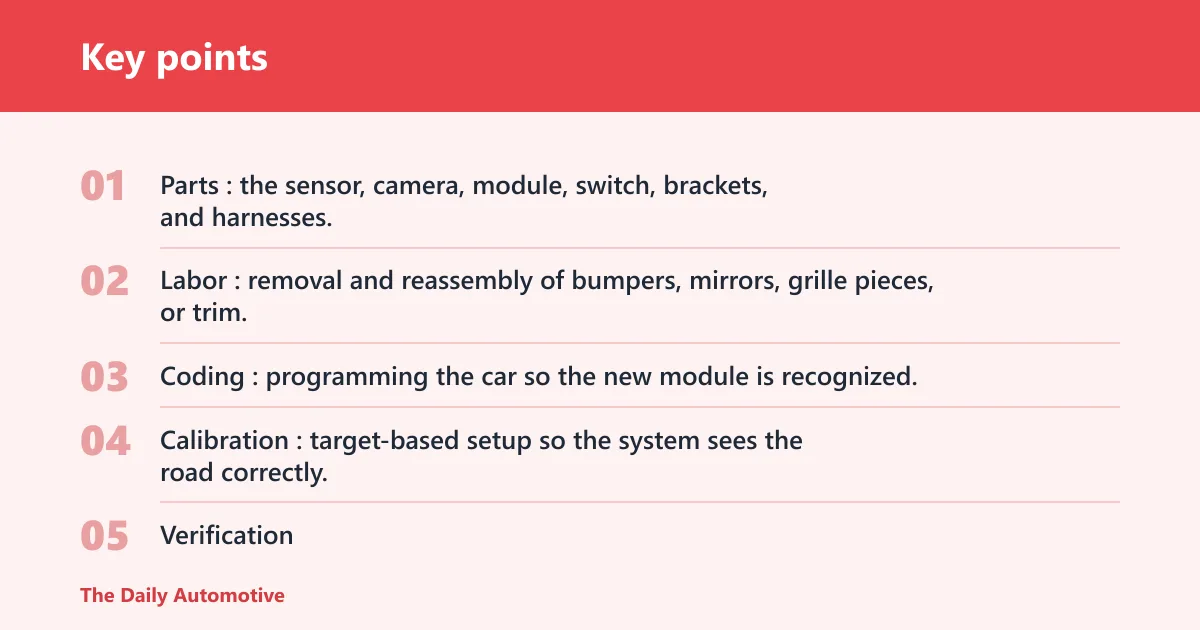


The part price is only the start. A retrofit bill often includes brackets, harnesses, switches, module coding, scan-tool programming, static or dynamic calibration, and ADAS alignment. If the feature needs windshield-mounted cameras or bumper-mounted sensors, body work and reinstallation can add more time and more risk.
That is why two cars with the same feature can land at very different totals. One platform may already have the wiring and mounting points for an OEM upgrade. Another may need custom wiring, a replacement steering wheel button set, or a different windshield.
Why retrofit totals are higher than part prices
- Parts: the sensor, camera, module, switch, brackets, and harnesses.
- Labor: removal and reassembly of bumpers, mirrors, grille pieces, or trim.
- Coding: programming the car so the new module is recognized.
- Calibration: target-based setup so the system sees the road correctly.
- Verification: scan-tool checks, road test, and fault-code clearing.
Follow the vehicle and product manual, never work under a vehicle held only by a jack, never exceed the vehicle’s rated roof, hitch, or tow limit, keep items out of airbag zones and the driver’s view, and check local laws.
Safety feature cost matrix
The matrix below separates aftermarket add-ons from OEM-style retrofit feasibility. It also shows the hidden work that changes the bill. The totals are typical installed estimates, built from parts, labor, coding, and calibration where those steps are usually required.
| Feature | Aftermarket add-on parts | Labor | Calibration / coding | Typical installed total | OEM retrofit feasibility | Usually cost-effective on a used car? |
|---|---|---|---|---|---|---|
| Adaptive cruise control | $1,200 to $2,500 for radar and control hardware | $800 to $1,800 | $400 to $1,200 | $2,400 to $5,500+ | Usually low; vehicle architecture must support throttle, braking, and software integration | Usually no |
| Automatic emergency braking | $1,500 to $3,000 for camera, radar, and modules | $900 to $2,000 | $500 to $1,500 | $2,900 to $6,500+ | Usually very low; true brake-command systems are often model-limited | Usually no |
| Blind-spot monitoring | $500 to $1,200 for rear-corner sensors and indicators | $300 to $800 | $150 to $500 | $950 to $2,500 | Moderate on some models with factory provisions | Sometimes |
| Active park assist | $700 to $1,500 for sonar, radar, and control pieces | $500 to $1,200 | $200 to $700 | $1,400 to $3,400 | Moderate to low; depends on steering, parking logic, and sensor layout | Sometimes |
| Automatic high-beams | $150 to $450 for camera-based control parts | $150 to $400 | $100 to $250 | $400 to $1,100 | High on some cars with compatible lighting and stalk wiring | Often yes |
| Driver-attention warning | $250 to $700 for camera or steering-based parts | $200 to $600 | $100 to $300 | $550 to $1,600 | Moderate; camera-based systems can be blocked by mirror, dash, or windshield setup | Sometimes |
| Rear parking sensors | $150 to $350 | $150 to $400 | $50 to $150 | $350 to $900 | High on many vehicles | Often yes |
| 360-degree camera | $500 to $1,200 | $500 to $1,500 | $200 to $600 | $1,200 to $3,300 | Moderate to low; image stitching and calibration matter | Sometimes |
Adaptive cruise control
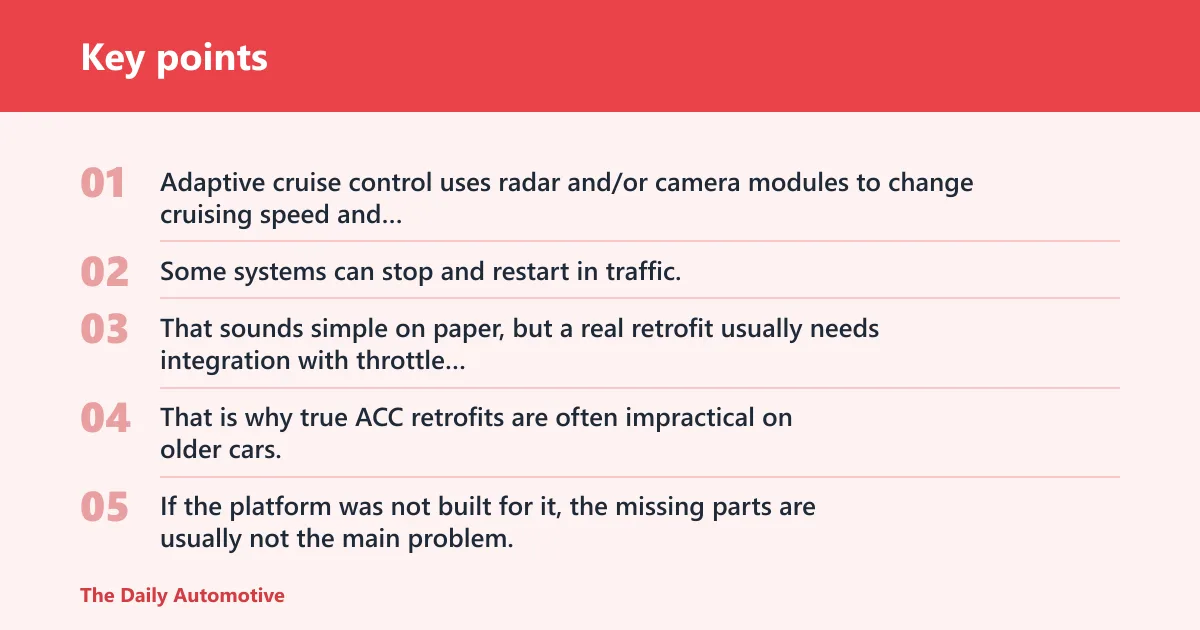
Adaptive cruise control uses radar and/or camera modules to change cruising speed and keep a set gap from the vehicle ahead. Some systems can stop and restart in traffic. That sounds simple on paper, but a real retrofit usually needs integration with throttle control, braking logic, steering-wheel controls, and the car’s software network.
That is why true ACC retrofits are often impractical on older cars. If the platform was not built for it, the missing parts are usually not the main problem. The architecture is.
Automatic emergency braking
Automated emergency braking uses forward-facing cameras and/or radar, and it can apply the brakes if the driver does nothing. Some systems work at highway speeds. A warning-only aftermarket device is not the same thing as a true AEB system that can command the brakes.
That distinction matters for cost. A real retrofit needs sensing hardware, brake-control integration, software approval, and calibration. On many older vehicles, that is why the feature is model-limited rather than parts-limited.
Blind-spot monitoring
Blind-spot monitoring uses sonar sensors in rear bumpers or cameras in mirrors, and it often uses warning lights in or near the exterior mirrors. It warns about vehicles in adjacent lanes and can help prevent lane-change collisions. On retrofit projects, rear-corner sensor placement and trim fit are usually simpler than the software side.
Among complex driver-assistance features, this is one of the more retrofit-friendly options on used cars. Even then, the car has to accept the sensor hardware, the indicator logic, and the coding work.
Active park assist
Active park assist uses sonar and radar to find empty parking spots and can steer the vehicle into them. The driver may still need to handle throttle and brake input, and parallel versus perpendicular parking support varies by manufacturer. A bumper-only parts quote does not tell the full story.
These systems often need sensor mounts, steering integration, and software setup. If the car was not offered with this feature from the factory, the retrofit path can become expensive quickly.
Automatic high-beams
Automatic high-beams are controlled by camera modules. They switch between low and high beams automatically when the system detects oncoming vehicles and road-sign reflections. This is one of the easier upgrades on some cars because it may need less hardware than a radar-based driver-assist package.
Still, the exact retrofit depends on the headlight hardware, stalk controls, and body control software. Check the manufacturer’s listing for your model before assuming the swap is simple.
Driver-attention warning
Driver-attention warning tracks steering corrections and vehicle movement, and some systems use interior-mounted cameras. It is designed to detect drowsy or distracted driving. Many versions are tied to the car’s existing lane and steering sensors, which means the retrofit may depend on the original trim level.
Suppose a 2017 sedan already has the correct steering angle sensor and camera-ready windshield, but no attention warning in the base trim. The parts bill may look manageable. The coding and calibration step can still decide whether the upgrade works at all.
What can you realistically add to an older car?
Older cars can take some safety upgrades well, but not all of them. Parking sensors, automatic high-beams, and some blind-spot monitoring kits are the most realistic because they can be built around separate sensors and simpler warning logic. True ACC and true AEB are much harder because they depend on throttle, brake, and software integration.
In practice, the best candidates are features that do not need the car’s core control systems to change. The worst candidates are features that must alter speed or apply the brakes.
Features that are usually retrofit-friendly
- Rear parking sensors
- Automatic high-beams on compatible vehicles
- Some blind-spot monitoring setups
- Some driver-attention warning upgrades
Features that are usually model-limited
- Adaptive cruise control on older cars without factory support
- Automatic emergency braking that can actually command the brakes
- Active park assist on cars without the right steering and sensor architecture
- Factory-style 360-degree camera systems on cars not prewired for them
When factory integration matters more than parts price
Factory integration matters most when the feature depends on multiple sensors talking to one another. Radar and camera modules often work together. So do parking sensors, steering sensors, and brake logic. If the car lacks the harnesses, mounting points, or software support, the price of the parts no longer predicts the final bill.
A common first-timer mistake is buying a low-priced ACC kit and assuming the rest is minor. The radar unit is only one piece. The vehicle still has to know how to slow down, stop, restart, and report faults.
Why ACC and AEB retrofits are limited
ACC and AEB are the least friendly upgrades for older cars because they rely on radar, camera, throttle, and brake integration. These are not standalone accessories. They are parts of the car’s control system, which is why OEM-style retrofits are often blocked by software, wiring, or unsupported modules.
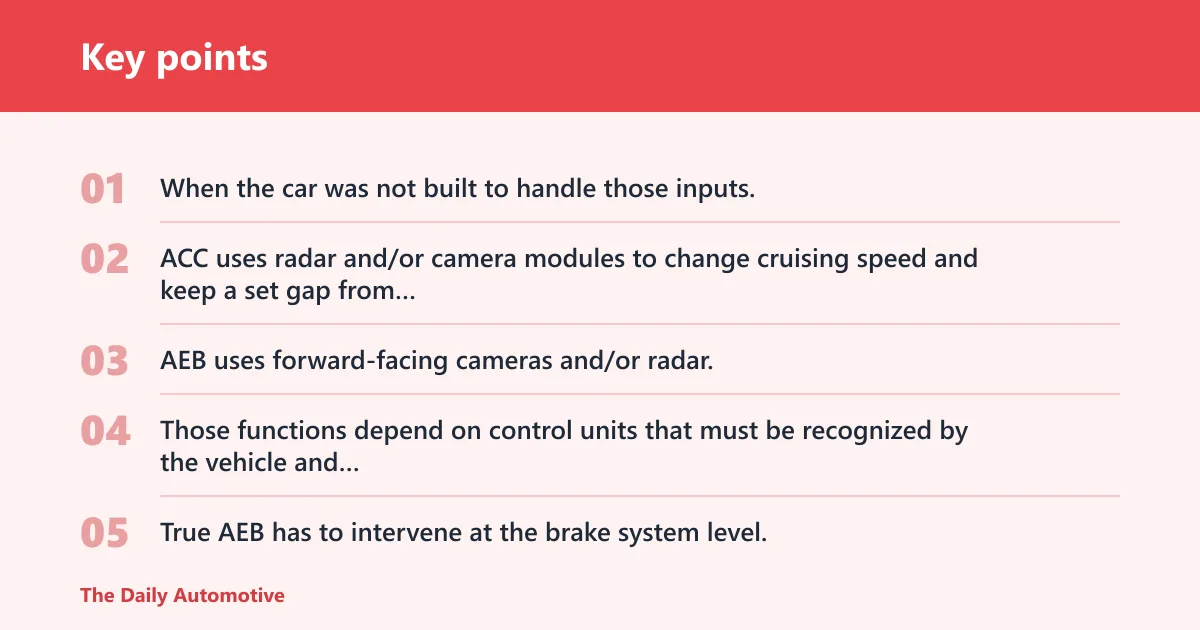
When the car was not built to handle those inputs, the retrofit can become a long chain of compromises. That is where many projects stop.
Radar, camera, throttle, and brake integration
ACC uses radar and/or camera modules to change cruising speed and keep a set gap from the vehicle ahead. AEB uses forward-facing cameras and/or radar, and it can apply the brakes if the driver does nothing. Those functions depend on control units that must be recognized by the vehicle and approved by the software.
Why true automatic braking is not a simple add-on
Warning-only products can beep or flash. True AEB has to intervene at the brake system level. That usually means OEM-grade coding, calibration, and compatibility checks. Without those, the car may throw faults or the system may disable itself.
When OEM wiring and programming are the blocker
If the original wiring harness does not include the right branch, or the body control module does not support the feature, the retrofit cost rises fast. At that point, a higher-trim used car with the feature already installed is often the better buy.
Is it cheaper to buy a higher trim?
Often yes. If the used-car price gap between trims is smaller than the retrofit bill, buying the better-equipped car is the cheaper move. That is especially true for ACC and AEB, where installed retrofit totals can climb past $5,000 and still not deliver factory-level behavior.
For simpler items like rear parking sensors or automatic high-beams, a retrofit can make sense if the car is otherwise the right match. For radar-heavy systems, buying the feature from the start is usually the cleaner path.
Compare retrofit cost with used-car price gaps
If a higher trim costs about $1,500 to $3,000 more on the used market, and the retrofit would cost about $2,500 to $6,500, the trim upgrade often makes more sense. If the feature already exists on the exact same platform and only needs a small hardware change, the retrofit case improves.
When a trim upgrade makes more sense
- You want ACC or AEB with factory behavior.
- The car needs radar, camera, and brake-system integration.
- The installer cannot verify OEM coding support before teardown.
When a retrofit still makes sense
- You only want rear parking sensors.
- The car already has compatible wiring and module support.
- You are adding automatic high-beams or a simple attention warning.
How much do parking aids cost?
Parking aids are the part of this market that most owners can price with some confidence. Rear parking sensors are usually the cheapest. A 360-degree camera system costs more because it needs multiple cameras, image processing, and calibration. If you only want help backing into a tight space, sensors usually beat a full surround-view setup on price.
Rear parking sensors
Rear parking sensors are usually the lowest-cost factory-style parking upgrade. Their simpler hardware and short-range function keep the installed total down. They are also easier to justify on a used car because they rarely require the same level of software integration as ACC or AEB.
Blind-spot monitoring: how much does blind spot
How much does blind spot monitoring cost to install? A typical installed total is about $950 to $2,500, depending on whether the car already has mounting points, mirror indicators, and compatible control modules. Because factory systems commonly use sonar sensors in rear bumpers, the bumper and wiring work matters as much as the sensor price.
Active park assist: active park assist sits
Active park assist sits in the middle of the cost stack. It uses sonar and radar to find parking spaces and can steer the vehicle into them, but it still needs the right steering and sensor integration. That is why the install cost can land above a basic parking sensor retrofit.
360-degree camera systems
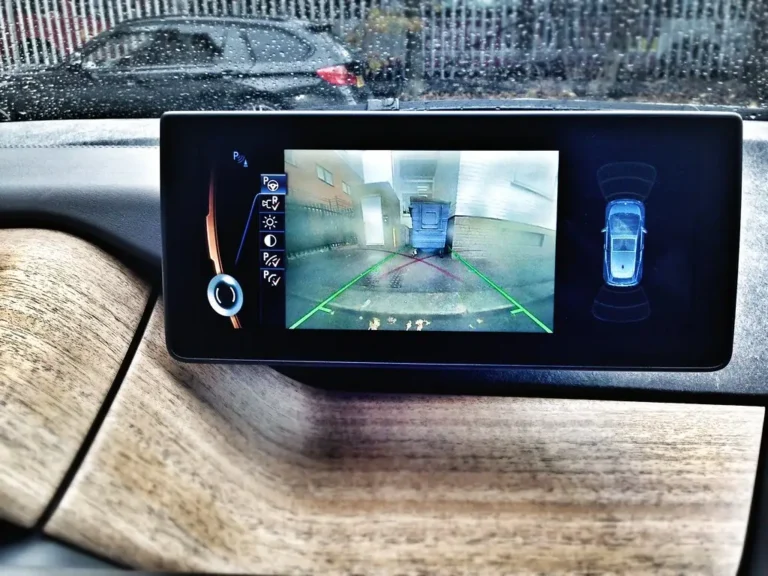
Are parking sensors cheaper than a 360 camera? Yes, usually by a wide margin. Parking sensors are commonly cheaper because they use fewer sensors, less image processing, and less calibration than a surround-view system. A 360 camera can still be worth it if you park in tight garages or city lots every day.
What hidden costs change the bill?
The hidden costs are what turn a parts quote into a real invoice. Wiring, brackets, coding, calibration, alignment, and trim work can matter more than the sensor itself. On ADAS jobs, the labor line can easily rival the hardware line.
Sensor brackets and wiring
Even a simple sensor needs a place to mount and a path for the wiring. Bumper removal, mirror replacement, or grille work can add labor fast. If the car needs a different harness, the quote can jump again.
Module coding and software setup
Many retrofits need scan-tool programming so the vehicle sees the new hardware. Without coding, the feature may not appear in the menu, or it may fail a self-check and stay off.
Static and dynamic calibration
Radar and camera modules often need calibration after installation. Some systems use static target setup in the shop. Others need dynamic calibration on the road. That is one reason the final bill can be much higher than the parts list suggests.
Alignment and windshield or bumper work
Camera systems can depend on windshield type, camera mount position, and clean bumper alignment. If the windshield or bumper has been replaced, or if the vehicle is out of alignment, the calibration step can take longer and cost more. Follow the vehicle manual, and check local laws before driving with any modified safety system.
Frequently asked questions
How much does it cost to add car safety features?
The final number depends on whether the car already has compatible wiring, modules, and mounting points.
What safety features can be added to an older car?
Rear parking sensors, some blind-spot monitoring kits, automatic high-beams on compatible cars, and some driver-attention warning systems are the most realistic. ACC and true AEB are much harder because they depend on deeper control-system integration and model-specific software support.
Is it cheaper to buy a trim with safety features already installed?
Often yes, especially for ACC and AEB. If the used-car price gap is smaller than the retrofit total, the higher trim is the better value. That is common when a retrofit needs radar, camera, brake integration, or full ADAS calibration.
How much does blind spot monitoring cost to install?
A typical installed cost is about $950 to $2,500. Lower totals usually assume an easier car with factory-friendly mounting and wiring. Higher totals appear when the mirrors, rear bumper sensors, coding, and calibration all need extra labor.
How much does adaptive cruise control cost to add?
How much does adaptive cruise control cost to add? A realistic installed estimate is about $2,400 to $5,500 or more, and some older cars cannot take a true retrofit at all. The cost climbs because ACC uses radar and/or camera modules, then needs throttle, brake, and software integration.
Can automatic emergency braking be retrofitted to an older car?
Sometimes, but true AEB retrofits are usually model-limited and often impractical. A warning-only product is not the same thing as a system that can apply the brakes if the driver does nothing. If the vehicle was not built for that control logic, buying a newer trim is usually smarter.
Are parking sensors cheaper than a 360 camera?
Yes. Parking sensors usually cost less because they use simpler hardware and less calibration than a surround-view camera system. A basic rear sensor retrofit can stay under $1,000 installed, while a 360-degree camera system commonly reaches $1,200 to $3,300 installed.
Do aftermarket safety features work as well as factory ones?
Usually not for complex systems. Factory setups are better integrated with the vehicle’s radar, camera, steering, braking, and warning logic. Aftermarket products can help with parking or alerts, but they rarely match factory ACC or AEB behavior on a car that was not designed for those systems.
Products related to this article
Sponsored / affiliate links. As an Amazon Associate I earn from qualifying purchases. I may earn additional commission from eligible campaigns.