Best Brake Cleaners for Car Maintenance (2026): We Compared
The best brake cleaner is the one matched to the job: chlorinated for heavy greasy metal parts, non-chlorinated for general DIY use, and no-residue formulas for rotor and caliper cleanup. Pick the wrong solvent and you can damage rubber boots, paint, wheel finishes, and plastic, while weak cleaners leave dust and oil behind. This guide compares the main brake-cleaner types, what each can safely clean, and how to pick one for your workspace and parts.
Quick comparison
| Product | Badge | Best for | Price | ||
|---|---|---|---|---|---|
 |
CRC Brakleen Brake Parts Cleaner SprayCRC | Our pick | 14 oz · Non-Chlorinated · 12-Pack | $52.90
Price as of 5 Nov 2026
|
View |
 |
GUNK M705-12PK Non-Chlorinated Brake CleanerGunk | Budget pick | 14 oz · Non-Chlorinated · 12-Pack | $42.52
Price as of 5 Nov 2026
|
View |
 |
Aeropak Non-Chlorinated Brake Cleaner SprayAeropak | Pair with it | 2 Cans · Non-Chlorinated · Spray | $15.59
Price as of 5 Nov 2026
|
View |
Use the table above to match formula to the part at risk, not just to the mess you want gone. If your garage has poor airflow or you are cleaning near coated wheels, finish sensitivity should matter as much as cleaning strength.
The safest default for most DIY brake work is usually a non-chlorinated, residue-free cleaner with clear nozzle control and a label that clearly indicates brake use. Chlorinated products can cut heavy contamination, but ventilation and surface compatibility matter before you buy.
How we chose
Selection was based on manufacturer specs, listing details, and published buyer feedback, with emphasis on formula type, drying behavior, nozzle control, and legal availability. The aim is practical fit, not marketing copy.
We also weighed can size and pack value for hobbyists versus frequent maintenance, plus claims about residue, VOC compliance, and whether a product is suited to brake parts, clutch parts, or wheel-adjacent work. Safety claims and label limits stayed part of the decision.
Which brake cleaner formula fits your job?
For most DIY brake jobs, non-chlorinated cleaner is the safest starting point because it still removes brake dust, grease, and oil without leaning on the harshest solvent profile. Chlorinated formulas can help on stubborn metal grime, but they raise more concern around ventilation, surface sensitivity, and shipping restrictions.
Chlorinated vs non-chlorinated
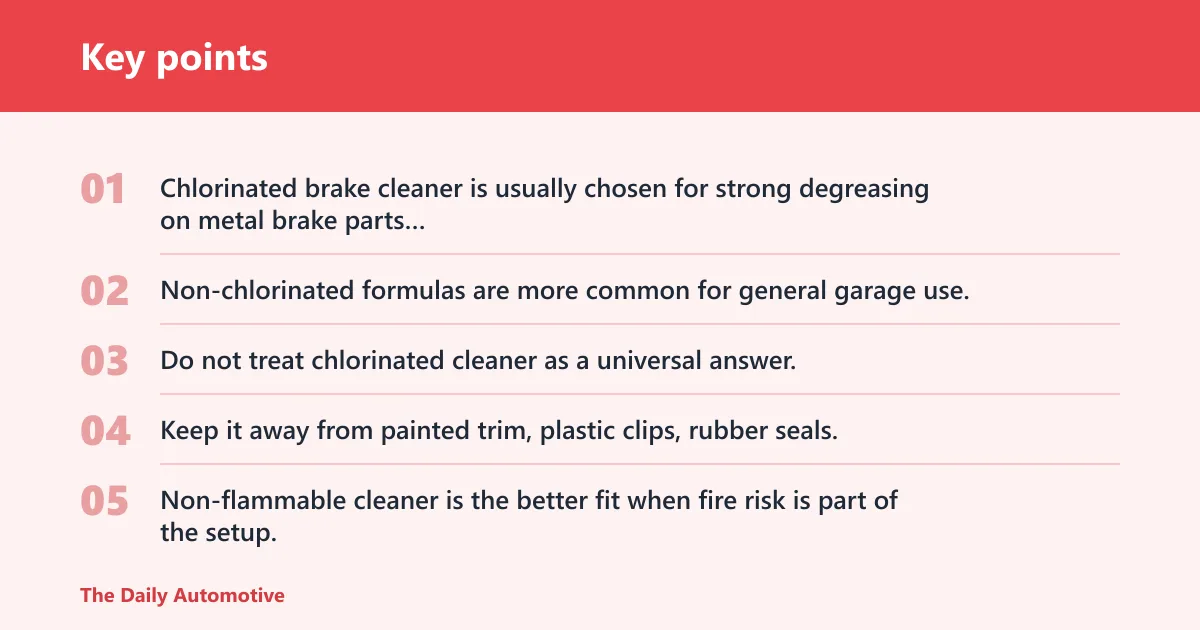
Chlorinated brake cleaner is usually chosen for strong degreasing on metal brake parts when airflow is good and the label allows it. Non-chlorinated formulas are more common for general garage use, especially when you want a lower-odor option or a 50-state compliant product.
Do not treat chlorinated cleaner as a universal answer. Keep it away from painted trim, plastic clips, rubber seals, and finished wheel surfaces unless the label says otherwise.
Non-flammable vs fast-drying
Non-flammable cleaner is the better fit when fire risk is part of the setup. Fast-drying matters when you need parts to be dry quickly after spraying, especially on rotors, calipers, drums, and metal hardware.
Those are not the same promise. A product can dry fast and still be flammable, so read the label instead of assuming speed means safety.
Low-VOC and residue-free claims
Low-VOC claims matter when you work in a closed garage and want less solvent odor and less air-quality burden. Residue-free matters when you are cleaning rotors, calipers, clutch discs, or any surface where leftover film can interfere with friction or inspection.
Residue-free does not mean safe on every material. It only means the cleaner is intended to evaporate without leaving an oily film behind.
When can size and spray pattern matter more than formula?
Can size and spray pattern matter more when the job is repetitive, awkwardly angled, or spread across many parts. A precision nozzle helps when you need to target one spring, one caliper bracket, or one stain, while a high-pressure nozzle helps blast dust from hard-to-reach areas.
For frequent maintenance, pack value matters too. CRC Brakleen Pro Series is a 29 oz can, Sprayway SW330 comes in 18.5 oz packaging, and the non-chlorinated CRC Brakleen option is a 14 oz can.
Brake cleaner decision matrix
| Job type | Workspace ventilation | Part sensitivity | Recommended formula | Avoid-if conditions | Do not use on |
|---|---|---|---|---|---|
| Brake dust on calipers | Open garage or strong cross-breeze | Metal caliper only, with seals nearby | Non-chlorinated, residue-free, fast-drying | Avoid if the area is sealed off or ignition sources are present | Painted, plastic, rubber-sensitive surfaces |
| Greasy rotors | Well ventilated workspace | Rotor surface, pads removed or shielded | Fast-drying brake parts cleaner with precise spray control | Avoid if the rotor is hot or the label warns against coated surfaces | Paint, plastic, rubber, wheel finish edges |
| Indoor garage use | Limited ventilation | Nearby rubber boots, plastic clips, and painted panels | Low-VOC, non-chlorinated, 50-state compliant when available | Avoid chlorinated or strongly flammable formulas in a closed space | Painted, plastic, rubber-sensitive surfaces |
| Wheel-only cleaning | Any | Steel, aluminum, chrome, paint, or powder coat finish | Non-acid wheel cleaner, not brake cleaner | Avoid if you need a rinse-safe finish cleaner, not a solvent blast | Painted, plastic, rubber-sensitive surfaces |
| State-compliance concern | Any | Buyer needs legal availability and shipping clarity | 50-state compliant or clearly labeled regional formula | Avoid if the listing is unclear on California or New Jersey availability limits | Painted, plastic, rubber-sensitive surfaces |
| Clutch cleaning | Well ventilated | Clutch discs and nearby springs or hardware | Non-chlorinated, fast-drying, residue-free | Avoid if the clutch material or assembly label forbids solvent cleaning | Painted, plastic, rubber-sensitive surfaces |
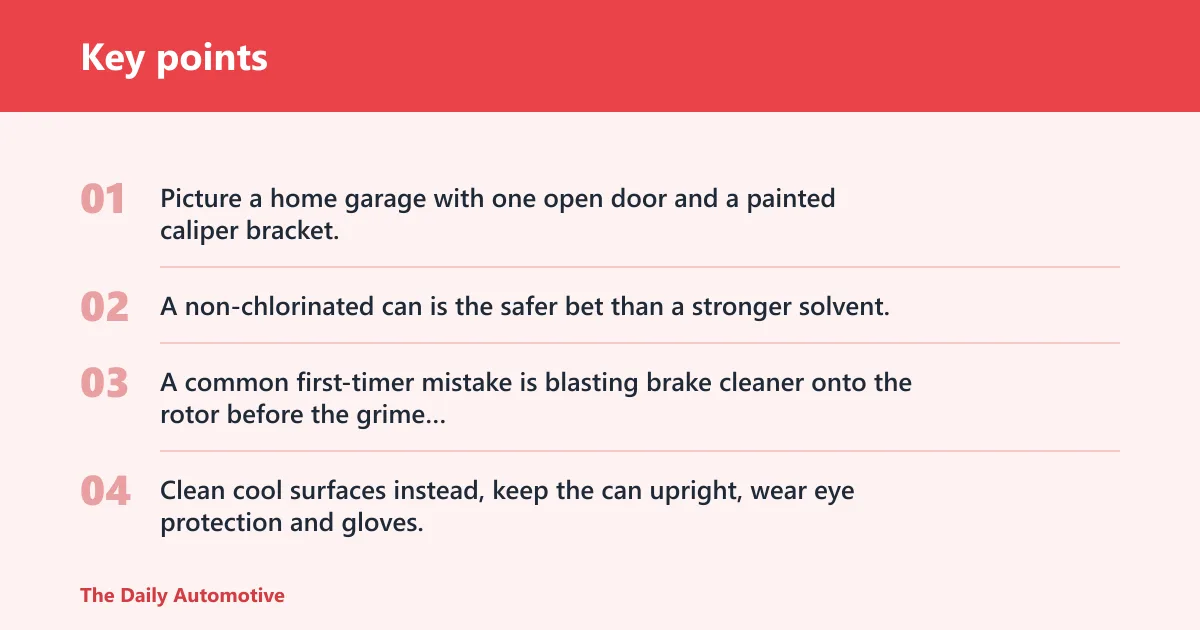
Picture a home garage with one open door and a painted caliper bracket. A non-chlorinated can is the safer bet than a stronger solvent, because the limit is not only cleaning power; it is also whether the air, finish, and nearby rubber can take the spray.
A common first-timer mistake is blasting brake cleaner onto the rotor before the grime and dust have been brushed away. Clean cool surfaces instead, keep the can upright, wear eye protection and gloves, avoid breathing solvent mist directly, and never spray near open flames or a running heat source.
What can brake cleaner be used for?
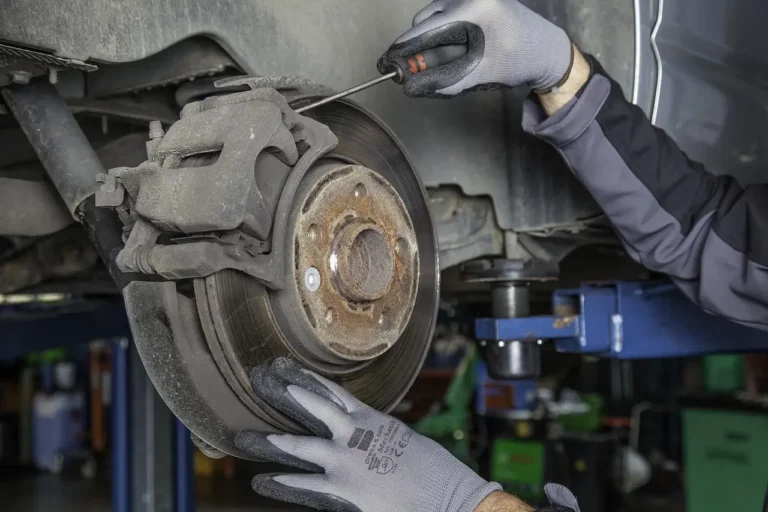
Brake cleaner is best for brake and clutch parts, plus bare metal pieces that need grease, oil, brake fluid, or brake dust removed fast. It is commonly used on pads, rotors, calipers, drums, linings, springs, cylinders, and some clutch discs when the label allows that use and the manufacturer does not restrict solvent cleaning for those materials.
Pads, rotors, calipers, drums, linings, springs, and cylinders
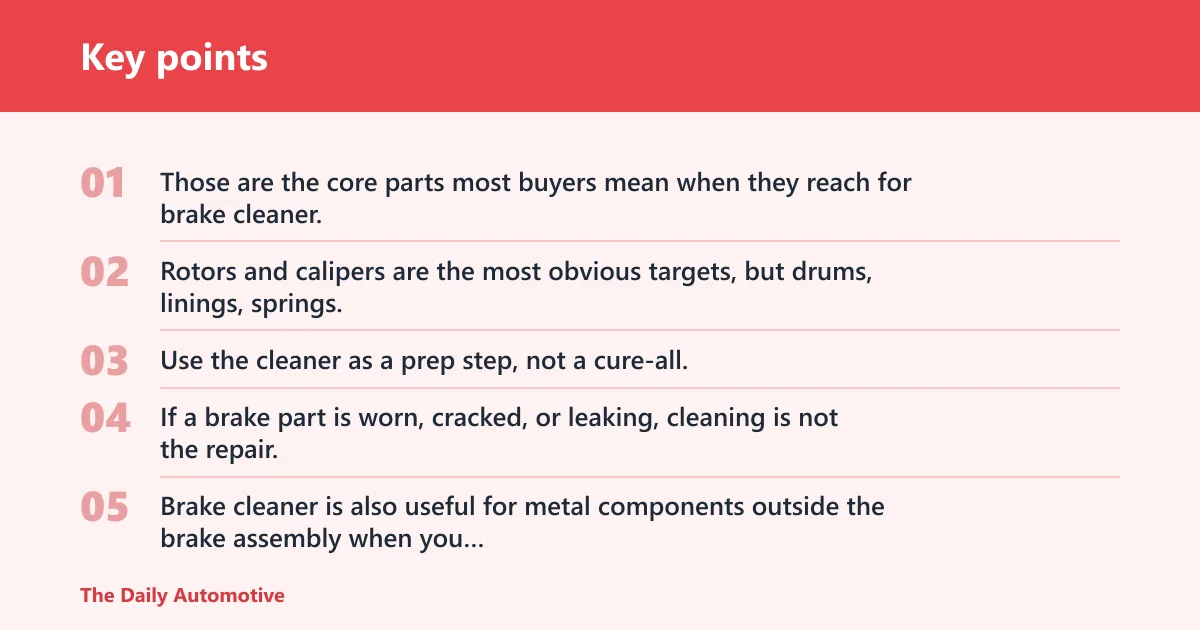
Those are the core parts most buyers mean when they reach for brake cleaner. Rotors and calipers are the most obvious targets, but drums, linings, springs, and wheel-cylinder areas also collect dust and oily residue that can affect braking feel or inspection.
Use the cleaner as a prep step, not a cure-all. If a brake part is worn, cracked, or leaking, cleaning is not the repair.
Grease, oil, and brake fluid cleanup on metal parts
Brake cleaner is also useful for metal components outside the brake assembly when you need to remove light grease or oil before reassembly. That includes brackets, fasteners, and small hardware, as long as the surface is compatible and the label allows it.
For heavy petroleum buildup, a stronger degreasing approach may be better. Brake cleaner is a solvent cleaner, not a substitute for full parts washing where thick sludge is involved.
Wheel finishes: steel, aluminum, chrome, paint, and powder coat
Wheel finish compatibility is where many DIY jobs go wrong. Steel, aluminum, and chrome wheels may tolerate some cleaners, but painted and powder-coated wheels are far more vulnerable, and brake cleaner can dull or stain them if used casually.
Do not spray brake cleaner on wheel finishes unless the label specifically supports that use and you are confident the finish can handle it. When in doubt, use a wheel-specific product instead.
Where brake cleaner stops and a wheel cleaner starts
Brake cleaner and wheel cleaner solve different jobs. Brake cleaner is for brake components and metal parts; a non-acid wheel cleaner is made for finish-safe wheel washing, often with foam application and a rinse step that brake cleaner does not require.
That difference matters on coated wheels. A wheel-safe cleaner is usually the better choice for paint, powder coat, chrome, and modern wheel finishes because it is designed to be rinsed off rather than flashed dry as a solvent.
Brake cleaner vs wheel cleaner
Brake cleaner is the right tool for brake hardware, while non-acid wheel cleaner is the right tool for wheel faces and finish-sensitive surfaces. If you are cleaning the wheel itself rather than the brake assembly, a rinse-safe, finish-safe cleaner is usually the lower-risk choice.
Non-acid wheel cleaner and foam application
Non-acid wheel cleaners often use foam so the product clings to the wheel surface long enough to loosen dirt. That approach is useful on steel, aluminum, chrome, paint, and powder coat because the cleaner is meant to lift road film and rinse away cleanly.
Brake cleaner is much more aggressive and much less wheel-finish friendly. It should not replace a true wheel cleaner on visible finishes.
Why rinse steps matter for wheel-safe products
Wheel-safe cleaners usually require a rinse step because the product is meant to carry contamination away from the finish. That rinse step is part of the method, not an extra chore.
Brake cleaner does not work that way. It flashes off quickly, which is useful on brake parts but less suitable for large cosmetic surfaces that need a controlled rinse.
When brake cleaner is the wrong choice for painted or coated wheels
Brake cleaner is the wrong choice when the wheel finish is the surface you want to protect. Painted and powder-coated wheels can spot, haze, or lose gloss if you use a strong solvent where a finish-safe wheel cleaner should go.
If the goal is brake dust removal from the wheel face, choose a non-acid wheel cleaner first and keep brake cleaner reserved for the brake assembly behind the wheel.
Top picks: best for different garage needs
CRC Brakleen non-chlorinated 14 oz 12-pack: best for frequent DIY brake jobs
This is a non-chlorinated, low-VOC cleaner in a 14 oz 12-pack. The listing says it targets brake fluid, grease, and oil for drums, calipers, and clutch discs.
The main strength is the balance of broad-use DIY practicality and 50-state compliant labeling. The drawback is that a smaller can may go faster if you clean several corners, so hobbyists who maintain multiple vehicles may still want to compare cost per ounce before buying.
GUNK M705-12PK non-chlorinated 14 oz: best for no-residue cleanup
This option is a 14 oz case of 12 and is described as a fast-drying cleaner with no residue. It is meant to be used without disassembly, which can save time on straightforward brake service.
The drawback is that the can size is modest, so frequent users may go through it quickly. If your job also needs stronger spray control for deep brake dust pockets, check the nozzle pattern on the manufacturer listing for your model.
Aeropak non-chlorinated brake cleaner spray: best for brake and clutch parts
This cleaner comes as 2 cans and is described as a brake parts degreaser for cleaning grease during auto brake maintenance. It is aimed at discs, calipers, rotors, pads, springs, and clutch parts.
The drawback is that the pack is smaller than the bulk cases above, so value buyers may need to compare price per can and how often they service brakes. As always, check the label for surface compatibility before using it near painted or rubber-sensitive areas.
Which one should you buy?
If you maintain brakes a few times a year, start with the CRC non-chlorinated 14 oz 12-pack because it combines broad DIY use with 50-state compliant labeling. If you care most about no-residue drying, the GUNK case is the cleaner fit. If you want a smaller buy for brake and clutch parts, Aeropak is the shortest path.
Say your front brakes are dusty, your garage door is half open, and the calipers sit next to rubber boots and a painted knuckle. A non-chlorinated, residue-free cleaner is the practical call, while a stronger chlorinated can is a poor match for the same space.
Suppose you are cleaning wheel faces on powder-coated rims. Brake cleaner is the wrong product, even if the brake dust is the problem; a non-acid wheel cleaner with foam and a rinse step is the safer choice for the finish.
Frequently asked questions
What is the best brake cleaner?
The best brake cleaner is usually a non-chlorinated, residue-free formula for general DIY use, because it handles brake dust, oil, and fluid without the harsher tradeoffs of chlorinated products. If you are working in a tight garage or around sensitive materials, that safer default matters more than raw solvent strength.
What is brake cleaner good for?
Brake cleaner is good for removing brake fluid, grease, oil, and brake dust from brake parts and some metal components. It is commonly used on pads, rotors, calipers, drums, linings, springs, cylinders, and clutch discs when the label allows it and the surfaces are cool.
Brake cleaner vs parts cleaner
Brake cleaner is a specialized solvent for brake components, while parts cleaner is a broader category that may be better suited to general metal degreasing. If you need finish-safe wheel cleaning or a rinse step, neither may be the right tool; a non-acid wheel cleaner can be the better choice.
Brake cleaner vs carb cleaner
Brake cleaner and carb cleaner are not interchangeable. Carb cleaner is aimed at fuel-system parts and may have different residue, aggressiveness, and material compatibility, while brake cleaner is designed for brake dust, oil, and fluid on brake hardware and nearby metal parts.
Products related to this article
Sponsored / affiliate links. As an Amazon Associate I earn from qualifying purchases. I may earn additional commission from eligible campaigns.