Best Car Vinyl Wraps for DIY Projects (2026): We Compared
The best car vinyl wrap depends on the job: cast vinyl is commonly recommended for full-body wraps and complex curves, while calendered vinyl is commonly recommended for flat panels. 3M, Avery Dennison, and Orafol are the safest mainstream picks. Pick the wrong film and you waste material, fight bubbles, and shorten the wrap’s life. This guide compares wrap types by use case, panel complexity, finish, and upkeep so you can buy the right roll.
Best car vinyl wrap, by use case
If you are wrapping an entire car, start with cast film. If you are doing a roof, trim, or a flat accent panel, calendered film can be the cheaper, simpler move. For DIY buyers, the best choice is the one that matches the panel shape and your tolerance for edge work, not the gloss level on the label.
Top pick for full-vehicle wraps
Cast vinyl is the safer choice for full-vehicle jobs because it conforms better to bumpers, mirrors, deep recesses, and other complex shapes. It also tends to outlast calendered film when the install is clean and the car lives outside.
Top pick for DIY-friendly installs
Look for air-release adhesive and a film that can be repositioned before final squeegee work. That gives you more time to chase out trapped air, which matters more on a first wrap than a glossy spec sheet.
Top pick for high-gloss paint-like looks
Gloss films with a paint-like face are the best fit when the goal is factory-style shine. They are less forgiving than satin or matte, though, so dust, fingerprints, and edge prep matter more.
Quick comparison
| Product | Badge | Best for | Price | ||
|---|---|---|---|---|---|
 |
VViViD XPO Black Carbon Fiber Car Wrap Vinyl Roll FeaturingVViViD | Our pick | 25ft x 5ft · carbon fiber · black | $144.98
Price as of 28 Oct 2026
|
View |
 |
3M 2080 High Gloss Black (HG12) Vinyl Wrap Film – 5ft x 6ftTRUE LINE Automotive | Also great | 5ft x 6ft · high gloss · black | $137.35
Price as of 28 Oct 2026
|
View |
 |
Avery SW900-197-O SATIN BLACK 5ft x 25ft (125 Sq/ft)Avery Dennison | Upgrade pick | 5ft x 25ft · satin black · supreme | $273.20
Price as of 28 Oct 2026
|
View |
 |
ORACAL 970RA Matte Metallic Charcoal 937M Wrapping CastRvinyl | Pair with it | 5ft x 5ft · matte metallic · charcoal | $104.04
Price as of 28 Oct 2026
|
View |
 |
TECKWRAP Mirror Chrome Gold Vinyl Wrap for Car 11.5" x 60"TECKWRAP | Budget pick | 11.5 in x 60 in · mirror chrome · gold | $11.90
Price as of 28 Oct 2026
|
View |
Use the table above as a filter, not a trophy list. The right choice changes with panel shape, climate, parking exposure, and how much cleanup you will accept after installation.
How we chose
We compared these wraps using manufacturer specs, listing details, and published buyer feedback. The main filters were film construction, adhesive behavior, finish maintenance, and whether each wrap makes sense on curved panels or flat trim.
- Film construction: cast, dual-cast, or calendered construction and how that affects conformability.
- Adhesive behavior: air-release channels, repositioning, and bubble control for DIY installs.
- Finish burden: how much dust, fingerprints, and edge cleanup the finish demands.
- Outdoor use: likely lifespan only in context of climate, washing, and parking.
Vinyl wrap decision matrix
This matrix answers the buying question most pages skip: where on the car are you wrapping, and how much fuss can you tolerate later? A roof wrap in a dry garage has a different job than mirror caps in freezing weather or a chrome delete on a daily driver parked outdoors.
| Wrap type | Best vehicle zone | Skill level | Climate exposure | Maintenance effort | Fit score |
|---|---|---|---|---|---|
| Gloss | Full body, hood, roof, accents | Intermediate | Moderate to high if cared for | Medium | Best for paint-like shine |
| Matte | Roof, hood, trim, interior-style accents | Beginner to intermediate | Moderate | Medium | Best for hiding minor surface flaws |
| Satin | Full body, panels, trim | Beginner to intermediate | Moderate to high | Low to medium | Best balance of looks and upkeep |
| Carbon fiber | Mirrors, spoilers, trim, small panels | Intermediate | Moderate | Medium | Best for small parts and texture |
| Chrome | Small accents, show parts, custom details | Advanced | Low to moderate | High | Best for attention, not ease |
| PPF-style color wrap | Front-end zones, high-wear panels, daily drivers | Intermediate to advanced | High | Low | Best for protection-first buyers |
Think in zones. A roof, mirror cap, and bumper do not ask the same thing from a film, even if the finish name is identical. Cast vinyl handles those changes in shape better than calendered film, which is better suited to flatter panels.
A common first-timer mistake is choosing a mirror finish for a daily-driver hood because it looks dramatic in photos. The first fingerprints, dust specks, and edge contamination show up fast, and the install window is narrow once the film starts to lock in.
3M 2080 series: best for complex panels
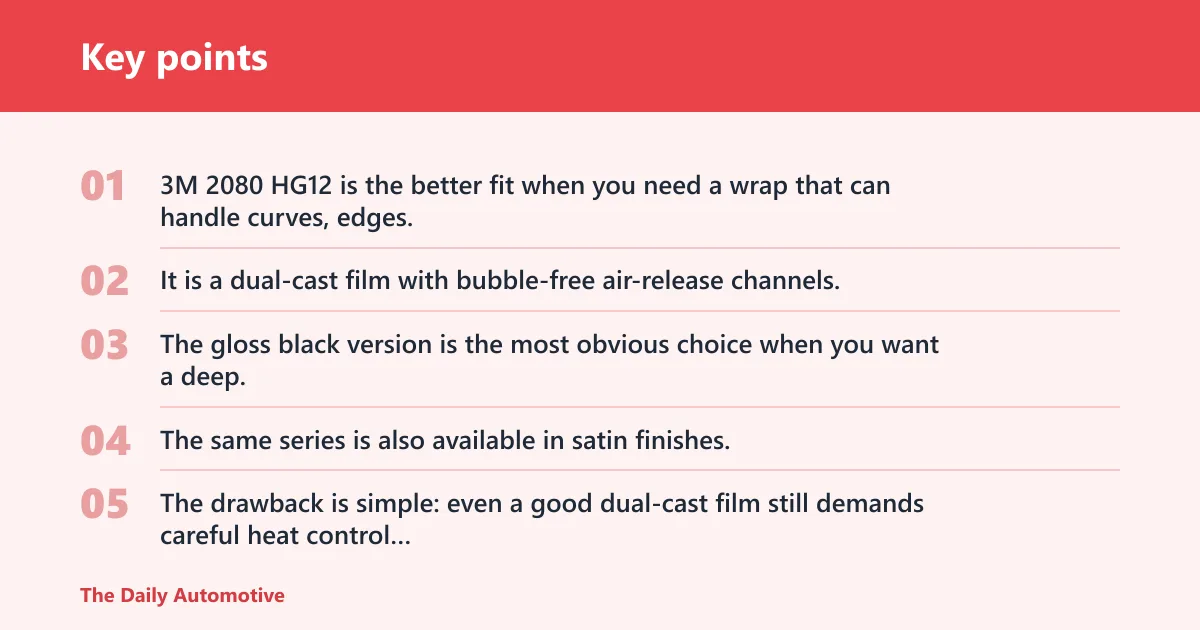
3M 2080 HG12 is the better fit when you need a wrap that can handle curves, edges, and repositioning without turning the install into a rush job. It is a dual-cast film with bubble-free air-release channels, and it is listed as removable and repositionable, which helps on bumpers and mirror caps.
The gloss black version is the most obvious choice when you want a deep, paint-like look on smaller panels or accent work. The same series is also available in satin finishes, which gives you more room to choose between shine and cleanup burden.
The drawback is simple: even a good dual-cast film still demands careful heat control and edge work. If the panel has tight curves, you still need a heat gun, patient stretching, and time spent setting the edges cleanly.
Why dual-cast construction matters
Dual-cast films are generally easier to shape than calendered films because they are built for more demanding contours. That matters on bumper corners, deep character lines, and areas where a flat sheet would try to pull back.
Where gloss and satin work best
Gloss works best on straighter body panels when you want a near-paint visual. Satin is the safer compromise for buyers who want a refined finish without the same dust sensitivity as high gloss.
Edges, seams, and repositioning
Repositionability helps you correct placement before the adhesive commits. It does not fix poor seam prep, though, and edge lifting is still a risk if you skip cleaning, post-heating, or edge sealing where needed.
VViViD+ Ultra Gloss: best for paint-like shine
VViViD+ Ultra Gloss is the strongest match if your priority is a deep gloss look with a more paint-like face. Its Nano Air-Release Technology is built to help move trapped air out during install, and the black gloss presentation is aimed at buyers who want a slick, high-contrast finish.
This is the kind of film that rewards clean prep and a careful install sequence. It can look excellent on hoods, roofs, and straight body panels, but dust, fingerprints, and contamination are more visible on mirror-bright finishes than on matte or carbon fiber textures.
The drawback is maintenance burden. High-gloss surfaces show installation flaws, and any stray speck under the film is easier to see once light hits it at an angle.
What nano air-Release technology changes
Micro-channels in the adhesive give air a path out while you lay the film down. That makes bubble management easier, especially for DIY installs where you are working panel by panel rather than in a pro booth.
How gloss films handle dust and fingerprints
Gloss films need cleaner surroundings and cleaner hands than textured options. If you are wrapping outdoors or in a dusty garage, the finish can pick up contamination faster than satin or matte.
Best panels for mirror-like finishes
Use premium gloss on flat to lightly curved panels, roof sections, and interior-style pieces where visual depth matters most. Save it for panels you can prep carefully and inspect under strong light before final pressure.
Avery satin black: best for balanced daily use
Avery SW900 satin black is a strong daily-driver option because it balances conformability with a finish that is less punishing to maintain than mirror gloss. The listing calls out super conformable behavior for irregular surfaces, easy-apply design, and outdoor durability up to 12 years.
That makes it a smart choice for buyers who want a smoother install on mixed panels and a finish that does not demand constant detailing. Satin also hides small install imperfections better than high gloss, which matters if you are still learning edge control.
The drawback is that satin will not deliver the same mirror depth as a glossy black wrap. If your only goal is factory-clear shine, satin is the compromise, not the finish trophy.
Why satin is the middle ground
Satin sits between gloss and matte in both appearance and upkeep. It softens reflections without flattening the surface completely, which makes it easier to live with on a car that sees regular use.
Where it fits on the car
It works well on full-body wraps, roofs, doors, and larger accent panels. It is also a practical choice for chrome delete work because the finish stays cleaner-looking than mirror films.
Outdoor life and daily maintenance
The claimed outdoor life still depends on parking, washing, and climate. A shaded car in a mild region will generally age better than the same film on a commuter that sits in sun, road salt, and repeated automatic washes.
ORACAL 970RA matte metallic charcoal: best for textured style
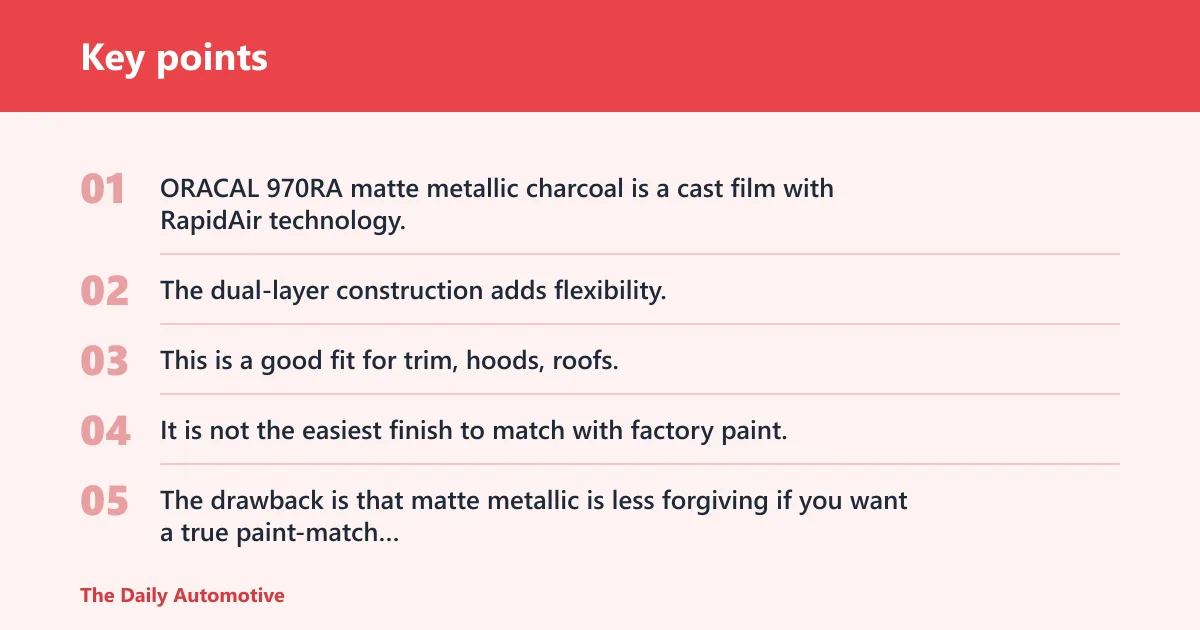
ORACAL 970RA matte metallic charcoal is a cast film with RapidAir technology, which makes it a sensible choice for buyers who want texture and bubble control in one roll. The dual-layer construction adds flexibility, and the film is built with long-term removability in mind.
This is a good fit for trim, hoods, roofs, and other panels where a matte metallic look hides minor flaws better than gloss. It is not the easiest finish to match with factory paint, but it can be a smart visual choice when you want a darker, more technical look.
The drawback is that matte metallic is less forgiving if you want a true paint-match sheen. It is also not the first pick for someone who wants a mirror-like or show-car surface.
Why matte metallic hides flaws well
Less reflection means less attention on tiny high spots, dust specks, and minor prep issues. That makes matte metallic useful when the panel is imperfect or when you want a broader margin for a first wrap.
Where cast dual-layer film earns its keep
Cast construction helps the film follow gentle curves and complex shapes more predictably than calendered vinyl. That makes it a stronger choice for partial wraps and small panels that still have compound shape.
Removal and long-term use
Long-term removability matters if you expect to change color later or return the car to stock. A film that comes off cleanly is easier to live with on leased cars or vehicles that may be sold in wrapped form.
TECKWRAP mirror chrome gold: best for small accents
TECKWRAP mirror chrome gold is the attention-first option in this group, best reserved for small accents, craft pieces, or detailed styling work. It uses air release and repositionable adhesive, which helps careful placement, but the finish itself makes the install more sensitive than satin or matte film.
Mirror chrome is not a low-maintenance choice. It is prone to showing contamination, and any stretch, wrinkle, or edge mistake stands out quickly because the surface reflects everything around it.
The drawback is obvious: this is an advanced finish, not a forgiving one. If you want a daily-driver wrap with a relaxed maintenance routine, this is the wrong direction.
Why mirror finishes are sensitive
Mirror films magnify dust, adhesive haze, and surface imperfections. That is why they demand careful handling and a cleaner install environment than most gloss or satin wraps.
Best use case for chrome gold
Use it on small badges, trim pieces, motorcycles, or accent parts where visual impact matters more than easy upkeep. Large body panels raise the difficulty fast.
What to watch for during install
Heat control matters, but so does cleanliness. A speck of contamination can become visible from several feet away once the panel goes into direct light.
Which finish looks closest to factory paint?
Gloss usually looks closest to factory paint because it reflects light in a similar way and keeps the finish visually deep. Satin is the next closest if you want a softer, more modern look. Matte and carbon fiber read as styling choices, while chrome is intentionally dramatic.
If you want a paint-like result, choose a gloss cast film with air-release adhesive and a smooth panel. If you want the appearance to hide minor flaws better, satin is the safer compromise.
Gloss
Best for factory-style shine, but it exposes contamination and edge issues more than the other common finishes.
Matte
Best for hiding minor flaws and reducing reflections, though it moves farther from a painted look.
Satin
Best balance for most daily drivers. It keeps a clean appearance without the maintenance burden of mirror gloss.
Carbon fiber
Best for trim and small panels, where texture adds interest. It does not mimic paint.
Chrome
Best for visual impact only. It is the most demanding in terms of installation and cleanliness.
Which one should you buy?
Choose calendered vinyl if you are wrapping flat or lightly curved panels and want to keep cost down. Choose cast vinyl if the job includes bumpers, mirrors, deep curves, or a full-body color change. For outdoor life and daily use, satin or a protection-focused film is usually easier to live with than mirror chrome.
If you want the safest DIY route, start with a satin or gloss film that has air-release channels and repositionability. If you want the longest outdoor service life from this lineup, the Avery satin black option is the strongest fit based on the listing and its claimed outdoor life, while a protection-focused color wrap is the better direction if scratch resistance matters more than style.
Say your car has a flat roof, black mirror caps, and a chrome strip under the doors. A satin or gloss film can handle the roof and trim with less frustration, while the mirror caps may still need more heat control and patience than the flat section.
Suppose you want a bumper wrap in a cold, wet climate where the car sits outside. Cast film with air-release adhesive is the safer bet, and edge sealing becomes more useful because moisture, road grime, and repeated wash cycles punish loose seams.
Best choice for flat panels and trim
A calendered film can be enough for roof strips, interior-style trim, and simple chrome delete work. You give up some conformability, but you also avoid paying for a film built for shapes you do not need.
Best choice for curved bumpers and mirrors
Cast vinyl is the right call. It stretches and settles better around compound curves, and it is less likely to fight back on the tight edges that ruin a partial wrap if the film is too rigid.
Best choice if you want the longest outdoor life
Outdoor life varies by film quality, install quality, climate, wash method, and parking conditions. Some consumer wraps are rated around 1-7 years, some claim 5-8 years, and a premium option may claim more. A shaded car washed by hand usually outlasts a daily driver parked in strong sun.
What tools do I need to install a car vinyl wrap?
At minimum, you need a heat gun, a squeegee, a clean microfiber towel, a cleaning solution recommended by the film maker, a sharp blade, and patience. The heat gun matters because it helps stretch, set, and finish edges around curves and seams.
For better edge durability, some installers use an edge sealer such as 3M Edge Sealer. It is not a magic fix, but it can help improve edge adhesion on seams and exposed edges where lifting starts.
Car vinyl wrap checklist
- Wash and decontaminate the panel.
- Dry it fully and remove wax or sealant residue.
- Measure the panel and cut extra film for overlap.
- Position the film and tack one section first.
- Squeegee from the center outward to push air away.
- Use the heat gun to relax curves and lock down edges.
- Trim carefully and post-heat stressed areas.
Do not rush the cleanup stage. Contamination under a gloss or chrome film can show up later as haze, bumps, or edge failure, and that is much harder to fix after the adhesive sets.
How thick should a car vinyl wrap be?
Many consumer wraps sit around 3.5-4.3 mil, which is thick enough for normal install work without becoming unmanageable on curves. Thicker films may offer more protection, but they can be harder to conform around edges and complex body lines.
Thickness should not be chosen in isolation. A slightly thicker film that resists shaping may be the wrong buy for a bumper, while a more flexible cast film with good adhesive channels can be easier to place and finish.
Do vinyl wraps protect paint from scratches?
Vinyl wraps can help against minor scratches, scuffs, road wear, and UV exposure, but they are not impact armor. They are a surface layer, not a substitute for collision protection or a proper paint correction when the paint is already damaged.
Protection-focused color wraps and PPF-style color wrap options make the most sense when scratch resistance matters more than finish drama. For rock chips, heavy abrasion, or repeated impact, the limits of vinyl show fast.
Frequently asked questions
What is the best car vinyl wrap for a DIY install?
The best DIY wrap is usually a cast or dual-cast film with air-release adhesive and some repositioning window. That combination gives you time to correct placement, push out bubbles, and manage curves without locking the panel too early. Satin is often easier than mirror gloss for a first project.
Which vinyl wrap lasts the longest outdoors?
Durability depends on film quality, install quality, climate, wash method, and parking conditions. Some consumer wraps are rated around 1-7 years, some claim 5-8 years, and a premium film may claim more. The longest life usually comes from a quality cast film on a car that is parked out of direct sun as much as possible.
Is cast vinyl better than calendered vinyl for car wraps?
Yes, when the panel is complex. Cast vinyl conforms better to curves, mirrors, bumpers, and full-body wraps, and it generally lasts longer than calendered film. Calendered vinyl is still useful for flatter surfaces and lower-cost jobs where you do not need heavy conformability.
What vinyl wrap is easiest to apply without bubbles?
Look for air-release adhesive with micro-channels or air channels. That feature helps air escape during application and is especially useful for DIY work. A flat panel in a calm, clean workspace is easier too, because dust and trapped air are the two biggest enemies of a clean finish.
How do I choose between gloss, matte, satin, and carbon fiber wrap?
Choose gloss if you want the closest thing to factory paint. Choose satin if you want a balanced look with easier upkeep. Choose matte if you want to hide flaws better. Choose carbon fiber for small parts, texture, and styling rather than paint mimicry.
Can I wrap curved panels and bumpers with vinyl wrap?
Yes, but the film choice matters. Cast vinyl is the better pick for curved panels, bumpers, and mirrors because it conforms more easily than calendered film. You will also need a heat gun, careful stretching, and enough time to set edges without rushing.
Products related to this article
Sponsored / affiliate links. As an Amazon Associate I earn from qualifying purchases. I may earn additional commission from eligible campaigns.