3 Best Dash Cams with GPS for Cars (2026): We Compared
The best pick here is the Viofo A329S if you want the broadest evidence package: front 4K, rear 2K, cabin 2K, and GPS in one setup. That matters more than resolution alone when you want route, speed, and interior context to back up a claim.
Quick comparison
| Product | Badge | Best for | Price | ||
|---|---|---|---|---|---|
 |
VIOFO Dash Cam Front A119 Mini 2, STARVIS 2 Sensor, 2KVIOFO | Our pick | 2K · STARVIS 2 · GPS | $129.99
Price as of 21 Oct 2026
|
View |
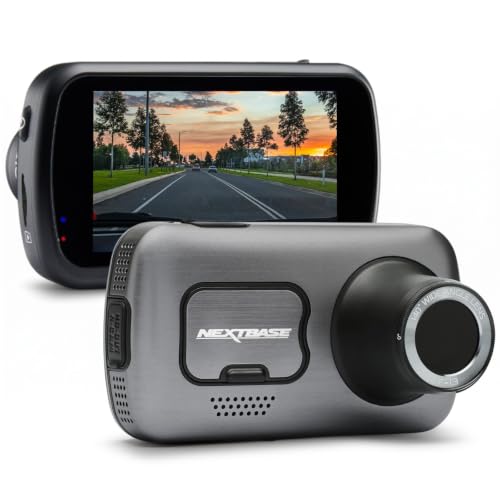 |
Nextbase 622GW Dash Cam Full 4K/30fps UHD Recording in CarNextbase | Upgrade pick | 4K · 140° · GPS | $199.99
Price as of 21 Oct 2026
|
View |
 |
THINKWARE ARC700 Dash Cam 4K Front and 2K Rear, Dual HDR,THINKWARE | Also great | 4K/2K · Dual · GPS | $329.99
Price as of 21 Oct 2026
|
View |
 |
70mai True 2.7K 1944P Ultra Full HD Dash Cam Pro Plus+70mai | Budget pick | 2.7K · ADAS · GPS | $99.99
Price as of 21 Oct 2026
|
View |
GPS only helps if the rest of the setup keeps the clip usable. The real decision is whether you want the strongest coverage, the cleanest smart features, or the lowest entry cost with GPS still included.
For a driver who wants route and speed stamps, parking protection, and a simple install path, the trade-off is plain: more channels and smarter features usually mean more wiring, more app dependence, and more total cost.
How we chose
The comparison is based on four things that matter in real use: GPS usefulness in a claim, video quality beyond resolution, parking mode and power setup, and total ownership cost. That means memory cards, hardwire kits, mounts, and any subscription or app dependence all matter.
It also reflects what the listed products are built to do. Trusted Reviews says some dash cams include GPS technology to measure speed, and The Independent names the Viofo A329S, Vantrue element 1 lite, and Nextbase iQ 4K among its category picks.
One more point matters. GPS data can support a report, but it does not prove fault on its own. A readable plate, clear lane position, and stable footage still do the heavy lifting.
| Buyer matrix | Nextbase iQ 4K | Viofo A329S | Vantrue element 1 lite |
|---|---|---|---|
| GPS function | Yes; built for route and speed records, plus connected features | Yes; GPS included | Yes; GPS included |
| Speed overlay | Available through GPS-based logging and app features | Available through GPS-based logging | Available through GPS-based logging |
| Parking mode | 24/7 Smart Parking | Parking mode support | 24-hour parking mode |
| Rear-camera support | Yes; three channels overall | Yes; 2K rear camera included | Not listed here |
| Cabin camera | Yes; built-in cabin camera with infrared lighting | Yes; 2K cabin lens included | No cabin camera listed |
| Install complexity | Higher; more channels and connected features usually mean more setup | Higher; front, rear, and cabin routing takes time | Lower; simpler single-channel layout |
| Hidden ownership costs | Memory card, mounting hardware, power setup, and possible subscription costs | Memory card, extra wiring, and more cable management | Memory card, mount, and possible hardwire kit for parking mode |
Nextbase iQ 4K: best for smart features
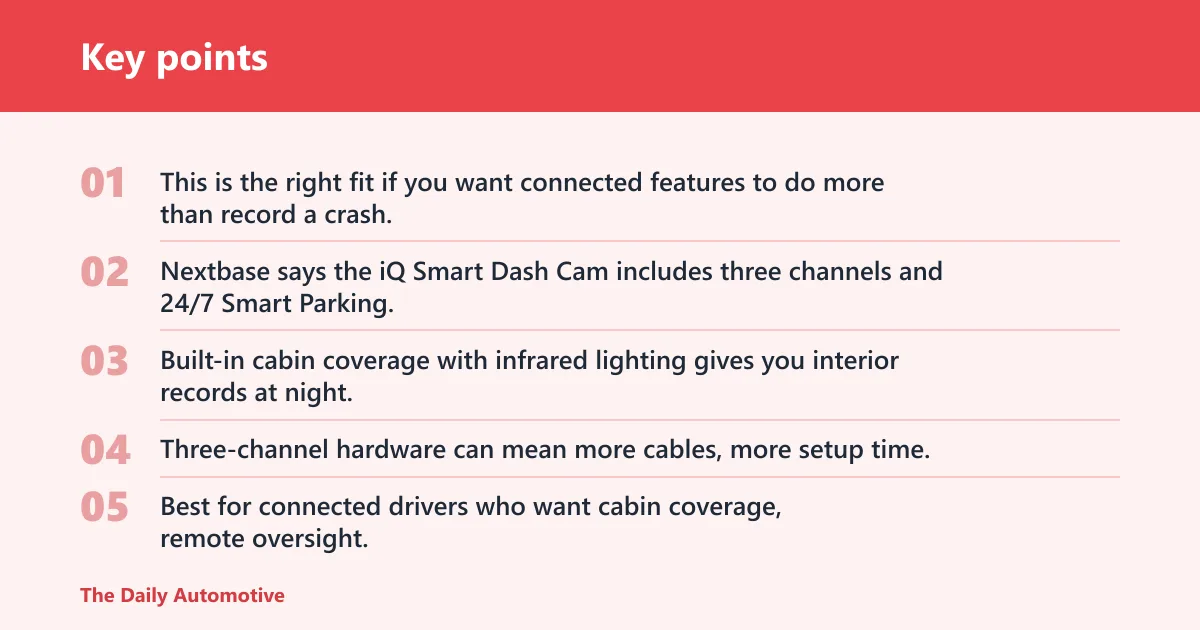
This is the right fit if you want connected features to do more than record a crash. Nextbase says the iQ Smart Dash Cam includes three channels and 24/7 Smart Parking, while its 4K forward-facing camera adds the kind of detail that can help with plate reads and lane context.
The appeal is not only video. Built-in cabin coverage with infrared lighting gives you interior records at night, and the live view plus Emergency SOS features are aimed at drivers who want a more connected safety setup.
The drawback is cost and complexity. Three-channel hardware can mean more cables, more setup time, and more to pay for if the app or cloud features matter to you over time.
Best for connected drivers who want cabin coverage, remote oversight, and a feature-heavy dash cam rather than the cheapest path to GPS logging.
Why this model stands out
Nextbase iQ 4K is the most feature-forward option in this group. For a commuter who parks on the street and wants motion and impact coverage with route data, that combination matters more than an extra shorthand badge on the box.
Trade-offs to know
Smart features can be useful, but they also raise the bar for installation and ongoing ownership. If you do not need live view, Emergency SOS, or a cabin camera, much of what you are paying for may never get used.
Viofo A329S: best for coverage
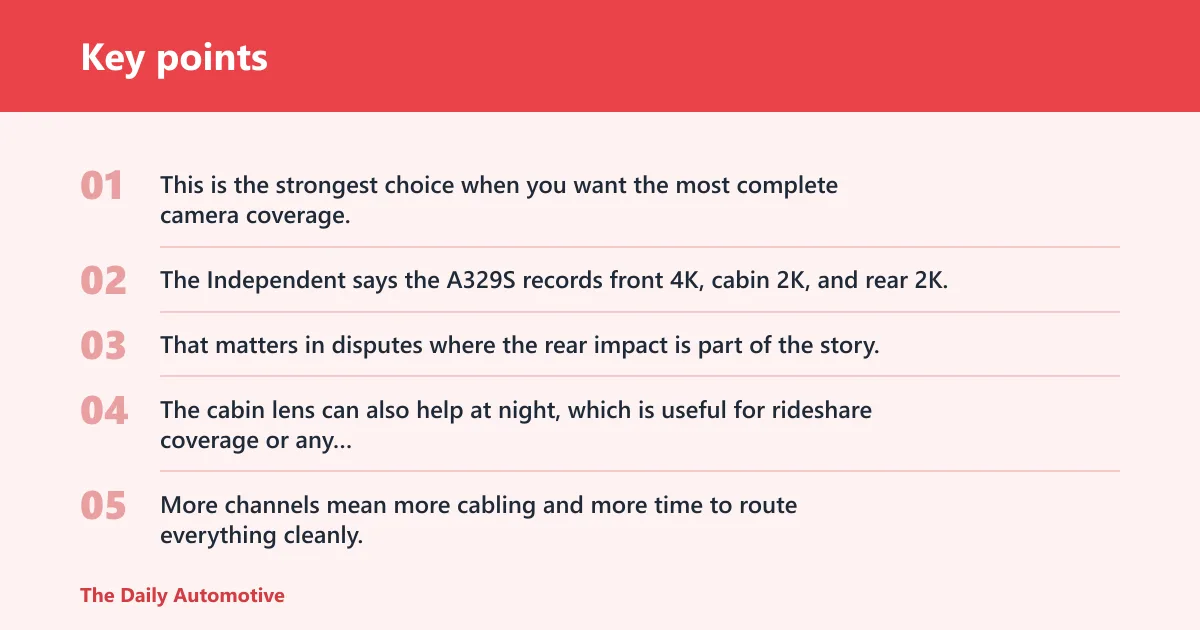
This is the strongest choice when you want the most complete camera coverage. The Independent says the A329S records front 4K, cabin 2K, and rear 2K, and it also includes GPS, so you get location and speed context with a three-camera layout.
That matters in disputes where the rear impact is part of the story, or when a side window, passenger seat, or interior event needs to be documented. The cabin lens can also help at night, which is useful for rideshare coverage or any interior incident.
The drawback is setup burden. More channels mean more cabling and more time to route everything cleanly, and more storage pressure if you keep longer clips or higher-bitrate footage.
Best for drivers who want front, rear, and cabin angles in one package and are willing to spend more time on installation.
Trade-offs to know: coverage is not free
Coverage is not free. You may need a larger microSD card, a cleaner hardwire setup, and a little more patience during install because three channels create more wiring and more points to manage.
Vantrue element 1 lite: best for value
This is the budget-minded GPS pick in the group. The Independent rates the Vantrue element 1 lite as its best budget dash cam, and it lists 1080p recording, a 160-degree viewing angle, GPS, voice control, and 24-hour parking mode.
That makes it a practical choice for drivers who want speed and route logging without paying for a more complex smart system. The voice control also helps if you want a little convenience without a deeper app ecosystem.
The drawback is coverage. It is a more basic single-channel setup, so you lose the rear and cabin context that can be valuable in a disputed parking lot hit or a passenger-related claim.
Best for drivers who want GPS and parking mode on a tighter budget and do not need multi-camera coverage.
Trade-offs to know: 1080p can be enough
1080p can be enough for many use cases, but video quality still depends on sensor quality, lens quality, compression, and plate legibility. A lower price does not change that equation.
What GPS does on a dash cam
GPS adds route and speed data to the video file, which can help when a driver needs to show where the car was and how fast it was moving. The same source notes that some dash cams include GPS technology to measure speed. That extra layer can support an insurance claim or police report, but it should never be treated as the only proof.
In practice, GPS is most useful when it agrees with the footage. If a rear-end impact happened at a traffic light, the timestamp, route, and speed stamp can help place the vehicle in the right location at the right time.
GPS can also support speed-camera warnings on some models, though that is a convenience feature rather than an evidence feature. Do not buy GPS only for that.
What GPS adds to evidence
It gives a written trail for speed and position. That is useful when someone disputes whether the car was moving, stopped, or on a certain road at the time of the event.
Say your car is clipped in a roundabout and the other driver claims you merged too fast. A speed overlay and route log can help show the car’s actual movement, while the video shows lane position and impact sequence.
When GPS is worth paying
Buy GPS if you want the footage to do more than show a crash. It is worth paying for when you commute in traffic, park on the street, or want cleaner claim support without pulling data from your phone later.
When a non-GPS model is enough
If your main goal is only to record a collision clearly and you do not care about location or speed logs, a non-GPS dash cam can be enough. That is more common for drivers who want a simple front camera and are not trying to document route history.
Are front and rear dash cams better?
Front and rear dash cams are better for many drivers because they capture more of the event, but they are not automatically the right answer for everyone. A front-only camera can still be enough for a straightforward commute, while a rear camera matters more when tailgating, backing impacts, or parking-lot damage are likely.
A cabin camera changes the value again. It can record passengers or interior events, and infrared lighting at night makes that footage more usable after dark. That matters more for rideshare drivers, taxi use, or family incidents inside the vehicle.
Rear coverage usually helps the claim most when another driver hits you from behind or when someone reverses into the car. The added angle can show the impact path and reduce arguments about what happened.
Front-only versus two-channel coverage
Front-only models are simpler, cheaper, and easier to hide. Two-channel systems add more context, but they also add more wiring and more storage demand.
Picture a supermarket parking lot scrape. A front camera may show nothing useful if the damage happens behind the car. A rear camera can turn that into a usable clip.
When a cabin camera makes more sense
A cabin camera is the better choice when people inside the car may matter. That includes rideshare work, disputes with passengers, or incidents where interior activity is part of the story.
How rear coverage changes claim value
Rear footage can confirm impact direction, lane position, and whether another vehicle was following too closely. It does not replace a clean front view, but it fills in a gap that front-only cameras cannot cover.
How accurate is dash cam speed recording?
Speed recording is useful, but it is not a precision instrument. GPS speed can drift briefly in tunnels, dense city streets, or under poor sky view, so the number should be treated as supportive data, not a perfect measurement.
That is why speed overlay clarity matters. If the reading is small, hard to read, or buried in clutter, it is less useful in a report. Clear on-screen text and synchronized timestamps matter as much as the raw GPS feed.
What affects accuracy
Three things matter most: satellite signal quality, how the camera processes the GPS feed, and whether the vehicle has a clear view of the sky through the windscreen. Heavy tint, metalized glass, and city canyons can all interrupt the signal briefly.
What to watch for in the clip
Look for a steady route trace, readable speed stamps, and correct timestamps. If the overlay jumps around or lags behind the car’s movement, that file is less convincing for a claim.
What features matter most in a GPS dash cam?
The strongest features are the ones that improve evidence quality and reduce failure risk. That means sensor quality, lens quality, compression, and plate legibility first, then GPS, parking mode, and finally app or smart features.
The G-sensor matters too. It detects sudden movement or impact and saves event footage to protected memory, which helps prevent overwrite. Without that protection, the best clip in the world can be lost if the card loops too quickly.
Parking mode is valuable, but it has costs. Motion or collision detection can cause false alarms, and 24-hour recording can create battery drain unless you use a hardwire kit or another proper power source.
Parking mode and power setup
Parking mode comes in different forms. Some models record only when motion or impact is detected, while others offer low-power monitoring. The harder the mode works, the more attention you need to give to battery drain and wiring.
Hardwire kits are the usual answer for parked-car protection. OBD power can be easier to install in some vehicles, but it may not give the same clean, hidden cable routing. A discreet setup usually looks better and reduces snag risk, but it can take more time.
Install choices and trade-offs
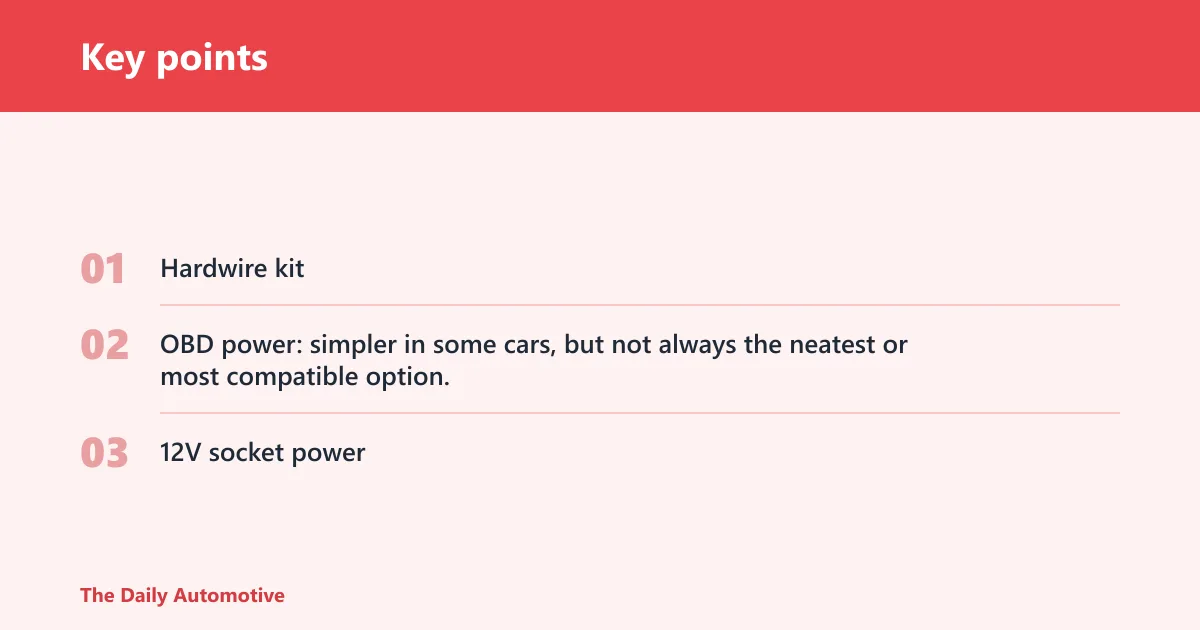
- Hardwire kit: best for parking mode and clean wiring, but it adds install effort.
- OBD power: simpler in some cars, but not always the neatest or most compatible option.
- 12V socket power: easiest to set up, but less ideal if you want continuous parking coverage.
Hidden ownership costs
Do not price only the camera. Add a memory card, mount or replacement mount if needed, and any hardwire kit. If the system depends on an app or cloud feature, check whether that adds a subscription or a long-term service cost.
The cheaper camera can become the pricier ownership choice once you add the parts needed to use GPS, parking mode, and clean cabling the way you want.
Choose Nextbase iQ 4K if… / Choose Viofo A329S if… / Choose Vantrue element 1 lite if…
Choose Nextbase iQ 4K if you want connected features, three channels, and 24/7 Smart Parking in a single package. It fits drivers who want cabin coverage, remote oversight, and a smarter system even if the install and ownership costs are higher.
Choose Viofo A329S if you want the broadest camera coverage for claims and passenger or interior incidents. It is the strongest pick when front, rear, and cabin angles matter more than keeping the system simple.
Choose Vantrue element 1 lite if price matters most and you still want GPS, voice control, and 24-hour parking mode. It is the cleaner value play for drivers who do not need rear or cabin recording.
A common first-timer mistake is buying for 4K alone and ignoring parking power. A camera with sharp footage but no proper hardwire setup can fail exactly when the car is parked in a supermarket lot at 9 p.m., which is when many owners want the extra protection most.
Which one should you buy?
If your priority is the most complete evidence package, start with the Viofo A329S. It gives you front, rear, and cabin coverage plus GPS, which is the best match for claims where more than one angle matters.
If you want the smartest protection features and do not mind a more involved system, choose the Nextbase iQ 4K. It is the better fit for connected drivers who value live view and emergency features alongside GPS and parking protection.
If your budget is tighter and you still want GPS plus parking mode, the Vantrue element 1 lite is the practical buy. It gives you the core functions without paying for multi-camera hardware you may never use.
If you drive mostly in daylight, do not park on the street, and only want a basic accident record, a simpler non-GPS front camera can still be enough. But if you want route logs, speed stamps, or cleaner claim support, GPS is worth the extra spend.
Frequently asked questions
Which dash cam with GPS is best for my car?
The best choice depends on how much coverage you need. For full evidence, the Viofo A329S is strongest because it adds rear and cabin cameras. For smart parking and connected features, the Nextbase iQ 4K fits better. For lower cost, the Vantrue element 1 lite keeps GPS and parking mode.
Do I need GPS on a dash cam?
You do not need GPS for basic crash recording, but it helps if you want location and speed stamps. That extra data can support a police report or claim. If you only want a simple front-facing record, a non-GPS model can still do the job.
What does GPS do on a dash cam?
GPS logs route and speed data and can add speed overlay information to the clip. Some models also use it for speed-camera warnings. Its main value is giving the footage more context, not proving fault by itself.
Are front and rear dash cams better than single-channel models?
Yes, for many drivers they are. Rear coverage can capture tailgating, backing impacts, and parking-lot damage that a front-only camera misses. Single-channel models are simpler and cheaper, but they leave gaps when the incident happens behind the car.
Which dash cam is best for parking protection and GPS?
The best fit depends on the setup you want. Nextbase iQ 4K is the strongest smart-parking choice, Viofo A329S offers the most complete coverage, and Vantrue element 1 lite gives you 24-hour parking mode at a lower price.
Is a more expensive smart dash cam worth it?
It can be, if you will use the extra functions. Live view, Emergency SOS, cabin recording, and smarter parking can justify the cost for some drivers. If you only need basic evidence, though, the extra hardware and possible subscription costs may not be worth paying.
Products related to this article
Sponsored / affiliate links. As an Amazon Associate I earn from qualifying purchases. I may earn additional commission from eligible campaigns.