Vinyl Wrap Car Cost: Price by Vehicle Size and Job Type
Vinyl wrap car cost is commonly reported at about $2,000 to $5,000 for a full wrap on a compact car or sedan, roughly $3,000 to $7,000 for an SUV or truck, and $6,000 or more for luxury or exotic vehicles with more complex bodywork. Skipping a detailed quote can leave you paying far more for panel prep, color changes, or removal than the base price suggests. This guide breaks costs into a vehicle-size-by-job-type matrix and explains when you should get a second estimate.
Vinyl wrap cost matrix

This matrix turns wrap pricing into a size-by-job reference. The ranges below reflect installed pricing for common color-change work, then add notes where complexity, film choice, or removal risk can push a quote outside the usual band.
| Vehicle size | Full wrap | Partial wrap | Hood or roof wrap | Chrome delete | Removal |
|---|---|---|---|---|---|
| Compact / small car | $1,800-$2,800 | $900-$1,800 | $250-$650 | $150-$400 | $500-$900 |
| Sedan | $2,000-$4,000 | $1,000-$2,000 | $250-$650 | $150-$400 | $600-$1,000 |
| SUV / crossover | $2,500-$5,500 | $1,200-$2,500 | $300-$700 | $175-$450 | $700-$1,200 |
| Pickup truck | $3,200-$5,000 | $1,500-$3,000 | $300-$700 | $175-$450 | $800-$1,400 |
| Luxury / exotic | $5,000-$10,000+ | $2,000-$4,500+ | $400-$900+ | $250-$600+ | $1,000-$2,000+ |
Vehicle size moves the price, but shape can move it further. A truck with flat panels may come in near a sedan quote, while a luxury coupe with deep bumpers, sharp creases, and tight trim usually needs more teardown and more careful finishing.
Compact car pricing bands
Compact cars usually sit at the low end because they need less film and less labor. A standard full wrap often falls near the Kelley Blue Book small-car estimate of $1,800-$2,500, while a shop may quote more if the car has mirror caps, roof rails, or difficult trim lines. On small cars, labor still costs more than material, but the gap is smaller than on larger or trickier vehicles.
Sedan pricing bands
Sedans are the baseline for most consumer wrap quotes. A standard full wrap at J.D. Power is about $2,000-$4,000, which fits the common market band for a four-door car with ordinary body panels. If the quote rises above that without a change in film type or body complexity, ask what is driving the premium.
SUV and truck pricing bands
SUVs and pickups need more material and more handling time. A full wrap typically lands around $3,000-$7,000, with Kelley Blue Book listing pickup truck wrap estimates of $3,200-$5,000. Large tailgates, tall side panels, and more trim pieces all add time, especially when the installer has to work around badging or deep bumper sections.
Luxury and exotic pricing bands
Luxury and exotic vehicles move into a different pricing tier because the panels are often harder to wrap cleanly. The common market band is $5,000-$10,000 or more, and that is before specialty films or extra prep. A quote in this range is not unusual when the car has complex curves, sensitive trim, or expensive panels that require more caution.
How much does a car wrap cost?
For most cars, a professionally installed color-change wrap costs about $2,000 to $5,000. Smaller cars sit lower, SUVs and trucks sit higher, and luxury or specialty work can go well above that. Material-only pricing is much lower, but labor usually makes up the biggest share of the final bill.
Typical installed price ranges
Installed pricing includes film, labor, surface prep, and the time needed to finish edges cleanly. A basic quote on a normal sedan may look reasonable until the installer adds charges for old adhesive, removed trim, or extra disassembly. That is why two quotes for the same vehicle can differ by hundreds of dollars.
Material-only versus installed cost
DIY film for a full car is about $660-$900, which is far below a professional install. That gap is the labor bill. It also covers waste, panel corrections, edge work, and the skill needed to keep the wrap from lifting at corners and seams.
- Use material-only pricing to judge the film cost.
- Add installer labor for panel prep, application, and finishing.
- Increase the budget if the car has body kits, vents, spoilers, or deep bumpers.
- Ask whether the quote includes removal of old wrap or adhesive.
- Get a second estimate if the price sits far outside the relevant size band.
Why labor takes the biggest share
Labor is the expensive part because the installer is buying time, not only vinyl. The job includes cleaning, measuring, lifting trim where needed, applying heat carefully, and trimming edges without cutting paint. On complex vehicles, labor can outrun the film cost by a wide margin.
How does vehicle size change the price?
Vehicle size changes price in two ways, more surface area and more panel count. Larger vehicles need more film, and they also need more seams, more edge finishing, and more time around doors, bumpers, and trim. That is why SUVs and trucks climb faster than many shoppers expect.
Body surface area and panel count
A compact car may have less total material demand, but a long SUV can double the amount of film on certain panels. More panel count also means more chances for alignment work. The installer spends time on each surface, not just the total square footage.
Deep bumpers, spoilers, and vents
Deep bumpers and integrated vents add labor because they force the film to stretch and settle around recesses. Spoilers, diffusers, and grilles often need extra trimming or removal. Those details can add a noticeable complexity premium even when the vehicle is not especially large.
Body kits, creases, and angles
Body kits, sharp creases, and tight angles make wrapping slower. A smooth door panel is straightforward. A panel with a hard crease, a sculpted side skirt, and multiple cut lines is not. That is where quotes start to separate by installer skill and not only by film choice.
Say your sedan has factory panels and a simple roofline. It may sit near the lower end of the sedan band. Suppose the same sedan has an aftermarket body kit, a spoiler, and vented bumpers. The price can move upward even though the car class did not change.
Full wrap versus partial wrap cost
A full wrap costs more because it covers the whole vehicle, while a partial wrap limits film and labor to selected panels. A half wrap package sits between the two. Partial work makes sense when you want a visual change without paying for every panel on the car.
Full wrap pricing by vehicle class
Full wraps are the most common quote structure. They usually start around $2,000 to $5,000 for most cars and SUVs, then rise for larger vehicles and specialty films. Full wraps also create the cleanest finish because the color change is consistent across the body.
Half wrap package pricing
A half wrap package usually covers a larger visual zone, such as the lower body, roof, or a two-tone treatment. Pricing depends on how much of the car is covered and whether the installer must break the job into multiple sections. It is usually cheaper than a full wrap, but it is not a small add-on.
Hood, roof, mirrors, and chrome delete
A hood or roof wrap is listed at about $250-$650. Chrome delete is listed at about $150-$400. Mirrors often price with other small accent pieces, and they can cost more per part than the area suggests because they are curved and time-consuming.
Where partial wraps make sense
Partial wraps make sense when you want targeted changes, a contrast roof, or a chrome-delete package without full-body cost. They also work well when you only need a few high-visibility panels redone. If the quote for a partial approach is close to full-wrap pricing, ask why.
What drives wrap pricing up?
Film choice, finish, design work, and labor rates all move a wrap quote. Cast vinyl is the standard for full vehicle wraps. Specialty films such as chrome, color-shift, and carbon fiber raise both material and install time. Commercial printed wraps add design and production cost on top of installation.
Cast vinyl versus calendered vinyl
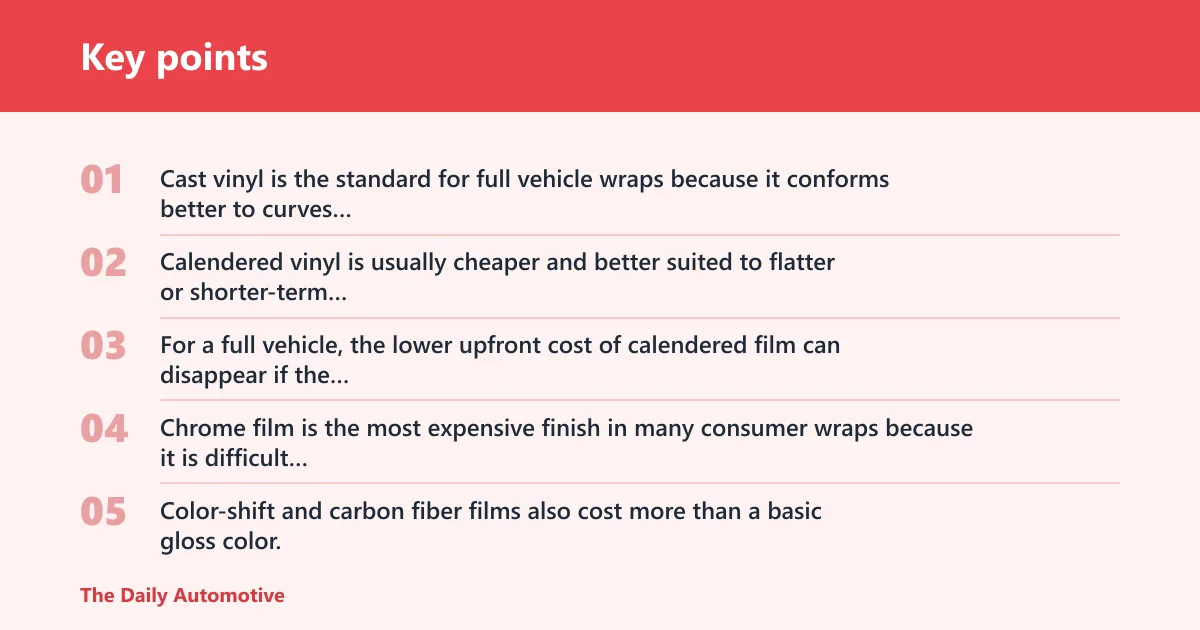
Cast vinyl is the standard for full vehicle wraps because it conforms better to curves and complex panels. Calendered vinyl is usually cheaper and better suited to flatter or shorter-term applications. For a full vehicle, the lower upfront cost of calendered film can disappear if the install is harder or the wrap fails sooner.
Chrome, color-shift, and carbon fiber film
Chrome film is the most expensive finish in many consumer wraps because it is difficult to install cleanly and shows defects quickly. Color-shift and carbon fiber films also cost more than a basic gloss color. These films often need more careful handling, which raises labor as well as material cost.
Gloss, matte, satin, and textured finishes
Gloss is usually the baseline. Matte and satin commonly cost more because the finish needs careful surface prep and the film may be less forgiving during installation. Textured finishes can rise further when the wrap must align texture direction across multiple panels.
Commercial printing and design work
Commercial printed wraps are a separate budget line from consumer color-change wraps. The installer may need design time, proofing, print production, and panel layout before installation even starts. A cargo van wrap is estimated at $3,800-$7,000, and a box truck wrap is estimated at $4,500-$9,000+, which reflects both size and commercial production work.
Regional labor rates and complexity premiums
Installer region pricing matters. Large metro markets, high-rent retail districts, and premium specialty shops often quote more than smaller markets. A quote that is well below the local band can signal shortcuts, while a quote far above it should come with a clear reason such as specialty film, teardown, or difficult paint condition.
How long does a wrap last?
A wrap typically lasts 5-7 years with proper care, though finish, sun exposure, and panel position change that number. Vertical panels usually age better than horizontal panels because they take less direct sunlight and standing water. Cheaper film can age faster and may be harder to remove later.
Vertical versus horizontal panels
Doors and side panels often last longer than hoods and roofs. Horizontal surfaces face more UV, heat, and contamination. That matters because a wrap can look fine on a door while fading or drying out sooner on the roof or hood.
Sun exposure and maintenance
Parked outside often? Expect more fade and shorter life than a garaged vehicle. Regular washing helps remove grime that can stain edges and seams. Strong sun, road film, and neglected cleaning all shorten service life, especially on lighter-colored or matte wraps.
Why cheaper film can age faster
Lower-cost film can save money up front, but it may not hold the same finish or removal profile over time. That matters on a wrap you plan to keep for years. If the vehicle will be sold soon, a budget film may be acceptable; if it will stay wrapped longer, the safer choice is often better material.
Removal, prep, and paint risk
Wrap removal cost is commonly $500-$1,400 for ordinary vehicles, and more when the wrap is old, sun-baked, or installed over a difficult surface. Repainted panels and weak paint can raise the risk because adhesive may pull harder on those areas. Prep also matters before the new wrap goes on.
Wrap removal cost
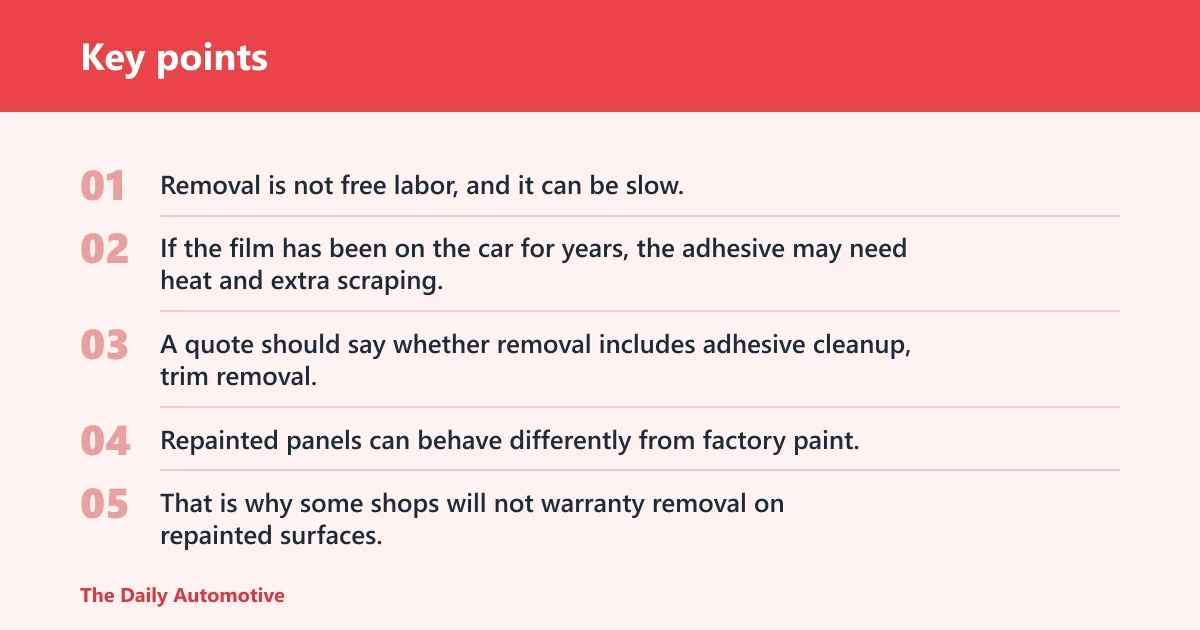
Removal is not free labor, and it can be slow. If the film has been on the car for years, the adhesive may need heat and extra scraping. A quote should say whether removal includes adhesive cleanup, trim removal, and disposal of old material.
Paint condition and repainted panels
Paint condition is a major risk factor. Repainted panels can behave differently from factory paint, especially if the refinishing work is older or lower quality. That is why some shops will not warranty removal on repainted surfaces, or they will charge more for the added risk.
Surface prep before install
Surface prep often includes washing, degreasing, and correction of contamination before the film touches the car. If a panel has wax buildup, road tar, or old adhesive, labor rises. Prep time is easy to miss in a quote, but it can be the difference between a clean wrap and one that lifts early.
A common shopper mistake is judging a vinyl wrap quote only by the total and ignoring whether it covers a full SUV or just a partial accent job. Suppose two SUVs both get color-change wraps, but one has a clean factory finish and the other has old wrap residue plus repainted doors. The second quote should be higher, and if it is not, the shop may be underpricing risk.
Frequently asked questions
How much does it cost to vinyl wrap a car?
For most cars, a full installed wrap runs about $2,000-$5,000. Small cars can sit lower, while SUVs, trucks, and luxury vehicles move higher. Specialty films, removal work, and body complexity can push the final bill above the usual range.
How much does it cost to wrap an SUV versus a sedan?
An SUV usually costs more than a sedan because it needs more film and more labor. A sedan often falls around $2,000-$4,000, while an SUV more often lands around $2,500-$5,500. Tall panels, more trim, and larger surface area drive the difference.
What is the price difference between a full wrap and a partial wrap?
A full wrap covers the entire vehicle and usually costs far more than a partial wrap. Partial work may cover a hood, roof, mirrors, or a lower-body section, while a full wrap changes the whole exterior. The gap is driven by film use, labor time, and edge finishing.
How much more does chrome wrap cost than matte or gloss?
Chrome wrap usually costs more than matte or gloss because the film is harder to install and more sensitive to imperfections. It also tends to need more careful handling. In many quotes, chrome is priced as a specialty finish rather than a standard color change.
What does it cost to wrap a hood, roof, or mirrors?
A hood or roof wrap is listed at about $250-$650. Mirrors are usually priced as part of a small accent package or as an add-on to another panel job. The small size does not mean low labor, because curves, edges, and seams take time.
How much does wrap removal cost?
Wrap removal often costs $500-$1,400 for a typical vehicle, with higher pricing for old, baked-on film or painted surfaces that need extra care. If the wrap has been exposed to years of sun, removal can take longer and may require more adhesive cleanup.
What is cheaper: DIY vinyl or professional installation?
DIY is cheaper on materials alone, with a full car at about $660-$900 for film. Professional installation costs more because it includes labor, prep, and finish quality. For a simple, low-risk project, DIY can save money. For a full car or complex panels, professional work is usually the better value.
Products related to this article
Sponsored / affiliate links. As an Amazon Associate I earn from qualifying purchases. I may earn additional commission from eligible campaigns.