5 Best Keyless Entry Covers for Smart Keys: Based on Specs and Reviews
The best keyless entry cover matches your exact smart-key model, button count, and FCC ID. Pick a slim silicone skin for scratch and drop protection, or a Faraday pouch only when you need signal blocking. If the fit is wrong, buttons can bind, remote range can drop, or the key can stay exposed. This guide shows how to verify compatibility, avoid mispresses, and decide between a shell and a signal-blocking pouch.
Quick comparison
| Product | Badge | Best for | Price | ||
|---|---|---|---|---|---|
 |
Key Fob Cover for Nissan 2023-2026 Rogue PathfinderTANDRIVE | Our pick | 5 Button · 2-Pack · Black Gray | $9.99
Price as of 31 Oct 2026
|
View |
 |
FEYOUN Key Fob Cover Compatible with Toyota Avalon CamryFEYOUN | Also great | 4 Buttons · TPU · Green | $8.96
Price as of 31 Oct 2026
|
View |
 |
Faraday Pouch for Key Fob, Car Key Fob Signal Blocker Case,XIAODUN | Upgrade pick | 1 Pack · Faraday Pouch · Black | $9.99
Price as of 31 Oct 2026
|
View |
 |
WORCAS TPU Smart Cover Key Case Fits for Hyundai 4WORCAS | Budget pick | 4 Button · TPU · Green | $5.99
Price as of 31 Oct 2026
|
View |
 |
sdidzad Car Key Chain Case, Bling Rhinestone Zipper Closuresdidzad | Also great | Universal · Zipper Case · Black | $8.99
Price as of 31 Oct 2026
|
View |
Use this chart to separate everyday protection from storage security before you buy. The right choice depends on whether the key lives in your pocket, in a console, or in a secure pouch at home.
How we chose
We compared the listings by exact fit claims, material type, button layout, included hardware, and whether the product is a cover, shell, or Faraday pouch. Also check manufacturer specs, listing details, and published buyer feedback for compatibility clues such as FCC ID matches and vehicle-specific shape notes.
The goal is fit first, failure second. That means matching the remote before choosing the material.
Smart key comparison table
| Cover type | Best use case | Compatibility check | Signal impact | Bulk | Accidental-press risk | Emergency blade access | When to skip it |
|---|---|---|---|---|---|---|---|
| Silicone sleeve | Daily pocket carry, scratch protection, soft grip | Match make, model, year, button count, and key shape | Preserves normal signal transmission | Low to moderate | Low if the button openings align | Usually open or easy to reach | Skip if the housing is cracked or loose |
| TPU cover | Slimmer daily protection with a firmer feel | Match the exact remote layout and FCC ID or part number | Preserves normal signal transmission | Low | Low to moderate | Usually reachable, but verify the blade slot | Skip if you want a soft, flexible sleeve |
| Leather key fob case | Carry style plus wear protection | Match the exact key shape and button positions | Preserves normal signal transmission | Moderate | Moderate if the case is roomy | Must stay easy to access | Skip if you want minimal pocket bulk |
| Replacement shell | Cracked housings, worn buttons, damaged outer cases | Match the exact remote layout, blade style, and internal board shape | Preserves normal signal transmission after electronics transfer | Usually close to stock | Low if the halves close tightly | May include an uncut blade | Skip if the original housing is intact and you only want surface protection |
| Faraday pouch | Spare-fob storage and theft prevention | Check that the pouch is sized for the fob and closed fully | Blocks car key and RFID signals when closed | Moderate | None for buttons while stored | Not the point of the product | Skip for daily pocket carry if you still need remote operation |
A modern car key is a small, expensive computer, so the failure mode matters as much as the finish. Thomas Acres says key fob covers are not one product, and that split is the first thing buyers need to see.
- Confirm the make, model, and year on the listing.
- Match the button count and button layout.
- Check the FCC ID or part number printed on the remote.
- Compare listing photos to the shape of the shell, blade slot, and emergency access points.
- Choose the material based on use: sleeve, TPU, leather, shell, or Faraday pouch.
Say your remote has a 5-button layout with a panic button tucked at the corner. If the cover is built for a 4-button face, the panic area can sit under the wrong opening and create a sticky press or a partial block. That is a fit problem, not a style problem.
Key fob cover for Nissan: best for daily handling
This TANDRIVE silicone cover is the best fit for drivers who want soft, everyday protection for listed Nissan smart keys. The listing calls out 2023-2026 Rogue, Pathfinder 2024-2026, and Sentra fitment, with a 5-button layout, two covers, and keychains included.
Based on the product details, the white button markings should help with button identification in low light. Silicone sleeves are a practical choice when you want scratch protection, drop cushioning, and easy slip-on installation for daily wear.
The drawback is simple: it is still a vehicle-specific sleeve, not a universal solution. If the exact remote shape or blade opening does not match your fob, the fit can be loose or the buttons can feel off.
Toyota TPU cover: best for a slimmer fit
FEYOUN’s TPU cover suits Toyota owners who want a firmer shell feel without moving to a full replacement housing. The listing names Avalon, Camry, Corolla, RAV4, Sequoia, Highlander, and 4Runner smart keys with a 4-button layout, and it is sold as a signal-friendly accessory.
TPU sits between soft silicone and a harder shell. The same source says TPU covers snap on like a phone case, which is the right mental model here: a tighter, slimmer profile with full button access when the fit is correct.
One drawback is that slim fit depends on exact layout. If your remote has a different button map or a different FCC ID, the openings may not line up cleanly.
Hyundai TPU cover: best for a firm shell feel
WORCAS lists this TPU smart cover for Hyundai 4-button keys, and the listing stresses easy installation and full 360-degree coverage. It is a good option when you want firmer protection than silicone but do not need a storage pouch.
TPU is useful for drivers who want less pocket squish and a cleaner outline. That slimmer profile can help with snagging, while still keeping normal signal transmission for everyday use.
The honest drawback is that the listing is tied to a specific 4-button Hyundai format. If the remote differs in shape, button spacing, or blade cutout, the cover can be awkward or misaligned.
Leather key fob case: best for carry style
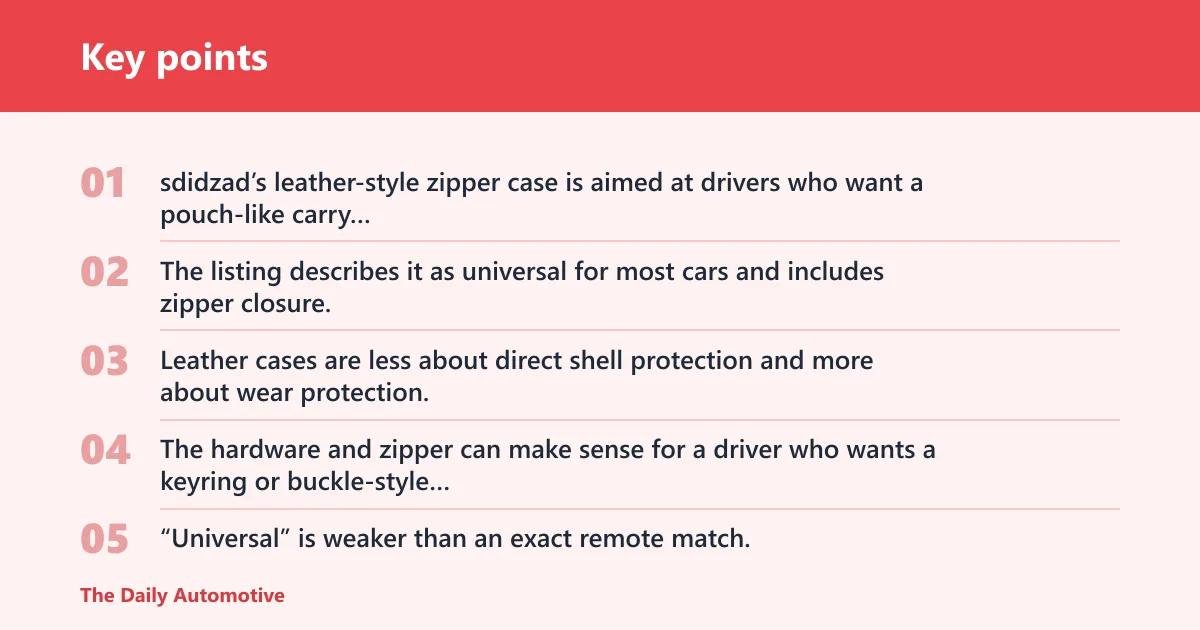
sdidzad’s leather-style zipper case is aimed at drivers who want a pouch-like carry option with a more finished look. The listing describes it as universal for most cars and includes zipper closure, which helps keep the key together in a bag, console, or coat pocket.
Leather cases are less about direct shell protection and more about wear protection, carry convenience, and scratch control. The hardware and zipper can make sense for a driver who wants a keyring or buckle-style carry aid.
The drawback is fit certainty. “Universal” is weaker than an exact remote match, so you should check the fob shape and confirm that the emergency blade remains easy to reach when the case is closed.
Replacement shell: best for cracked housings
XIAODUN’s Faraday pouch is the right product only when signal blocking is the goal, not everyday cover protection. It is meant for spare smart keys, and the listing says it blocks key fob signals when closed while adding a waterproof, fireproof outer shell and a built-in clip.
That makes it different from a normal sleeve. Faraday storage is for relay-attack prevention and spare-fob security, not for daily button use. Thomas Acres includes a Faraday pouch specifically for keyless-entry fobs, which is the correct category here.
The drawback is that a pouch blocks operation while closed. If you need the remote to work in your pocket, glove box, or hand, this is the wrong choice.
Which one should you buy?
If the key housing is cracked, choose a replacement shell rather than a sleeve. If storage security matters, choose a Faraday pouch. If you carry the key daily and want protection from scratches, drops, and pocket wear, start with silicone, TPU, or leather.
A good rule is to match the product to the failure you want to prevent. A shell fixes worn plastic, a sleeve softens daily contact, and a pouch blocks signals for a spare fob.
Suppose your smart key has a loose seam near the battery cover. A silicone sleeve may hide the damage but will not restore structural fit. A shell is the better answer because it replaces the outer housing while keeping the electronics from the original remote.
For commuters, silicone is usually the least fussy choice because it cushions drops and adds grip without changing how the remote behaves in the pocket. For fleet drivers who want a slimmer pocket profile, TPU is a cleaner fit when the button map is correct.
For luxury-key owners, leather can be the better carry choice if the exact shape matches and the blade remains accessible. For a spare kept at home, a Faraday pouch gives you the signal-blocking storage that a sleeve cannot.
How to match an aftermarket cover to your FCC ID
Start with the photo of your actual remote, then check the part number or FCC ID printed on it, and only then compare the listing photos and fit notes. That order matters because the same vehicle line can use different remotes across trim levels, model years, or button layouts.
Cars Techie lists an example Toyota cover for FCC ID HYQ12BBY / GQ4-29T / MOZB41TG, which shows how specific fitment can get. Cars Techie also says some products are replacement pads rather than full covers, so you need to verify the housing type before you buy.
The same source says covers fit only specific key shapes. That is the heart of the compatibility check.
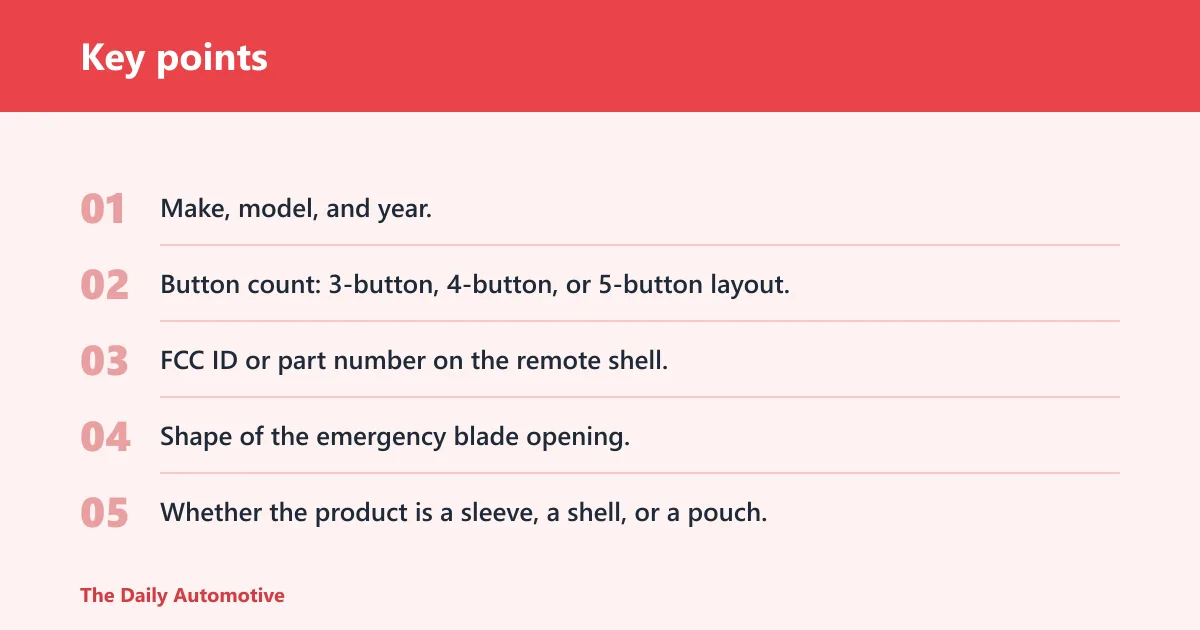
What to check before you buy
- Make, model, and year.
- Button count: 3-button, 4-button, or 5-button layout.
- FCC ID or part number on the remote shell.
- Shape of the emergency blade opening.
- Whether the product is a sleeve, a shell, or a pouch.
- Whether keyring, carabiner, or buckle hardware fits your carry style.
A common first-timer mistake is buying for the vehicle name alone. Two remotes for the same model can differ in layout, and a wrong cutout can leave the lock button easy to press while the panic button sits half-covered.
Failure modes to watch
Stuck buttons usually point to a mismatch in button height or opening size. Loose housings point to the wrong shell shape or an oversized universal case. Emergency blade interference shows up when the blade slot is buried or pinched, which is a problem if you need quick access.
Accidental presses are common when the cover is too soft in the wrong place or the button layout is off by one position. Pocket bulk is the quieter problem, but it matters if the fob rides with coins, cards, or a keyring.
Daily carry versus storage security
Silicone sleeves work best for daily handling because they cushion drops and add grip. TPU is the slimmer option when you want firmer edges and better pocket shape. Leather adds wear protection and carry hardware, but it should still match the exact key shape.
Faraday pouches are different. They are for spare fobs and signal-blocking storage, not for regular unlocking and starting. Used correctly, they prevent the remote from transmitting when closed.
Frequently asked questions
What is the best keyless entry cover for a smart key?
The best cover matches your exact smart-key model, button count, and FCC ID. For daily carry, silicone is usually the easiest fit because it adds grip and drop protection. For signal blocking, use a Faraday pouch instead of a sleeve.
How do I know which key fob cover fits my car?
Check the make, model, and year first, then match the button count, button layout, and FCC ID or part number printed on the remote. Compare the listing photos to the exact shell shape before you buy. If any of those details differ, skip it.
Do key fob covers block the signal?
Most silicone, TPU, and leather covers do not block normal signal transmission. They are protective covers, not shielding products. A Faraday pouch is the item built to block keyless-entry and RFID signals when closed, which is why it is used for spare-fob storage.
What is better for a smart key, silicone, TPU, leather, or a shell?
Use silicone for soft grip and daily scratch protection, TPU for a slimmer and firmer pocket profile, leather for carry style and wear protection, and a shell when the housing is cracked or the buttons are worn. The best choice depends on the failure you are trying to prevent.
Will a key fob cover stop accidental button presses?
It can help, but only if the fit is right. A cover with the wrong layout can make mispresses worse by leaving the panic or lock button too exposed. Tight button alignment and a snug shell are what reduce accidental presses, not material alone.
Can I use a Faraday pouch for my spare smart key?
Yes. That is one of the best uses for it. A Faraday pouch is meant for storing a spare smart key so the fob cannot transmit when you do not want it to. Just make sure the pouch fully closes and stays in good condition.
Are replacement key fob shells the same as covers?
No. A cover wraps the existing remote, while a replacement shell replaces the outer housing and usually requires transferring the electronics from the original fob. Some shells may include an uncut blade, but they are still a different product category from a slip-on cover.
Products related to this article
Sponsored / affiliate links. As an Amazon Associate I earn from qualifying purchases. I may earn additional commission from eligible campaigns.