Best Motor Oil for High Mileage Cars: Top Picks for Longevity
The best motor oil for high-mileage cars is usually a high-mileage synthetic in the OEM viscosity, but move to a thicker grade only if the engine burns oil or leaks enough that the manual allows it. Using the wrong viscosity can raise consumption, worsen cold starts, and leave worn seals or bearings less protected. This guide matches oil choice to mileage, leak severity, oil use, climate, and factory spec so you can pick the right bottle.
Top overall pick and how high-mileage oil works

- Made for engines 75,000+ miles
- Helps clean the engine in one oil change
- Designed for long protection intervals
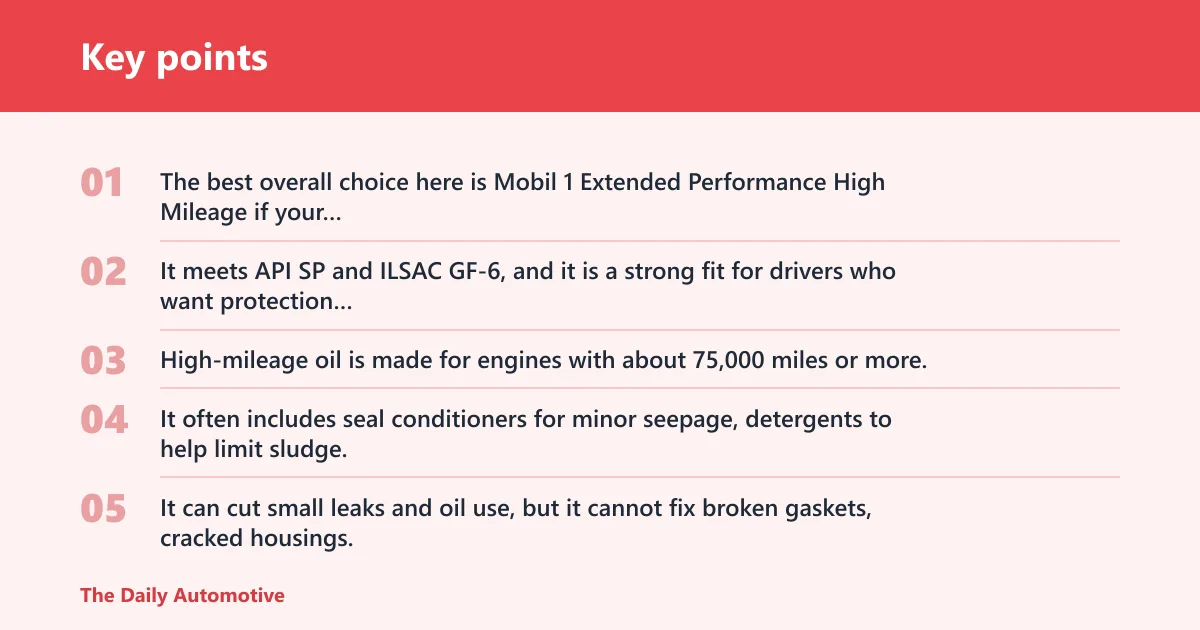
The best overall choice here is Mobil 1 Extended Performance High Mileage if your owner’s manual calls for 5W-20 or 5W-30 and you want a full synthetic with long-drain potential. It meets API SP and ILSAC GF-6, and it is a strong fit for drivers who want protection and fewer service stops.
What high-mileage oil is designed to do
High-mileage oil is made for engines with about 75,000 miles or more. It often includes seal conditioners for minor seepage, detergents to help limit sludge, and anti-wear additives for worn parts. It can cut small leaks and oil use, but it cannot fix broken gaskets, cracked housings, or internal damage.
Why the best choice depends on symptoms, not mileage alone
Two engines with the same mileage can need different oils. One may be dry and quiet, while another may use a quart between changes or leak onto the driveway. That is why the right bottle depends on oil use, leak severity, climate, and OEM viscosity, not odometer reading by itself.
Which oil fits your engine?
Start with the factory viscosity, then match the oil type to what the engine is doing. Full synthetic is often better for older engines because it offers the strongest protection, but a synthetic blend can make sense when you want value and seal conditioning without paying for the longest interval. The right choice should fit the symptom, not fight the spec.
Quick picks
| Use case | Pick | Key detail from the listing | Caution note |
|---|---|---|---|
| Best overall long-drain synthetic | Mobil 1 Extended Performance High Mileage | Full synthetic; API SP; ILSAC GF-6; up to 20,000 miles per oil change | Use only the viscosity your manual allows |
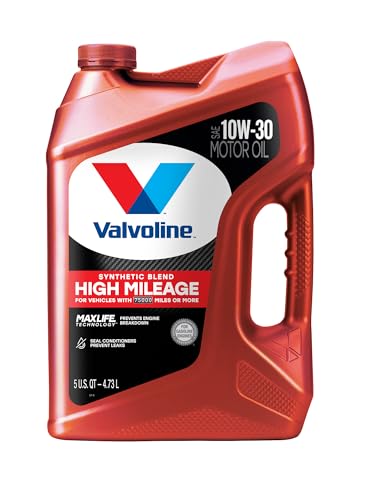
| Best value for older engines | Valvoline High Mileage MaxLife | Synthetic blend with seal conditioners; multiple viscosities | Best for drivers who do not need the longest interval |
| Best for cold starts | Mobil Full Synthetic High Mileage 0W-20 | Full synthetic 0W-20; up to 7,500-mile interval; API SP; resource-conserving formulation | Stay with 0W-20 only if the engine calls for it |
| Best for older engine wear control | Castrol GTX Full Synthetic | Full synthetic; wear protection; sludge control; thermal breakdown resistance | Check the viscosity and service spec for your vehicle |
| Best for towing and heavy-duty use | Shell Rotella T6 5W-40 | Full synthetic diesel oil; 5W-40; low-ash formulation; trucks, towing, heavy-duty use | One competitor notes it is not for gasoline engines |
Best for long drain intervals
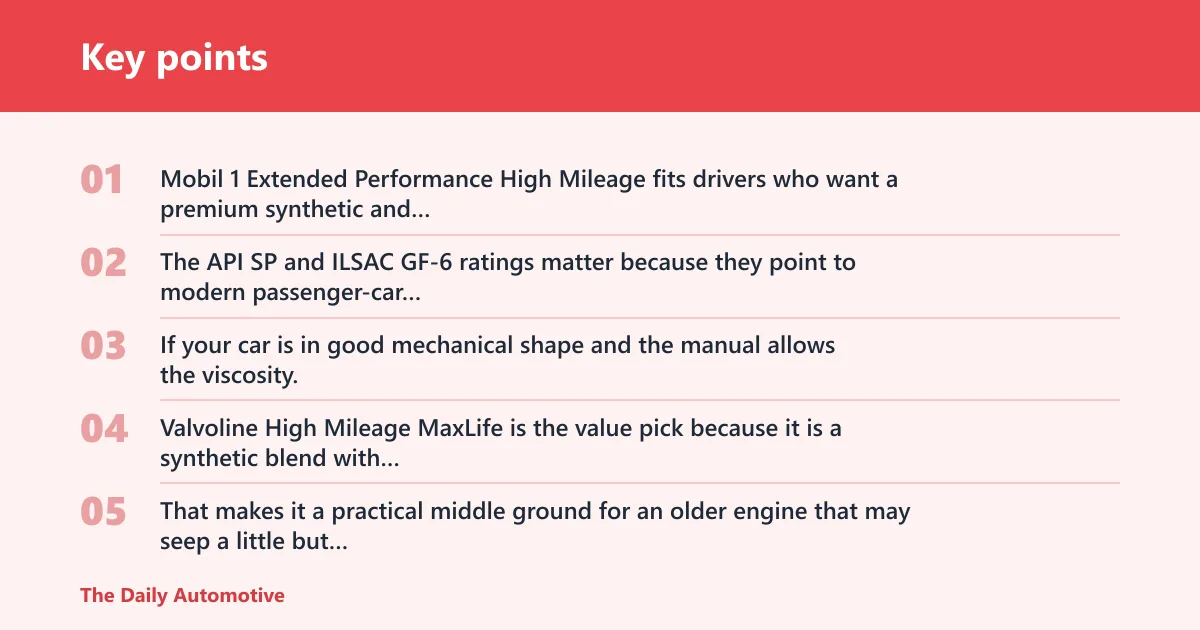
Mobil 1 Extended Performance High Mileage fits drivers who want a premium synthetic and a long interval target. The API SP and ILSAC GF-6 ratings matter because they point to modern passenger-car protection, including LSPI protection. If your car is in good mechanical shape and the manual allows the viscosity, this is the cleanest fit for extended service.
Best value for older engines
Valvoline High Mileage MaxLife is the value pick because it is a synthetic blend with seal conditioners and temperature stability. That makes it a practical middle ground for an older engine that may seep a little but does not need the longest drain interval. It is available in multiple viscosities, which helps you stay close to the OEM recommendation.
Best for cold starts and thin viscosity needs
Mobil Full Synthetic High Mileage 0W-20 is the sensible pick when your manual specifies 0W-20 and you want a high-mileage formula. It is commonly listed as a full synthetic oil with an API SP rating and a service interval that may be up to about 7,500 miles, depending on the application. That matters in cold weather, where thinner oil can flow faster on startup than a heavier grade.
Best for older engine wear control
Castrol GTX Full Synthetic fits drivers who want strong wear protection, sludge control, and better resistance to thermal breakdown. That makes it a sensible choice for an older engine that sees mixed driving and needs a full synthetic without moving to a heavier grade. It still needs the right viscosity from the manual.
Best for towing and heavy-duty use
Shell Rotella T6 5W-40 is a diesel oil for trucks, towing, and heavy-duty use, and it uses a low-ash formulation. That thicker 5W-40 grade can make sense for heat, load, and sustained high engine temperature. It is SAE-certified for both diesel and gasoline use, so check your application before buying.
What viscosity should you use?
Match the OEM viscosity first. If the owner’s manual calls for 0W-20, 5W-20, or 5W-30, start there and avoid moving thicker unless the manufacturer allows it. A heavier oil can reduce consumption in some worn engines, but it can also slow cold flow and increase startup wear if it is outside spec.
Cold climate vs. hot climate
In cold weather, a lower winter number such as 0W-20 can help startup flow. In hot weather or high-load use, a manufacturer-approved 5W-30 or, in some engines, a thicker grade may help maintain film strength. The key is to stay inside the viscosity range the engine was designed for.
When to stay with 0W-20, 5W-20, or 5W-30
If the engine runs cleanly, does not consume oil, and the manual calls for a light grade, stay with it. If oil use has increased or noise has become noticeable, high-mileage oil may help, but the correct viscosity still matters more than the label on the bottle. A thicker grade is a symptom-based choice, not a default upgrade.
Mobil 1 options for long drain intervals
Mobil 1 Extended Performance High Mileage and Mobil Full Synthetic High Mileage 0W-20 cover two common needs: long service intervals and factory-correct thin viscosity. The first is aimed at drivers who want a long drain window in a high-mileage synthetic; the second fits newer older-cars that still call for 0W-20.
Mobil 1 extended performance high mileage
This is the premium choice if your engine wants 5W-20 or 5W-30 and you want a full synthetic with API SP and ILSAC GF-6. For drivers who do not want to stretch service too far, the product still fits as a strong protection-first option.
Mobil full synthetic high Mileage 0W-20
This is the better match when the manual calls for 0W-20 and the driver wants a high-mileage formula without changing viscosity. The listed up-to-7,500-mile interval is shorter than the Extended Performance bottle, but it keeps the engine in the right grade while still adding high-mileage support.
Valvoline High Mileage MaxLife
Valvoline High Mileage MaxLife is the synthetic blend choice for buyers who want seal conditioners and value in one bottle. That blend approach can be enough for many older engines with mild seepage, normal wear, and standard drain intervals. It is the budget-minded answer when full synthetic is not required by the owner’s manual or service plan.
Why the synthetic blend matters
A synthetic blend can offer a lower entry price while still giving more protection than many basic conventional oils. That matters in older cars where the goal is practical wear control, not maximum interval length. It is a reasonable middle step for drivers who are not ready to pay for a top-tier full synthetic.
Seal conditioners and temperature stability
Seal conditioners can help reduce minor seepage from aged seals. Temperature stability matters too, because older engines often see wider swings between cold starts and hot-running traffic. MaxLife fits that profile without asking you to change the engine’s viscosity strategy.
Castrol GTX full synthetic
Castrol GTX Full Synthetic is the safer full-synthetic choice for older engines that need wear protection and sludge control. It is a good fit when the service history is uncertain and you want a cleaner, more stable oil film without moving outside the factory viscosity. Thermal breakdown resistance matters more as an engine ages.
Wear protection for older engines
Older engines often need better protection at startup and in stop-and-go use. A full synthetic can help there, especially if the vehicle has seen long intervals or mixed service. This pick fits an owner who wants a conservative upgrade without changing the engine’s oil grade.
Sludge control and thermal breakdown resistance
Detergents help keep deposits from building up, and thermal stability helps the oil hold up in heat. That makes this a sensible choice for engines that have not always had perfect maintenance. It is a maintenance fix, though, not a repair for worn seals or damaged rings.
Shell Rotella T6 5W-40
Shell Rotella T6 5W-40 belongs in the towing and heavy-duty lane. Its diesel-oil positioning, low-ash formulation, and thicker 5W-40 grade make sense for trucks and high-load work. It is not the first pick for a normal gasoline sedan, especially if the engine was built for a lighter viscosity.
Why towing and heavy-duty use change the decision
Towing keeps oil hot for longer and can raise stress under sustained load. A heavier viscosity can help some engines hold pressure and film thickness in those conditions. That is useful only when the engine and application support it.
Diesel-oil caveats for gasoline engines
Because this oil is positioned for diesel use, you should check your vehicle requirements carefully before choosing it for a gasoline engine. The right decision here depends on the engine family, emissions equipment, and viscosity approval. Do not assume a thicker oil is automatically safer.
High-mileage oil decision matrix
This matrix ties the oil choice to what the engine is doing. Mileage matters, but symptoms and factory spec matter more. Use the red-flag column to rule out cases where oil choice will not solve the problem.
| Scenario | Recommended viscosity range | Oil type | Change-interval caution | Red flag: oil will not fix this |
|---|---|---|---|---|
| Minor seepage | OEM viscosity first; stay close to 0W-20, 5W-20, or 5W-30 unless the manual allows more thickness | High-mileage synthetic or synthetic blend with seal conditioners | Keep normal intervals; do not stretch service because the leak is small | Wet valve cover gasket, pan gasket, or rear main seal that is actively dripping |
| Noticeable oil burning | OEM viscosity first; a manufacturer-approved thicker grade only if allowed | Full synthetic high-mileage oil with detergents and anti-wear additives | Monitor the dipstick more often; shorten the interval if consumption is rising | Blue smoke from worn rings, valve seals, or turbo seals that need repair |
| Cold-climate daily driving | 0W-20 or the lightest grade listed in the manual | Full synthetic high-mileage oil, ideally API SP and ILSAC GF-6 where available | Avoid thick grades that slow cold flow | Hard starting caused by battery, starter, or fuel issues |
| Towing or high-heat use | Only the heavier grade approved by the manufacturer, such as 5W-30 or 5W-40 where specified | Full synthetic with strong heat resistance; for diesel or truck use, Shell Rotella T6 5W-40 is the listed heavy-duty option | Heat and load can shorten real-world oil life | Overheating from cooling-system faults, not oil choice |
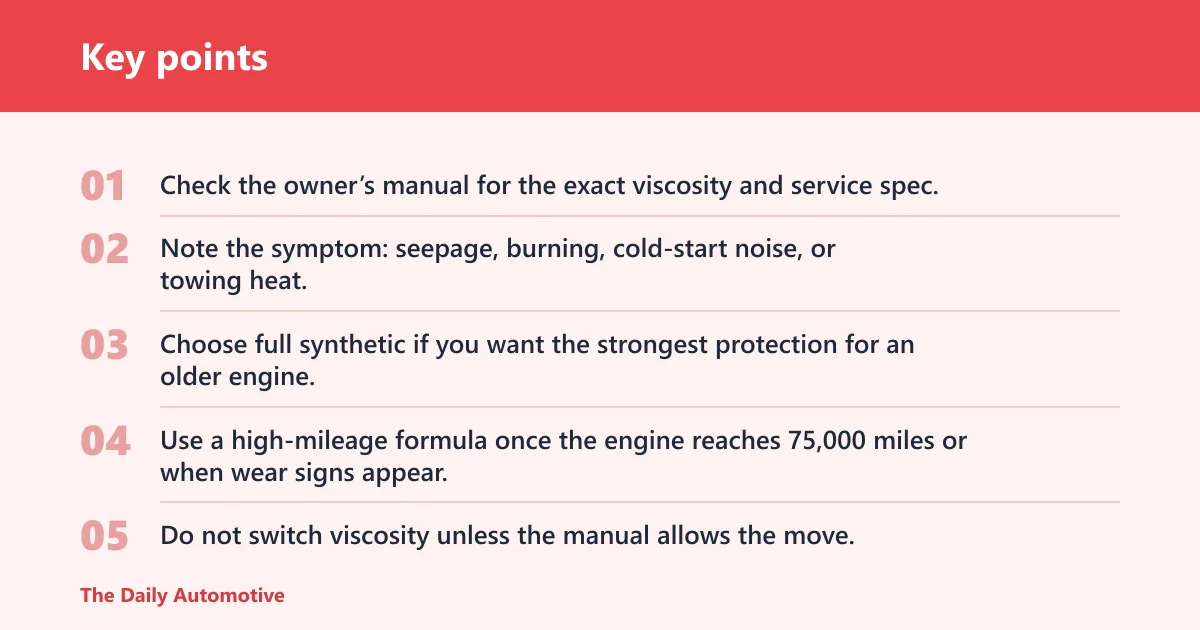
- Check the owner’s manual for the exact viscosity and service spec.
- Note the symptom: seepage, burning, cold-start noise, or towing heat.
- Choose full synthetic if you want the strongest protection for an older engine.
- Use a high-mileage formula once the engine reaches 75,000 miles or when wear signs appear.
- Do not switch viscosity unless the manual allows the move.
- Watch the dipstick after the next few tanks of fuel if consumption is already rising.
Say your sedan calls for 0W-20, has 92,000 miles, and uses a small amount of oil between changes. A high-mileage 0W-20 full synthetic is the cleanest fit. Do not jump to a thicker grade just because the odometer is high; the factory spec still comes first.
Suppose your pickup tows on summer weekends, runs hot on long grades, and the manual allows 5W-30 or 5W-40 for heavy use. In that case, a heavy-duty synthetic like Shell Rotella T6 5W-40 can make sense, but only if the engine family and emissions equipment support it.
How to choose
Start with the symptom, then confirm the spec. If the engine only has minor seepage, a high-mileage synthetic blend can be enough. If it burns oil or lives in heat, step up to a full synthetic. If it is cold outside, stay with the lightest approved viscosity. That order keeps the engine in range and avoids turning an oil choice into a mechanical guess.
High-mileage oil is worth it for an old car when the engine is still mechanically sound and the goal is better seal support, cleaner internals, and better wear protection. It is not worth paying extra if the real issue is a failed gasket, a coolant leak, or compression loss. Oil can support an aging engine. It cannot rebuild one.
Frequently asked questions
When should I start using high mileage oil?
Many drivers start high-mileage oil around that point or when signs of wear appear, such as increased oil use or small leaks. That said, mileage is only part of the decision. If the engine is still healthy and the manual calls for a standard oil, you can wait until symptoms make the switch useful.
Is synthetic oil better for high mileage engines?
Yes, synthetic oil is often better for protection in older engines. It usually handles heat and deposit control better than conventional oil, and it can support longer intervals when the manufacturer allows them. The important part is still the correct viscosity and service spec for the engine.
Will high mileage oil stop oil leaks?
It may reduce minor seepage by conditioning aged seals, but it will not stop major leaks. A worn gasket, damaged seal, or cracked housing needs repair. If oil is leaving puddles, the leak is beyond what a bottle of oil can fix.
What viscosity should I use in a high mileage car?
Use the viscosity listed in the owner’s manual first. If the engine burns oil or the manufacturer allows a heavier grade, you can consider a step up, but only within the approved range. Cold climates favor lighter grades, while towing or sustained heat may call for the heavier approved option.
Can I switch to high mileage oil after 100,000 miles?
Yes. Switching after 100,000 miles is common, especially if oil use or seepage has increased. The change is usually straightforward as long as the new oil matches the factory viscosity and service requirements. It is also fine to switch much earlier if wear signs show up sooner.
Which oil is best for high mileage cars that burn oil?
Choose a full synthetic high-mileage oil in the approved viscosity, then monitor usage closely. A product like Mobil 1 Extended Performance High Mileage fits engines that still want 5W-20 or 5W-30, while a heavier grade only makes sense if the manual allows it. If burning is heavy, the fix is mechanical, not chemical.
Products related to this article
Sponsored / affiliate links. As an Amazon Associate I earn from qualifying purchases. I may earn additional commission from eligible campaigns.