Best Car Engine for Longevity: What Lasts Longest
For longevity, a simple naturally aspirated, port-injected four- or six-cylinder with a solid cooling system and easy service access is often a good choice; if you want very high mileage, I would usually favor that over a high-output turbo design with weak points. Skip that, and you can end up with oil use, timing failures, cooling faults, and repair bills that outrun the car’s value. This guide compares engine layouts, common failure modes, and the ownership habits that decide how long an engine really lasts.
This guide is part of our Transmission problems and fixes series.
What engine longevity really means


Longevity means real service life in normal use, not a forum story or a sales pitch. A durable engine can still cost plenty to keep alive, and a reliable engine may still fall short if it is run hard, overheated, or serviced late. Mileage matters, but care matters more.
Longevity is not the same as reliability
Reliability is about how often an engine breaks. Longevity is about how long it keeps working before wear, leaks, compression loss, or a major repair push it out of service. Parts supply changes the answer too. A cheap engine with common parts may be easier to keep running than a rare engine with a better basic design.
Why mileage alone can mislead buyers
Two engines can both show the same mileage and still be far apart in condition. One may have clean oil, steady temperatures, and a calm service record. The other may have missed oil changes, coolant loss, or repeated overheating. The odometer tells you distance. It does not tell you load.
How ownership pattern changes lifespan
Short trips, towing, dust, and long oil intervals cut life fast. Highway use, correct fluids, and quick repairs do the opposite. I have seen the same engine feel tired at 120,000 miles in one car and still pull cleanly at 250,000 miles in another.
Which engine layouts last longest?
Engine layout affects durability because it changes parts count, heat control, service access, and how hard the engine must work to make power. Inline engines often age well. V engines can last a long time too. Flat engines run smoothly. Diesel engines, when cared for, often stay in service longer than petrol engines.
Inline engines: I4 and I6
Inline engines usually have fewer moving parts than equivalent V layouts, and that helps. An I4 is common in modern cars because it is compact and efficient. An I6 is naturally balanced and often very smooth. Both can age well when cooling and oiling are sound.
V engines: V6 and V8
V6 and V8 engines fit more cylinders into a short package, which helps in SUVs, trucks, and sports cars. That packaging gain comes with more complexity. Bank-to-bank service can be harder, rear-bank heat can rise, and more components can mean more to inspect over time.
Flat and boxer engines
Flat or boxer engines place cylinders horizontally opposite each other. They have a low center of gravity and smooth running traits. The tradeoff is service access. On many designs, plugs, seals, and timing work take more labor because the engine is wide and tightly packaged.
Diesel engines in high-mileage use
Diesel engines run higher compression ratios and are generally built stronger for the load. Diesel engines often outlast petrol counterparts when properly maintained. That does not make them magic. It does mean they are often the right tool for long-distance, high-load, high-mileage ownership.
Longevity scorecard
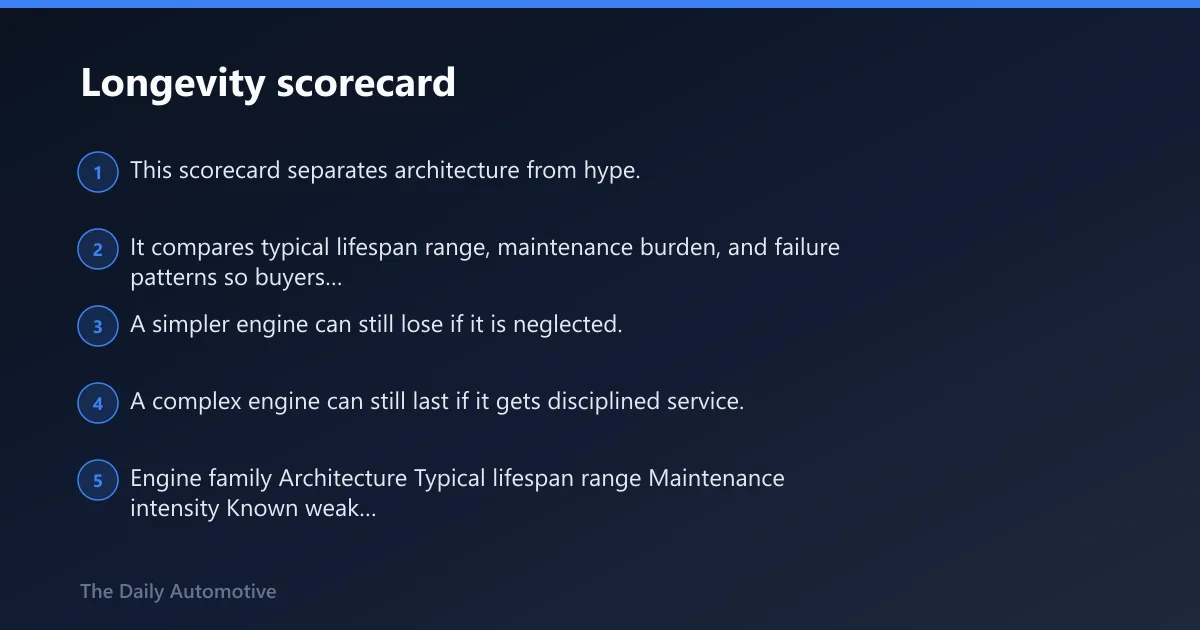
This scorecard separates architecture from hype. It compares typical lifespan range, maintenance burden, and failure patterns so buyers can judge fit. A simpler engine can still lose if it is neglected. A complex engine can still last if it gets disciplined service.
| Engine family | Architecture | Typical lifespan range | Maintenance intensity | Known weak points | Best-use case |
|---|---|---|---|---|---|
| Small naturally aspirated I4 | Inline 4 | Often 200,000 to 300,000 miles | Low | Cooling neglect, oil leaks, timing wear | Commuter cars |
| Large naturally aspirated I6 | Inline 6 | 250,000 miles and beyond | Low to moderate | Cooling system wear, rear seal leaks | Long-distance sedans, tow-capable cars |
| Compact V6 | V6 | 150,000 to 250,000 miles | Moderate | Rear-bank heat, intake leaks, timing service cost | Family sedans, crossovers |
| Pushrod V8 | V8 | 200,000 to 300,000 miles | Moderate | Cooling wear, oil leaks, accessory drive failures | Trucks, body-on-frame SUVs |
| Turbocharged I4 | Inline 4 | 120,000 to 200,000 miles | High | Oil coking, turbo wear, heat load, chain stretch | Efficient daily drivers with strict service |
| Turbocharged V6 | V6 | 120,000 to 220,000 miles | High | Complex cooling, turbo heat, intake carbon, timing cost | Performance SUVs, tow vehicles |
| Boxer four | Flat 4 | 150,000 to 250,000 miles | Moderate to high | Oil leaks, head seal issues on some designs, service access | Cars where low center of gravity matters |
| Light-duty diesel I4 | Inline 4 | 250,000 miles and beyond | High | Fuel system cost, EGR buildup, emissions hardware | High-mileage commuting, towing, fleet use |
| Heavy-duty diesel V8 | V8 | 300,000 miles to 1 million kilometers | High | Cooling load, injector cost, turbo and aftertreatment service | Trucks, towing, commercial duty |
Why some engines reach 300,000 miles and others do not
Engines reach 300,000 miles when wear stays slow. That means clean oil, stable temperatures, and enough mechanical margin that the engine is not living at the edge. The engines that fail earlier usually do so because heat, sludge, detonation, or poor service history pile up over time.
Oil changes, sludge, and oxidation
Engine oil carries heat, controls wear, and keeps deposits in suspension. When oil changes are delayed, oxidation rises, detergents get used up, and sludge can form in oil passages. Once passages narrow, the top end and timing parts get less protection. That is how a cheap skipped service turns into a major repair.
Cooling system health and thermal stress
Overheating bends aluminum parts, weakens seals, and can crack heads or warp surfaces. Coolant condition matters because it supports temperature control and corrosion protection. A sound cooling system belongs to longevity, not as an extra item. A weak radiator cap or stuck thermostat can shorten engine life fast.
Conservative tuning and detonation margin
Conservative tuning keeps internal stress lower. That means safer margins on air-fuel control, spark timing, and boost, if boost exists. Lower stress reduces wear and lowers detonation risk. A high-output tune can be fun, but it often trades life for power.
Are diesel engines more reliable for longevity?
Diesel engines are often better for long service life because their internals are built for higher compression and sustained load. That said, diesel ownership can get expensive when fuel systems, emissions hardware, or turbo parts age. They are longevity tools, not free longevity.
Why diesel internals often last longer
Diesel engines tend to use strong blocks, stout crankshafts, and heavy-duty bearings because combustion pressure is higher. That hardware can tolerate long service life when oil quality, filtration, and cooling stay in check. For mileage, diesel is often a good bet. For simplicity, it usually is not.
Where diesel ownership gets expensive
Common wear items can cost more, and short-trip use is hard on diesel systems. Soot buildup, injector wear, and emissions equipment faults can eat the savings if the vehicle never sees proper load and temperature. A diesel that lives on errands is often a poor fit.
Who should actually buy diesel for longevity
Buy diesel if the vehicle will rack up highway miles, tow often, or run long enough each trip to stay hot. That is where the design makes sense. For low-mileage city use, a simple petrol engine is usually the wiser long-life choice.
What should I look for in a long-life used engine
Look for proof of care, not just a clean idle. Service records, correct oil intervals, stable coolant history, and signs of ordinary wear matter more than the seller’s claims. A used engine can be a good buy, but only if it looks maintained rather than merely still running.
Service records and oil change intervals
Regular servicing matters because it tells you the engine was not left to cook itself with old oil. Check for a pattern of oil changes, coolant service, and timing-related work where relevant. Gaps in records are a warning, especially on turbocharged or high-output engines.
Signs of overheating or sludge
Look for stained coolant, crusty hoses, repeated overheating, bubbling in the expansion tank, and sludge under the oil cap. These are not cosmetic details. They point to thermal stress or poor lubrication, both of which shorten lifespan in a hurry.
Compression, leaks, and inspection priorities
A proper inspection should check compression or leak-down where possible, plus valve cover leaks, coolant seepage, and timing noise. A healthy used engine should show even running, clean oil, and no sign of neglect around oil passages, belts, or the cooling system.
Which engine choice fits your vehicle type?
The best engine depends on duty cycle. Commuter cars do well with simple petrol I4s or I6s. SUVs and trucks often benefit from larger petrol or diesel engines with more torque. Used-engine buyers should focus on inspection and records first, because condition beats reputation every time.
Best picks for commuter cars
For commuting, a naturally aspirated I4 is often the safest long-life bet. It is usually lighter, simpler, and cheaper to service than a turbo alternative. If the car is larger, an I6 can be a strong choice when the cooling system is well designed and access is reasonable.
Best picks for SUVs and trucks
For SUVs and trucks, a mild petrol V6, a pushrod V8, or a well-kept diesel can make sense. These vehicles carry load, so torque and thermal control matter. The longest-lived examples usually avoid constant high boost and have enough cooling capacity for the job.
Best picks for used-engine buyers
Used-engine buyers should value easy inspection, common parts, and visible care. A boring engine with records is usually a better buy than a famous engine with unknown history. If the donor car shows overheating, sludge, or neglected oil changes, walk away.
What mileage should a reliable engine reach?
A reliable engine should often pass 100,000 miles without major issues, and many well-kept engines can move well beyond that. Some can reach very high mileage, including the 300,000-mile range or more. 500,000+ km is realistic for the right diesel and duty cycle, and a few heavy-duty engines can approach 1 million kilometers.
Use mileage as a checkpoint, not a promise
Those numbers are milestones, not guarantees. A neglected engine may fail before 100,000 miles. A carefully maintained engine may outlast the vehicle around it. Mileage only matters once you pair it with service history and operating conditions.
Frequently asked questions
which engines last the longest
Engines that tend to last longest are simple, naturally aspirated petrol I4s and I6s, plus well-maintained diesel engines used in the right duty cycle. The layout matters, but so do cooling, lubrication, and service history. A durable engine is usually one that avoids heat, sludge, and constant stress.
which car engines last longest
The longest-lasting car engines are usually conservative designs with easy access, common parts, and modest output. That often means non-turbo four- and six-cylinder engines in cars that were not tuned for speed. Longevity follows restrained thermal load and regular care, not badge status.
which engine lasts the longest
In broad terms, heavy-duty diesel engines often last the longest when they are used as intended and maintained on schedule. For passenger cars, a simple inline petrol engine often offers the best blend of lifespan, service cost, and parts availability. The right answer depends on duty cycle.
what makes a car engine last for 300,000 miles
Clean oil, healthy coolant, conservative tuning, and prompt repairs make 300,000 miles possible. The engine must also have enough mechanical margin that it is not running hot or lean all the time. Good maintenance records matter because they show the engine has not been slowly damaged by neglect.
are diesel engines more reliable for longevity
Diesel engines are often better for longevity because they are built for higher compression and sustained load, and the basic hardware is usually stout. But the fuel and emissions systems can be costly, and short-trip use can shorten life. Diesel is strongest when the vehicle is worked properly.
which engine layouts are most durable
Inline layouts often age well because they can be simpler to package and service, while V engines can also be durable if cooling and maintenance are on point. Flat and boxer engines can last, but service access is harder. Durability comes from the layout plus how the engine is cared for.
Products related to this article
Sponsored / affiliate links. As an Amazon Associate I earn from qualifying purchases. I may earn additional commission from eligible campaigns.