5 Best Socket Sets for Budget Car Repairs (2026): We Compared
For budget DIY car repairs, a practical starting point is a 3/8-inch drive metric socket set with 6-point sockets in about 8 mm to 19 mm, plus a 1/2-inch breaker bar for lug nuts. Skip tiny specialty kits and mixed filler pieces. The wrong drive size burns money and leaves you short on common fasteners or wheel hardware. This guide shows the smallest socket set that covers most car jobs, explains which sizes matter, and shows where a cheap set earns its keep.
Quick comparison
| Product | Badge | Best for | Price | ||
|---|---|---|---|---|---|
 |
DEWALT 142 Piece Mechanics Tool Set, 1/4 Inch and 3/8 InchDEWALT | Our pick | 1/4 & 3/8 in. · 142 pc. · SAE/Metric | $112.49
Price as of 30 Oct 2026
|
View |
 |
EPAuto 40 Pieces 1/4-Inch & 3/8-Inch Drive Socket Set, 72EPAuto | Budget pick | 1/4 & 3/8 in. · 40 pc. · Metric/English | $29.97
Price as of 30 Oct 2026
|
View |
 |
TEKTON 3/8 Inch Drive 6-Point Socket Set, 102-Piece |TEKTON | Also great | 3/8 in. · 102 pc. · 6-point | $250.00
Price as of 30 Oct 2026
|
View |
 |
GEARWRENCH 57 Pc. 3/8" Drive 6 Pt. Mechanics Tool Set,GEARWRENCH | Pair with it | 3/8 in. · 57 pc. · SAE/Metric | $129.00
Price as of 30 Oct 2026
|
View |
 |
SUNEX TOOLS 2653 1/2-Inch Drive Deep Metric 6 Point ImpactSunex Tools | Also great | 1/2 in. · 14 pc. · Deep Metric | $80.99
Price as of 30 Oct 2026
|
View |
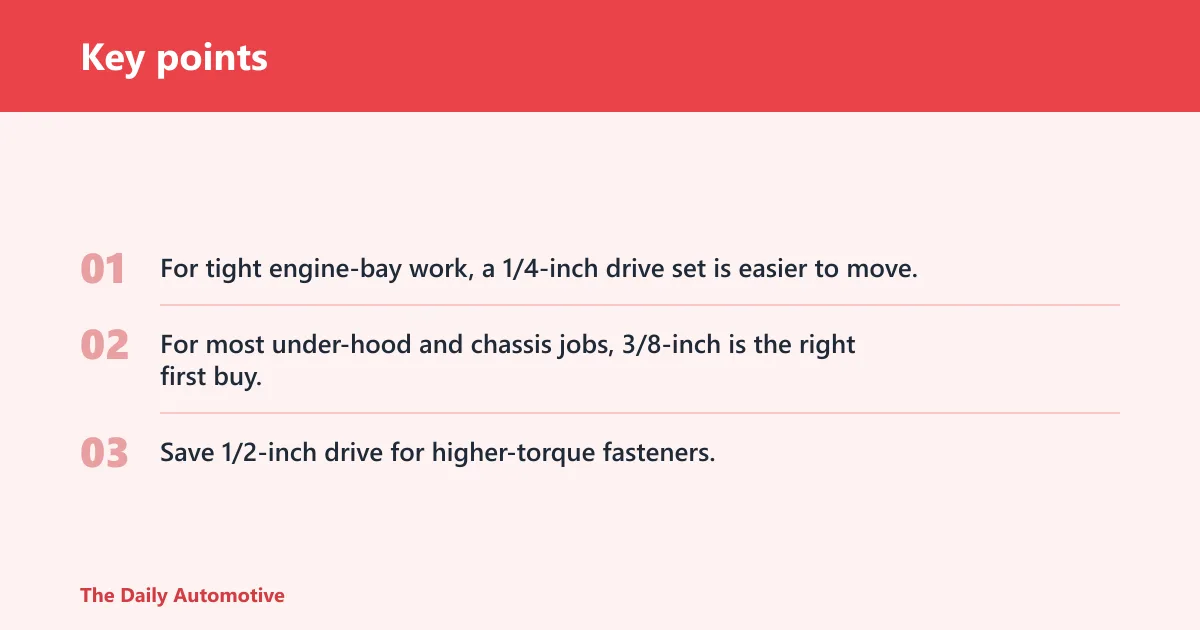
For tight engine-bay work, a 1/4-inch drive set is easier to move. For most under-hood and chassis jobs, 3/8-inch is the right first buy. Save 1/2-inch drive for higher-torque fasteners, especially lug nuts and other stubborn hardware.
How we chose
Selections rely on manufacturer specs, listing details, and published buyer feedback. The aim was to favor the smallest kit that still covers common repairs, then weigh drive size, socket type, included accessories, case quality, and whether the set wastes money on filler pieces.
One thing mattered more than piece count: whether the kit matches the fasteners you will actually touch. A cheaper set with the wrong drive size, no deep sockets, or a flimsy case can cost more through missed repairs and duplicate buys.
DEWALT 142-piece mechanics set: best for one-stop coverage
This set fits a buyer who wants one larger kit that covers both 1/4-inch and 3/8-inch work, plus SAE and metric sizes. The listed low-profile ratchet helps in tighter spaces, and the 72-tooth ratchet should help when swing room is limited.
Based on the listing, the main strength is breadth without jumping straight to a huge garage cart kit. The drawback is simple: 142 pieces can include more than a beginner needs, so you may pay for tools you will not use on occasional maintenance.
EPAuto 40-piece set: best for the lowest entry cost
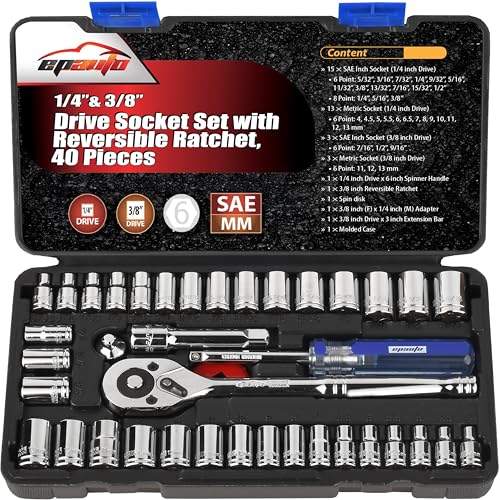
This is for a budget buyer who wants a basic mixed-size starter kit without spending much. It includes both metric and English sizes, plus 1/4-inch and 3/8-inch drive coverage, which helps for light maintenance and some common car fasteners.
The 72-tooth reversible 3/8-inch ratchet and plastic case add practical value at this price. The tradeoff is that a 40-piece set can run short on specialty sizes, and a low-cost case is often the first weak point when pieces get moved around often.
TEKTON 102-piece 3/8-inch set: best for mixed-depth coverage
This set fits a buyer who wants one 3/8-inch drive kit that leans toward car work rather than a random homeowner bundle. It includes shallow, semi-deep, and deep sockets, which matters when a recessed nut or a long stud would stop a shallow-only set.
The six-point design and radiused corners are aimed at stubborn fasteners, which is useful on older hardware. The drawback is price: this is a much bigger spend than a bare-bones starter kit, so it makes sense only if you know you will use the added depth range.
GEARWRENCH 57-piece 3/8-inch set: best for everyday repairs
This is a strong middle-ground choice for basic automotive work. The 3/8-inch drive is the common automotive sweet spot for general repairs, and the set includes both standard and deep sockets, which helps when a fastener sits farther down a bracket or cover.
The 90-tooth gear and stubby ratchets point to tighter access and finer movement. The drawback is coverage, not quality: 57 pieces is useful, but it is not the broadest kit, so some mixed fastener jobs may still call for another set later.
SUNEX TOOLS 1/2-inch deep metric set: best for high-torque jobs
This set is aimed at buyers who know they need 1/2-inch drive sockets for tougher fasteners. The deep metric sizes and chrome molybdenum construction make sense for higher-torque work, especially where a recessed nut or stubborn hardware needs more reach and a heavier-duty setup.
The drawback is focus. It is a metric deep set, not a general starter kit, so it does not replace a smaller 3/8-inch set for everyday maintenance. If you mainly change filters, brackets, and small engine-bay parts, this is more specialized than you need.
Socket set decision table
| Repair type | Likely fastener size/drive | Must-have features | What can wait |
|---|---|---|---|
| Oil changes, air filter boxes, battery hold-downs, trim fasteners | 8 mm to 13 mm, usually 1/4-inch or 3/8-inch drive | Metric sockets, ratcheting socket wrench, a few extensions | Large 1/2-inch set, impact sockets, wide SAE range |
| Brake brackets, small suspension shields, engine-bay hardware | 10 mm to 19 mm, usually 3/8-inch drive | 6-point sockets, deep sockets for recessed nuts, extensions | Oversized case, duplicate specialty bits, huge mixed kit |
| Wheel-related fasteners and other high-torque hardware | Often 1/2-inch drive, larger metric sizes | Impact sockets, 6-point design, breaker bar or impact-rated set | Extra small sockets, decorative case, thin shallow-only kit |
| Rounded bolts, deep recesses, rusted hardware | Depends on the failure, often the same size as the original fastener | Extractor sockets, deep sockets, 6-point grip, corrosion-aware approach | Assuming a shallow 12-point socket will rescue damaged hardware |
A common first-timer mistake is buying a shiny 150-piece kit that still misses one of the three things that matter most: the right drive size, a few deep sockets, and a case that keeps the sockets in order. Pieces that roll loose in the trunk are not a bargain.
Should you buy metric or SAE?
For most modern cars, metric is the first buy because many common fasteners on engines, brackets, and covers are metric-only. SAE still matters on some older vehicles, mixed hardware, and a few accessories, so a mixed metric/SAE set is the safest broad-use choice if your budget allows it.
Where metric usually wins
Metric sizes cover the fasteners you are most likely to see on late-model cars. That means the better first dollar is usually spent on complete metric coverage in a useful drive size, not on extra SAE pieces you may never touch.
When SAE still earns its place
SAE sizes remain useful on older American vehicles, older hardware, and certain mixed repairs where previous owners have replaced fasteners with whatever fit. If your vehicle is older or your garage time includes several different brands, a mixed set can prevent constant size hunting.
How to avoid waste
Do not buy a giant SAE-heavy kit because it looks complete. Start with the sizes you will actually use most often, then add only the missing range later. That approach is better than paying for ten sockets that sit untouched in the tray.
Are deep sockets worth it?
Yes, when the fastener sits below the surface or on a long stud. Deep sockets help on recessed nuts, spark-plug-adjacent hardware, and many under-hood spots where a shallow socket cannot reach fully. If your car work is mostly surface-level trim or bracket bolts, shallow sockets can be enough for now.
Jobs that favor deep sockets
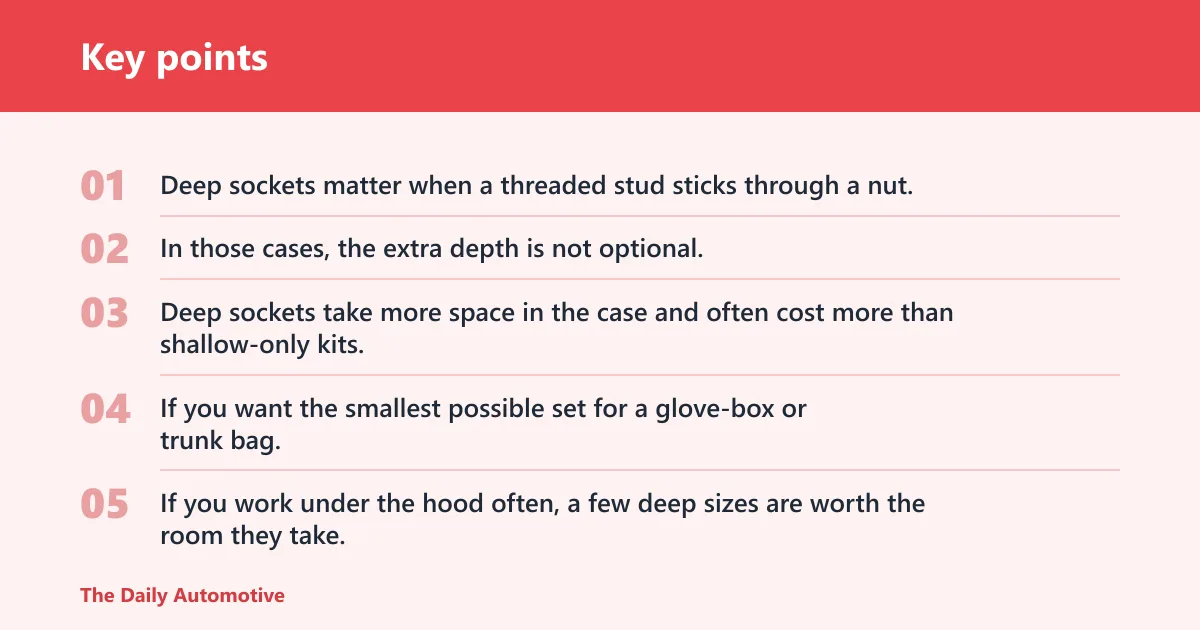
Deep sockets matter when a threaded stud sticks through a nut, when a bracket recess hides the fastener head, or when a long bolt leaves too little room for a shallow socket to seat fully. In those cases, the extra depth is not optional.
The tradeoff
Deep sockets take more space in the case and often cost more than shallow-only kits. If you want the smallest possible set for a glove-box or trunk bag, shallow sockets are easier to carry. If you work under the hood often, a few deep sizes are worth the room they take.
When shallow sockets are enough
For interior trim, battery clamps, many airbox fasteners, and other exposed hardware, shallow sockets are often fine. The problem shows up when the socket cannot sit flat or when the nut is buried too far down the stud. That is when a cheap shallow-only kit starts to fail.
Do you need an impact socket set?
Only if you plan to use an impact gun or regularly deal with high-torque fasteners. Impact sockets are built for that job and are commonly six-point, which helps with grip on stubborn hardware. For hand tools only, standard sockets are usually the cheaper and lighter choice.
When impact sockets make sense
Buy impact sockets if you already own an impact wrench or expect to use one on wheel hardware, suspension work, or stuck fasteners. Their heavier-duty construction is the point, not a bonus feature. If you never use powered impact tools, the added cost may not pay off.
Why six-point matters
Six-point sockets grip the flats of the fastener better than many 12-point designs, especially on stubborn bolts. That can help reduce rounding on worn or rusted hardware. For budget car work, six-point is usually the safer bet unless you have a specific reason to choose otherwise.
Standard hand-tool sockets versus impact-rated tools
Standard chrome hand-tool sockets are a better value for light maintenance and occasional repairs with a ratchet. Impact sockets are thicker and less suited to a tiny starter kit, but they earn their keep when torque and stuck hardware enter the picture.
Which one should you buy?
The best buy depends on how much you want to spend and what you repair most often. For a bare minimum, start with a 1/4-inch and 3/8-inch mixed metric kit. For the better starter choice, a 3/8-inch metric set with deep sockets covers more car work without jumping into an oversized mechanics set.
Pick by budget
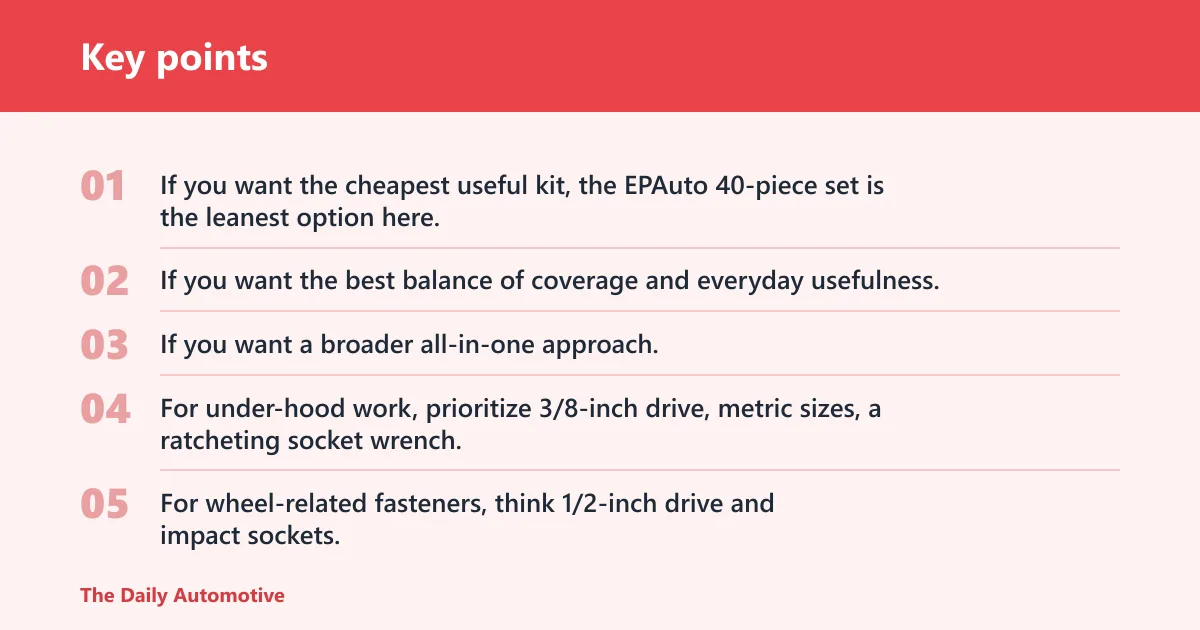
If you want the cheapest useful kit, the EPAuto 40-piece set is the leanest option here. If you want the best balance of coverage and everyday usefulness, the GEARWRENCH 57-piece set is the better middle ground. If you want a broader all-in-one approach, the DEWALT 142-piece set gives more reach and size coverage.
Pick by job type
For under-hood work, prioritize 3/8-inch drive, metric sizes, a ratcheting socket wrench, and a few extensions. For wheel-related fasteners, think 1/2-inch drive and impact sockets. For light interior or trim jobs, 1/4-inch drive is enough and easier to work with in cramped spaces.
Features to pay for first
Pay for the ratchet first, then the right drive size, then a few useful extensions and adapters. After that, buy deep sockets only if your fasteners need them. A strong case matters too, because a bad organizer can turn a cheap kit into a frustrating one.
Suppose you are removing a 10 mm battery hold-down bolt behind a hose and the socket will not sit straight. A 1/4-inch ratchet with a short extension usually solves that. If the same job sits deeper on a stud, the shallow socket may fail and the deeper size becomes the better fix.
What makes a socket set good for a homeowner or beginner?
A beginner-friendly set covers common fasteners without forcing you to buy another kit next week. That means clear size labels, useful drive sizes, a ratcheting handle, some extensions, and a case that keeps pieces from scattering under a seat or in a trunk.
What is the best socket set for the money?
For pure value, the best choice is the kit that matches your car and repair habits without excess pieces. A smaller mixed set is often the better money move than a giant box full of sizes you will never use. In many cases, that means buying the right drive size first and expanding later.
Which socket set is best for tight spaces under the hood?
For tight spaces, 1/4-inch drive usually gives the easiest access, especially with a ratcheting socket wrench and short extensions. A low-profile ratchet helps when there is little swing room. If you often work near brackets, hoses, or the firewall, compact tools beat a big general set.
Frequently asked questions
What is the best budget socket set for car repairs?
The best budget pick is the smallest set that still covers your car’s common fasteners, usually a 3/8-inch metric set with 6-point sockets. Add a 1/4-inch set if you do light under-hood work in tight spaces. Skip oversized kits unless you know you will use them.
What size socket set do I need for basic car maintenance?
For basic maintenance, start with 3/8-inch drive and metric sockets in the common range from 8 mm to 19 mm. That covers many routine jobs without forcing you into a larger mechanics set. Keep a few extensions nearby for fasteners buried behind hoses or covers.
Are deep sockets worth it for car repairs?
Deep sockets are worth it when the fastener sits recessed or on a long stud. They are less useful for shallow, exposed hardware. If your repairs mostly involve surface-level trim or easy-access brackets, you can postpone deep sockets and spend on a better ratchet first.
Do I need an impact socket set for DIY automotive work?
Not unless you plan to use an impact gun or deal with high-torque fasteners often. For hand tools, standard sockets are usually enough and cost less. If you expect wheel work, suspension work, or seized hardware, impact sockets and six-point designs are the safer route.
Should I buy metric, SAE, or a mixed socket set for my car?
Metric is the safer first choice for most modern cars. A mixed metric/SAE set makes sense if your vehicle is older, you work on multiple vehicles, or you want one kit that handles mixed hardware. Avoid paying for a huge SAE range if your car is mostly metric.
Products related to this article
Sponsored / affiliate links. As an Amazon Associate I earn from qualifying purchases. I may earn additional commission from eligible campaigns.