Husky Car Door Lock Lubricant Review
For car door lock cylinders, a dry or graphite-style lubricant is the safer long-term choice; grease is generally better suited to latch hardware than to a key slot, where it can trap grit and slow the tumblers.
Verdict
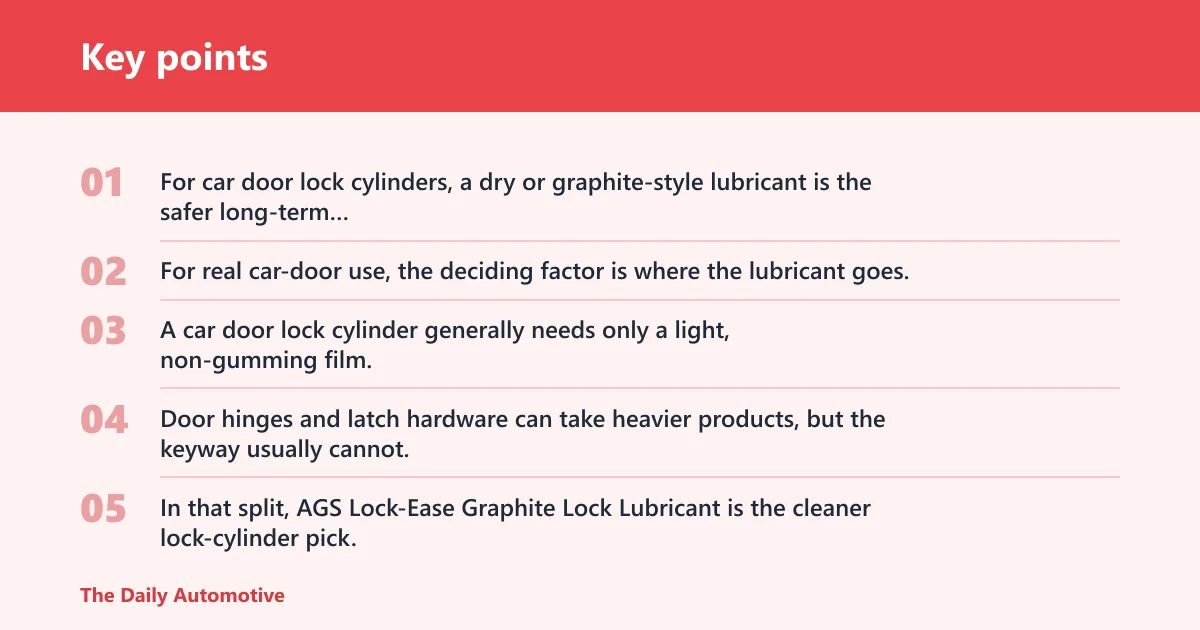

For real car-door use, the deciding factor is where the lubricant goes. A car door lock cylinder generally needs only a light, non-gumming film. Door hinges and latch hardware can take heavier products, but the keyway usually cannot. In that split, AGS Lock-Ease Graphite Lock Lubricant is the cleaner lock-cylinder pick, while white lithium grease belongs on broader metal hardware.
Specs at a glance
| Item | What the listing says | Best use | One drawback |
|---|---|---|---|
| AGS Lock-Ease Graphite Lock Lubricant | 3 oz aerosol; graphite; dry spray; helps keep locks from freezing; no sticky residue; recommended for car doors and trunk locks | Exterior lock cylinders and key slots | Dry products are less forgiving if the lock already has heavy oil residue |
| 3-IN-ONE Lock Dry Lube | 2.5 oz aerosol; quick-drying; dries clear within minutes; straw helps reach narrow lock mechanisms; won’t attract dirt like oily lubes | Clean lock cylinders that need precise spray application | Can be less ideal in extreme cold than a graphite-focused option |
| LIQUIDFIX Door, Lock & Hinge Lubricant | 4 oz oil lube; needle combo; needle tip helps with precise application; works in cold weather to -55F; multi-purpose for locks, hinges, and tracks | Mixed-use maintenance where you want a needle oiler and broader hardware coverage | Multi-purpose oil can be less clean in a keyway than a dry lock lube |
Who it
This kind of product is for drivers with sticky but working lock cylinders, older key slots that feel dry, and exterior locks that see rain, sleet, or morning frost. It is also for anyone who wants cleaner key slots and less residue on the key.
It is less suitable for a lock that is already gummy from old oil, or for a door that needs hinge or latch service instead of cylinder service. If the problem is the latch mechanism, a heavier lubricant may make more sense. If the problem is the keyway, keep the product light.
Picture a sedan parked outside overnight in sleet. The key turns, but the cylinder feels rough. That is a lock-cylinder problem, not a hinge problem, and it calls for a dry or graphite product with careful application.
What works
A dry lock lubricant works well because it leaves little or no residue, which matters in a small car door lock cylinder. Graphite lock lubricant is the cleaner choice for exterior lock cylinders and key slots because it reduces friction without leaving an oily film that can hold dirt.
Dry lube aerosol is also useful because it dries quickly and can be aimed through a precision straw into a narrow keyway. That helps when the lock is still usable but feels sticky. In cold weather, a dry formula is often the better bet because it is less likely to thicken or collect moisture in the cylinder.
LIQUIDFIX adds a needle oiler, which helps control the amount and reduces overspray at tight key slots and latch points. Its -55F claim is useful for very cold climates, but the multi-purpose oil format still belongs in the use the smallest amount possible category for a lock cylinder.
Common first-timer mistake: flooding the key slot until the key comes out wet. That usually adds mess without solving the cause. Use a brief burst or a small drop, work the key gently, and stop as soon as the action feels smoother.
Pros and cons
- Pros: graphite and dry lube are cleaner for lock cylinders; dry films reduce dirt attraction; precision nozzles and needle tips cut mess.
- Cons: heavy application can still leave residue; oil-based multi-purpose products are easier to overuse; graphite and dry lube are not the best fix for a lock packed with old grease.
What does not?
White lithium grease is generally not suitable for most car door lock cylinders. It is a heavier lubricant, better suited to door hinges and latch hardware, where it can offer corrosion and rust protection and tolerate higher-friction motion. In a keyway, the same thickness can hold dust and create gummy buildup.
If the lock already feels sticky because old oil, wax, or grease has built up, a fresh coat is the wrong first move. Clean out the residue first, then apply a light dry product. A lock cylinder needs a reset, not another layer of sludge.
Suppose a truck door lock has been hit with general-purpose grease for years. The key now drags in cold weather and leaves dark residue on the blade. That is a sign to clean the cylinder before relubricating, not to add more grease.
Cleanup and reset
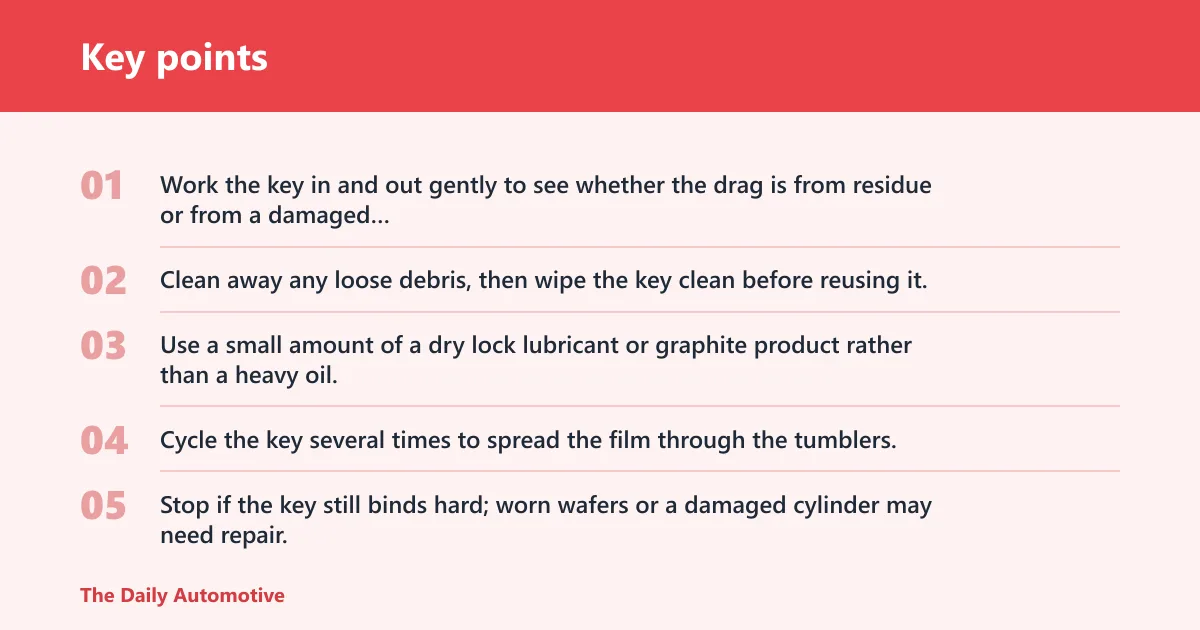
- Work the key in and out gently to see whether the drag is from residue or from a damaged cylinder.
- Clean away any loose debris, then wipe the key clean before reusing it.
- Use a small amount of a dry lock lubricant or graphite product rather than a heavy oil.
- Cycle the key several times to spread the film through the tumblers.
- Stop if the key still binds hard; worn wafers or a damaged cylinder may need repair.
Husky car door lock decision table
| Symptom | Climate | Application format | Best lubricant type | Why it works | What to avoid | Reapplication timing |
|---|---|---|---|---|---|---|
| Frozen lock | Freezing rain, snow, sleet, or repeated overnight frost | Precision straw or graphite tube | Graphite lock lubricant or dry lube aerosol | Dry film helps the key turn while limiting moisture retention and residue | White lithium grease and heavy oil in the keyway | After thawing and once the lock feels dry again, especially before the next cold snap |
| Dusty lock | Dry, windy, or road-grit conditions | Needle oiler or precision nozzle | Graphite lock lubricant | Leaves little or no residue, so dust is less likely to stick | Oily sprays and thick grease | Only when the key starts to drag or after a cleanup/reset |
| Rusty lock | Wet climate, salted roads, or long outdoor parking | Precision nozzle with a light touch | Dry lube aerosol or a lock-safe graphite product | Helps the tumblers move while keeping the cylinder cleaner than grease | Grease in the cylinder and any product applied heavily enough to pool | After the cylinder is cleaned, then at seasonal intervals if the lock sees weather exposure |
| Sticky but working lock | Mild or mixed weather | Small straw or needle tip | Dry lube aerosol | Quick-drying film is often enough for a lock that still operates | White lithium grease unless the problem is actually the latch | When key effort rises again, usually after normal use or seasonal change |
| Misused grease buildup | Any climate, but worse in cold and dusty conditions | Cleanup first, then precision application | Graphite or dry lube after cleaning | Lets the cylinder return to a light, non-gumming film | Adding more grease on top of old residue | After cleanup only, then as needed if the lock starts to feel dry |
How to apply it without making a mess
The safest approach is a small dose, aimed directly into the key slot. A needle oiler or precision nozzle gives control in tight spaces and reduces overspray onto paint, trim, and the key. For a lock cylinder, less is usually better.
Insert the nozzle just at the opening. Give a brief application. Then work the key gently several times so the lubricant reaches the tumblers. If the lock is exterior and weather exposed, wipe away any visible excess from the key and surrounding trim.
A common mistake is to spray the door panel, then hope the product migrates inward. It usually migrates to the wrong places first. Keep the application aimed at the cylinder only, and use a towel to catch drips.
- Insert the key or nozzle into the key slot only as far as needed.
- Apply a brief burst or a small drop.
- Move the key in and out slowly.
- Turn the key several times without forcing it.
- Wipe the key and the surrounding area clean.
Alternatives and trade-offs
AGS Lock-Ease Graphite Lock Lubricant is the cleanest fit for a car door lock cylinder because it is a dry graphite spray with no sticky residue. The listing also says it helps keep locks from freezing and is recommended for car doors and trunk locks. The trade-off is that a lock with old oil or grease may need cleaning first.

3-IN-ONE Lock Dry Lube is a good choice when you want a quick-drying aerosol with a straw for narrow mechanisms. It dries clear within minutes and is meant to avoid dirt attraction. The main drawback is that dry lube can be less ideal in extreme cold than a graphite-focused product.
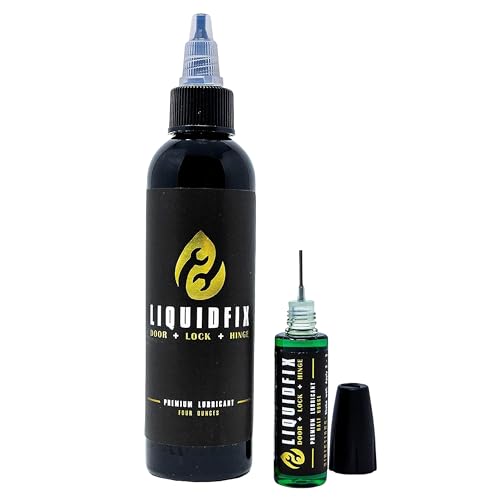
LIQUIDFIX Door, Lock & Hinge Lubricant is the better pick when you want one bottle for locks, hinges, and tracks, plus a needle tip for pinpoint application. Its cold-weather claim down to -55F is a strong point. The trade-off is that an oil lube is easier to overapply in a lock cylinder than a dry formula.
White lithium grease is still useful, but mainly on door hinges and latch hardware. That hardware is higher-friction and can take a heavier film better than a key slot. If the issue is squeak at the hinge or a stubborn latch, white lithium grease makes sense. If the issue is a sticky keyway, it usually does not.
Should you buy it?
Buy a Husky-branded car door lock lubricant only if the label clearly identifies it as a lock-cylinder product with a dry or graphite-style film. For the lock itself, cleaner is better than thicker. For the hinge or latch, grease can have a place, but keep it out of the keyway.
If your goal is an exterior car lock that works in cold weather, resists moisture, and stays clean, graphite lock lubricant is the safest default. If you need a quick-drying spray and easy straw control, dry lube is a strong second choice. If the door hardware is the real problem, save the grease for that job.
Frequently asked questions
What is the best lock lubricant?
For most car door lock cylinders, the best choice is a dry graphite lubricant or a dry lube made for locks. Both leave little residue and are less likely to attract dirt. If the problem is the hinge or latch hardware, white lithium grease can be the better fit because those parts can take heavier lubrication.
What is the best lubricant for car door locks?
For a car door lock cylinder, graphite or a dry lock lube is usually the best choice because it keeps the keyway cleaner than oil or grease. In cold weather, that matters even more. If the lock is already contaminated with old residue, clean it first before switching to a dry product.
Should I use graphite or silicone on a car door lock?
Graphite is the safer traditional pick for lock cylinders because it is dry and leaves little residue. Silicone is better suited to some rubber and weather-seal jobs than to a keyway. For a car door lock, a dry lock lubricant or graphite product is the cleaner and more predictable choice.
Can white lithium grease be used on car door locks?
It can be used on door hinges and latch hardware, but it is usually the wrong product for a lock cylinder. White lithium grease is heavier and can attract dust if overapplied. In a key slot, that can lead to gummy buildup and a sticky key feel, especially in cold or dusty conditions.
How often should I lubricate car door locks?
There is no universal interval, because climate and use matter. A practical rule is to relubricate when the key starts to drag, after cleaning out old residue, or before heavy winter exposure if the lock has a history of freezing. Locks that see rain, snow, or road salt usually need attention more often than sheltered ones.
What lubricant is best for exterior car locks in cold weather?
For exterior locks in cold weather, graphite or a dry lube is usually the safest choice because both reduce friction without leaving much residue. They also help avoid moisture-related freezing better than thick grease in the keyway. If the lock is frozen solid, allow the vehicle manual and safe thawing methods to guide the next step.
Products related to this article
Sponsored / affiliate links. As an Amazon Associate I earn from qualifying purchases. I may earn additional commission from eligible campaigns.