Black+Decker Car Battery Charger Review
Black+Decker car battery chargers are best for maintenance and light recovery: use a 2A or 4A model for stored batteries, but replace the battery or seek service if voltage stays below 12.4V after charging. Skip that check and you can waste hours charging a failing battery, strand the car again, or miss a charging-system fault. This Black+Decker Car Battery Charger Review compares home-garage use for dead-start recovery, storage maintenance, and fault diagnosis.
Verdict
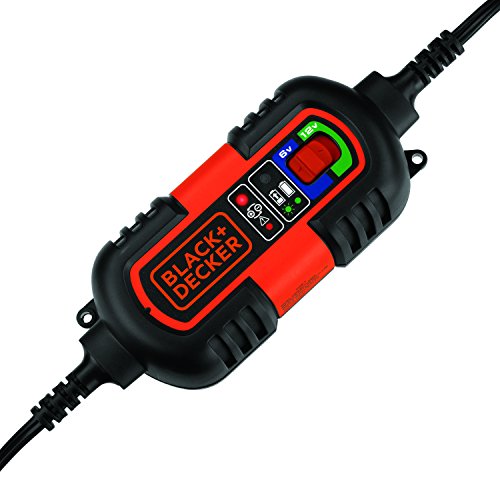
For a weekend car, lawn gear, or a vehicle that sits, Black+Decker fits the middle ground well. It is a practical 12V home charger for flooded, AGM, and often gel batteries, with automatic charging and float maintenance on supported models. It is less convincing when the battery is deeply discharged, the chemistry is unknown, or the goal is to diagnose a no-start that may be alternator-related rather than battery-related.
📊 The Drive says some chargers can be used on 6- or 12-volt batteries. Source: Thedrive.
Specs at a glance
| Spec | What to look for on a Black+Decker unit | Why it matters |
|---|---|---|
| Voltage support | 6V and 12V on some models | Matches small powersports batteries and most car batteries |
| Battery chemistry | Flooded, AGM, gel, and on some chargers lithium-ion support | Wrong chemistry settings can charge poorly or trigger protection |
| Charge current | Low-amp maintenance on 1.5A to 4A class home chargers | Lower output suits storage; higher output helps recovery work |
| Charging behavior | Automatic charging with float maintenance on supported models | Reduces overcharge risk during long storage |
| Recovery behavior | Force or recovery mode on some units | Can start charging very low-voltage batteries, with limits |
| Connection hardware | Battery clamps or ring terminals, plus leads long enough for garage use on many models | Determines how safely and easily you can attach it |
Who it
Black+Decker chargers fit drivers who want a straightforward home-garage tool for storage charging, seasonal cars, and low-drain batteries. They are a sensible buy when the battery is still fundamentally healthy and you need automatic charging, not shop-level diagnostics.
They also suit owners who want a maintainer that can stay connected during off-season storage. A common first-timer mistake is leaving a battery disconnected all winter and expecting it to come back fully ready in spring. A maintainer avoids that slow drain, as long as the battery itself is still serviceable.
Suppose your sedan sits for two weeks and the battery drops after several short trips. A low-amp automatic charger can restore and maintain it without overloading a small battery. That is the right lane for Black+Decker.
If the car cranks slowly even after a full charge, the charger may be doing its job while the battery or charging system is not. That is the point where a charger stops being the answer and diagnosis starts.
What works
Black+Decker’s useful advantage is automation. On supported models, charging moves through initialization, bulk charge, absorption, and float mode, which is the behavior you want in a home garage because it reduces guesswork and helps prevent overcharge during storage.
That float-style maintenance is the main reason to buy one. A maintainer keeps a healthy battery topped off without trying to “cook” it back to life, which matters when a vehicle sits for weeks or months.
Battery amperage matters here. A 1.5A charger is slow but gentle, which fits small batteries and long storage. A 4A unit still stays in home-garage territory, but it gives more headroom for recovery on a larger 12V battery without jumping to shop-style output.
Some Black+Decker chargers are listed for 6V and 12V use, which helps if you also service older toys, motorcycles, or equipment batteries. For car use, 12V is the key number.
Connection hardware matters too. Clamp style affects convenience, and O-ring terminals are useful if you want a semi-permanent storage setup. Longer leads are simply easier to route around a garage without placing the charger where it can be bumped or doused.
What does not?
Black+Decker chargers are not a cure for every dead battery. If a battery has fallen deeply below normal charging thresholds, the charger may refuse to start, or it may start and then report a fault instead of recovery. That is not a defect by itself; it is often the charger protecting itself or flagging a battery that is too far gone.
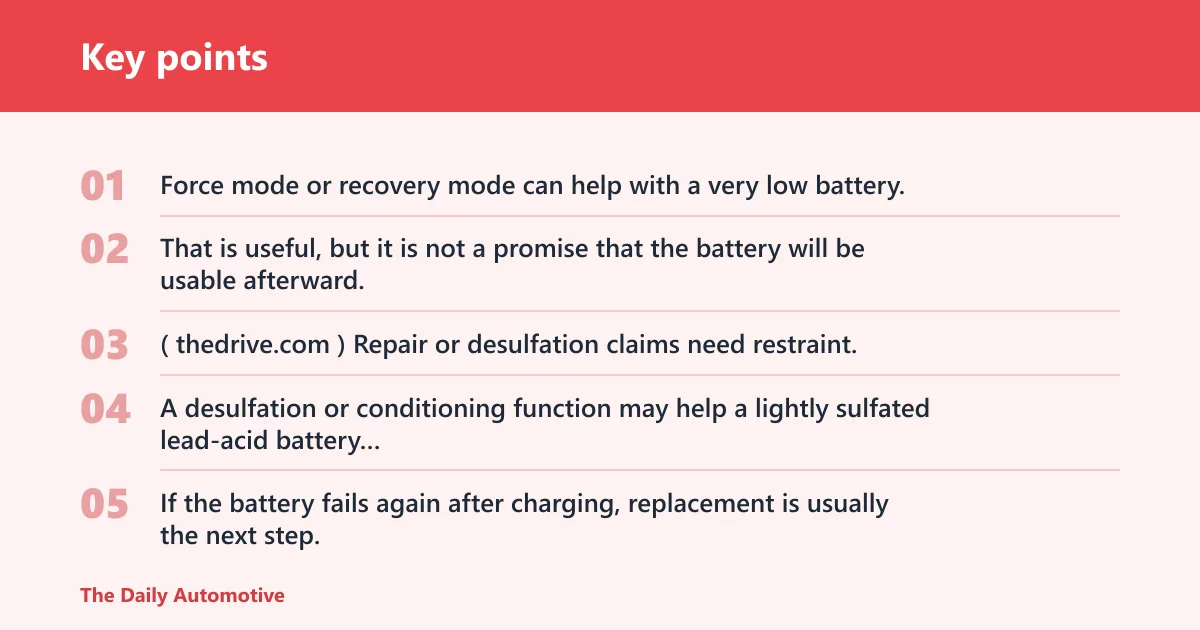
Force mode or recovery mode can help with a very low battery, and The Drive says some chargers can charge batteries as low as one volt, while Force mode can start charging a dead battery down to zero volts. That is useful, but it is not a promise that the battery will be usable afterward. (Thedrive)
Repair or desulfation claims need restraint. A desulfation or conditioning function may help a lightly sulfated lead-acid battery recover some capacity, but it cannot reverse a shorted cell, cracked case, or battery that no longer holds charge after a full cycle. If the battery fails again after charging, replacement is usually the next step.
Chemistry support is also limited by model. The Drive notes some chargers work on gel, flooded, AGM, and lithium-ion batteries, but not every Black+Decker unit supports lithium. Check the label and the manual before connecting anything with a chemistry setting you cannot verify.
Black+Decker is also not a substitute for diagnosing the charging system. If the battery repeatedly comes back weak, the alternator, parasitic draw, or bad cable connection may be the real problem.
Is a Black+Decker car battery charger good for dead batteries?
Yes, for some dead batteries. If the battery is deeply discharged yet still intact, a Black+Decker charger with recovery or Force mode may begin charging. If the battery is internally damaged, shorted, or unable to hold voltage after charging, the charger will not turn it into a reliable battery again.
What counts as “dead” matters. A battery that is flat after lights were left on overnight is different from one that has sat sulfated for months. The first may respond to charging. The second may charge briefly and then collapse again.
For a home user, the safer rule is simple: charge it, then check whether it holds a usable voltage. If it does not hold up after charging and rest, the battery is the problem, not the charger.
Battery charger decision table
| Symptom | Likely battery condition | Charger feature needed | Safe to try | When to replace the battery |
|---|---|---|---|---|
| Lights left on overnight | Deeply discharged but often recoverable | Automatic 12V charging, possibly recovery mode | Yes, if the battery case is intact | If it will not hold charge after a full cycle |
| Winter no-start after sitting | Low state of charge or mild sulfation | Low-amp charger or maintainer function | Yes | If voltage drops quickly after disconnecting the charger |
| Long-term storage | Healthy battery that only needs upkeep | Float charging or maintainer mode | Yes | If the battery self-discharges unusually fast |
| AGM vehicle | Healthy AGM battery needing correct chemistry support | AGM-compatible setting | Yes, if the charger supports AGM | If the battery cannot reach or keep a stable charge |
| Battery won’t hold charge | Possible failed cell or severe sulfation | Recovery attempt only | Yes, once | Often yes, especially if it fails again quickly |
| Very low voltage, near zero | Deep discharge or unsafe condition | Force or recovery mode, if available | Only with manual caution | If the charger will not start or the battery heats up |
| 6V lawn or hobby battery | Small lead-acid battery | 6V support | Yes, on 6V-compatible units | If it fails to take a charge at all |
| Lithium battery in a vehicle or device | Possible lithium chemistry | Explicit lithium support | Only if the manual lists lithium support | If the charger is not rated for that chemistry |
What size Black+Decker charger do I need for a 12V car battery?
For most home-garage use, a low-amp Black+Decker charger is the right fit for a 12V car battery. A 1.5A or 4A class unit suits maintenance and slower recovery, while higher output is only worth it if the battery is larger, very low, and the charger is designed for that job.
The practical match is simple: smaller batteries and storage work favor lower amps, while a bigger battery or a deeper discharge may justify more output. Do not oversize the charger just because it sounds faster. Match the charger to the battery’s chemistry, capacity, and condition.
Say your compact car sits for a month at a time. A maintainer-class charger is usually the better fit than a high-output model, because you are trying to preserve charge, not rush a rescue.
Alternatives

The NOCO GENIUS1 is the cleaner pick if you need broader chemistry support, including lithium, and want Force mode with a published ability to charge batteries down to 1 volt. Based on the manufacturer details and buyer feedback, it is more flexible than a basic maintainer, but it is still a low-amp charger, so it is not a rapid recovery tool for every flat battery.
Compared with Black+Decker’s simpler home-garage models, NOCO’s drawback is that you pay for the extra flexibility even if you never use lithium support. It is the better fit when your garage includes multiple battery chemistries and you want a single compact charger.
Should you buy it?
Buy a Black+Decker charger if your main problem is storage, seasonal charging, or occasional recovery on a 12V lead-acid battery. It makes sense for flooded, AGM, and some gel applications when you want automatic charging and simple home use.
Skip it if your battery is repeatedly failing after charge, if the chemistry is unknown, or if you need a fast rescue tool for frequent dead-start situations. In those cases, a jump starter or a replacement battery may be the smarter move.
Black+Decker also loses value when the real issue is vehicle electronics rather than storage drain. If the battery tests weak after charging, or if the car keeps going flat after short parking periods, the charger is only part of the solution.
Frequently asked questions
Can a Black+Decker charger maintain a battery overnight?
Yes, if the charger supports maintenance or float mode and the battery is healthy enough to accept it. Overnight maintenance is normal for storage use. The point is to hold charge safely, not force a weak battery back into service. If the battery warms up or faults, stop and inspect it.
How long does it take a Black+Decker smart charger to charge a car battery?
Time depends on battery size, depth of discharge, and charger output. A low-amp smart charger is slow by design, which is fine for maintenance and moderate recovery. If the battery is deeply discharged, the charger may spend time in initialization or refuse to proceed until voltage recovers enough to charge safely.
Will a Black+Decker charger work on AGM, gel, or lithium batteries?
Some Black+Decker chargers work with AGM, flooded, gel, and lithium-ion batteries, but chemistry support is model-specific. AGM and gel often need the correct mode. Lithium support is not universal, so check the manual before connecting any lithium pack. Wrong chemistry settings can create charging problems or safety cutoffs.
What should I check if my Black+Decker battery not charging?
Check polarity, clamp contact, outlet power, selected voltage, and whether the battery is too deeply discharged for normal charging. Also look for fault lights and confirm the battery chemistry matches the charger. If the battery accepts a charge but quickly falls back down, the battery may be failing rather than the charger.
Is a Black+Decker charger better than a battery tender?
Not always. A Battery Tender Junior is straightforward and simple to use, but The Drive says it can only maintain charge, not revive a dead battery. Black+Decker is the better fit if you want more recovery flexibility. If your battery only needs upkeep, a simpler maintainer may be enough.
What do the Black+Decker battery charger instructions actually mean?
They usually refer to voltage selection, chemistry mode, clamp placement, and whether the unit is in charge, float, or fault status. Pay special attention to the difference between charging and maintaining. If the manual mentions recovery or Force mode, treat it as a rescue feature with limits, not a promise of battery repair.
Products related to this article
Sponsored / affiliate links. As an Amazon Associate I earn from qualifying purchases. I may earn additional commission from eligible campaigns.