Camera for Car Security: Tested & Reviewed (2 Picks)
For street parking and apartment garages, choose a buffered parking-mode dash cam. For live theft alerts and remote checking, choose a connected 4G car security camera. Pick the wrong one and you may miss the first impact, lose usable footage, or learn about a break-in only after the damage is done. This guide compares two picks, explains who each may suit, and shows which camera may be a good choice for parking and theft evidence.
Quick picks at a glance


| Pick | Best for | Security strategy | Ownership cost |
|---|---|---|---|
| VIOFO A229 Pro | Evidence after a hit, break-in, or vandalism | Buffered parking mode with front and rear recording | Camera price plus hardwire kit and microSD card |
| FOCUWAY L7 4G LTE Dash Cam | Live alerts, remote viewing, stolen-car monitoring | 4G LTE live view with cloud-backed access | Camera price plus data plan and any subscription |
Best for evidence after a break-in
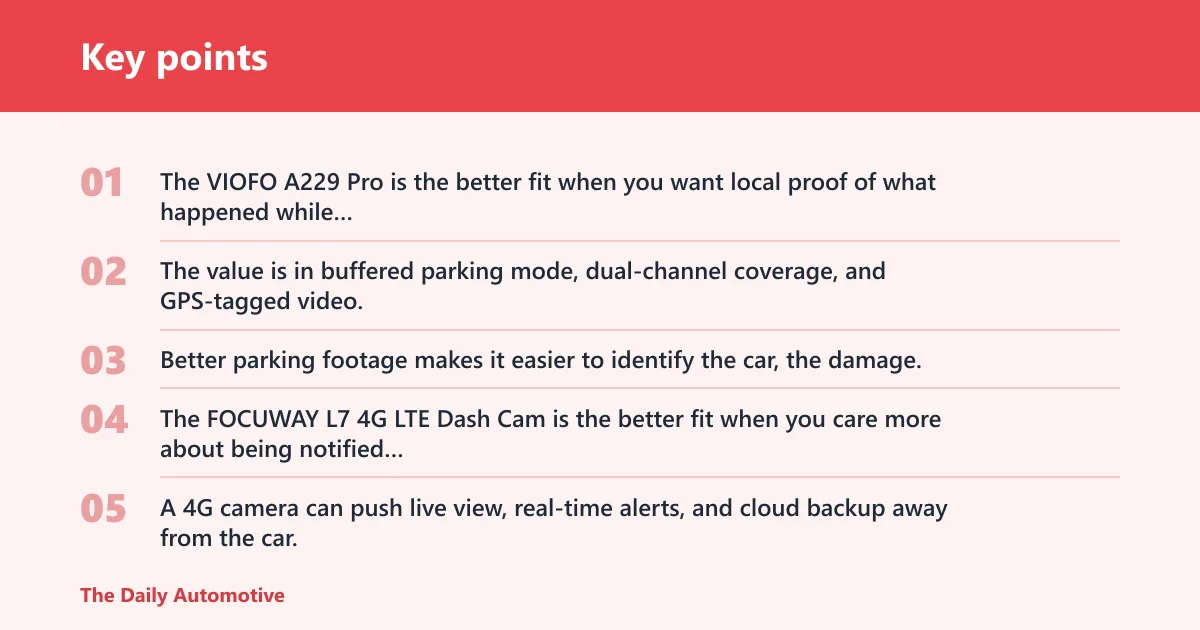
The VIOFO A229 Pro is the better fit when you want local proof of what happened while the car was parked. The value is in buffered parking mode, dual-channel coverage, and GPS-tagged video, not in remote alerts. Better parking footage makes it easier to identify the car, the damage, and the order of events.
Best for live alerts and remote viewing
The FOCUWAY L7 4G LTE Dash Cam is the better fit when you care more about being notified during the incident than retrieving a clip later. A 4G camera can push live view, real-time alerts, and cloud backup away from the car, which matters if the vehicle sits on the street or in a lot you do not check often.
Buffered parking-mode dash cams
A buffered parking-mode dash cam records a short segment before an event, not only after it. That matters because the first seconds often show the plate, the person, or the force of the hit. Parking mode usually combines motion detection, impact detection, and a time-lapse option, but it needs hardwire power or another external source to keep running.
Why buffered recording matters
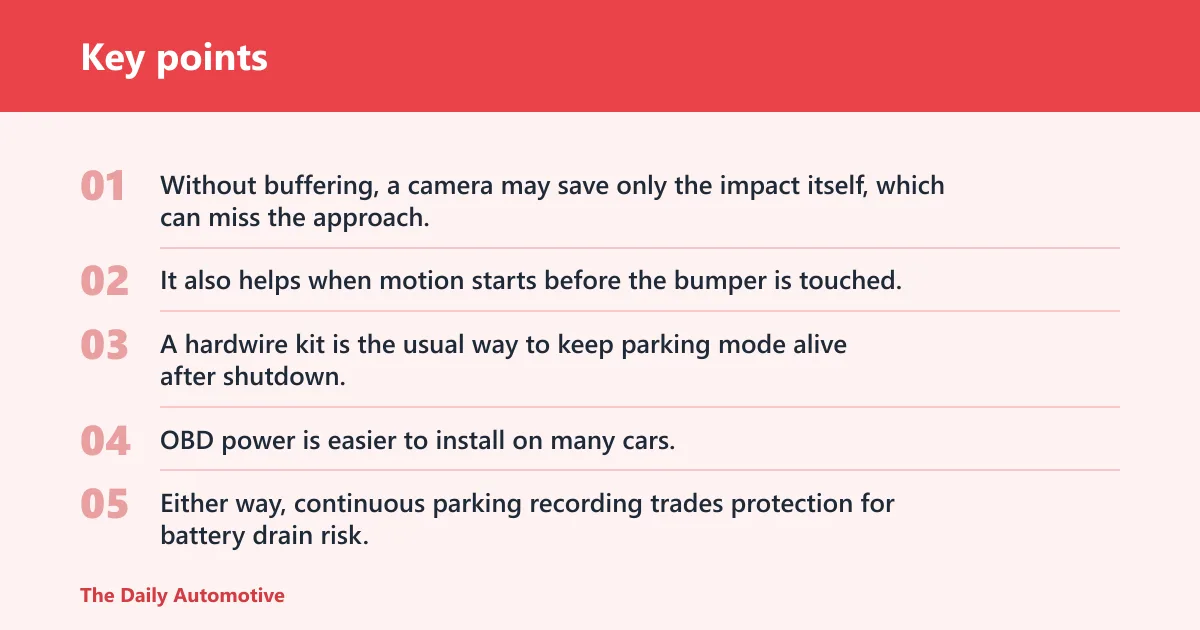
Without buffering, a camera may save only the impact itself, which can miss the approach, the plate, or the hand reaching into the cabin. Buffered recording adds context. It also helps when motion starts before the bumper is touched, such as someone circling the car or leaning in through an open door.
What hardwiring adds
A hardwire kit is the usual way to keep parking mode alive after shutdown. OBD power is easier to install on many cars, but it is not the cleanest option for every vehicle and may not support the same low-voltage cutoff control as a dedicated hardwire kit. Either way, continuous parking recording trades protection for battery drain risk.
Where this setup falls short
Buffered parking mode cannot warn you in real time. If a thief removes the camera, steals the memory card, or blocks the lens, the evidence can go with it. Motion alerts can also overfire in busy lots, especially if headlights, pedestrians, or passing carts keep waking the sensor.
4G live-view security cameras
A 4G LTE car security camera is built for remote access first. It can send live view, real-time alerts, and cloud backup through a cellular connection, so you can check the car even when you are nowhere near it. That is a different job from local recording. It is surveillance you can reach from your phone.
How live alerts work
These cameras usually pair an optional module or a built-in SIM with a data plan. When motion, impact, or door activity triggers the unit, it can send a push alert and upload video to the cloud. That reduces the chance that a stolen camera takes the only copy of the footage with it.
What the data plan changes
Ownership cost rises fast once LTE enters the picture. You are paying for the camera, the cellular plan, and sometimes cloud storage. That makes a 4G camera better for high-risk parking, fleet use, or vehicles that sit unattended for long stretches. It is harder to justify for a garage-parked commuter car.
When connected monitoring is worth it
Connected monitoring makes sense if you need to know about an event while it is happening. Suppose your car sits on a street overnight and the cabin gets disturbed at 2 a.m. A 4G camera can notify you then, not the next morning. The tradeoff is monthly cost and more setup.
Do car security cameras work when the car is parked?
Yes, but only if the camera supports parking mode and has power after the ignition turns off. Motion detection can catch someone walking near the car, while impact detection records a hit, bump, or break-in attempt. Some cameras also use time-lapse to save storage during long parked periods.
Motion detection versus impact detection
Motion detection is useful, but it is noisy. Shadows, passing cars, and headlights can trigger it. Impact detection is more precise for vandalism and collisions because it wakes the camera after a physical jolt. The best parking setups use both, then save a buffered clip before and after the trigger.
Why parking mode needs external power
A dash cam that runs all night from its own internal battery is usually not practical. Parking mode typically needs a hardwire kit, OBD power, or another continuous source. That is how you get 24/7 protection, but the tradeoff is battery drain, voltage cutoff settings, and more installation work.
What footage you still get after the car is hit
You should still get the event clip, but not always the whole story. If the plate is blocked by angle, darkness, or a quick turn, the video may identify the vehicle class or color rather than the exact plate. That is why parking cameras matter most when they record the approach, not only the damage.
Do you need Wi-Fi or 4G for alerts?
Wi-Fi is enough for phone playback, settings control, and quick clip downloads when you are near the car. 4G is different. It gives true remote access, live view, and alerts from anywhere with cell service. If the camera only uses Wi-Fi, it cannot call you when the car is blocks away.
Phone playback versus true remote access
Wi-Fi app control is useful for changing settings, checking clips, and downloading footage faster over 5GHz or dual-band connections. It does not solve the unattended-car problem by itself. Once you leave the parking area, the phone is no longer connected unless the camera also has cellular service.
Cloud backup and retention limits
Cloud backup is helpful when the camera is stolen or the memory card is damaged, but it adds subscription cost and usually retention limits. Local microSD storage still matters because loop recording overwrites old files once the card fills up. Event files may be protected, but a full card can still erase non-locked footage.
When Wi-Fi is enough and when it is not
Use Wi-Fi if you mainly want local evidence, fast clip transfer, and lower monthly cost. Use 4G if you want live alerts, remote checking, or cloud backups that survive theft. A common first-timer mistake is buying a “security” camera that only talks to your phone when you are standing beside the car.
Which setup fits your parking situation?
The right answer depends on where the car sits and what failure you care about most. Street parking leans toward remote alerts and buffered recording. Apartment garages favor evidence after the fact. Rideshare and fleet use often need broader coverage. High theft risk pushes the choice toward connected monitoring.
Street parking
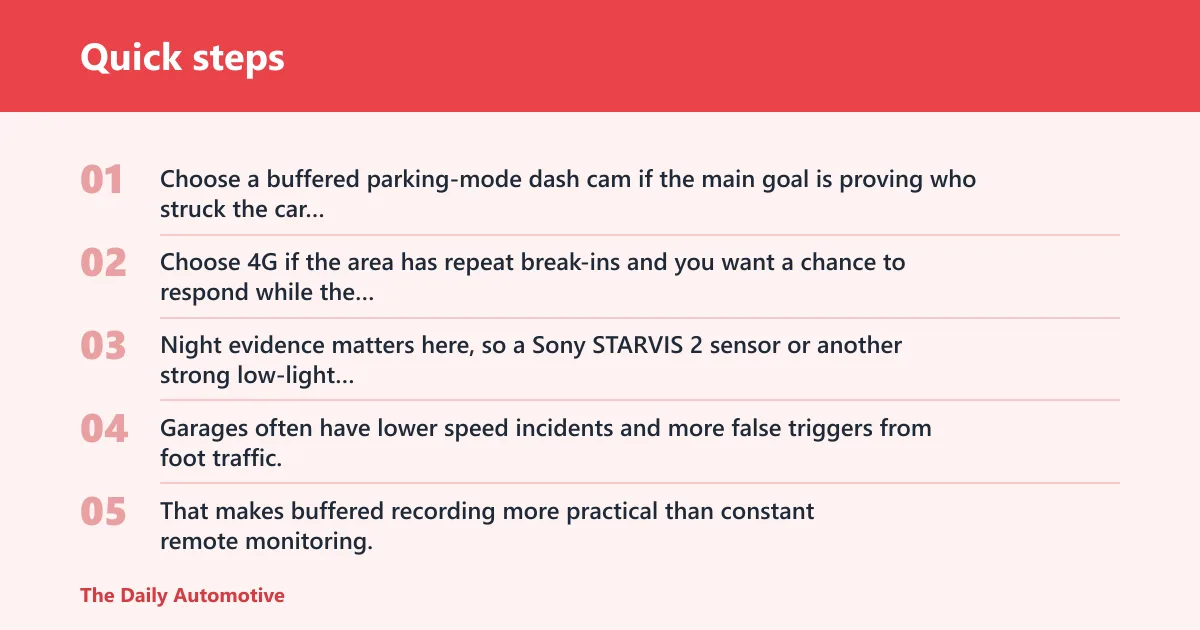
Choose a buffered parking-mode dash cam if the main goal is proving who struck the car or who tried the door. Choose 4G if the area has repeat break-ins and you want a chance to respond while the incident is active. Night evidence matters here, so a Sony STARVIS 2 sensor or another strong low-light setup is worth prioritizing.
Apartment garage
Garages often have lower speed incidents and more false triggers from foot traffic, carts, and nearby headlights. That makes buffered recording more practical than constant remote monitoring. You still want good night footage, but you may not need the recurring monthly cost of LTE unless theft is common in the building.
Rideshare and fleet use
Rideshare and fleet vehicles benefit from multi-channel coverage because incidents can happen inside and outside the car. A dual-channel dash cam covers front and rear, while a 360-degree or 4-channel setup can add side and interior coverage. The PRUVEEO 4-Channel 360 is the right kind of tool when interior events matter as much as parking protection.
High theft risk
High theft risk is where 4G earns its keep. If the camera is ripped out, a cloud copy may still exist. If the car is moved, live view and alerts give you a better chance of tracing it quickly. That is the main difference between local evidence and remote security.
Car security camera decision matrix
| Buyer condition | Buffered parking-mode dash cam | Connected 4G live-view camera |
|---|---|---|
| Street parking | Strong for evidence after a hit | Stronger for immediate alerts |
| Apartment garage | Usually the better value | Only worth it if theft is frequent |
| Rideshare use | Good if you want front and rear proof | Useful if you also need remote oversight |
| Theft risk | Evidence can be lost with the camera | Cloud backup lowers evidence loss risk |
| Need for live alerts | Poor fit | Best fit |
| Install difficulty | Hardwire kit or OBD power required | More setup, especially with SIM and app pairing |
| Ongoing monthly cost | Usually low after purchase | Higher because of data plan and possible cloud fees |
| Night evidence quality | Best when paired with a Sony STARVIS 2 sensor | Depends on sensor and uplink quality |
| Stolen-camera risk | Higher if the card is inside the unit | Lower if cloud backup is active |
| Power requirements | Continuous parking power needed | Continuous power plus cellular power budget |
How to choose
- Pick buffered parking mode if your main question is, “Who hit my car?”
- Pick 4G live view if your main question is, “Can I know while it is happening?”
- Choose dual-channel if you want front and rear coverage, especially for rear-end parking claims.
- Choose 360-degree or 4-channel coverage if you need side or interior evidence too.
- Check for 5GHz or dual-band Wi-Fi if you want faster clip download and easier settings control.
- Budget for the full setup: camera price, hardwire kit or OBD power, microSD storage, and any LTE or cloud fees.
- Do not ignore low-light performance. Parking lots punish weak night footage.
- Set expectations for false alerts and plate visibility. Angle, glare, and darkness still matter.
Say your sedan parks under a streetlamp in an apartment lot and someone scrapes the rear bumper at 11:40 p.m. A buffered dual-channel camera is the right tool, because the clip should show the impact and the vehicle path without monthly fees. The plate may still be hard to read if the car turns away too fast.
Suppose your SUV sits in an open lot near a train station for two days at a time. A 4G camera makes more sense, because the main value is live alerts and cloud-backed evidence if someone tampers with the car or removes the unit. That is a different risk profile from simple parking damage.
Frequently asked questions
What is the best camera for car security?
The best choice depends on the threat. For evidence after a hit or break-in, a buffered parking-mode dash cam is usually the better pick. For live alerts and remote monitoring, a 4G LTE camera is stronger. The VIOFO A229 Pro fits the first job; the FOCUWAY L7 fits the second.
Which car security camera has the best parking mode?
Buffered parking-mode dash cams are the strongest choice for parking evidence because they save the seconds before the trigger. Dual-channel models add front and rear context. If you need a broader perimeter, a 360-degree or 4-channel setup can be better, but it usually adds complexity and cost.
Do I need Wi-Fi or 4G for car security monitoring?
Wi-Fi is enough for clip downloads, settings changes, and local phone playback when you are near the car. 4G is needed for true remote access, live view, and off-site alerts. If the vehicle is often unattended, cellular monitoring is the better security layer, even with the added monthly cost.
What is the difference between a dash cam and a car security camera?
A dash cam usually records locally for evidence after the fact. A car security camera may do that too, but it often adds parking surveillance, remote alerts, cloud backup, or wider coverage. The bigger difference is whether the camera only saves video or also warns you while the car is unattended.
How much does a car security camera cost?
CherryPicks reported an average price of $47.62 across its selected cameras, with a low of $8.90 and a high of $219.99 in its market overview. Real ownership cost can be higher once you add a hardwire kit, microSD card, professional installation, or an LTE data plan and cloud subscription.
Products related to this article
Sponsored / affiliate links. As an Amazon Associate I earn from qualifying purchases. I may earn additional commission from eligible campaigns.