Best Car Cameras for Security (2026): We Compared
Buffered parking mode is the better car security camera setup for most drivers because it saves the seconds before impact. Choose LTE remote live view only if you need live alerts and will pay for data. Without buffered recording, a smash-and-grab or hit-and-run can leave you with only the aftermath, which weakens police reports and insurance claims. This guide compares both architectures, explains where each captures usable evidence, and shows which one fits parking theft, vandalism, and overnight monitoring.
Quick comparison
| Product | Badge | Best for | Price | ||
|---|---|---|---|---|---|
 |
VIOFO A129 Pro Duo 4K Dual Dash Cam 3840 x 2160P Ultra HDVIOFO | Our pick | 4K dual-channel ·, · buffered parking mode | $199.95
Price as of 25 Oct 2026
|
View |
 |
4G LTE Dash Cam with Live View,2K+1080P Front-Inside CarGEREE | Also great | 2K+1080P dual-channel ·, · 4G LTE live view | $128.99
Price as of 25 Oct 2026
|
View |
 |
70mai A810 Lite 4K Dash Cam Front and Rear, 5GHz Wi-Fi 670mai | Also great | $89.98
Price as of 25 Oct 2026
|
View | |
 |
THINKWARE U3000 PRO Dash Cam 4K Front, Sony STARVIS 2,THINKWARE | Also great | $479.99
Price as of 25 Oct 2026
|
View | |
 |
ROVE Ultimate Dash Cam Hardwire Kit, USB-C Port, 24HrROVE | Also great | $29.99
Price as of 25 Oct 2026
|
View |
The core trade-off is simple: buffered parking mode preserves evidence, while LTE live view lets you check the car from your phone. That difference matters most when the event happens fast, at night, or in a lot where you are nowhere near the vehicle.
How we chose
We compared the two architectures on five checks that affect real security outcomes: pre-event recording, remote awareness, low-light capture, parking power requirements, and total cost to run. Also keep coverage in view, because front-only footage can miss a shove, scrape, or tow truck at the side or rear.
Price was only used where product data was provided, and every cost stack below includes the parts buyers often forget: hardwire kit, storage card, and any LTE plan or cloud fee. That makes the comparison useful for ownership, not just checkout.
Security camera decision matrix
Here is the decision matrix for the failure cases that matter most, parking dings, break-ins, tow-aways, long-stay lots, and dark garages. Buffered parking mode wins on evidence quality because it can save the seconds before impact. LTE wins on awareness because it can alert you while the event is still unfolding.
| Failure case | Buffered parking mode cam | LTE live view cam | Why |
|---|---|---|---|
| Parking-lot ding | 5/5 | 3/5 | Buffered video can catch the approach and contact; LTE may notify you, but notification timing does not improve the clip itself. |
| Break-in | 4/5 | 4/5 | Both can work if motion or impact wakes the camera, but LTE adds a live alert while buffered video usually gives the cleaner evidence trail. |
| Tow-away | 3/5 | 5/5 | LTE is better if you want to know while the car is being moved. Buffered footage may still document the tow, but only if the camera stays powered and aimed well. |
| Long-stay parking | 5/5 | 2/5 | Buffered parking with low-voltage protection is built for days away. LTE depends on plan cost and cloud access, which matters more the longer the car sits. |
| Low-light capture | 5/5 for models with Sony STARVIS 2 and HDR | 3/5 | Sensor quality and HDR matter more than app access in dark lots. LTE can help you check status, not improve the image by itself. |
Cost stack, before you buy: a parking-capable camera, a hardwire kit, a high-endurance microSD card, and, for LTE models, a data plan or cloud fee. The hidden cost is storage wear: dual-channel and four-channel recording fill cards far faster than a basic front-only setup.
Say your car is parked under a dim garage light for three nights. A front bumper scrape at 1:12 a.m. is the kind of event buffered recording is meant to preserve, because the seconds before contact often show the other vehicle’s approach, plate angle, or door swing. LTE may alert you, but it cannot recover footage that was never buffered.
Buffered parking mode cam: best for evidence capture
VIOFO A129 Pro Duo is the better pick if your priority is preserving the moment before contact. Based on the published specs, it records 4K front and 1080P rear video, includes buffered parking mode, and adds built-in GPS and Wi-Fi for review and setup.
That mix suits theft evidence, hit-and-runs, and curbside dings. The rear channel matters here, because a side swipe, reverse bump, or tailgate tap often starts outside the front camera’s view.
The drawback is simple: this is a local-recording security camera, not a phone-first monitoring system. You still need a hardwire kit for parking use, and you still need to manage storage size and overwrite cycles.
Why buffered recording matters
Buffered parking mode keeps a short pre-event buffer, then saves the clip after motion or impact detection triggers. That is the part most buyers want when a car is dinged, nudged, or opened without permission.
VIOFO’s three parking modes are useful because no single trigger fits every lot. Motion detection can catch approach behavior, impact detection can save an actual hit, and time-lapse can reduce file size during long stays.
Parking power, storage, and overwrite limits
Parking mode usually depends on a hardwire kit connected to the fuse box or OBD-II power, plus low-voltage protection so the camera does not drain the starter battery. That is not optional for 24/7 parking use on most setups.
A common first-timer mistake is putting a dual-channel camera on a small card and expecting a week of uninterrupted parking clips. Multi-channel recording creates large files, and once the card fills, older clips overwrite first unless the event is locked.
Where dual-channel coverage helps
Dual-channel dash cams split resolution between front and rear, but the trade-off is worth it for security. Front-only 4K can miss the rear plate, the door-side approach, or a tow hook that appears behind the car.
GPS tagging also matters because a case report often needs time and location, not only video. That makes dual-channel models better suited to parking surveillance than a single front camera, even when the front lens has the higher resolution.
LTE live view cam: best for remote awareness
GEREE 4G LTE Dash Cam is the better fit if your main need is to check the car from anywhere. Its published features include 4G LTE remote live view, cloud uploads, 2K front plus 1080P cabin recording, instant app alerts, and 24H parking mode.
That makes it useful when you want to know whether someone is near the car, whether the alarm has tripped, or whether the vehicle is still where you left it. It is a phone-first tool for awareness.
The drawback is cost and dependency. LTE requires a data plan or cloud service, and remote access does not automatically improve evidence quality if the camera’s view is blocked, the signal is poor, or the event happens after the camera has already been moved or shielded.
Remote live view and push alerts
LTE dash cams stand apart because they can push alerts and stream live video without waiting for local Wi-Fi. FOCUWAY’s L7 shows the same category idea with 4G LTE remote live view and cloud uploads.
That matters most when the car sits far away from you. If a tow truck starts moving the vehicle, a live alert can tell you sooner than a memory card review ever could.
Cloud access versus local storage
Cloud access helps when the car is out of reach, but it does not replace local storage. If the network drops, the app is slow, or the plan lapses, the camera still needs on-device recording to preserve the clip.
Local storage is also more predictable for long-stay parking. You are not dependent on subscription status, and you are not paying monthly for footage that may never be viewed.
When monthly data makes sense
LTE is worth it when the vehicle is parked in an area with theft risk, the driver needs live alerts, or the car is tied to fleet or rideshare operations. In those cases, remote awareness can be more useful than waiting to review clips later.
It is a weaker fit for drivers who only want evidence after the fact. Those buyers usually get more value from a buffered camera and a strong microSD card than from recurring cloud fees.
Thinkware U3000 Pro: best for night parking
Thinkware U3000 Pro is the strongest night-parking option in this list because it combines Sony STARVIS 2, radar parking mode, HDR, and 4K front plus 2K rear recording. The published package also includes a 64GB card, CPL filter, and hardwiring cable.
The radar parking mode is the standout. Thinkware says it wakes the camera on approach, which can reduce unnecessary recording and help preserve battery while still catching a real person moving toward the vehicle.
The drawback is price. It is the most expensive camera here, and buyers still need to think about storage capacity if they plan to keep long parking clips or use the rear channel heavily.
Why sensor quality matters more than headline resolution
4K does not automatically mean better security footage after dark. A strong sensor and HDR often matter more when the camera has to read a face, plate reflection, or clothing color under weak lot lighting.
Sony STARVIS 2 is relevant here because it is built for low-light clarity, and the U3000 Pro pairs it with HDR. That combination is more useful than a high pixel count alone when the parking area is badly lit.
Radar parking mode versus motion detection
Radar parking mode has one practical advantage over simple motion detection: it wakes when something approaches, instead of waiting for the camera’s image processor to decide whether movement is real. That can cut down on false triggers from rain, shadows, or passing headlights.
Motion detection still has value, especially where radar cannot see cleanly. But for security, radar is often the better first choice because it is tied to approach, not just pixel motion.
ROVE Ultimate Hardwire Kit: best for parking power
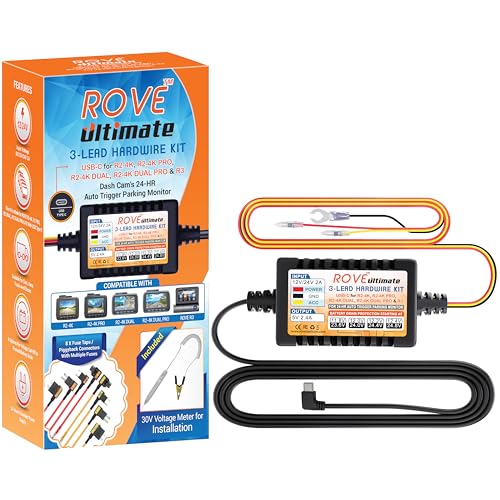
ROVE Ultimate Dash Cam Hardwire Kit is not a camera, but it matters for anyone building a secure parking setup. The published details say it fits ROVE R2-4K, R2-4K PRO, R2-4K DUAL, DUAL PRO, and R3 models with USB-C ports, and it includes low-voltage protection for 24-hour parking monitoring.
That makes it a practical accessory for drivers who want parking mode without draining the starter battery. A proper hardwire kit is what turns parking mode from a menu option into an actual overnight protection setup.
The drawback is obvious: it is only useful with compatible ROVE cameras, and it adds install work that some buyers would rather avoid.
Fuse-box and OBD-II power options
Hardwire kits usually connect to the fuse box, though some setups use OBD-II power. Either way, the goal is the same: keep the camera running after the ignition turns off while protecting the battery from deep discharge.
If you want parking surveillance, this is the part that matters more than a flashy app. No hardwire kit usually means no true 24-hour parking mode.
Why supercapacitors still matter
Supercapacitors are preferred over lithium batteries in many dash cams because they handle heat better and shut down more safely. They also tend to behave better in winter than small internal batteries that dislike cold starts and parking abuse.
For a security camera that sits in a hot windshield or cold garage, that matters. A supercapacitor does not replace hardwire power, but it can make shutdowns more reliable and reduce battery-related failure risk.
How to choose the right model
The right choice depends on the event you fear most. If you want the best evidence trail, buffered parking mode is the safer bet. If you want live awareness from your phone, LTE is the better fit.
- Pick a camera with buffered parking mode if your concern is vandalism, side swipes, or hit-and-runs.
- Pick LTE if your concern is knowing right away that someone is near the vehicle, or that the vehicle has moved.
- Choose dual-channel if you want front and rear coverage, especially in public lots or curbside parking.
- Choose a model with Sony STARVIS 2, HDR, or both if your parking area is dark.
- Budget for a hardwire kit and high-endurance microSD card before you budget for extras.
Picture a garage where a sedan is parked nose-in, but the only damage is a rear bumper scrape from a reversing SUV. A front-only 4K camera may miss the plate entirely. A dual-channel setup has a far better chance of catching the car that backed into it.
Choose VIOFO A129 Pro Duo if… / Choose GEREE 4G LTE Dash Cam if…
Choose VIOFO A129 Pro Duo if you want the stronger evidence trail, you care about pre-event buffer footage, and you are willing to hardwire the camera for real parking coverage. It is the better call for hit-and-run proof, overnight street parking, and drivers who want both front and rear evidence.
Choose GEREE 4G LTE Dash Cam if you want remote live view on your phone, need instant alerts, or park somewhere where early awareness matters more than the cleanest clip. It is the better fit for drivers who will pay for data and cloud access to watch the car in real time.
Budget rule: if you are trying to keep ownership cost down, factor in camera price, hardwire kit, microSD card, and any LTE plan before you compare headline features. A cheap LTE camera can end up costing more over time than a pricier buffered model with local storage.
For night security: Thinkware U3000 Pro is the strongest pick here because of radar parking mode, Sony STARVIS 2, and HDR. For many drivers, that combination matters more than a phone app.
Which one should you buy?
If your goal is proof after a parking incident, buy the buffered parking mode camera. It captures the seconds before impact, works well with dual-channel coverage, and avoids monthly plan costs.
If your goal is to check on the car from anywhere, buy the LTE camera. It is the better tool for live alerts, tow-away awareness, and app-based control, provided you accept the recurring cost.
Do not spend for LTE if you only need footage after an incident. Do not spend for 4K alone if the camera cannot see in the dark or cannot buffer the event before the hit.
For most drivers, the best value is a buffered dual-channel camera plus a hardwire kit and a high-endurance card. That setup gives you the strongest balance of evidence, reliability, and ownership cost.
Frequently asked questions
What is the best car camera for security while parked?
For most drivers, the best parked-security setup is a buffered parking mode camera with front and rear coverage. It captures the seconds before contact, which is the part most likely to identify a door ding, reverse bump, or break-in attempt. LTE is better only if remote awareness matters more than clip quality.
Do I need a hardwire kit for parking mode on a car camera?
Usually yes. Parking mode needs power after ignition shuts off, and a hardwire kit is the normal way to supply it while protecting the battery with low-voltage cutoff. Some accessories can also power parking use, but true overnight monitoring usually depends on hardwiring.
Is 4K front recording enough for security or do I need rear coverage too?
Front-only 4K helps, but it is not enough for every case. Rear coverage matters for tailgates, backing collisions, tow-away events, and many curbside hits. A dual-channel camera is the safer choice when you want a fuller evidence trail.
What is buffered parking mode on a dash cam?
Buffered parking mode keeps a short pre-event recording before motion or impact triggers the camera. That means the clip includes what happened just before the hit, not only the aftermath. For security, that pre-roll is often the difference between a useful report and a vague one.
Are LTE dash cams worth the monthly data plan?
They can be, but only for drivers who really need live alerts and remote checks. LTE helps when the car is far away, but the plan adds recurring cost and does not improve footage by itself. If you only need evidence after an event, local storage is usually the better value.
What is better for security: radar parking mode or motion detection?
Radar parking mode is usually better for security because it wakes on approach and is less prone to false triggers from shadows, rain, or changing light. Motion detection still works, but radar is often more selective and more useful in busy parking areas.
Which dash cam is best for night parking lot footage?
The Thinkware U3000 Pro is the strongest night option in this comparison because it combines Sony STARVIS 2, HDR, radar parking mode, and 4K front plus 2K rear recording. That matters more in dark lots than a headline resolution number alone.
Products related to this article
Sponsored / affiliate links. As an Amazon Associate I earn from qualifying purchases. I may earn additional commission from eligible campaigns.