Christmas Light Kit for Car: Types, Legal Rules, and Our Pick
For car Christmas lights, use exterior-rated LED kits only when parked; if the car will move, choose a no-exterior-lights setup. Bad placement can mean tickets, failed inspections, blown bulbs, battery drain, or a light show that blocks signals and visibility. This guide ranks legal risk by location, motion, and driving status, then helps you pick the right kit for your use case. The best all-around buy here is the Aurelema 12V Christmas 33 ft 100 LED Car LED String Light for a parked display, because it is built around a 12V vehicle outlet and outdoor use rather than household-only power.
Legal note and methodology: vehicle-lighting rules vary by state, and local enforcement can be stricter than the baseline state code. This guide uses federal safety references such as NHTSA guidance and FMVSS No. 108 as a safety baseline, then compares common state vehicle-code patterns on required lamps, color restrictions, flashing/emergency-like lighting, and plate visibility. Examples include California Vehicle Code rules on lighting and plate visibility, New York Vehicle and Traffic Law restrictions on colored lights and lamps, and Texas Transportation Code provisions on prohibited lights and required equipment. Always verify your state, county, and parade/event rules before buying or installing decorative lighting.
| Mounting method | Visibility risk | Enforcement risk | Why it ranks there |
|---|---|---|---|
| Roof rack | High | High | Most likely to be seen from distance and most likely to interfere with roofline sightlines or loose wiring. |
| Grille | High | High | Can obstruct or wash out required front lighting and attract attention from the front of the vehicle. |
| Window | Medium | High | May interfere with driver visibility and can look like an emergency or parade light pattern from the outside. |
| Trunk | Medium | Medium | Usually easier to control than roof or grille mounting, but it can still block plate or tail-lamp visibility. |
| Bed rails | Low to medium | Medium | Often less likely to interfere with the cab, but wiring still needs secure routing and clear rear visibility. |


Must-have
For a parked holiday display, start with a simple exterior-rated string light kit that stays away from lamps, the plate, and moving parts. For a road-going car, the safest setup is no exterior lights at all. State and local vehicle lighting laws decide whether decorative lights are allowed on a moving vehicle, and local police or highway patrol enforce them. For a quick legal overview, see the context in car underglow rules and visibility concerns and the state-by-state discussion in state and local law controls.
Our pick for a parked display

Aurelema 12V Christmas 33 ft 100 LED Car LED String Light is the clearest fit for a parked car, truck bed, or tailgate display where you want a vehicle-power option instead of a household battery pack. Its listing calls out a standard 12V car outlet, waterproof construction, and simple holiday decorating.
Why it matters: the 12V setup avoids improvising power, and the outdoor build is more appropriate for exterior holiday use than a bare indoor string. Drawback: it still needs careful routing, because any strand that covers the plate, headlights, tail lights, turn signals, sensors, or the driver’s view can create an enforcement issue.
Federal lighting standards and NHTSA guidance matter here, but they do not generally create a free pass for decorative exterior lighting on a moving car. FMVSS No. 108 covers required lamps, reflective devices, and associated equipment, while state laws decide whether a decorative setup is allowed in motion. In practice, that means a display can be fine at rest and still draw a citation once it is driven on public roads.
Say your SUV is parked in a driveway for a neighborhood event. A 33-foot string can work if it is clipped down, kept off hot parts, and routed so the plate and lamps stay fully visible. If the same SUV rolls onto public streets, the risk changes immediately.
What makes a kit road-safe to mount
Road-safe mounting is about control, not sparkle. Automotive-grade clips or tie-downs should hold the wiring against vibration and road speed, and the setup should avoid loose strands that can snag, whip, or drop onto the roadway. If you use a power source, follow the vehicle and product manual, never exceed the vehicle’s rated limit, keep items out of airbag zones and the driver’s view, and check local laws. California Vehicle Code section 24600 and similar state provisions show how required lighting and visibility rules are treated as equipment issues, not decoration choices.
Loose wire is a common failure point. So is a battery or power lead hanging where a door, hatch, or hood can pinch it.
Power source and wiring basics
For a parked display, a 12-volt vehicle outlet or other correctly rated source is simpler than a jury-rigged inverter setup. The power source must be secured, and battery drain is a real concern if the lights run while the engine is off or the car sits unattended. Texas Transportation Code Chapter 547 and comparable state equipment rules show that the power source matters less than whether the final installation is secure, compliant, and non-obstructive.
Do not up-rate a fuse just to stop a nuisance blow. Use the manufacturer’s stated fuse or protected lead, or confirm the correct value in the vehicle manual if the kit plugs into an accessory circuit.
Can you drive with Christmas lights on your car?
Usually not a good idea. Whether you can drive a decorated car depends on where you live and whether the lights flash, but public-road driving is where restrictions tighten fast. Steady, non-obstructive lighting may still violate local rules, and anything that hides required equipment or distracts other drivers raises the risk further. New York Vehicle and Traffic Law and similar state codes generally treat colored lights, emergency-like lighting, and equipment obstruction seriously.
Parked car versus moving car
Parked displays are usually easier to legalize because they avoid road rules. Many jurisdictions allow decorative lights while a vehicle is stationary at a parade or festival, but that is not the same as ordinary street driving. A permit may also matter for a parade route or special event, and any approval usually depends on the route rules and event conditions rather than a broad waiver.
For a moving vehicle, the bar is much higher. Red and blue lights are the biggest legal risk colors because they can resemble emergency vehicles, especially when visible from the front.
Why steady-burning is safer than flashing
Flashing, strobe, or twinkle patterns are often the first thing that gets attention from police or a highway patrol stop. A steady-burning setup is generally safer than chase or twinkle effects, but it still does not solve plate obstruction, lamp visibility, or state-law limits on decorative exterior lighting. FMVSS No. 108 and state statutes both reflect the same practical concern: lighting should help visibility, not mimic official equipment.
Suppose a sedan has a twinkle pattern across the grille and hood. Even if the bulbs are small, the pattern can look emergency-like, and a single strand crossing the front plate can turn a harmless decoration into a ticket.
When a parade permit may matter
Parade and festival rules are separate from everyday street use. A permit or event-specific approval may allow decorative lighting while stationary or moving slowly in a controlled setting, but that permission does not carry over to normal driving once the event ends. This is where local ordinances and event permits often override what a state code might otherwise allow for private decorative use.
If you plan to use a decorated car in a parade, confirm the route rules before you buy the kit. That is the point where color, flashing, and mounting method matter most.
Car light kit decision matrix
This matrix sorts the main use cases by where the lights sit, how they are powered, and how much legal risk they create. The safest answer for street driving is still no exterior decorative lighting. Parked display is the easiest lane to manage, and parade use sits in the middle only when the event rules allow it.
| Use case | Parked display | Parade use | Street driving | Power source | Best light type | Legal risk level | Common failure point |
|---|---|---|---|---|---|---|---|
| Aurelema 12V Christmas 33 ft 100 LED Car LED String Light | Yes | Possible only if event rules allow | No | 12V vehicle outlet | Steady-burning exterior string | Medium for parked use; high for driving | Loose routing across the plate or lamps |
| Joomer Battery Operated Christmas Lights, 66FT 200LED 8 Modes & Timer | Yes | Possible only if event rules allow | No | Battery powered | Outdoor LED string for static display | Low to medium when parked; high in motion | Battery pack exposure and weak mounting |
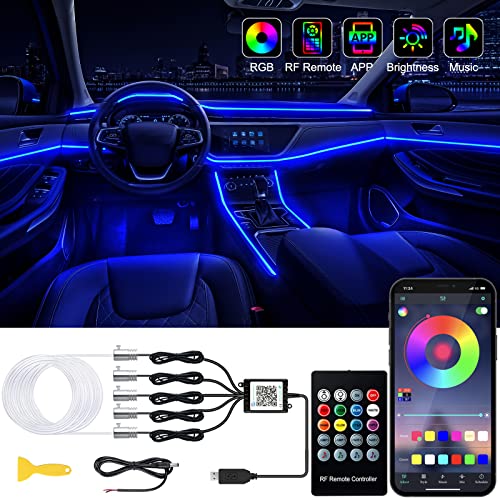
| Smart RGB Car Underglow Kit with App & RF Remote | Show-only display | Maybe, if allowed by route rules | Not recommended | 12V DC vehicle power | Underglow with fixed, steady settings | High | Visible color patterns and front-facing enforcement |
How power source changes the choice
Battery lights avoid a vehicle outlet but bring their own issue: the pack itself has to stay dry, secure, and out of the way. A 12V plug is cleaner for vehicle use, but it still needs a protected lead and a correctly rated connection. If the power source is loose, overheated, or left unattended, the safest-looking display can fail quickly.
Where failure usually happens
Most failures are practical, not fancy. The strand sags. A clip slips. The lead rubs on metal. A hatch pinches the wire. Or the display covers something a traffic officer expects to see, such as the license plate, headlights, tail lights, or turn signals.
What colors and effects are legal?
Red and blue are the highest-risk colors because they are commonly reserved for official vehicles and can trigger impersonation or equipment violations, especially if they are visible from the front. White, amber, and green are often safer choices in general holiday decorating, but state and local law still controls whether any exterior decorative light is allowed on a moving vehicle. See the broader discussion in car underglow rules and visibility concerns for why underbody and accent lighting gets treated cautiously.
Red and blue front-facing risk
Front-facing red or blue is the easiest way to attract attention from enforcement. Even if the lights are decorative, they can resemble emergency equipment or a patrol-style setup. That risk is why many drivers avoid those colors entirely on a moving car.
Rear-facing red is a separate issue. It may be treated differently under lighting guidance, but decorative rear lighting still has to stay within state law and cannot interfere with required lamps. California, New York, and Texas all have different wording, but they share the same basic concern: do not confuse other drivers or hide safety equipment.
White, amber, and green placement limits
White and amber are often discussed as forward-facing colors, and green is commonly treated as less sensitive than red or blue. That does not make them automatically legal everywhere. Placement matters more than the color alone, especially if the lights reach the front of the car, mirror housings, or windshield area.
Flashing, strobe, and twinkle concerns
Flashing lights are another common reason drivers get cited. Twinkle and chase modes can look distracting or emergency-like, and some jurisdictions treat rotating or pulsing effects as a separate violation even when the car itself is otherwise lawful. Steady-burning is the lower-risk choice.
Nice-to-have
These extras do not make a risky setup legal, but they do reduce the chance of a mechanical problem. Weather-rated connectors, extra clips, and a protected power lead matter more than flashy controls when the lights are going on the outside of a vehicle.
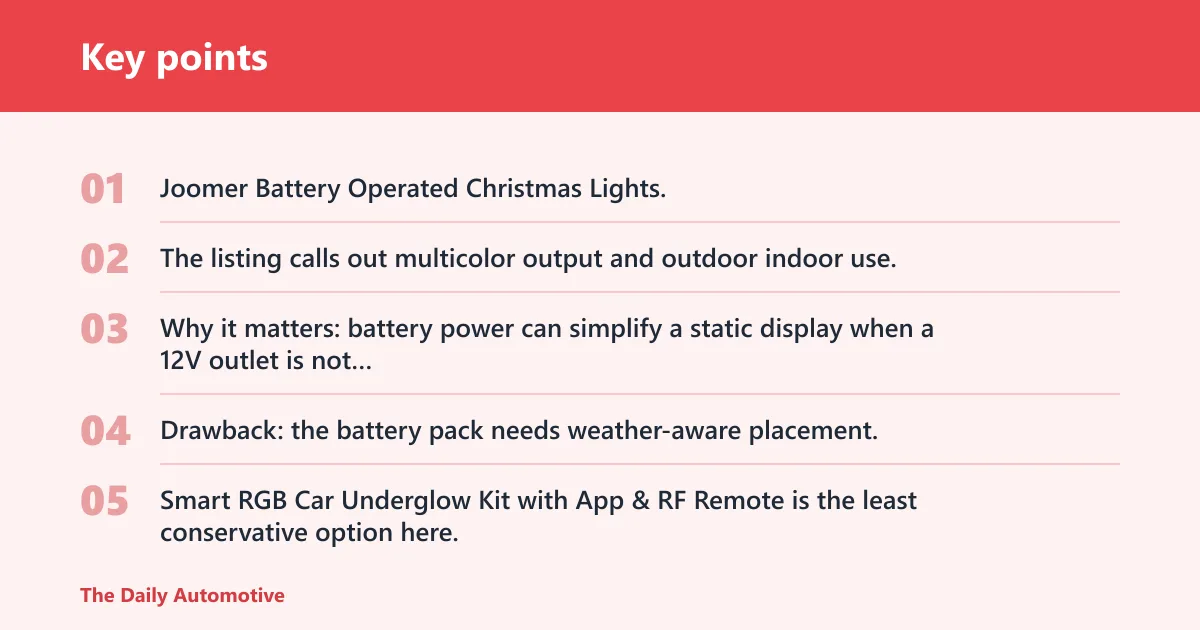
Our pick for a parked display: our pick Joomer Battery Operated

Joomer Battery Operated Christmas Lights, 66FT 200LED 8 Modes & Timer is better suited to a parked display, tailgate setup, or yard-side vehicle scene where you want battery power and timer control without using the car’s electrical system. The listing calls out multicolor output and outdoor indoor use.
Why it matters: battery power can simplify a static display when a 12V outlet is not convenient. Drawback: the battery pack needs weather-aware placement, and the 8 modes are not all ideal for road use because flashing effects draw more attention and legal risk.
Underglow pick for show use only

Smart RGB Car Underglow Kit with App & RF Remote is the least conservative option here. Its listing emphasizes app and RF control, music sync, IP67 waterproofing, and 12V DC exterior lighting.
Why it matters: the waterproof rating and vehicle-power design can suit a show-style setup. Drawback: underglow is still a high-enforcement-risk choice for street driving, especially if colors or effects are visible from the front or resemble emergency lighting.
For connectors, choose weather-rated parts that can stay sealed around splash and salt. For mounting, use clips or ties that hold under vibration. For wiring, avoid a loose run near the exhaust, steering components, or anything that moves.
How do you keep lights from blocking equipment?
Keep the plate, headlights, tail lights, and turn signals fully visible. That is not a styling preference; it is one of the most common enforcement issues with decorated vehicles. If a strand crosses any of those zones, the setup becomes a visibility problem even before color or flashing is considered. For the legal backdrop, vehicle codes such as California Vehicle Code section 24601 and Texas Transportation Code rules on plate and lamp visibility are the kinds of provisions officers use in real stops.
License plate visibility
The license plate must stay readable. Do not run a strand across it, and do not hang a battery pack or controller where it partially covers the plate frame. A plate that is only partly blocked can still draw a stop.
Headlights, tail lights, and turn signals
Lighting that hides or washes out required lamps is a common reason for traffic violations. Decorative strands should route around the light housings, not over them. If the vehicle’s turn signals are not clearly visible, the decoration has gone too far.
Sensors, vents, and airbag zones
Modern cars have parking sensors, cameras, vents, and airbag-related areas that should not be covered. Keep exterior decorations away from sensor faces and do not route anything through the driver’s view. Follow the vehicle and product manual, never exceed the vehicle’s rated limit, keep items out of airbag zones and the driver’s view, and check local laws.
Budget setups
These budget tiers use the products above and keep the use case clear. The goal is to match power and mounting to the setting, not to squeeze a road-going car into a display kit meant for a driveway.
| Setup | Best use | Product | Price | Simple read on fit |
|---|---|---|---|---|
| Starter | Parked holiday display | Joomer Battery Operated Christmas Lights | $15.19 | Good for static decorating when you do not want to use vehicle power |
| Mid | Parked car, tailgate, or truck bed display | Aurelema 12V Christmas 33 ft 100 LED Car LED String Light | $18.99 | Better match for a vehicle outlet and outdoor mounting |
| Serious | Show-style exterior effect | Smart RGB Car Underglow Kit with App & RF Remote | $28.99 | Most attention-grabbing, but also the hardest to justify for normal road driving |
Consumables and spares
Keep a few small spares nearby if you are building a display around a vehicle. Replacement clips, fresh ties, and a clean way to secure the power lead can save the setup after a cold night or a rough road.
Replacement clips and ties
Clips and ties are the first parts to fail when the display sees wind or vibration. Keep extras on hand so you can re-secure a sagging section before it reaches a lamp or the plate.
Battery or fuse guidance from the manual
If the kit uses batteries, follow the manufacturer’s replacement guidance and watch for corrosion in the compartment. If it uses a vehicle circuit, use the fuse type called for in the manual or the listing. A larger fuse is not a fix for an overloaded circuit.
A common first-timer mistake is to hide the controller inside the grille because it looks tidy. It may stay out of sight, but heat, vibration, and trapped moisture can shorten the life of the lights and create an avoidable failure point.
Frequently asked questions
Is it illegal to put Christmas lights on your car?
It depends on where you live, whether the car is moving, and how the lights are mounted. Parked displays are usually easier to legalize, while public-road use is where state and local rules tighten. The biggest problems are red or blue colors, flashing effects, and anything that blocks required lights or the plate.
What colors of car Christmas lights are legal?
There is no universal answer because state and local law controls decorative vehicle lighting. Red and blue are the highest-risk colors, especially at the front. White, amber, and green are often safer choices, but they still have to stay clear of required equipment and cannot create a flashing or emergency-like look.
Are flashing Christmas lights on a car illegal?
Often they are, or at least they are a common reason drivers get cited. Flashing, strobe, twinkle, and chase effects can look distracting or emergency-like. Even where a decorative light is allowed, the pattern can still create a violation if it resembles authorized vehicle lighting or distracts other drivers.
Do Christmas lights on a parked car need to follow the same laws?
No. A parked display is usually treated differently from a moving vehicle, and many jurisdictions are more permissive when the car is stationary. That said, parked lights still need secure mounting, safe power management, and clear access to the plate and required lamps if the vehicle might be moved.
What is the safest way to decorate a car with Christmas lights?
The safest approach is to keep the car parked, use an exterior-rated LED kit, choose steady-burning lights, and mount everything so the plate, lamps, sensors, and driver’s view stay clear. For a moving car, skip exterior lights entirely. Check local rules before buying, especially if you plan to use the car in a parade.
Products related to this article
Sponsored / affiliate links. As an Amazon Associate I earn from qualifying purchases. I may earn additional commission from eligible campaigns.