Best Mini Generator for Car: 4 Picks Compared
A common recommendation for a mini generator for a car is a portable power station in the roughly 300 to 700Wh range with USB-C, AC output, and pass-through charging. Pick a model with enough surge power for your tools or jump-start needs. Choose poorly and you may end up with a dead phone, a flat tire light, or a unit that cannot start your day. This guide compares four compact picks for trunk storage, emergency starting, device runtime, and recharge options.
Which mini generator matches your car needs?


For most drivers, the VTOMAN Jump 600X is the strongest all-around choice because it pairs 299Wh capacity with 600W continuous output, 1200W surge, and a car jump-start port. That mix matters more than a long port list if you want one compact battery power station for emergencies, light camping, and road-trip charging.
What this guide compares
This comparison separates jump-start-capable battery power stations from ordinary compact units. That matters because a model can be fine for phones and laptops yet still be the wrong tool for a dead starter battery or a 12V cooler.
The four picks here cover different use cases: emergency starting, mixed travel use, ultra-compact storage, and port-rich value. They all fit the same broad category, but they do not solve the same car problem.
Top pick at a glance
| Pick | Best for | Key spec | Car-use note |
|---|---|---|---|
| VTOMAN Jump 600X | Roadside emergencies | 299Wh, 600W continuous, 1200W surge | Includes a car jump-start port and expandable capacity |
| DARAN Portable Power Station | Mixed road-trip use | 288Wh, 350W continuous, 600W surge | Two AC outlets and USB-C PD 60W for everyday devices |
| Tenlike 99.9Wh Mini Power Station | Ultra-compact storage | 99.9Wh, 120W max, 80W AC output | Light-duty only, but easy to stash and carry |
| pangootek Portable Power Station | Port count and value | 299Wh, 300W continuous, 600W surge | Seven-port layout with BMS protection and LiFePO4 battery |
How to read the specs
Watt-hours tell you stored energy, so they tell you how much runtime you have on tap. Continuous watts tell you what the inverter can keep running without tripping. Surge watts cover the brief start-up burst some devices need. For car use, all three matter, and the wrong one can stop the whole plan.
A battery power station also needs the right output type. A 12V car socket can run some inflators, coolers, and small accessories directly. AC output is better for laptops and some medical devices, but only if the inverter output matches the load.
Quick picks
If you want the shortest answer, start with the VTOMAN Jump 600X for emergencies, the DARAN for balanced everyday travel, the Tenlike for tight storage, and the pangootek if you want more ports with LiFePO4 chemistry. Those are the clearest matches by use case, not by spec sheet alone.
- Best for roadside emergencies: VTOMAN Jump 600X
- Best for mixed road-trip use: DARAN Portable Power Station
- Best for ultra-compact storage: Tenlike 99.9Wh Mini Power Station
- Best for port count and value: pangootek Portable Power Station
VTOMAN Jump 600X review
The VTOMAN Jump 600X is the best fit if jump-start readiness is part of the job. Its 299Wh capacity, 600W continuous output, and 1200W surge place it above the ultra-light class, and the jump-start port makes it more useful in a true roadside emergency than a standard compact power station.
Why the jump-start port matters
Most compact battery power stations can charge phones and laptops. Far fewer can help with a flat starter battery, and that distinction matters if you want a single unit for the trunk. The jump-start port is the feature that moves the VTOMAN out of “nice backup” territory and into “can help get the car moving” territory.
It also expands to 939Wh, which changes how long it can support accessory loads, though expansion does not turn it into a truck-sized power source. It still belongs in the compact category.
Where 299Wh and 600W fit
At 299Wh, the VTOMAN is better suited to short jobs and moderate device loads than to all-night appliance duty. A laptop is reasonable. A CPAP may be possible only with careful power budgeting, and a 12V cooler is the kind of load that can drain a small battery quickly if it runs for many hours.
Picture a driver who needs phone charging, a dashboard camera, and a jump-start option in one box. That is the VTOMAN use case. It is not the right answer for someone who wants to run high-draw kitchen gear or keep a cooler powered all weekend.
What expandable capacity changes
Expandable capacity helps if you need more overnight runtime without moving to a much larger unit. It does not change the output limit, so a 600W inverter still cannot support appliances that exceed that ceiling. Buyers should treat expansion as more runtime, not more appliance class.
DARAN portable Power Station review
The DARAN Portable Power Station is the most balanced road-trip pick here because it combines 288Wh capacity with 350W continuous output, 600W surge, two AC outlets, and USB-C PD 60W. It is the cleanest middle-ground option for drivers who want normal device charging without paying for jump-start hardware they may never use.
Why 2 AC outlets matter
Two AC outlets make a difference when you need a laptop and another wall-plug device at the same time. That matters on travel days, in hotel parking lots, and during short outages when outlet access is limited.
The DARAN also supports solar, car, and wall charging, which gives it useful recharge flexibility. If you travel often, being able to refill from a 12V vehicle input can matter as much as raw capacity.
When USB-C PD 60W helps
USB-C PD 60W is the right lane for many laptops, tablets, and fast-charging phones. It is not a fix for every computer, but it can reduce AC inverter use and simplify cable packing.
A common first-timer mistake is buying enough watt-hours and forgetting output type. A device may fit the battery budget, yet still need AC because its charger will not accept USB-C. That is why the DARAN’s mix of AC and USB-C matters.
Tenlike 99.9Wh Mini Power Station review
The Tenlike 99.9Wh Mini Power Station is the ultra-compact pick. Its 99.9Wh capacity, six output ports, 60W Type-C PD, and 120W maximum output make it suitable for light travel use, not appliance duty. This is the model to favor when storage space matters more than long runtime.
Why 99.9Wh is the ceiling here
At 99.9Wh, this unit sits in the smallest practical class for a car backup battery. That makes it easier to pack, but it also means short runtime for anything beyond phones and small electronics. The 80W AC output is the clearest limit.
It is the least suitable of the four for CPAP use, and it is not a good fit for a 12V cooler. The ceiling is simple: light charging, not long-duration power.
Airline-friendly use cases
The airline-friendly capacity claim applies to this size class, not to the larger units in this comparison. For drivers who also travel by plane, that can make the Tenlike a useful bridge device for recharging electronics after landing.
It works best for short top-ups, emergency phone charging, and very light laptop use if the laptop’s charger stays within the output limit. Anything more demanding pushes it out of its lane.
Pangootek Portable Power Station review
The pangootek Portable Power Station is presented as a port-rich option. It uses a 299Wh LiFePO4 battery, delivers 300W continuous output and 600W surge, and includes a seven-port design with BMS protection. For drivers who want more connection options without moving to a larger box, that is a practical mix.
Why the 7-port layout matters
Seven ports matter when you need to charge multiple low-draw devices at once. Think phones, a dash cam, a GPS unit, and a tablet, all from one compact battery power station. Port count does not raise output, but it can reduce cable swapping.
LiFePO4 and BMS in practice
LiFePO4 is common in portable power stations because it offers long cycle life, better thermal stability, and safer operation than many older battery chemistries. For car use, that is useful when the unit may be charged and discharged repeatedly on trips.
The BMS monitors voltage, current, and temperature, and it adds over-voltage, over-current, and short-circuit protection. That matters because overloads and bad cables are common failure points in compact power gear.
Car-use fit matrix
This matrix translates the four picks into real car jobs. “Yes” means a strong fit. “Limited” means the job is possible only with short runtime, careful load control, or narrow device choice. “No” means the model is the wrong tool for the task.
| Model | Roadside jump-starting | Overnight camping | Charging a laptop | Running a CPAP | Keeping a 12V cooler powered |
|---|---|---|---|---|---|
| VTOMAN Jump 600X | Yes, has a car jump-start port and higher surge headroom. | Yes, 299Wh and expandable capacity help with short overnight loads. | Yes, 600W continuous output easily covers most laptop charging. | Limited, possible for some setups, but runtime depends on CPAP draw and humidifier use. | Limited, 299Wh can run a cooler for a short period, not a long day. |
| DARAN Portable Power Station | No, no jump-start function is listed. | Yes, 288Wh and two AC outlets suit light overnight use. | Yes, USB-C PD 60W and AC output cover common laptops. | Limited, workable only if the CPAP load stays modest and AC conversion losses are accounted for. | Limited, suitable for brief cooler use, not all-night cooling. |
| Tenlike 99.9Wh Mini Power Station | No, too small and not built for starting a car battery. | Limited, fine for short charging, not for overnight appliance use. | Limited, 120W max output and 80W AC output narrow the laptop list. | No, capacity and output are too low for practical CPAP use. | No, a 12V cooler will drain it too quickly. |
| pangootek Portable Power Station | No, it is a power station, not a jump starter. | Yes, 299Wh and LiFePO4 make it a solid light-camping option. | Yes, 300W continuous output is enough for many laptops. | Limited, usable only for low-draw CPAP setups with short runtime goals. | Limited, can handle brief cooler duty, but not extended cooling. |
What size portable power station do you need?
For car use, size depends on the load. A phone and laptop need far less than a CPAP or 12V cooler, and a jump-start need is a separate category altogether. The right choice is usually the smallest unit that covers the highest-risk task you actually expect to face.
How many watts car use really needs
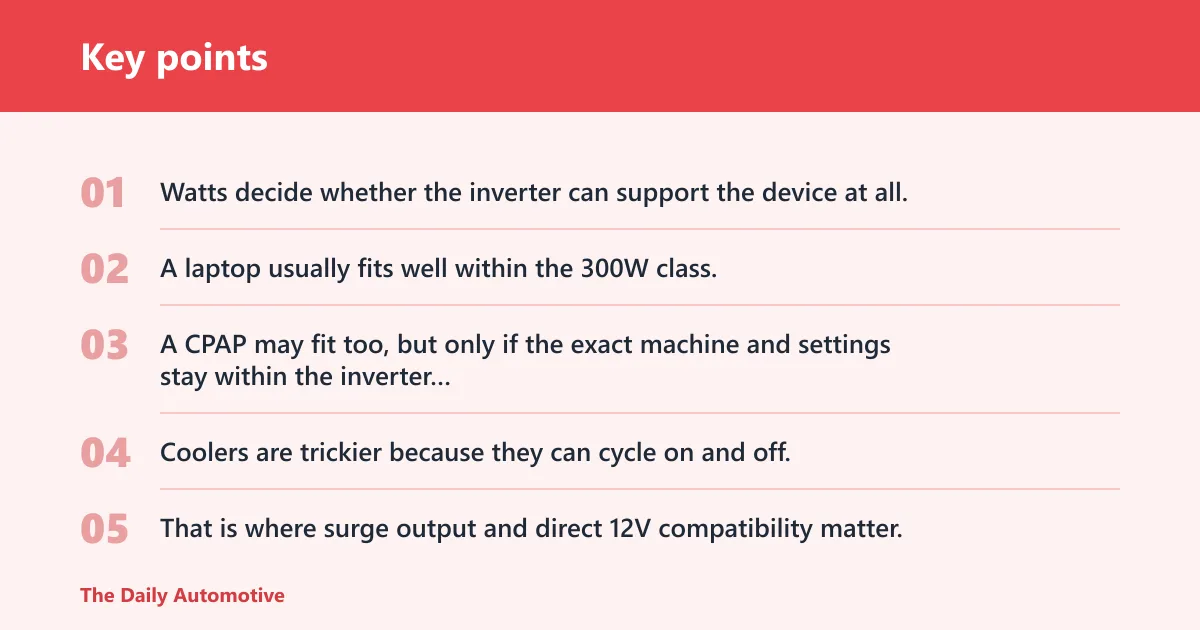
Watts decide whether the inverter can support the device at all. A laptop usually fits well within the 300W class. A CPAP may fit too, but only if the exact machine and settings stay within the inverter limits and the runtime goal is modest.
Coolers are trickier because they can cycle on and off, and startup draw can be higher than the nameplate suggests. That is where surge output and direct 12V compatibility matter.
When LiFePO4 is the better choice
LiFePO4 is the better fit for car camping and road use when you want long cycle life and better thermal stability. It is the chemistry most buyers should favor if the unit will be charged often from a car, then used again on the next leg of the trip.
It is not a license to ignore heat. Lithium battery devices should not be left in a hot parked car, and they should not be treated as if cabin temperature is harmless storage.
Why 12V car charging matters
12V vehicle charging gives you a road-trip refill option when wall power is not available. That matters after a long drive, during an outage, or on a campsite with no pedestal power. It also turns the vehicle itself into part of the charging plan.
Suppose your laptop and phone drain the unit on a Friday night. A 12V recharge path means the battery power station can recover on the next drive instead of waiting for an outlet.
When BMS protection matters most
BMS protection matters most when the load is uncertain, the weather is cold, or multiple devices are connected at once. Voltage, current, and temperature monitoring help reduce the chance of a fault turning into a damaged battery or a tripped output.
That does not make a unit overload-proof. If the inverter limit is 300W, a load above that can still shut the output down.
Frequently asked questions
What is the best mini generator for a car?
The best overall pick is the VTOMAN Jump 600X if you want the broadest car-use coverage in this group.
Can a mini generator power a car fridge or CPAP machine?
Sometimes, but only with realistic expectations. A CPAP may work on a 300W-class unit if the exact load is modest and the runtime target is short. A car fridge or cooler is more demanding, so direct 12V support and capacity matter more than port count alone.
How many watts do I need in a portable power station for car use?
For phones, tablets, and laptops, a 100W to 300W class unit is often enough. For CPAP use or a small cooler, higher continuous output and better battery capacity become more important. If jump-starting is part of the goal, you need a unit built for that job.
Is a LiFePO4 power station better for car camping?
Yes, for most buyers. LiFePO4 gives long cycle life, thermal stability, and safer operation, which suits repeated charging and discharge on road trips. It is especially sensible if the unit will live in the trunk between uses, though it still should not sit in excessive heat.
Can I recharge a mini generator from my car?
Yes, if the power station supports 12V vehicle input. That is one of the most useful road-trip features because it lets you recharge while driving. It is best for topping up a compact unit, not for expecting a full fast refill every time.
Do I need a jump-start feature in a car mini generator?
Only if roadside battery failure is part of your risk profile. If you mainly want electronics backup, a standard compact power station is enough. If you want one box that can help with a flat starter battery, the jump-start feature is worth paying for.
Which mini generator is best for emergencies and road trips?
The VTOMAN Jump 600X is the strongest emergency-and-road-trip choice in this group because it adds jump-start capability to a 299Wh, 600W-class battery power station. For pure travel charging and multiple devices, the DARAN is the better balance pick, while the Tenlike is best for very light carry.
Products related to this article
Sponsored / affiliate links. As an Amazon Associate I earn from qualifying purchases. I may earn additional commission from eligible campaigns.