Best Cop Horn for Car (2026): Based on Specs and Reviews
For a daily driver, the better all-around pick is the NEOGET 126dB Dual-Tone Car Horn Kit because it is a simpler 12V horn replacement with less legal exposure and better everyday drivability. For maximum attention, the FARBIN Car Horn Kit is louder on paper at 130dB and includes the relay kit and push-button setup that suits warning use, but it also raises the install and legality stakes.
Quick comparison
| Product | Badge | Best for | Price | ||
|---|---|---|---|---|---|
 |
NEOGET 126dB Dual-Tone Car Horn Kit with 2 Connector TypesNEOGET | Our pick | 126dB dual-tone · Ford/Tesla/Jean | $25.88
Price as of 25 Oct 2026
|
View |
 |
KICKER 48KMXL8 8" 4-Ohm RGB LED KMXL Horn-Loaded MarineKICKER | Also great | $899.99
Price as of 25 Oct 2026
|
View | |
 |
FARBIN Car Horn Kit with Button Loud Train Horns ElectricFARBIN | Also great | 130dB train style · Universal 12V | $24.99
Price as of 25 Oct 2026
|
View |
The comparison centers on the fitment questions that matter before you buy: 12V compatibility, output, tone pattern, install load, weather exposure, and how the horn behaves in normal traffic.
| Factor | NEOGET 126dB Dual-Tone | FARBIN 130dB Train-Horn Style |
|---|---|---|
| Loudness | 126dB claimed; loud, but less extreme | 130dB claimed; more attention-grabbing |
| Legality risk | Lower risk if used as a horn replacement | Higher risk because of train-horn styling and push-button use |
| Install difficulty | Moderate; connectors and splitter help | Moderate; relay wiring and button simplify wiring |
| Space required | Compact dual-horn layout | More awkward bell shape and mounting clearance |
| Power draw | Not fully stated in the listing; still a 12V horn kit | Not fully stated in the listing; relay wiring suggests heavier load handling |
| Tone flexibility | Dual-tone high/low pair | Single train-style blast |
| Weather resistance | No explicit waterproof claim in the provided details | Listed as waterproof |
| Everyday drivability | Better for private cars and mixed traffic use | Better for work vehicles, alerts, or off-road settings where allowed |
Daily driver verdict: start with the NEOGET kit if you want a stronger horn without turning every press into a legal question.
Maximum-attention verdict: pick the FARBIN kit if the goal is a louder warning device and your local rules allow that style of use.
How we chose
The comparison is built around the fitment questions that matter before you buy: 12V compatibility, output, tone pattern, install load, weather exposure, and how the horn behaves in regular traffic.
12V compatibility and fitment
Most car sirens operate at 12V and 100W, so that standard is the starting point for any replacement. These kits are meant for cars, trucks, vans, and many motorcycles, but you still need room for the horn body, bracket, and wiring path.
Loudness and tone range
Loudness does not equal usefulness. A 126dB or 130dB claim tells you the kit is meant to be heard, but it does not tell you how it will cut through cabin noise, rain, diesel traffic, or a closed-window commute.
Install risk and wiring load
Horn swaps fail when the fuse is too small, the ground is weak, the relay is wrong, or the wiring gauge is too thin. A kit with a relay and clear connectors usually gives you fewer surprises.
Weather resistance and mounting stability
Exposed mounting needs a housing that tolerates rain, dust, and corrosion. A solid bracket matters too, because a horn that vibrates loose loses volume and can point in the wrong direction.
NEOGET 126dB Dual-Tone Car Horn Kit: best for everyday cars
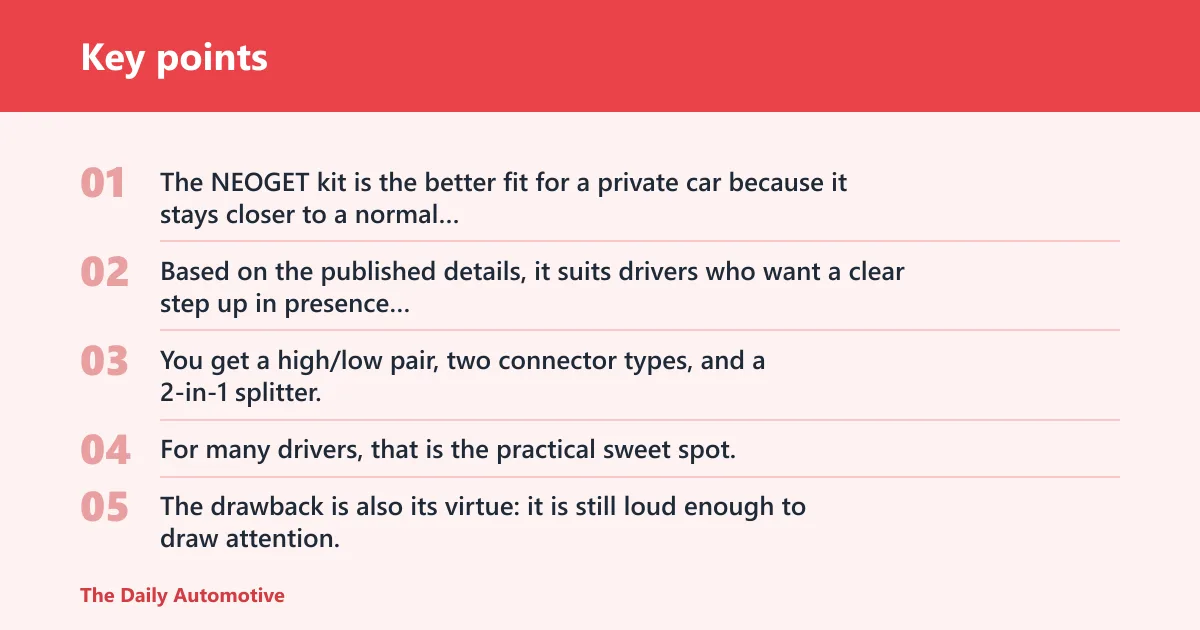
The NEOGET kit is the better fit for a private car because it stays closer to a normal horn replacement while still delivering a strong 126dB dual-tone blast. Based on the published details, it suits drivers who want a clear step up in presence without moving straight into maximum-siren territory.
Its strongest point is balance. You get a high/low pair, two connector types, and a 2-in-1 splitter, which makes the kit easier to adapt across different 12V vehicles and trim-level wiring layouts. For many drivers, that is the practical sweet spot.
The drawback is also its virtue: it is still loud enough to draw attention, so it is not a subtle city-car upgrade. It also does not give you the tone selection or public-address features of a fuller siren system, so it is not the better pick for crowd-direction or warning duties.
Why it suits a private car
A dual-tone horn is easier to live with than a siren bank that cycles through police, fire, or ambulance-style sounds. It gives you a sharper warning note without making every use feel out of place on ordinary streets.
Say your sedan already has weak factory horns and you want a more assertive signal for lane changes and distracted drivers. A dual-tone setup is the cleaner answer than a siren stack, because it is more likely to feel natural in daily traffic.
Where it can fall short
The listing does not spell out waterproofing, microphone use, or remote operation, so this is not the feature-rich option. It is also not the loudest path in the market, which matters if you are trying to cut through heavy worksite noise or very dense traffic.
Who should skip it?
Skip it if you want a true police-style warning unit with tone changes from the cabin, voice announcements, or the highest possible audible shock factor. You should also pass if your local rules are strict about siren-like tones.
FARBIN Car Horn Kit: best for maximum attention
The FARBIN kit is the louder, more aggressive choice. The listing calls out 130dB, a waterproof design, a relay wiring harness, and a push-button switch, which makes it more suited to warning use than a simple horn replacement.
Its advantage is presence. The square bell is described as helping maximize sound output, and the included relay wiring harness cuts some of the guesswork from wiring. If a driver wants the strongest possible attention signal from a 12V vehicle, this is the clearer match.
The drawback is everyday drivability. A train-horn style note can be too much for normal commuting, and the same traits that make it attention-grabbing can also increase legal risk. It is the least discreet option in this comparison.
Why it suits alerts and warnings
For work vehicles, roadside warnings, or off-road use where allowed, louder can be the point. The FARBIN kit is built around that logic, and the relay wiring harness supports a more direct install path than a barebones horn swap.
Picture a utility van parked near a noisy jobsite with diesel trucks idling nearby. In that setting, a louder horn can matter more than tone elegance, especially when the goal is to get noticed fast.
PA microphone and remote control value
This kit does not list a public-address microphone, so it cannot do voice announcements. That is a meaningful omission if you need to direct people, warn a crowd, or issue spoken instructions instead of just sounding the horn.
A wireless remote controller would add convenience, but this listing does not include one. If cabin-based tone changes matter, look for a kit that explicitly states remote control support.
Can your 12V vehicle run it?
Both kits are built for a 12V vehicle electrical system, which covers many cars, trucks, vans, and motorcycles. That said, voltage is only the first check; you still need room for the hardware, a safe mounting point, and a wiring path that can handle the load.
Compatibility checks before buying
- Confirm the vehicle uses a 12V system.
- Check where the horn will mount and whether the bracket can sit flat.
- Make sure the kit’s connectors match your factory plug or relay plan.
- Verify that the horn body will clear the grille, bumper, or engine bay parts.
- Check whether the install location will be exposed to spray, dust, or road salt.
Cop horn checklist
- Measure the mounting pocket before ordering.
- Confirm the bracket or adjustable mount can angle the horn opening properly.
- Plan a clean ground point on bare metal.
- Use the relay and fuse size that match the kit instructions.
- Inspect wire routing so it will not rub on sharp edges or hot parts.
Common failure points
A horn that sounds weak after install usually points to a wiring issue, not a bad brand. Weak grounding, a blown fuse, a poor relay connection, undersized wire, or a loose mount can all cut output before the horn ever gets a fair trial.
A common first-timer mistake is mounting the horn in a cramped pocket and then assuming the weak sound means the kit is underpowered. Often the real problem is that the horn is blocked, pointed into plastic, or vibrating against the bodywork.
How loud should a car siren horn be?
Seller-stated dB numbers are useful for rough comparison, but they are not always measured the same way. A 110dB listing and a 130dB listing do not guarantee the same real-world result, because test distance, frequency, and mounting all change what reaches the driver ahead.
What seller dB claims can and cannot tell you
Use the number as a starting point, not a verdict. One JDMSPEED siren is rated at 110 dB sound level, a KERWINN siren is described as up to 120 dB, the BANHAO 7 sound police siren is described with 115-135dB output, and one comparison lists a 130dB FARBIN dual-tone kit. Those figures signal relative intent, not identical test conditions.
That is why a 100W label matters too. Most car sirens operate at 12V and 100W, and a Banhao siren system is described as a 100W unit. Power rating helps you understand the class of the horn, but it still does not guarantee how loud it will sound in your vehicle.
Cabin noise, traffic noise, and real use
A loud horn matters most when the surrounding noise is already high. Closed windows, rain, tall vehicles, and diesel traffic all eat into a horn’s effectiveness, so the better question is whether the sound still cuts through in that environment.
Suppose a crossover is stuck in stop-and-go traffic with the windows up and the radio on. A lower-output horn may still be audible, but a more forceful kit is more likely to get noticed fast. That is why maximum numbers matter more in work use than in a quiet neighborhood.
When louder stops being more useful
Once a horn is loud enough to dominate normal road noise, more decibels mostly add legal risk and annoyance. For a private car, that is often the point where a dual-tone replacement makes more sense than a siren-style unit.
What you need to know before using it
Local legality comes first. Police-siren tones are restricted in many places, and some jurisdictions also limit train-horn style use on public roads. Check state and local rules before purchase, especially if the kit cycles through emergency-style sounds or includes a push-button layout.
When to verify local rules
Verify the rules before you install if the horn will be used on public streets, if you plan to mount it on a work vehicle, or if the listing mentions police, fire, ambulance, or train sounds. If there is any doubt, treat the siren function as restricted until proven otherwise.
When to use the horn and when not
Use a horn to warn, not to vent. That means brief alerting in traffic, a quick notice in a blind spot, or a short warning where safety is at stake. Do not use siren patterns for entertainment, intimidation, or prolonged attention-grabbing in neighborhoods or traffic jams.
Weather resistance and exposed mounting
Waterproof or weather-resistant housing matters when the horn sits behind a bumper, under a grille, or near wheel spray. Corrosion resistance and a secure mount help preserve output over time, while a loose or badly aimed horn can sound weaker than the spec sheet suggests.
Choose NEOGET if… / Choose FARBIN if…
Choose NEOGET if you want the better daily-driver upgrade, you care about dual-tone clarity more than raw blast, you need a more conservative legal profile, or your vehicle has tighter mounting space.
Choose FARBIN if you want the loudest option in this comparison, you are fitting a work vehicle or warning setup, you want the included relay wiring harness and push-button switch, and your local rules permit that style of horn use.
If the goal is simple replacement, start with NEOGET. If the goal is maximum attention and the legal check comes back clean, FARBIN is the stronger hit.
Frequently asked questions
What is the best cop horn for a car?
The best cop-horn-style choice for most cars is the one that adds presence without turning every press into a legal issue. For that reason, a dual-tone 12V kit is usually the safer pick for daily driving, while a siren-style kit belongs more naturally in work or warning use where local rules allow it.
Do I need a microphone or PA on a police-style horn?
Only if you need to speak to people, not just alert them. A public-address microphone is useful for warnings, crowd guidance, or spoken instructions from the vehicle, but many drivers do not need it for a basic horn replacement. If you only want a louder blast, PA is extra hardware.
How do I test a car horn before buying?
Check the vehicle’s 12V system, the available mounting space, and the wiring path before purchase. If the listing gives no clear relay, fuse, or bracket details, treat that as a warning sign. You should also compare the horn style against local rules before deciding the final mount location.
When can you use a car horn?
Use a car horn when you need to warn another road user of immediate danger or a likely collision. Brief, safety-based use is the right standard. Long blasts, repeated use in frustration, or siren-style use on public roads can create legal and social problems.
Which is better: a siren horn or an air horn for a car?
For normal street driving, a horn replacement is usually the cleaner choice. A siren horn is more attention-grabbing and can be restricted, while an air horn brings compressor and space issues that do not suit every vehicle. If you want a direct comparison here, this guide favors the horn-style route for most drivers.
Products related to this article
Sponsored / affiliate links. As an Amazon Associate I earn from qualifying purchases. I may earn additional commission from eligible campaigns.