Cover for Car Hood: Tested & Reviewed (3 Picks)
Choose a custom-fit hood cover for daily outdoor parking when your vehicle has a model-specific option. Use a universal one for short-term shade or mild weather. A poor fit can trap grit, scuff paint, flap in the wind, and leave the hood exposed where UV, sap, and hail hit hardest. This guide shows which hood cover fits your parking setup, weather exposure, and fit risk before you buy.
Best overall hood cover and fit basics

The best overall hood cover here is Howilath Black Car Hood Cover, because it gives you a stated universal size, elastic edge, and straps in one low-cost listing for everyday parking. Fit and fastening matter more than price, especially if you park outside where wind, dust, and spray can pull a loose edge free.
That answer changes if your vehicle needs a model-specific fit or if you want style-only vinyl work instead of temporary protection. A hood cover that matches the hood and anchor points is usually the safer buy than the cheapest universal option.
Quick comparison
| Product | Badge | Best for | Price | ||
|---|---|---|---|---|---|
|
Custom Car Hood Cover Customized Hood Flags, ElasticGeneric | Our pick | 59"x43" to 63"x47" · customizable · elastic fit | $19.99
Price as of 1 Nov 2026
|
View |
 |
Car Hood Protector Bra Compatible with Toyota Land CruiserTerIourfou | Upgrade pick | Land Cruiser 250 Prado · leather · model-specific | $59.99
Price as of 1 Nov 2026
|
View |
 |
AurLunUs Universal Foldable Half Car Cover for Windshield &AurLunUs | Pair with it | Universal fit · foldable · half cover | $19.99
Price as of 1 Nov 2026
|
View |
 |
Howilath Black Car Hood Cover Stretchable Engine ProtectorHowilath | Also great | 39.37" x 59.05" · stretch wrap · universal | $29.59
Price as of 1 Nov 2026
|
View |
Use the table above to separate temporary protection from cosmetic wrap work. After that, narrow the choice by parking environment, not by marketing language.
How we chose
Selections are based on manufacturer specs, listing details, and published buyer feedback, with extra weight given to fit clues, fastening design, and the kind of protection each listing actually claims.
That matters because hood covers are not one product family with one use case. Some are built for quick deployment and dust control, while others are tuned for a tighter outdoor fit or for cosmetic vinyl work.
Which hood cover fits your use case?
| Parking scenario | Vehicle type | Needed material | Securement method | Failure risk |
|---|---|---|---|---|
| Street parking in wind | Any with exposed hood edges | 210D fabric or a lined cover with better edge hold | Elastic band plus hook fastening and any reflective straps listed | High if the fit is loose or anchor points are weak |
| Snowy climates | Cars parked outside overnight | All-season hood protection with frost and snow claims on the listing | Secure hooks or bands that hold the front edge down | Medium to high if snow buildup lifts the edges |
| Garage dust storage | Garage-kept cars | Elastic polyester or soft-lined fabric for easy removal | Simple elastic edge is often enough | Low, unless the cover is oversized and rubs badges |
| SUV and Jeep fit | SUVs and Jeeps | 210D or a larger universal listing with the right length range | Elastic band and hook system with safe grille hook points | High if the hood vents or grille shape leave poor anchor points |
| Sedan and hatchback fit | Sedans and hatchbacks | Elastic polyester or a smaller universal hood size | Elastic edge plus hooks only if the listing supports them | Medium if the cover hangs past the hood line |
| Style-only vinyl wrap use | Cars with paint prep and controlled install space | Heat-activated vinyl wrap | Adhesive fit, not hood-cover hooks | High if the install area is dusty, cold, or poorly prepped |
For outdoor parking, the failure risk is usually about movement, not just material. Wind lift, poor anchor points, hood vents, and oversize flapping cause most of the trouble.
Say your sedan sits on a curb under trees and a crosswind hits the front corner every evening. A loose universal cover can shift at the badge line, collect grit under the edge, and rub the paint each time the wind moves it.
Universal hood cover: best for quick fit
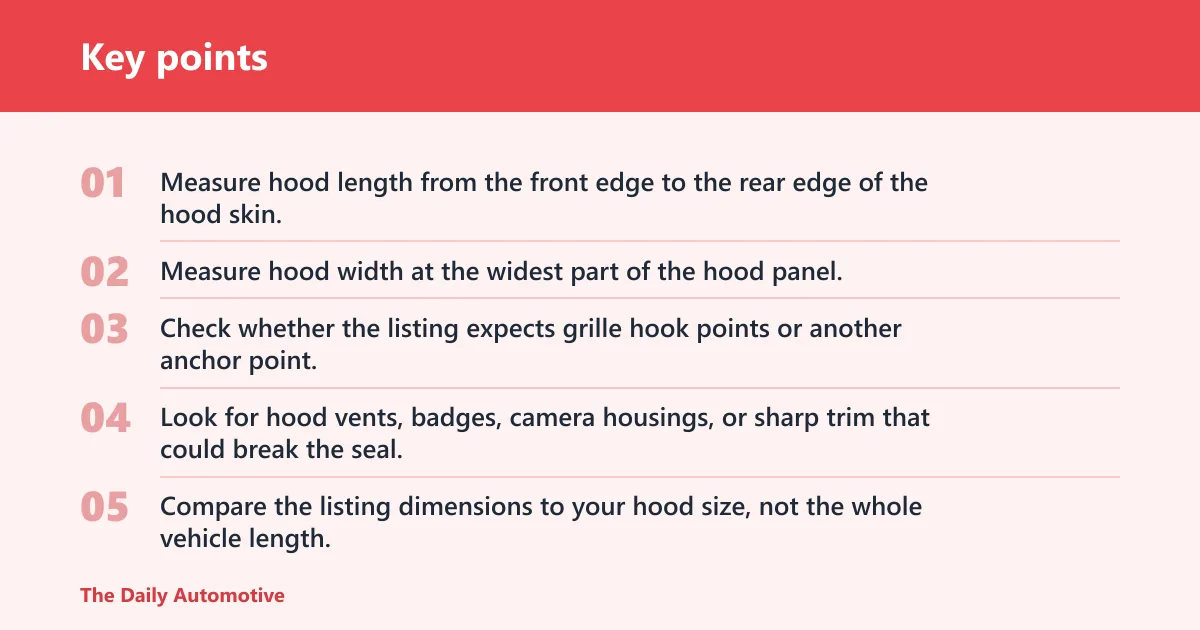
Universal hood covers work best when you need fast coverage and your parking conditions are mild to moderate. Measure hood length and width before buying, then confirm grille hook points and edge coverage so the fit matches the front of the car instead of floating over it.
Common universal size references include 39.37 x 59.05 inches, and larger SUV/Jeep ranges are listed as L 138-181 inches and D 63-71 inches. Those numbers are not a substitute for measuring the hood itself, because sedans, SUVs, hatchbacks, and trucks place the front edge and grille differently.
What to measure before you buy
- Measure hood length from the front edge to the rear edge of the hood skin.
- Measure hood width at the widest part of the hood panel.
- Check whether the listing expects grille hook points or another anchor point.
- Look for hood vents, badges, camera housings, or sharp trim that could break the seal.
- Compare the listing dimensions to your hood size, not the whole vehicle length.
Keetegami uses elastic polyester fabric and a universal fit, which fits the quick-deploy category well. Elastic polyester is light, easy to store, and convenient when you want temporary coverage for dust or brief weather exposure.
A common first-timer mistake is choosing a hood cover by car model alone instead of checking the hood’s exact shape and dimensions. A hatchback and a sedan can land in the same family, but their hood profile and front anchor points can still differ enough to create flap risk.
How universal fit can go wrong
Oversize covers can flap at the edges, and that movement is the problem. If the listing is meant for a larger front end than your hood, the cover may not sit flat enough to resist wind or keep grit out from under the edge.
210D hood cover: best for outdoor protection
210D fabric is a common choice for outdoor hood protection because listings use it for scratch, dust, and minor impact coverage. It is a practical pick for daily parking, but denier by itself does not prove waterproof performance, so check the listing’s weather claims before you assume more than the spec supports.
One SUV/Jeep listing uses 210D and an elastic band and hook system, which is the type of combination that helps when the car sits outside in wind.
What 210D can help
- Dust and road grit that settle on the hood.
- Light contact from branches, shopping carts, or similar minor bumps.
- Outdoor parking where the cover may sit in tension for long periods.
What it does not prove by itself is full waterproofing or storm-grade weather resistance. If a listing promises weather protection, read that claim as the seller wrote it and separate it from the fabric number.
For snow belt parking, a thicker cover can help with frost and light ice, but only if the fastening keeps the edges down. PONYBRO is described as a 7-layer cover and protected down to -30°F, which shows how some listings push further into all-season claims.
Are hood covers good for snow and frost?
Yes, if the listing specifically claims snow or frost protection and the cover fits tightly enough to stay put. All-season hood protection is usually about dust, leaves, rain spray, snow, ice, UV exposure, and minor impacts on the hood and front area, not about full vehicle coverage.
If you park where frost forms hard overnight, look for a soft inner face and secure front-edge hold. A loose cover can freeze to the surface or scrape more on removal if ice has built up under the edge.
Cotton velvet hood cover: best for paint safety
Cotton velvet or a soft lining helps where paint contact is the main concern. A thick, soft face reduces scratch risk during install and removal, which matters when you are placing the cover around badges, edge trim, or tight front corners.
ZBGUN lists a front cover at about 4.92 feet by 6.56 feet with thickened cotton velvet. That kind of material is aimed at gentler contact, and listings in this category often lean on anti-ultraviolet and anti-frost claims for all-season use.
Soft lining does not fix a poor fit. If the cover is too large or the hooks pull at the wrong point, the edge can still rub paint or badges even when the inner layer feels gentle.
Can a hood cover scratch paint?
Yes, if dirt gets trapped under the cover, if the fit is loose, or if the hook points pull the fabric across a painted edge. Soft lining lowers the contact risk, but clean paint, careful placement, and the right size matter more than the material label alone.
Say your hood has light dust on it and the cover is removed in a rush. That dust can turn into an abrasive layer if the cover shifts while you pull it off, so a clean surface and slow removal are part of paint safety.
Vinyl hood wrap: best for cosmetic changes
A vinyl hood wrap is a different product from a temporary hood cover. It is heat-activated, usually listed around 3 to 3.9 mil thickness, and is meant for cosmetic change rather than temporary weather protection.
One wrap listing is described at 3.9 mils and uses air-release technology, which points to installation behavior rather than outdoor storage use. That is why wrap material needs controlled conditions and careful paint prep; it is not a quick weather shield.
Do not buy a vinyl wrap thinking it will act like a hood cover for dust or snow. A wrap changes the surface appearance, while a temporary hood cover sits over the hood to protect it.
How do you change your hood cover on a car?
Remove the old cover by releasing the hooks or elastic points in the reverse order used to install it, then lift it away without dragging grit across the paint. For a vinyl wrap, follow the manufacturer’s install and removal instructions, since heat and adhesive behavior are part of that product’s process.
What is the difference between a hood cover and a full car cover?
A hood cover protects the hood and sometimes the windshield or front section, while a full car cover covers the whole vehicle. A half-car or front hood cover is not a full vehicle cover, and it is not the same as a vinyl hood wrap either.
That difference matters for storage and weather exposure. If only the front of the car sits in sun, sap, or spray, a hood cover can be enough; if the whole car is exposed, you need a full-vehicle product instead.
Which one should you buy?
If you park outdoors and want the simplest all-around answer, start with Howilath because it combines universal sizing, straps, and a stated 39.37 x 59.05 inch fit reference. If your vehicle needs a model-specific fit, the TerIourfou Land Cruiser option is the tighter match, but only for that one vehicle family.
If your main need is quick storage and light-duty coverage, an elastic polyester cover is easier to live with. If your main need is paint contact protection, choose the soft-lined option and confirm the fit does not pull across badges or sharp trim.
Pick by parking environment first: wind exposure, snow, dust, or style work. Then check hood dimensions, confirm the fastening method, and make sure the listing matches your vehicle type before you pay for the wrong category.
How do you secure a car hood cover so it does not blow off?
Use the exact fastening method the listing provides, usually elastic bands, hook points, or both, and make sure the hooks attach only to safe anchor locations called for by the product. Poor anchor points can let the cover lift, and reflective straps are useful because they add visibility and can help with wind-day stability on some listings.
Do not improvise a mounting point that rubs paint, blocks sensors, or sits inside a vent opening. If the cover is meant for a grille hook point, that point needs to be clear, solid, and compatible with the product design.
Follow the vehicle and product manual; never work under a vehicle held only by a jack, never exceed the vehicle’s rated roof, hitch, or tow limit, keep items out of airbag zones and the driver’s view, and check local laws.
Can I use a hood cover with hood vents?
Only if the cover’s shape and anchor points leave the vents clear and the listing does not warn against that layout. Hood vents can create fit problems because fabric may bridge over the opening, shift under wind, or sit unevenly around the vent edges.
If the vent area changes the front contour, measure that section as part of your fit check. A cover that works on a flat hood can behave differently once vents interrupt the surface.
How do I choose the right hood cover size for my car?
Measure the hood length and width, then compare those numbers with the listing dimensions and the vehicle type it is meant to fit. Universal fit ranges can work, but fit still varies by sedan, SUV, hatchback, and truck because the front edge, grille, and hood shape are not identical.
Use the listing’s size reference as a filter, not as proof. If the cover is too loose, expect edge flapping; if it is too tight, expect stress at the corners and a harder install.
What hood cover works best for an SUV or truck?
For an SUV or truck, choose a listing that names that body style and uses secure fastening, such as an elastic band and hook system.
For truck or SUV fronts with taller grilles or more exposed anchors, the fit and hook path matter more than a basic elastic edge. If the front end has odd contours or vents, check the manufacturer’s listing for your model before you buy.
Frequently asked questions
What is the best cover for a car hood?
The best cover is the one that matches your parking conditions, hood size, and fastening points. For most outdoor parking, a universal hood cover with a stated size, straps, and a secure hook system is the safest starting point, while a custom-fit cover is better when the vehicle-specific fit is available.
Products related to this article
Sponsored / affiliate links. As an Amazon Associate I earn from qualifying purchases. I may earn additional commission from eligible campaigns.