LED Cup Holder Lights for Car: Colors, Charging & Best Picks
Choose LED cup holder lights for car models with three checks: auto sensor response, USB charging or battery life, and an adjustable base that fits your cup holder diameter. Poor fit or unreliable sensing means dim light, constant battery drain, or a unit that rattles loose. This guide compares colors, charging methods, sensor behavior, and fit so you can buy the right one.
Top pick for most buyers: KESNEY is the best all-around starting point here because it combines seven colors, three modes, USB-C recharging, and light plus vibration sensors, which covers the main convenience features most shoppers want without forcing a constant manual switch.
Cup holder lights comparison matrix


This matrix focuses on the details that change daily use: color modes, charging type, sensor behavior, runtime, diameter or footprint, waterproof rating, and the most practical use case. Read it first for fit and charging, then decide whether color effects or auto-on behavior matter more for your cabin.
| Model | Color modes | Charging type | Sensor type | Stated runtime | Diameter / footprint | Waterproof rating | Likely best use case |
|---|---|---|---|---|---|---|---|
| Z-oneMart | Seven colors; three distinct modes | Check the manufacturer’s listing for your model | Check the manufacturer’s listing for your model | Check the manufacturer’s listing for your model | Check the manufacturer’s listing for your model | IP67 | Buyers who want a broader color palette and spill resistance |
| KESNEY | Seven colors; three modes | USB-C; color indicators | Light and vibration sensors | Check the manufacturer’s listing for your model | Check the manufacturer’s listing for your model | Check the manufacturer’s listing for your model | Commuters who want automatic activation and easy charging |
| Zorratin | Check the manufacturer’s listing for your model | Check the manufacturer’s listing for your model | Check the manufacturer’s listing for your model | 200mAh lithium battery listed | 2.7-inch footprint | Check the manufacturer’s listing for your model | Drivers who want a compact footprint reference before buying |
| JINRUITOP | Check the manufacturer’s listing for your model | Check the manufacturer’s listing for your model | Check the manufacturer’s listing for your model | Check the manufacturer’s listing for your model | 2.68 inches in diameter | Check the manufacturer’s listing for your model | Buyers starting with a diameter check for tighter cup holders |
How to read the table: a quoted diameter or footprint is only one part of fit. Cup holder depth, lip shape, liners, and nearby console trim can matter just as much. If the charging port sits low on the body, a tight cup holder can block the cable before the light even powers up.
Z-oneMart
Z-oneMart is the clearest pick if you want a broader color set and a waterproof claim in the same listing. It offers seven color options with three distinct modes, and it is described as IP67 waterproof. That makes it attractive for people who want easier wipe-downs after spills and a stronger case for daily use.
The tradeoff is simple: the available facts do not spell out its charging type, sensor behavior, or runtime. If those details matter more than color count, check the manufacturer’s listing before you buy. IP67 also does not mean the light should be soaked or left in standing liquid.
KESNEY
KESNEY is the most complete convenience package in the available data. CarGear identifies it as a 2-pack LED car cup holder light product, says it has seven colors and three modes, and notes USB-C recharging. What Cars Want also lists light and vibration sensors, which is useful if you want the lights to turn on without hunting for a button.
The color indicators on USB-C charging are a practical touch because they help you confirm charging status at a glance. That matters in real use, especially if you charge from a car USB port and want to know whether a short drive topped the battery up.
Zorratin
Zorratin stands out for the footprint reference. What Cars Want says it has a 2.7-inch footprint and a 200mAh lithium battery. That combination is useful if you are trying to judge whether a light will sit flat without crowding the cup holder walls.
Because the available facts do not list sensor type, charging port, or runtime, Zorratin works best as a fit-first choice. If your console opening is snug or oddly shaped, the footprint detail is more useful than a vague universal-fit claim.
JINRUITOP
JINRUITOP gives you a direct size number: 2.68 inches in diameter. That is the kind of listing detail buyers should look for when the car’s cup holders vary from shallow, wide inserts to tighter, deeper wells.
It is the safest starting point when your main concern is whether the insert will sit cleanly inside the opening. If the diameter looks close, still check depth, trim clearance, and whether a rubber liner or molded insert narrows the usable space.
Which color modes are worth paying for?
A seven-color palette is useful if you want the light to match the cabin or switch moods on demand, but a fixed color is usually enough for most drivers. Cycling and breathing modes add motion and novelty, yet they can feel busy in a dark cabin, especially if you want the light to stay low-glare during night driving.
For everyday use, the best setup is usually a steady color with a dim or controlled output. That keeps the cup holder visible without turning it into a distraction. If you want stronger visual effects for parking, meetups, or display-focused interiors, cycling and breathing modes make more sense.
A common first-timer mistake is choosing a cup holder light for its rainbow modes and overlooking whether it has a dimmer for nighttime driving. A pale blue or white glow can still be harsh if the lens throws light directly into the cabin. Look for a listing that explains whether the unit has static, cycling, and breathing modes, then decide whether you will actually use all three.
Will they fit your cup holders?
Many listings call these lights universal, but fit still depends on diameter, footprint, and the shape of the opening. A 2.68-inch diameter or 2.7-inch footprint is helpful as a reference, not a guarantee. Shallow cup holders, stepped walls, and rubber liners can all change how the insert seats.
Wobble usually comes from an opening that is too wide or too tapered. Loose contact can also happen when the base touches the holder before the light sits level. If the charging port faces the wrong direction, the cable may block the fit or force the unit to sit crooked.
Say your center console has a deep cup holder with a rubber insert and a narrow bottom drain. A light that fits at the top may still tilt if the base narrows too quickly. In that case, a smaller diameter or footprint matters more than color count.
- Measure the opening at the widest usable point.
- Check the depth, not just the width.
- Look for liners, ribs, or stepped walls that reduce clearance.
- Confirm that a charging cable can plug in without bending sharply.
- Compare the stated diameter or footprint with the narrowest section of the holder.
How long do they last on a charge?
Rechargeable lithium battery runtime is what decides whether the light is an occasional accent or a daily convenience. If the listing says a light lasts around several hours, that is usually enough for commuting and short errands, but less comfortable for long evening use without a charging routine. WedFeir is listed at around 8 hours per charge, which is the kind of figure buyers should look for when runtime matters.
USB-C charging is generally easier to live with than micro-USB because the plug orientation is simpler and many newer car chargers use USB-C cables already. Kesney lists USB-C charging with color indicators, which helps confirm that the battery is taking a charge. By comparison, a micro-USB design may still work fine, but it is less convenient if your car already relies on newer cables.
Charging indicator lights and low-battery warnings matter because low power can cause dimming or awkward mode behavior. If the light fades early, the problem may look like weak brightness when it is really a low battery. That is why charging feedback is not cosmetic.
Which sensor type should you buy?
For driving use, a vibration sensor is the better fit when you want the light to wake up as soon as the car moves and switch off after inactivity. A light sensor is better when you want the unit to detect darkness and save power in daytime parking. KESNEY lists light and vibration sensors, which gives it a useful middle ground.
Vibration-triggered activation suits commuters who want the lights on when the vehicle is moving and off when parked. Ambient light sensing suits drivers who leave the car in the sun or want the light to stay off unless the cabin gets dark. The failure case to watch is sensor lag, where the light wakes slowly or stays on longer than expected.
Suppose you park in a garage each evening and want the light to turn on as soon as the car leaves the ramp. A vibration sensor fits that pattern better than a darkness-only sensor. If you mostly want the light to wake when the cabin gets dark after sunset, a light sensor is the cleaner choice.
Best picks by use case
Best for commuters who want automatic activation
KESNEY is the strongest commuter option because it pairs USB-C charging with light and vibration sensors. That makes it easier to keep charged and easier to use without switching modes by hand every day. The seven colors and three modes are a bonus, not the main reason to buy it.
Best for rideshare drivers who need easy charging and clean fit
Zorratin is the better fit-first choice for this group because the 2.7-inch footprint gives a concrete sizing clue before purchase. Rideshare use tends to expose fit issues quickly: if the unit rocks in the holder or blocks the port, it becomes annoying fast. Keep the battery listing in mind, since the available data cites a 200mAh lithium battery.
Best for family cars that need simple controls and spill cleanup
Z-oneMart makes the most sense when spill resistance and straightforward color variety matter more than sensor detail. The IP67 rating is the headline here, and the seven-color, three-mode setup covers basic cabin lighting without complexity. That said, check the exact charging setup before you count on it for daily family use.
Best for show-car interiors that care most about color effects
JINRUITOP is the best entry point for show-focused buyers who start with size and visual fit. Its 2.68-inch diameter gives a direct reference for the opening, which helps when the interior setup is tight or customized. If the cabin already has accent lighting, a precise fit matters more than a long feature list.
How to choose the right set
Start with charging port type, runtime, and battery warnings. If the light uses USB-C, it is easier to pair with modern car chargers. If it uses micro-USB, make sure you already have the cable you want to keep in the car. Then check whether the listing gives a runtime that matches your commute.
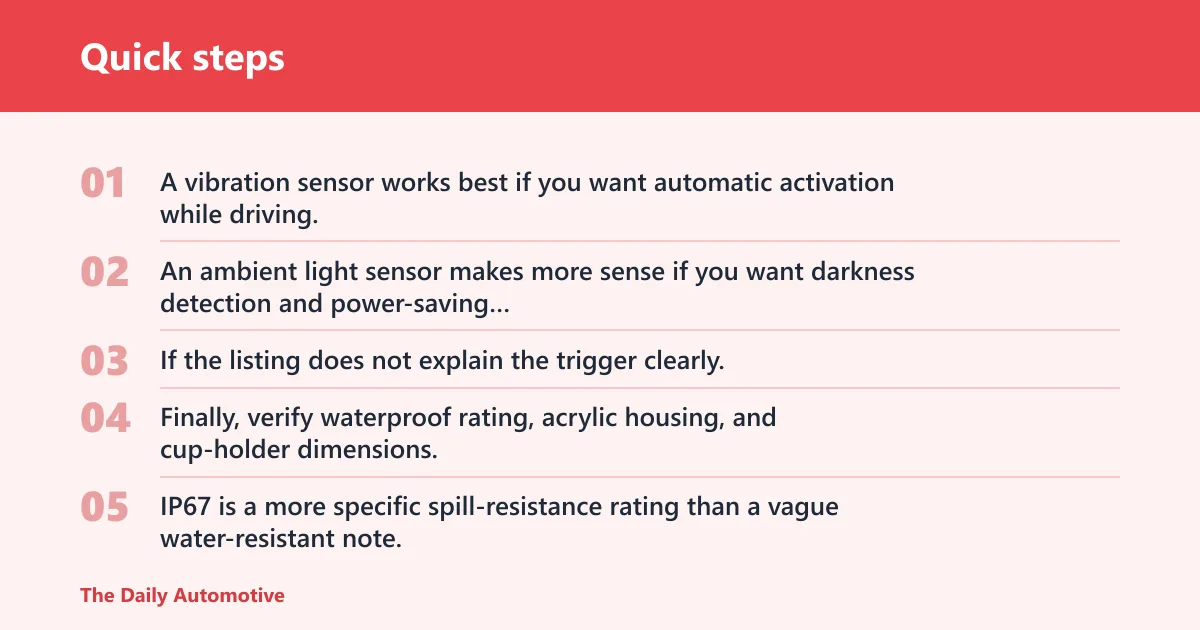
Next, match sensor behavior to your routine. A vibration sensor works best if you want automatic activation while driving. An ambient light sensor makes more sense if you want darkness detection and power-saving behavior when the cabin is already bright. If the listing does not explain the trigger clearly, do not assume it will work the way you expect.
Finally, verify waterproof rating, acrylic housing, and cup-holder dimensions. IP67 is a more specific spill-resistance rating than a vague water-resistant note, but it still does not mean full immersion is fine. Acrylic housing is useful because it transmits light cleanly, stands up to daily use, and is easier to wipe down after spills.
Check the vehicle manual and keep the light out of any airbag zone or the driver’s view if you plan to place it near other interior accessories. For cup holders, the safest approach is still simple: measure first, then buy the size that leaves room for the liner and the cable.
Frequently asked questions
What are the best LED cup holder lights for a car?
The best choice depends on what you value most. KESNEY is the strongest all-around option for automatic use because it combines USB-C charging, seven colors, three modes, and light plus vibration sensors. Z-oneMart is better if you want IP67 protection and color variety, while JINRUITOP and Zorratin are useful when fit numbers matter most.
Do LED cup holder lights fit most car cup holders?
They fit many, but not all. A diameter of about 2.7 inches, or a similar footprint, can work in many vehicles, though shape matters as much as size. Deep tapered holders, rubber liners, and narrow bottoms can cause wobble or poor contact even when the diameter looks close on paper.
Are LED cup holder lights USB-C or micro-USB rechargeable?
Either type appears in listings, but USB-C is the easier option for most buyers. KESNEY specifically lists USB-C recharging with color indicators, which is convenient in newer cars that already use USB-C cables. If a model uses micro-USB, check whether the cable is included and whether the port is easy to reach.
How long do LED cup holder lights last on a charge?
Runtime varies by battery size, brightness, and mode. The available listings include a model said to last around 8 hours per charge, while Zorratin is listed with a 200mAh lithium battery. For daily use, look for a runtime that covers your commute and note whether brighter modes shorten that figure.
Do LED cup holder lights turn on automatically when driving?
Some do, but the trigger matters. A vibration sensor can turn the light on with motion and off after inactivity, which suits driving use well. A light sensor reacts to darkness instead, so it is better for parking or low-light cabin use than for motion-based activation.
Are LED cup holder lights waterproof?
Some are spill-resistant, and a few list stronger protection. Z-oneMart is described as IP67 waterproof, which is better for accidental spill cleanup and daily dust exposure than a vague water-resistant claim. Even so, that rating should not be treated as permission to soak the unit or leave it in standing liquid.
Products related to this article
Sponsored / affiliate links. As an Amazon Associate I earn from qualifying purchases. I may earn additional commission from eligible campaigns.