CV Axle Replacement Cost: What to Expect at the Shop
A CV axle replacement is often reported at roughly $300 to $1,000 per axle at a repair shop, with many cars around $450 to $700; a DIY repair usually cuts that to the parts price plus a few tools. Leave a worn axle too long and you can strand the car, damage nearby suspension parts, or pay more after collateral wear spreads. This guide breaks down what a fair quote includes, what drives the price up, and when DIY actually pencils out.
What a CV axle does
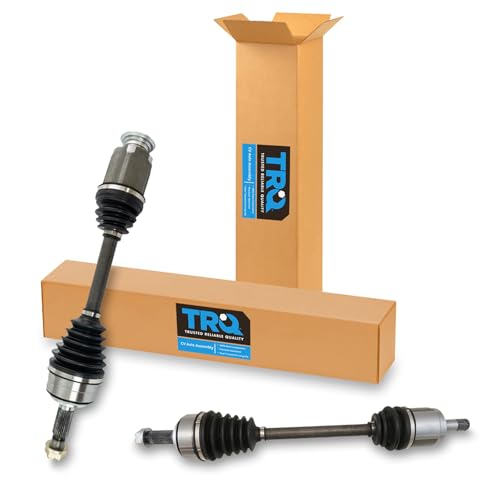


The CV axle assembly sends power from the transmission to the wheel hub while allowing the wheel to move up and down and turn left and right. It usually includes the shaft plus an inner and outer CV joint, and most shops replace the complete assembly instead of rebuilding one joint.
The outer joint is the one most often tied to the classic clicking noise in turns. The inner joint can clunk under acceleration or deceleration, and that matters because the noise pattern helps separate a worn joint from a bad wheel bearing, strut, or control arm bushing.
A torn CV boot is the early warning sign. Once grease leaks out, dirt and water can get in, and that contamination can wear the joint far faster than normal. If the boot is caught early and the joint is still quiet, some repairs can stop at the boot; if the joint is already noisy or loose, the axle assembly usually needs replacement.
Shops usually choose the full axle because the time spent chasing one joint on an old shaft often exceeds the value of the partial fix, and the result may still fail soon after.
How much should CV axle replacement cost?
For most cars, a fair shop quote falls in the $300 to $800 per-side range, and real-world totals often land around $400 to $1,200 depending on the vehicle and part choice. The axle assembly itself usually runs $60 to $180 before labor, with a new axle nut adding $5 to $15.
Parts pricing splits into two buckets. Aftermarket axles are usually cheaper and cover most repair jobs well enough for standard commuting use, while OEM parts cost more and may suit owners who want factory-spec fit or who are already dealing with a vehicle that is picky about driveline parts.
Labor is often 1 to 3 hours per side. On paper that sounds simple, but the quote changes fast when the axle is seized in the hub, the nut is rusted, the suspension needs extra separation, or the axle comes out of the transmission and risks fluid loss.
A DIY repair can remove most of the labor charge, but the savings depend on whether you already have the tools and whether the axle comes out cleanly. The Drive places the job in upper-level beginner territory, which is another way of saying it is possible at home, but not a casual first repair.
Typical cost spread by example vehicle
| Vehicle layout | Parts price | Labor hours | Axle nut/seal add-ons | Alignment risk | Fair total range |
|---|---|---|---|---|---|
| Front-wheel-drive compact car | $60 to $140 | 1 to 1.5 | $5 to $20 | Low unless steering parts are moved | $300 to $600 |
| Front-wheel-drive crossover | $90 to $180 | 1.5 to 2.5 | $10 to $30 | Medium if tie rods or knuckles shift | $400 to $800 |
| All-wheel-drive SUV, front axle | $100 to $220 | 2 to 3 | $10 to $40 | Medium | $500 to $1,000 |
| All-wheel-drive SUV, rear axle | $120 to $260 | 2 to 3 | $10 to $40 | Medium to high on some layouts | $550 to $1,200 |
| Rust-belt or hard-access vehicle | $90 to $260 | 3 or more | $20 to $60 | Higher if alignment is disturbed | $650 to $1,400 |
What changes the bill most?
Layout is the biggest cost driver. Front-wheel-drive cars usually cost less because the front axle is easier to access and the design is common, while all-wheel-drive vehicles may have front and rear CV axles, different packaging, and more labor time. Corrosion and tight access can add more than the part choice does.
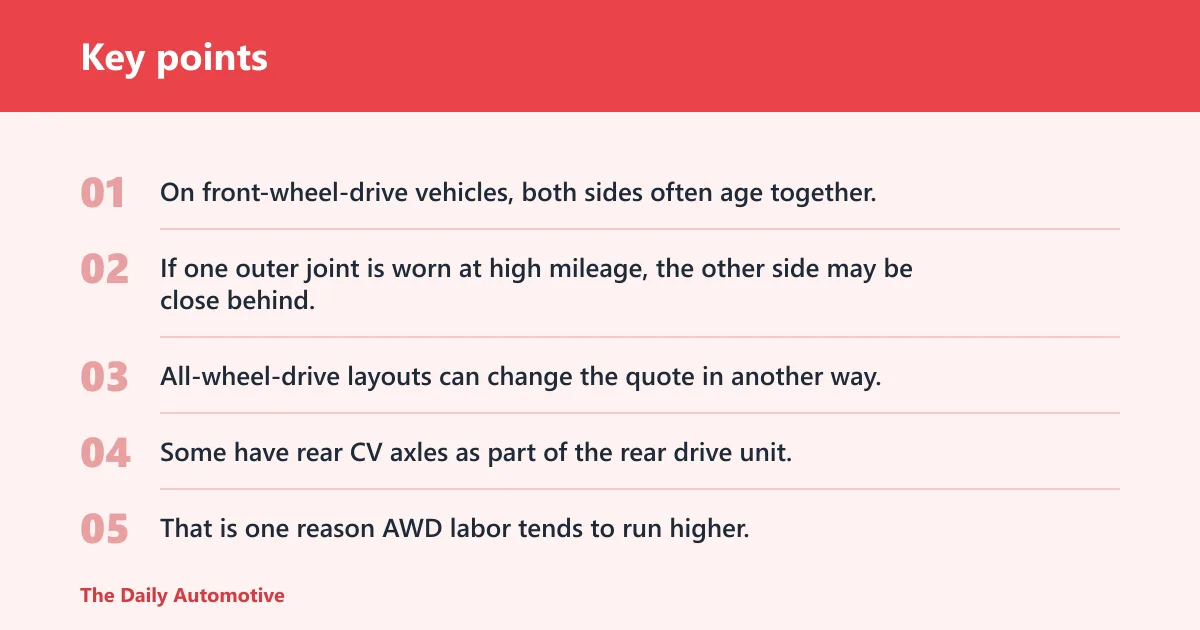
On front-wheel-drive vehicles, both sides often age together. If one outer joint is worn at high mileage, the other side may be close behind, which is why some repair quotes include both front axles even when only one is noisy.
All-wheel-drive layouts can change the quote in another way. Some have rear CV axles as part of the rear drive unit, so the job may involve different hardware, more underbody shielding, or more steps to reach the axle nut and hub. That is one reason AWD labor tends to run higher.
Say your 2014 FWD sedan starts clicking on right turns and has 130,000 miles. The shop quote may look modest because access is normal and the part is common. Suppose the same symptom appears on a lifted AWD crossover with rusted fasteners and a rear axle that has to come out around extra subframe hardware; the total can jump fast even though the symptom sounds similar.
Shop pricing versus mobile repair
Mobile mechanics can save towing costs when the car still rolls safely, but the labor rate may run higher because the job takes place away from a lift and parts storage. If the axle is broken enough that the car cannot move under its own power, towing to a shop often costs less than paying for complex roadside work.
That tradeoff matters most when the axle is close to failure. A vehicle that will not safely drive onto a truck may justify a shop visit plus tow, while a car with only a torn boot and no noise may be a better candidate for planned shop repair rather than emergency service.
CV axle quote audit
A quote reads better when you split it into parts, labor, and add-ons. The goal is to judge whether the quote fits the vehicle layout, the time required, and the extra items that often get buried in the fine print.
Quote checklist
- Check whether the axle is aftermarket or OEM.
- Confirm whether the quote includes a new axle nut.
- Ask if seals are included when the axle leaves the transmission or transaxle.
- Look for alignment or alignment-check charges if suspension parts are moved.
- Ask whether hub hardware is reused or replaced.
- Ask whether fluid top-off or extra fluid is included.
- Check whether the labor line matches the vehicle layout and access.
- Compare the quote to whether both sides need attention or only one side does.
Common add-ons that move the total
The axle nut is small, but it matters. Many repairs call for a new nut because the old one is deformed when removed, and the torque spec has to be right so the hub bearing is not overloaded.
Seals are another line item to watch. If the axle comes out of the transmission or transaxle, a worn or damaged seal can leak after reassembly, and a careful quote should note whether that risk is already priced in or left for later.
Alignment is not automatic for every axle job, but it becomes more likely if tie rods, knuckles, or other suspension points are shifted to get the axle out. If the shop mentions an alignment check, ask why it is needed and whether it is mandatory or precautionary.
How long does CV axle replacement take?
Plan on 1 to 3 hours per side for most repairs, with some jobs landing closer to 1 to 2 hours and others taking longer because of rust, tight packaging, or stubborn hub hardware. The time climbs on AWD vehicles and on cars where the axle is pressed, stuck, or buried behind other parts.
Rapidwrench places the job at about 1 to 2 hours per side, while other shop estimates stretch the labor window because real-world access changes from one vehicle to the next. Service Buddy lists 1.9 hours of labor, which sits in the middle of that spread.
A common first-timer mistake is assuming a front-wheel-drive axle replacement will cost the same as a rear-wheel-drive job with a seized hub and extra labor. On some cars, the axle comes out quickly. On others, the hub may need extra separation, the axle nut may be seized, or the axle shaft may stick in the transmission enough to slow the whole repair.
Can you replace a CV axle yourself?
Yes, but it is a moderate-to-advanced driveway repair rather than a beginner brake pad job. A DIY axle replacement can save a lot on labor, yet the job still needs correct lifting, the right torque, and enough force to break loose the axle nut and separate the hub end safely.
You will need a jack, jack stands, a breaker bar, and a torque wrench. Depending on the vehicle, a pickle fork or axle puller may also help, and the service manual matters because axle nut torque, hub torque, and fastener sequence vary by model.
What makes the job difficult
- Rust on the axle nut or hub splines.
- Tight access around the suspension and subframe.
- Seized inner splines or a stuck axle in the transmission.
- Need for exact torque on the axle nut during reassembly.
- Possible fluid loss when the axle is removed from the transaxle.
If the axle nut is rounded, the hub is corroded, or the axle will not budge without heavy force, a home repair can turn into a long delay. In that case, the labor savings may shrink enough that a shop is the better move.
Is it cheaper to replace the axle or the joint?
Replacing the whole axle is usually cheaper once labor is counted, even if the joint itself is the failed part. A boot-only issue caught early may cost less than a full axle, but once the joint clicks, clunks, or has play, shops usually price the complete assembly because it is faster and more reliable.
The outer CV joint is the one that most often clicks in turns. The inner joint is more likely to clunk during acceleration or deceleration. If the boot is torn but the joint is still quiet, a targeted repair may still make sense; if the grease is gone and the joint is noisy, the full axle is usually the safer call.
Picture a front-wheel-drive sedan with a split outer boot and no noise yet. A quick repair can sometimes catch the problem before dirt ruins the joint. Now picture the same car a month later with clicking on low-speed turns and grease sprayed around the wheel well. At that point, the quote should shift to axle replacement rather than boot repair.
Should I replace both CV axles at the same time?
It can make sense on high-mileage front-wheel-drive vehicles, especially when both sides have aged similarly. Replacing both front axles at once can save repeat labor, and it may prevent a second visit if the other side starts clicking soon after the first repair.
The case is weaker when only one side is clearly worn and the other still looks and feels healthy. On a vehicle with easy access and a single damaged boot, a one-side repair may be the better spend. On a rusty FWD car with 120,000 miles or more, paired replacement is often worth asking about.
AWD vehicles need a more careful look. Since some have rear CV axles too, “both sides” may mean both fronts, both rears, or a mixed repair plan based on where the noise and wear are coming from.
What does a failing CV axle sound like?
A failing outer CV joint usually clicks or snaps during low-speed turns, especially while accelerating through the turn. An inner joint more often clunks, shudders, or feels like a thump under load changes, which is why the sound pattern matters when you compare repair quotes.
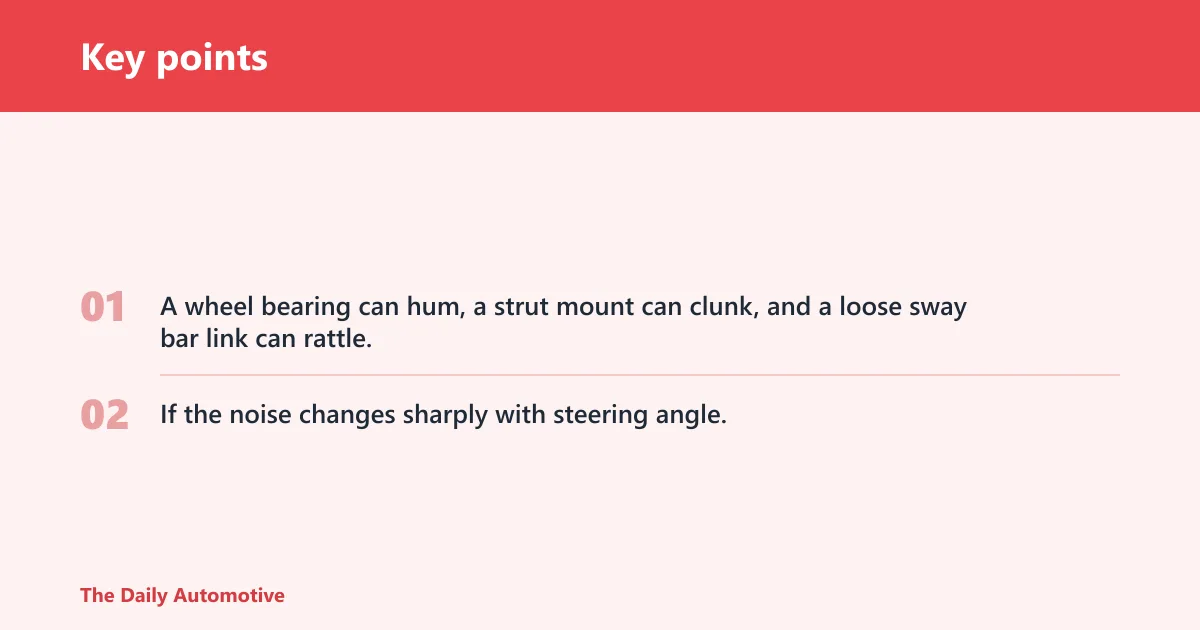
Not every front-end noise is a CV axle. A wheel bearing can hum, a strut mount can clunk, and a loose sway bar link can rattle. If the noise changes sharply with steering angle, that points more toward the outer joint; if it changes with acceleration and deceleration, the inner joint rises on the suspect list.
How much CV axle replacement cost per side?
The part itself is often $60 to $180, and labor is the part that swings the bill the most.
That range fits the national numbers from independent-shop pricing, and it lines up with broader fair-price data that places many repairs in the $530 to $1,050 zone when parts and labor are combined. A lower number is possible on common FWD cars. A higher number is normal on difficult layouts.
Frequently asked questions
How much CV axle replacement cost
If the quote is much lower or higher, check whether the estimate includes the axle nut, seals, alignment checks, and any fluid top-off.
How much does CV axle replacement cost per side?
Per side, expect roughly $300 to $800 at most independent shops, with some jobs lower on simple FWD cars and some higher on AWD or corrosion-heavy vehicles. The axle assembly itself is often $60 to $180, and a new axle nut may add $5 to $15.
What affects CV axle replacement cost the most?
Layout and labor time matter most. FWD cars are usually cheaper than AWD vehicles, and rear CV axle work can cost more on some AWD designs. Rust, hard access, hub seizure, alignment risk, and fluid-loss risk also move the total more than the part brand alone.
Can I drive with a bad CV axle?
Only briefly, and only if the symptoms are mild enough to get the vehicle to a repair site safely. A badly worn axle can leave you stranded or damage nearby parts. If the clicking gets loud, the car shudders, or the joint has heavy play, stop delaying the repair.
What tools do I need to replace a CV axle?
You will need a jack, jack stands, a breaker bar, and a torque wrench at minimum. Depending on the vehicle, a pickle fork or axle puller may help with separation. The service manual is important because axle nut torque and reassembly steps vary by model.
Products related to this article
Sponsored / affiliate links. As an Amazon Associate I earn from qualifying purchases. I may earn additional commission from eligible campaigns.