Blend Door vs Heater Core: How to Tell the Difference
Use the blend door when heat is present but stuck to one side or the wrong temperature. Suspect the heater core when both sides stay cold or only lukewarm, because one routes air and the other makes the heat. Misreading that split can burn hours on dash work or send you after the wrong part. This guide lays out the symptoms, quick tests, and the repair call.
Blend door vs heater core: the one-sentence difference
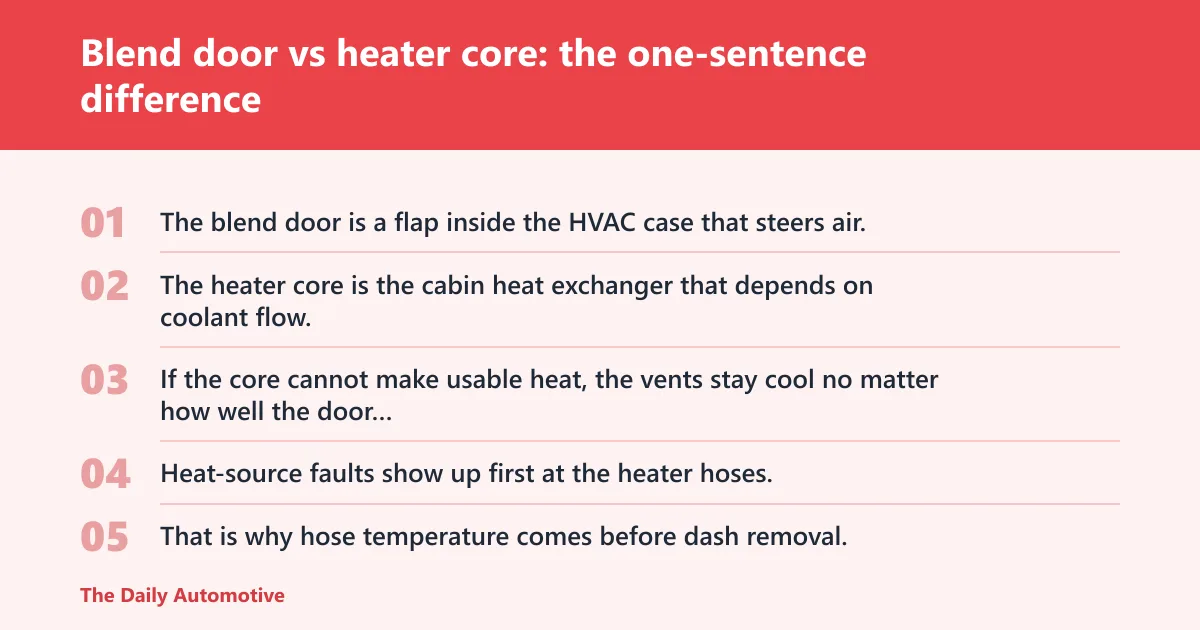
The blend door is a flap inside the HVAC case that steers air. The heater core is the cabin heat exchanger that depends on coolant flow. If the core cannot make usable heat, the vents stay cool no matter how well the door moves; if the core is hot but the door is wrong, the cabin still gets the wrong temperature.
| Decision factor | Blend Door | Heater Core | Winner |
|---|---|---|---|
| What it changes | Routes air through the heater core or AC evaporator | Creates cabin heat by transferring engine coolant heat to air | Tie |
| Best clue | Vent temperature changes oddly while hose temperature looks normal | Heater hose inlet/outlet show a meaningful temperature problem | Heater Core |
| Typical symptom | Stuck hot, stuck cold, split temperature on one side, or clicking behind dash | Lukewarm or cold air from all vents, weak heat at idle or all the time | Blend Door |
| Repair access | Sometimes glove box access, sometimes console and dash removal | Often buried in the HVAC box, and sometimes requires major disassembly | Tie |
| Risk of wrong replacement | A stuck door can destroy a new actuator if the door is not checked first | Replacing the core first can waste time if the issue is air mix, trapped air, or thermostat behavior | Tie |
What this table means in the driveway
Heat-source faults show up first at the heater hoses. Air-mix faults show up first at the vents. That is why hose temperature comes before dash removal. An infrared thermometer gives a fast read without opening the HVAC box.
Why the winner changes by symptom
A heater core fault wins when coolant is not giving up heat the way it should. A blend door fault wins when the core is hot but the cabin still gets the wrong air stream. Follow the first hard clue, not the loudest dash noise.
How a blend door works inside the HVAC case
A blend door is a temperature flap inside the HVAC case. It directs airflow through the heater core for heat or past the AC evaporator for cooling. The door can stick, crack, warp, or break at the pivot shafts, and many units use plastic parts with foam seals.
Foam seals and broken pivots matter
Foam seals fail a lot. When they wear out, air leaks around the door and the vents can go lukewarm even when the door moves. A cracked pivot shaft can do the same thing, because the actuator may move while the door no longer follows cleanly.
How a heater core makes cabin heat
The heater core is the cabin heat exchanger. Hot coolant passes through it, air moves across its fins, and the cabin gets warm only if coolant flow is present and the core is not blocked. If the inlet and outlet hose temperatures are nearly the same, that usually points away from a flow restriction.
What restricted flow feels like
A restricted or air-bound core often gives weak heat at the vents, especially when the engine is already warm. One hose may be hot and the other much cooler, or vent temperature may lag badly even with the fan on high. That is a coolant-side problem, not a door problem.
What the actuator and control head are doing
The blend door actuator is the device that moves the door to the commanded position. It can be an electric motor with feedback, or a cable or vacuum setup on older vehicles. Modern HVAC control modules may need recalibration after an actuator replacement or after the battery has been disconnected.
Clicking, hunting, and stop-short behavior
Clicking behind the dash can mean stripped actuator gears. Hunting means the actuator keeps correcting itself because feedback is lost or the calibration is wrong. Stop-short behavior usually means the module thinks the door reached home when it never really did.
Why a bad door can kill a fresh actuator
A stuck or broken blend door can destroy a new actuator if the door is not checked first. The motor keeps trying to move a jammed flap, and the gears or electronics take the hit. That is why the door has to be confirmed free before parts go in.
How do you tell if it is the heater core or blend door?
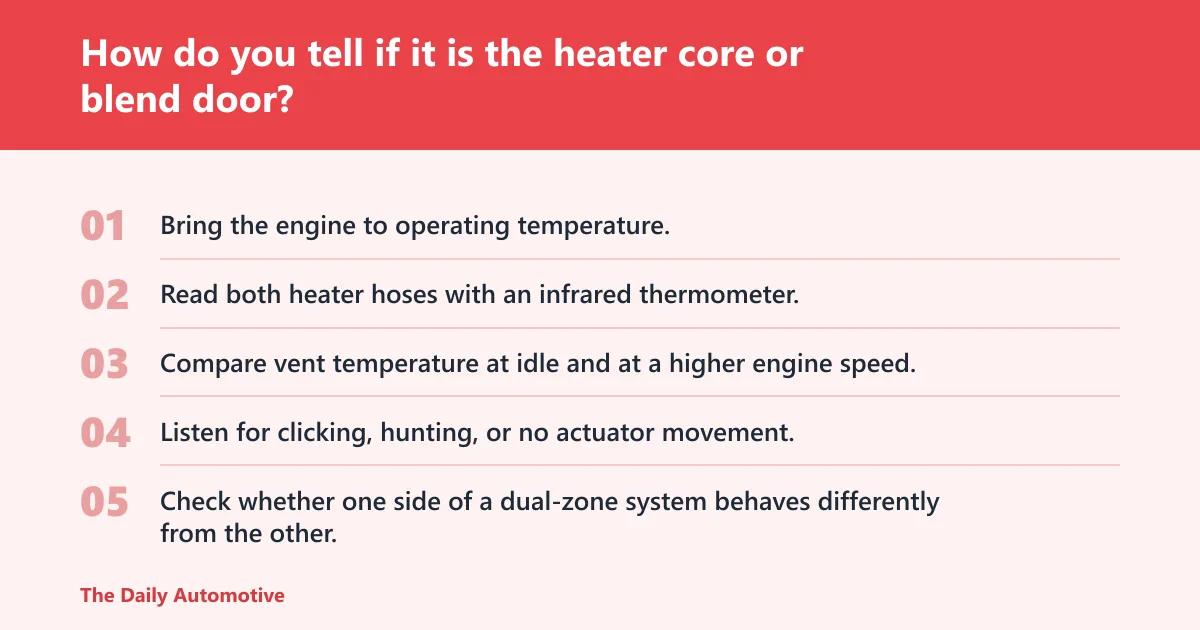
Start with heater hose temperature, then compare vent temperature, then listen for actuator behavior. If the hoses show good heat transfer but the vents stay wrong, the problem leans blend door. If the hoses do not warm evenly, or the core inlet and outlet act wrong, the problem leans heater core, trapped air, or thermostat flow.
Use an infrared thermometer first
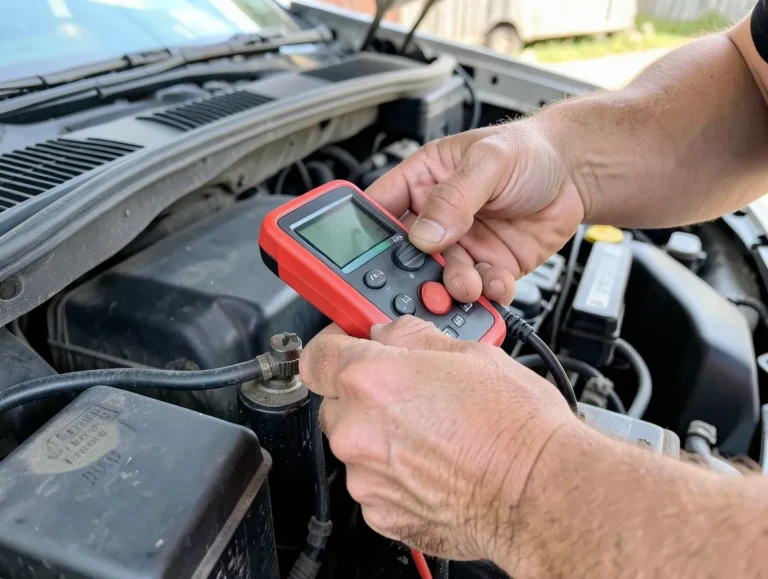
A good diagnostic move is to check heater hose temperatures with an infrared thermometer. On a healthy heater core, inlet and outlet hoses should have little or no temperature difference if flow is good. That quick check keeps you out of the dash until the coolant side has been ruled out.
Look at the vents at idle and under load
At idle, a weak cooling system, trapped air, or a lazy thermostat can make heat seem worse than it is. Under load and with the engine fully warm, a blend door issue usually stays inconsistent in the same way, while a heater core or cooling-system issue often changes with engine speed and coolant circulation.
Let actuator noise and response guide you
If the temperature knob or control head changes settings but the vents do not respond normally, listen for the actuator. Clicking, repeated movement, or no movement at all pushes suspicion toward the actuator or a broken door pivot. If the actuator sounds healthy but the cabin temperature does not change, the core or airflow path deserves more attention.
Where air bleed and thermostat faults fit
Trapped air in the cooling system can mimic a bad heater core. The old “98 Taurus” type complaint is a reminder to check for trapped air before tearing into the HVAC box. A thermostat that is stuck open can also keep engine coolant too cool for full heater performance.
- Bring the engine to operating temperature.
- Read both heater hoses with an infrared thermometer.
- Compare vent temperature at idle and at a higher engine speed.
- Listen for clicking, hunting, or no actuator movement.
- Check whether one side of a dual-zone system behaves differently from the other.
- Do not replace the heater core or actuator until the fault pattern matches the measurements.
Diagnostic decision table: what to replace, and what not to replace yet
| Symptom pattern | Heater hose readings | Vent behavior | Likely failure point | Do not replace yet |
|---|---|---|---|---|
| Both sides blow cold, engine fully warm | One hose hot, one hose much cooler, or both stay weak | Little heat everywhere | Heater core restriction, trapped air, or thermostat issue | Blend door actuator |
| Heat exists but stays stuck hot or stuck cold | Both heater hoses warm at about the same rate | Temperature does not follow the control knob | Blend door, actuator, or lost calibration | Heater core |
| Clicking behind the dash and no temperature change | Hose readings normal | Settings change on the display but not at the vents | Stripped actuator gears or jammed door | Heater core |
| One side cold, the other side warm on dual-zone systems | Hose readings generally normal | Driver and passenger side differ | Blend door on one bank, failed actuator, or calibration loss | Heater core |
| Heat is weak after battery disconnect or actuator replacement | Hose readings normal | Temperature wanders, hunts, or stops short | Relearn or calibration needed | Core replacement until calibration is checked |
Read the table like a fault tree
If the hose readings are wrong, the cooling system gets first attention. If the hoses look healthy but the cabin temperature is wrong, the air-mix door gets the blame. That is the fork most DIY repairs miss, which is why parts get changed in the wrong order.
Can a bad blend door actuator cause no heat?
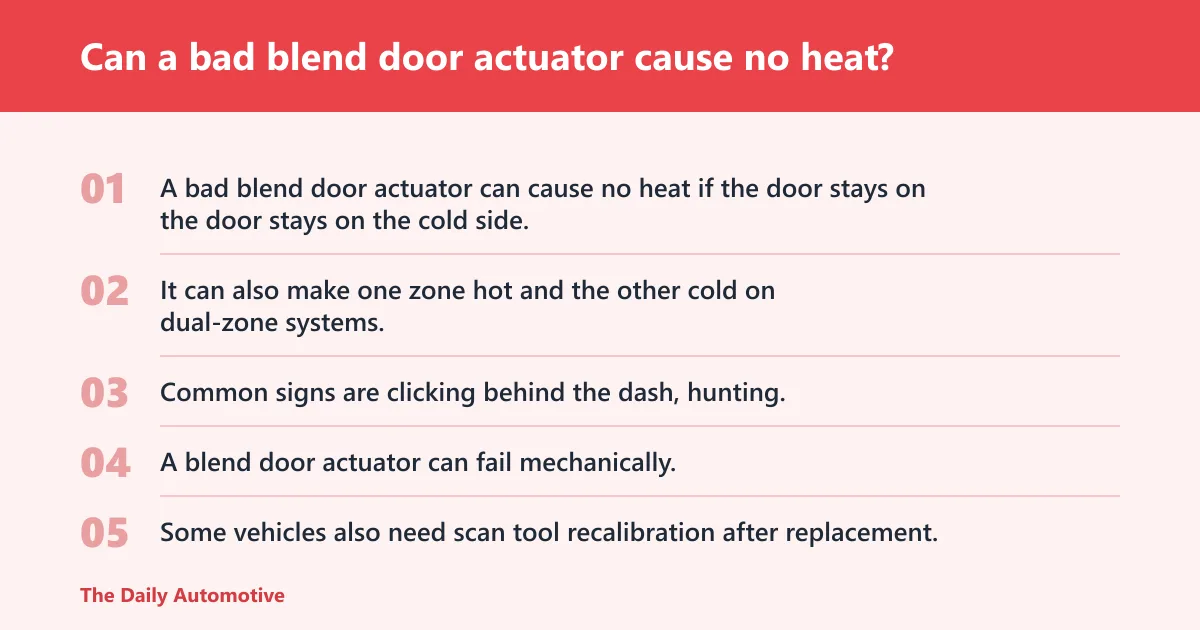
Yes. A bad blend door actuator can cause no heat if the door stays on the cold side, stops short of the heat position, or loses calibration. It can also make one zone hot and the other cold on dual-zone systems, which is why a dead-silent or clicking actuator deserves attention before any heater core replacement.
How to tell the actuator is bad
Common signs are clicking behind the dash, hunting, temperature changes that do not match the control head, and no movement after a command change. A blend door actuator can fail mechanically, or the motor or feedback electronics can fail. Some vehicles also need scan tool recalibration after replacement.
Why one bad door can look like no heat
If the door is stuck on the cold-air side, the heater core can be fine and the cabin still feels dead. That is common when the control head asks for heat but the actuator never reaches the correct stop. The vents tell the truth faster than the dashboard display.
Should I flush the heater core before replacing parts?
Flush the heater core before replacement only when hose temperature and flow signs fit a restriction pattern. If inlet and outlet temperatures suggest poor flow, a flush may be the right next step. If the core shows normal flow and the vents are wrong, a flush will not fix a blend door problem.
When a flush makes sense
A flush makes sense when one hose is clearly hotter than the other, the cabin heat is weak, and the rest of the cooling system points toward restriction or trapped debris. It also makes sense when the system has had air pockets and the heat has not returned after proper bleed procedures.
When a flush wastes time
If the hoses are warming together and the vent problem follows knob movement, the issue is usually not the core. That is the point where door travel, actuator movement, foam seals, and calibration deserve the next inspection. Replacing or flushing the core first can miss the real fault.
Blend door vs heater core
Use the blend door path when the heater core is hot but the cabin temperature is wrong, split, or stuck. Use the heater core path when the vents never get enough heat because coolant flow, trapped air, or thermostat behavior is wrong. The right call follows the hose check first, then the vent check, then the actuator check.
Choose blend door if…
Choose blend door if the heater hoses are warm at about the same rate, the control head changes settings, and the vents stay stuck hot, stuck cold, or split side to side. Choose blend door if clicking behind the dash points to stripped actuator gears, or if recalibration after battery disconnect changes nothing.
Choose heater core if…
Choose heater core if the inlet and outlet hose temperatures show poor flow, if both vents stay cold or lukewarm after the engine is fully warm, or if trapped air and thermostat behavior fit the complaint. Choose heater core after the cooling side has been checked, not before.
Access and cost caution
Some vehicles require removing the glove box to access the actuator. Other vehicles require console and dash removal for actuator replacement. Actuator motors are usually less than $100, but heater core and blend door repair cost can be very model-specific, so the labor decision matters more than the part price.
Frequently asked questions
what is a blend door
A blend door is the HVAC flap that controls whether air passes through the heater core or around it on the way to the vents. It is the part that decides cabin temperature, while the heater core is the part that makes the heat available in the first place.
how does a blend door work
The blend door rotates or swings to change the air path inside the HVAC case. The actuator moves it to a commanded position, and on many systems a feedback signal tells the HVAC module where the door actually is. If the door binds or loses calibration, vent temperature goes wrong.
what is the purpose of heater core
The heater core transfers heat from engine coolant to the air that enters the cabin. If coolant does not flow through it properly, the air cannot pick up enough heat, so even a perfect blend door will only deliver lukewarm or cold air.
is it the heater core or blend door
If the heater hoses are hot and nearly equal in temperature but the cabin temperature is wrong, think blend door or actuator. If the hoses do not show healthy heat transfer, think heater core, trapped air, or thermostat behavior first. Hose temperature is the quickest separator.
how do you tell if the blend door actuator is bad
Bad actuator clues include clicking behind the dash, repeated hunting, no response to temperature commands, or movement that stops short of the expected position. A scan tool may be needed for recalibration on some vehicles after replacement or battery disconnect.
can a bad blend door actuator cause no heat
Yes, if the door stays on the cold-air side or never reaches the heat position. That can create a no-heat complaint even when the heater core is fine. It can also produce one hot side and one cold side on dual-zone systems, which is a strong clue.
why does my car blow cold air until it warms up
That often points to thermostat behavior, trapped air, or weak coolant flow before it points to the blend door. If the engine is not up to temperature, the heater core cannot supply much heat. If the engine is warm but the vents still act wrong, the door or actuator moves higher on the list.
should I flush the heater core before replacing parts
Flush it first only when hose temperatures and symptoms point to a flow problem. If inlet and outlet hose temperatures suggest restriction or air in the core, a flush is reasonable. If the hoses look normal and the vent problem follows control changes, the blend door path deserves attention instead.
Products related to this article
Sponsored / affiliate links. As an Amazon Associate I earn from qualifying purchases. I may earn additional commission from eligible campaigns.