Jump Starter vs Portable Battery Pack
Pick a portable battery pack if you need roadside self-rescue. Pick a heavy-duty booster pack for larger engines or repeated starts, and keep jumper cables only if another vehicle is likely nearby. Pick wrong, and a dead battery can mean a tow, a delay, or a no-start in cold weather. This guide compares Jump Starter, Portable Battery Pack, and jumper cables by vehicle size, climate, and roadside scenario.
| Decision factor | Jump Starter | Portable Battery Pack | Winner |
|---|---|---|---|
| Self-rescue on the roadside | Self-contained 12-volt starting device; no second vehicle needed | Also self-contained, but the term is often used more loosely in retail | Jump Starter |
| Typical vehicle fit | Best for commuter cars, crossovers, and many light-duty trucks | Same use case when the pack is sized for starting, not charging | Tie |
| Cold-weather margin | Better when you size for higher peak current and smart clamps | Same hardware class can work, but small units lose margin fast in cold weather | Jump Starter |
| Size and carry convenience | Pocket units average about 6x2x2 inches and under 1 pound | Retail wording is broader, but the compact starting packs fit trunk or glove box | Jump Starter |
| Accessory value | Often includes USB ports, flashlight, and sometimes an air compressor | Often the same, depending on model | Tie |
| Heavy-duty service use | Works for many gas cars and light trucks; less suited to repeated large-engine service | Can refer to larger booster packs with lead-acid hardware and longer cables | Portable Battery Pack |
| Cost floor | Usually costs more than jumper cables, less than large service packs | Varies by class; heavy-duty versions cost more because of size and output | Jump Starter |
| Failure case coverage | Helps with a dead battery, but not a bad alternator or a battery that will not hold charge | Same limit; larger packs only add starting margin | Tie |
What each tool actually
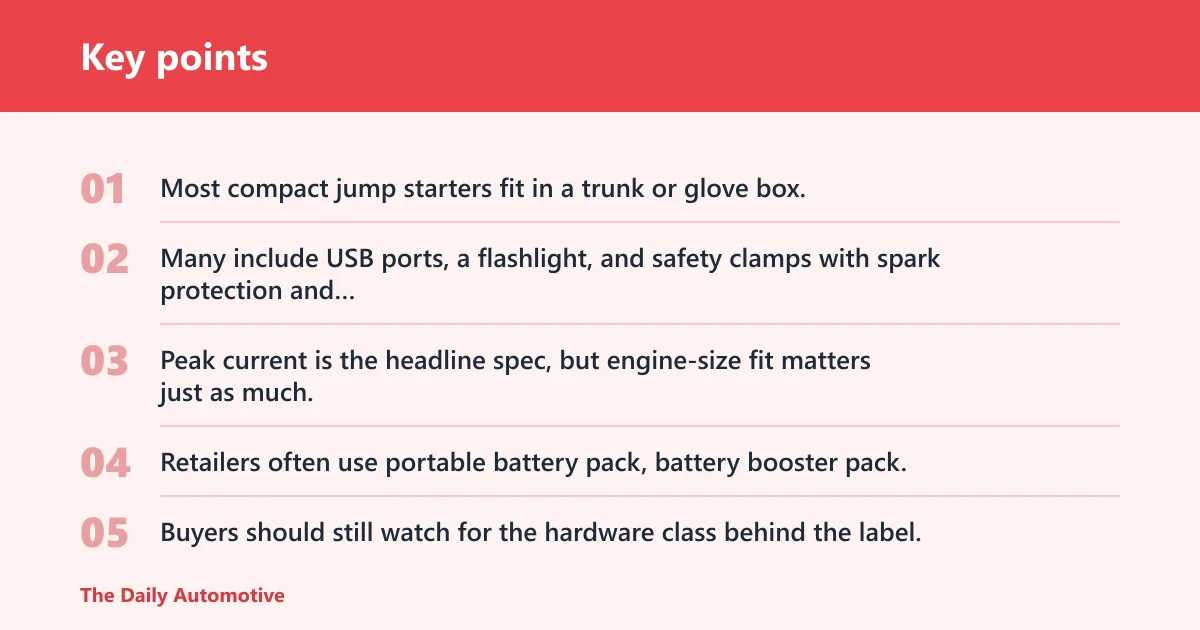
A portable jump starter is a self-contained 12-volt starting device. It replaces the need for another vehicle and jumper cables, which matters during a roadside dead-battery event. Pocket jump starters use lithium-ion batteries, while larger portable packs may use other lithium chemistries or lead-acid hardware.
Jump starter
Most compact jump starters fit in a trunk or glove box, and the pocket class averages about 6x2x2 inches and under 1 pound. Many include USB ports, a flashlight, and safety clamps with spark protection and reverse-polarity protection. Peak current is the headline spec, but engine-size fit matters just as much.
Portable battery pack
Retailers often use portable battery pack, battery booster pack, and jump box as overlapping names. Buyers should still watch for the hardware class behind the label, because some listings mean a compact self-rescue starter while others mean a larger, heavier booster pack for service use. The label alone does not tell you the size or output.
Heavy-duty booster pack
Heavy-duty packs use lead-acid technology in many cases, though not every one does. They are larger and heavier than pocket units, with averages around 12x12x5 inches and up to 40 pounds. That extra mass usually buys longer cables, higher output, and better fit for commercial or large vehicles.
Jumper cables
Jumper cables are the cheapest option, but they need a second vehicle and a willing driver. Cable length matters, clamp quality matters, and the risk of user error is higher because the connection is entirely manual. Many drivers keep a set in the car without charging them, which is their main storage advantage.
Jump starter decision matrix
The right choice depends on the failure case, not just the battery size in the ad. A dead-but-not-dead battery, a cold soak, or a vehicle that has not been driven for weeks all point to different needs. Use the matrix below before you shop.
| Vehicle type | Fuel type | Climate | Emergency scenario | Recommended device class | Minimum practical amp range | Portability tradeoff | When it will not work |
|---|---|---|---|---|---|---|---|
| Compact car, sedan, small crossover | Gas | Mild | Interior light left on; battery is flat but not failed | Jump Starter | 300A to 500A | Fits glove box or trunk easily | Bad alternator, battery that will not hold charge |
| Mid-size SUV or light pickup | Gas | Mild to cold | Long parking stay; battery is deeply discharged | Jump Starter | 500A to about 1,000A | Still portable, but a larger pack gives more reserve | Frozen battery, parasitic drain, charging-system fault |
| Full-size SUV or truck | Gas | Cold | Cold-crank failure on a weak battery | Portable Battery Pack | About 1,000A or more | Bulkier than pocket units, but safer margin for cold starts | Sulfated battery, alternator failure, or a battery at end of life |
| Large pickup or commercial van | Diesel | Cold | Multiple starts across a workday | Portable Battery Pack | About 1,000A or more | Heavier and less glove-box friendly | Very low battery voltage, frozen battery, failed starter circuit |
| Any vehicle | Any | Any | Battery has an internal fault or cannot hold charge | None of these tools solve the root problem | Not a sizing issue | No portability advantage matters here | Needs diagnosis, repair, or replacement battery |
Say your sedan has been parked for a week, and the dash lights come on but the starter only clicks. A compact Jump Starter in the 300A to 500A range is often the practical fix if the battery is merely discharged. If the same car has a bad alternator, the jump may get it moving once and then fail again very soon.
Suppose your 7.0L gas truck is stranded at 10 degrees, and the battery has sagged after a long overnight sit. That is where a larger Portable Battery Pack with about 1,000A or more may make more sense than a pocket unit. Cold weather can turn a marginal pack into a failed start.
How many amps do you need?
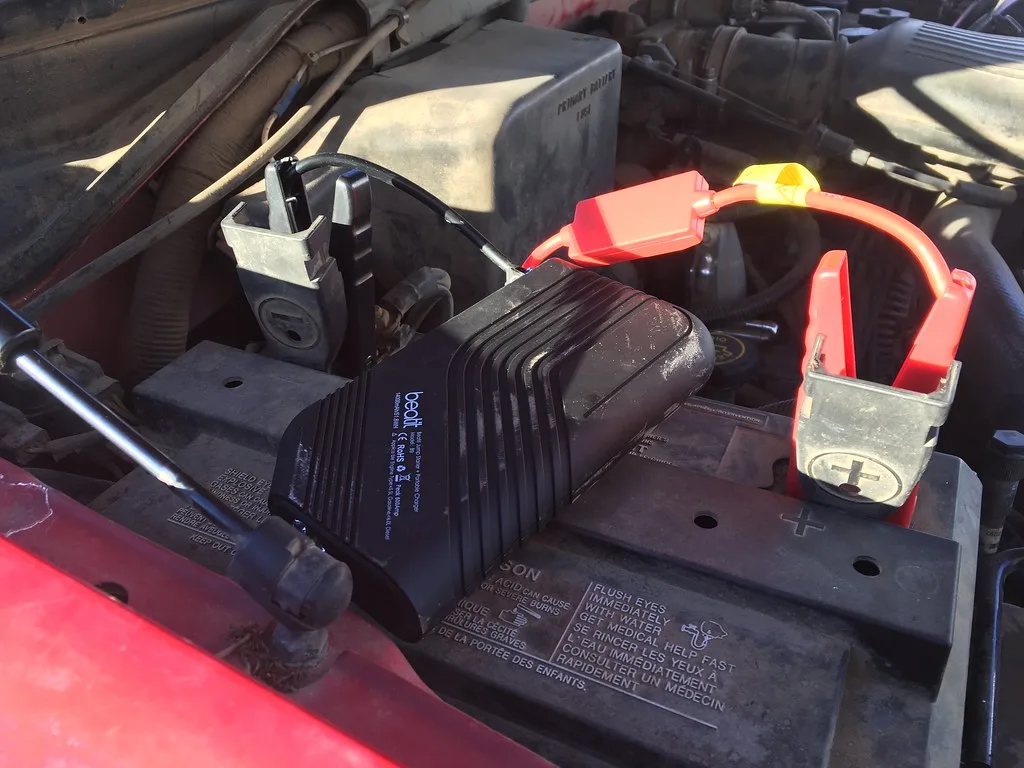
Peak current is the first number to read, but it is not the only one. Most cars require about 1,000 amps or less, and smaller gas engines often need less than that. Manufacturer engine-displacement ratings matter because a 500A pack that is fine for a 4.0L gas engine may be a poor fit for a diesel or a large truck.
Peak current versus cranking needs
Peak amps show the top burst the pack can deliver, not the exact current every engine will draw. That is why two products with the same peak number can behave differently if one has better clamps, thicker cables, or a stronger internal battery. Treat the peak number as the starting point, then check the engine-size rating.
Practical ranges by vehicle
For small cars and many commuter crossovers, a compact unit in the 300A to 500A range is often enough. For larger gas SUVs and trucks, a common buying range is about 500A to 1,000A. Diesel engines usually need more starting power than gas engines of similar size, so the same displacement number does not guarantee the same pack will fit both.
Why engine ratings matter
Look for the manufacturer-stated maximum engine size, such as 4.0L gas or 7.0L gas and 5.5L diesel. Those ratings are more useful than a vague “for most vehicles” claim. A compact pack like the NOCO GB20 is rated for gasoline engines up to 4.0 L, has a 500A peak starting current, and is not suitable for diesel engines.
Can a jump starter start a diesel truck?
Yes, but only if the pack is built for it. Diesel engines usually need more current than gas engines because compression is higher and cold starts are harder. A compact unit can help a small diesel in mild weather if the rating supports it, but many diesel trucks need a larger booster pack with more headroom.
When a compact unit is enough
A compact starter may work for a smaller diesel if the manufacturer explicitly allows diesel use and the weather is not punishing. The battery must still have some life left; a jump starter is not magic. If the engine is large, the battery is deeply discharged, or the weather is below freezing, the odds drop quickly.
When a heavy-duty pack is the safer choice
Choose the larger pack when you service diesel pickups, box trucks, or commercial vans on a regular basis. The extra cable length and higher output matter when the battery is tucked away or the vehicle sits for long periods. A larger pack is also easier to justify if you expect repeated starts in one day.
When a jump starter will not work
A jump starter can only supply starting current. It will not repair a charging-system fault, a parasitic drain, or a battery that is too damaged to take a charge. If the problem is the alternator, the battery may start the engine once and then die again after the vehicle runs for a short time.
Alternator failure
If the alternator is not charging, the jump starter only buys a short move to a repair bay. That is still useful in an emergency, but it is not a fix. Warning lights, dimming lights, and repeated stalls after a jump point to diagnosis, not a bigger pack.
Parasitic drain
A parasitic draw can flatten a battery overnight or over a few days. A jump starter will get the vehicle started, but the drain remains. If the battery keeps dying after short parking periods, the real job is to find what is staying on.
Frozen or sulfated batteries
Frozen batteries should not be jumped. A sulfated battery may accept a jump once, then collapse again because the plates have deteriorated. In both cases, the pack is masking the symptom, not fixing the source.
A battery that will not hold charge
If the battery voltage falls back to dead after a full drive, replacement is likely. A portable starter may still help you get home or to a parts store, but it is not the right answer for a battery at the end of its life. That is where a roadside rescue tool stops being enough.
Choose Jump Starter if… / Choose Portable Battery Pack if…
Choose Jump Starter if you want the compact self-rescue tool for a commuter car, crossover, or light-duty truck. Choose Portable Battery Pack if you regularly service larger engines, need higher output for diesel or cold-weather starts, or want a heavier unit with longer cables and more reserve for repeated calls.
Choose jump starter if…
You want trunk-friendly storage and fast access during a dead-battery event. You drive a gas vehicle in the small-to-mid-size range. You value smart clamps, USB ports, and a flashlight in one roadside emergency kit. You want a pack that can sit charged in the car and replace the need for another vehicle.
Choose Portable battery pack if…
You work with larger engines, including diesel trucks or commercial vehicles. You need a stronger margin in cold weather, especially when the battery is weak rather than merely discharged. You accept more weight for more starting headroom, longer cables, and a better fit for repeated service work.

Frequently asked questions
Portable jump starter vs battery charger
They are not the same tool. A portable jump starter supplies a short burst of starting current so the engine can crank. A battery charger restores battery charge over time. If the battery is too weak to start the car, a jump starter helps with the start; a charger helps with recovery afterward.
What is the best portable battery jump starter?
The best one is the unit that matches your engine size, fuel type, and climate. For a small gas car, a compact starter with smart clamps and around 300A to 500A can be enough. For larger gas vehicles or diesel, look higher and check the manufacturer’s engine-size rating before you buy.
How many amps does my jump starter need?
Use the vehicle, not the box art, to answer that question. Small cars usually fit lower peak-current models, while larger SUVs, trucks, and diesel vehicles need more.
What is the difference between a jump starter and a battery booster pack?
Retailers often use those terms interchangeably, but buyers should still check the hardware class. A jump starter usually means a compact self-rescue starter. A battery booster pack can also mean a larger, heavier unit with more output, longer cables, and a better fit for commercial or repeated service use.
Can a jump starter start a diesel truck: sometimes?
Sometimes, but only if the pack is rated for diesel use and the truck is within the stated engine-size limit. Diesel engines usually need more current than gas engines of similar size. A compact unit may be enough for a small diesel in mild weather, while larger trucks usually need a heavy-duty pack.
How do you use a battery pack jump starter safely?
Connect the clamps exactly as marked, with the positive clamp on positive and the negative on the proper ground point if the manual calls for it. Use smart clamps with reverse-polarity protection when possible. Start the engine promptly, then disconnect in the order the instructions specify. Never force a frozen battery to start.
Products related to this article
Sponsored / affiliate links. As an Amazon Associate I earn from qualifying purchases. I may earn additional commission from eligible campaigns.