Detailing Spray vs Quick Detailer: Which One Fits
Use a quick detailer for light dust and fingerprints on paint that is already clean or only lightly dusty. Reach for a finishing spray after drying or between washes when you want more gloss. Pick a ceramic detailer for maintenance on coated paint. If the panel is dirty enough to drag grit, wash first. Use the wrong spray on a dirty panel and you can scratch paint, smear residue, or leave protection uneven. This guide separates detailing spray, quick detailer, finishing spray, and ceramic detailer by job, surface, and safe use.
This guide is part of our Car wash supplies and equipment guide series.
Detailing spray vs quick detailer: the one-line difference

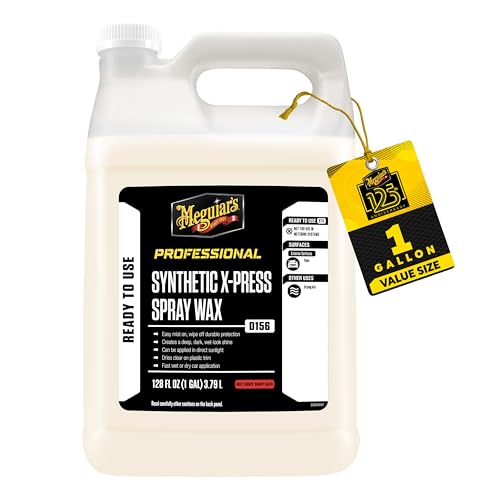

The core trade-off is simple. Quick detailer is mainly a cleaner for light dust, fingerprints, and smudges on clean or lightly soiled paint, while detailing spray is a broader label that can mean a quick detailer, a finishing spray, a wash-and-finish product, or a ceramic detailer.
The label spread matters because the bottle name does not tell you the whole job. One spray may clean and leave almost no protection. Another may leave slickness, gloss, polymers, silicones, or SiO2 behind. Start with the family name, then read the formula type and the surface you plan to touch.
| Decision factor | Detailing Spray | Quick Detailer | Winner |
|---|---|---|---|
| Main job | Can mean cleaning, finishing, wash aid, or protection depending on label | Light cleaning and dust removal on clean paint | Quick Detailer |
| Formula clarity | Broad category, less predictable from the name alone | Usually clearer: a fast touch-up cleaner | Quick Detailer |
| Protection | May include polymers, silicones, or SiO2 | Minimal or very light protection | Detailing Spray |
| Best-fit use case | After washing, drying aid, maintenance spray, gloss top-up | Fingerprints, smudges, light dust, quick cleanups | Tie |
Main job
Quick detailer wins when the question is “What removes a little dust fast?” That is its lane. Detailing spray can do that too, but the label is broader, so the buyer still has to identify whether the product is a cleaner, a finisher, or something with added protection.
Formula clarity
Quick detailer is easier to read because the job is narrow. Detailing spray is a category name, not one formula type, and that is why two bottles with similar packaging can leave very different residue, slickness, and durability.
Protection
Detailing spray wins here when the formula includes polymers, silicones, or SiO2. Quick detailer usually lasts until the next wash or rain and is not a long-term protectant.
Best-fit use case
Both can be right for light maintenance after a wash. A drying aid, a final wipe, or a quick gloss refresh may fit either one, depending on the formula and the finish the user wants.
According to eshop.umyem.com — Gyeon Q2M CeramicDetailer is a quick detailer with SiO2.
What each spray type actually does
Quick detailer
Quick detailer is the cleaner-first product. It is best for light dust, fingerprints, and fast touch-ups on a clean surface, and it is commonly used for dust, fingerprints, and smudges on paint that is not gritty.
Finishing spray and wash-and-finish spray
A finishing spray usually leans more toward gloss, slickness, and a final wipe than deep cleaning. A wash-and-finish product goes another direction again: it is built for maintenance cleaning and can help on lightly soiled panels, but it is still not a substitute for a wash on dirty paint. Koch Wash & Finish is positioned as a no-rinse wash and detailer, and Umyem recommends it as a top help for washing a car without water; the practical test described it as the best choice.
Spray wax
Spray wax is the gloss-plus-protection option. It is better when you want extra shine and a short-term protective layer after washing, and it often lasts days to a few weeks depending on product and conditions.
SiO2 and ceramic detailer
SiO2 detailers sit closer to maintenance protection than basic cleaning. Gyeon Q2M CeramicDetailer is a quick detailer with SiO2, and CarPro EliXir is sold as a ceramic detailer in a 500 ml size. These products are usually chosen for gloss and water behavior, especially on coated vehicles.
How do you choose the right one for the job?
Choose the spray by surface condition first, then by the finish you want. If the panel is clean and only has dust or fingerprints, quick detailer is the cleanest answer. If you want more gloss or some short-term protection after washing, a spray wax or ceramic detailer fits better.
Light dust and fingerprints
Use a quick detailer for light dust and fingerprints. That is its most reliable role, and it gives the least risk when the surface is already clean and the towel is soft and clean.
After washing the car
Choose a finishing spray, spray wax, or ceramic detailer depending on the finish you want. A quick detailer can work as a final wipe, but it is not the best choice if the goal is added protection.
Maintenance on a ceramic-coated car
Use a ceramic detailer when the goal is to support water behavior and gloss on coated paint. Gyeon Q2M CeramicDetailer and CarPro EliXir fit this job better than a plain quick detailer because they are aimed at ceramic-style maintenance rather than simple dust removal.
Gloss on clean dry paint
Use spray wax or a finishing spray if the panel is already clean and dry and the only goal is a better look. Quick detailer can add some slickness, but it is not the strongest choice for visible protection or long-lasting beading.
Side-by-side comparison of cleaning, gloss, and protection
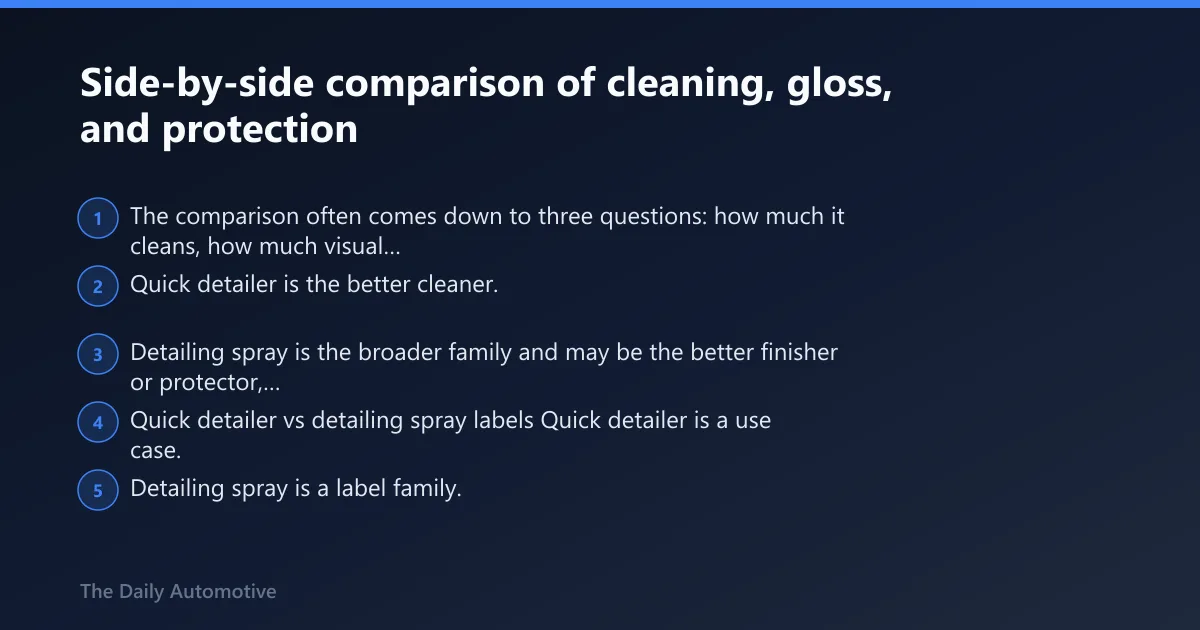
The comparison often comes down to three questions: how much it cleans, how much visual change it leaves, and how long that change lasts. Quick detailer is the better cleaner. Detailing spray is the broader family and may be the better finisher or protector, depending on formula.
Quick detailer vs detailing spray labels
Quick detailer is a use case. Detailing spray is a label family. That is why the label alone can mislead buyers; a product called detailing spray may be a finishing spray, a wash-and-finish product, or a ceramic spray with very different residue and feel.
Spray wax vs ceramic detailer
Spray wax aims at shine plus temporary protection. Ceramic detailer aims at gloss and water behavior, especially for maintenance use on coated vehicles. Both can look good fast, but the formula family changes the finish and the residue left behind.
Silicone-free vs silicone-containing formulas
Koch Chemie Qf Quick Finish is described as a multifunctional detailer without silicones. Koch Chemie Qs Quick & Shine is a multifunctional detailer with silicones. In practical terms, that often means a different residue profile and a different finish feel, which matters on trim, on delicate surfaces, and when the user wants a cleaner wipe-down.
Typical durability and surface feel
Quick detailer usually lasts until the next wash or rain. Spray wax often lasts days to a few weeks. Ceramic detailers sit closer to maintenance protection and can feel slicker, but none of these replace a real protectant or a proper wash routine.
When should you use quick detailer after washing your car?
Use quick detailer after washing only when the paint is already clean and you want a final wipe, light dust removal, or a little extra gloss. It works well as a drying aid on fresh, clean panels. Skip it if the surface is still contaminated or gritty, because the towel can drag debris across the paint.
Drying aid use
On a freshly washed panel, a quick detailer can help the towel glide more easily and reduce drag. The key is light spray, a clean towel, and a panel that no longer holds grit.
Final wipe on clean panels
A quick detailer is useful for fingerprints after drying, door jamb touch-ups, and a final pass before delivery or storage. It is a finishing step, not a cleaning rescue.
When to skip it and leave the paint alone
Skip quick detailer if the panel still feels rough, carries road film, or has visible grit. In that state, even a good spray can move dirt around instead of lifting it off.
Choose quick detailer if… / Choose detailing spray if…
Choose quick detailer when the job is light cleaning and the surface is already in good shape. Choose detailing spray when the label matches a specific maintenance job, such as a wash aid, finishing spray, spray wax, or ceramic detailer. The bottle name matters less than what the formula is meant to do.
Choose quick detailer if…
- The car has light dust, fingerprints, or smudges only.
- You need a fast clean on clean paint after a wash.
- You want minimal residue and only very light protection.
- You are dealing with a panel that should not be left slick or heavily coated.
Choose detailing spray if…
- You want a drying aid, gloss topper, or maintenance spray after washing.
- The product is a wash-and-finish type for light cleaning and waterless or no-rinse use.
- You want spray wax style shine plus temporary protection.
- You need ceramic-style maintenance on a coated vehicle.
Decision table: 8 real-world scenarios
| Scenario | Correct spray type | Why it fits | Failure risk if you pick wrong |
|---|---|---|---|
| Dust on a garage-kept sedan before a drive | Quick detailer | Light dust and fingerprints are its main job | Heavy residue or unnecessary protection layer |
| Fingerprints on black paint after a hand wash | Quick detailer | Fast touch-up on a clean surface | Streaks if overapplied |
| Freshly washed paint that needs extra gloss | Spray wax | Shine plus temporary protection after washing | Cleaner-only sprays may leave the look flat |
| Coated car needing maintenance between washes | Ceramic detailer | Built for gloss and water behavior on coated paint | Plain quick detailer may not support the coating as well |
| Final wipe before a weekend show | Finishing spray | Focuses on appearance and a clean finish | Too much product can leave haze |
| Lightly soiled panels during a no-rinse process | Wash-and-finish product | Made for cleaning and detailing in one step | Quick detailer may not lift enough soil |
| Matte paint that needs a quick touch-up | Label-approved matte-safe detailer | Matte surfaces need compatibility control | Glossing formulas can alter the finish |
| Exterior trim with light dust and no grime | Silicone-free or trim-safe detailer | Reduces residue risk on textured plastics | Silicone-heavy formulas can leave unwanted shine |
Failure-case checklist for streaking, residue, and marring
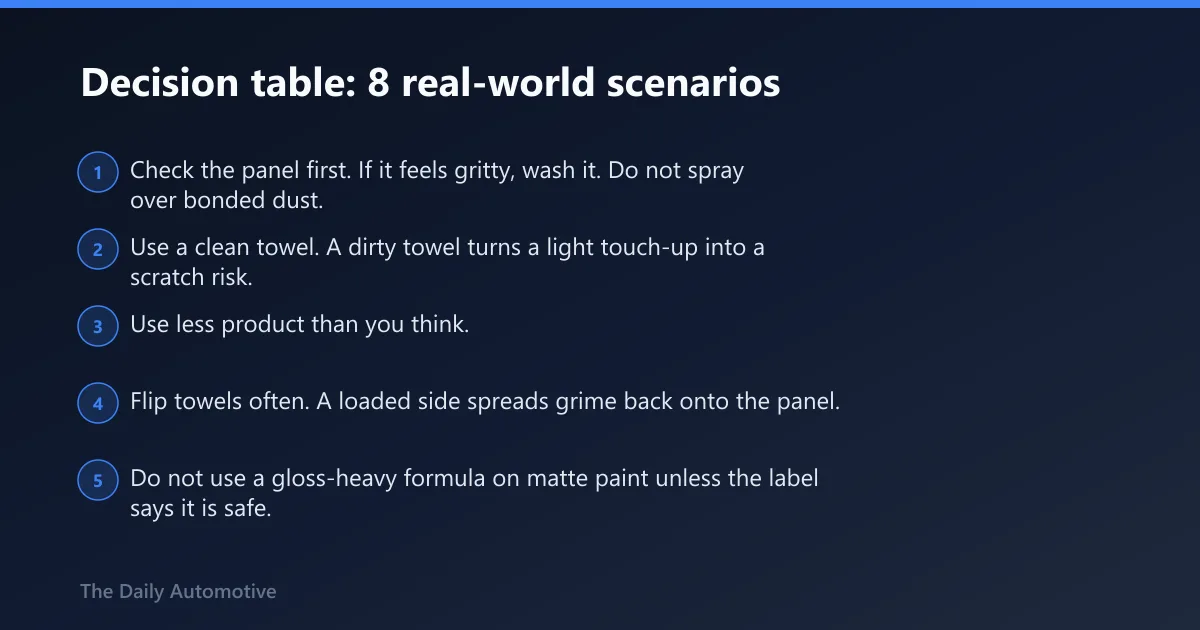
- Check the panel first. If it feels gritty, wash it. Do not spray over bonded dust.
- Use a clean towel. A dirty towel turns a light touch-up into a scratch risk.
- Use less product than you think. Overapplication is a common cause of streaking and smeared residue.
- Flip towels often. A loaded side spreads grime back onto the panel.
- Do not use a gloss-heavy formula on matte paint unless the label says it is safe.
- Watch trim and glass closely. Some formulas leave a film that shows up after the first wipe.
Can quick detailer be used on glass and trim?
Yes, sometimes, but only when the label allows it and the surface is clean. Glass can show streaking fast if the product is overapplied, and exterior trim can hold residue in texture. Matte paint and specialty finishes need even more caution, because the wrong spray can change the appearance.
Glass
Use quick detailer on glass only if the product is glass-safe and you are prepared to buff it fully. Some formulas leave a film that looks fine at first and then streaks in sun.
Exterior trim
Trim can accept a light detailer, but silicone-heavy products may leave a darker or shinier look than intended. A silicone-free option is often the safer starting point for textured trim.
Matte paint and specialty surfaces
Matte finishes need compatibility first, not shine. Any formula that adds gloss, residue, or slickness should be checked against the label before use.
Frequently asked questions
What is the difference between detailing spray and quick detailer?
Quick detailer is the narrower job: light cleaning of dust, fingerprints, and smudges on a clean surface. Detailing spray is a broader label that can mean a quick detailer, finishing spray, wash-and-finish product, or ceramic detailer, so the formula matters more than the name.
Can I use quick detailer on a dusty car?
Only if the dust is truly light and the panel is not gritty. The rule is simple: never use quick detailer or spray wax on a dusty car if the panel is gritty, because the towel can drag abrasive particles across the paint.
Is detailing spray the same as spray wax?
No. Spray wax is aimed at shine plus temporary protection after washing, while detailing spray may be a cleaner, finisher, wash aid, or ceramic-style product. The guide says quick detailer is mostly for cleaning, while spray wax is mostly for protection.
When should I use quick detailer after washing my car?
Use it after washing when the surface is already clean and you want a final wipe, a drying aid, or fast removal of fingerprints. If the paint still feels gritty or carries road film, leave it alone and wash again first.
How long does quick detailer protection last?
Quick detailer usually lasts until the next wash or rain. It is not a long-term protectant, so it should be treated as a short-lived touch-up tool rather than a substitute for sealant or coating maintenance.
What mistakes can scratch paint when using a detailer spray?
The biggest mistakes are using a dirty towel, spraying too much product, and working on a panel that still has grit on it. Streaking, residue, smearing, and marring usually come from contamination control problems, not from the label alone.
Products related to this article
Sponsored / affiliate links. As an Amazon Associate I earn from qualifying purchases. I may earn additional commission from eligible campaigns.