Battery Tender Junior Review: Is It Worth It?
The Battery Tender Junior is the right pick for keeping a healthy 12V battery alive during storage, not for bringing a flat one back, and at 750mA to 800mA it is slow by design. That makes it a solid fit for motorcycles, ATVs, lawn equipment, and stored second cars with modest battery sizes, but the wrong tool when you need quick recovery.
Verdict


Based on the published specs and buyer feedback, the value is straightforward: it charges, then floats automatically, so you can leave it connected to a parked vehicle for long stretches. If you need a charger that can move a deeply discharged battery back faster, a higher-output smart charger is the better buy.
Pros and cons
- Pros: automatic charge-and-float maintenance; compact single-port design; spark-proof circuitry and reverse-polarity protection; includes clips and a ring-terminal cable.
- Cons: too slow for recovery jobs; not a fit for large batteries that need meaningful charging current; wrong chemistry settings and weak connections can create confusion fast.
Specs at a glance
| Spec | Battery Tender Junior |
|---|---|
| Type | 12V smart battery maintainer |
| Output | 750mA to 800mA, depending on version |
| Charging stages | Initialization, bulk charge, absorption, float mode |
| Supported chemistries | Flooded lead-acid, AGM, gel; LiFePO4 on the switchable version |
| Included accessories | Alligator clips, permanent ring-terminal harness, 12-foot leads |
| Safety features | Spark-proof circuitry, reverse-polarity protection, reversed hookup detection, inline fuse |
| Indicator system | Two-color LED with charge and float status |
| Best use | Long-term storage on motorcycles, ATVs, boats, classic cars, second cars, and lawn equipment |
The 4-step program matters because it separates maintenance from brute-force charging. Initialization checks the connection, bulk charge pushes current in, absorption tops off the battery, and float mode holds it there without overcharging it.
That is exactly why this unit works well as storage gear. It is not a jump starter, and it is not meant to rescue a battery that has been sitting dead for weeks with a heavy parasitic draw.
Who it
The Battery Tender Junior is for owners who need a small, automatic maintainer for a battery that is already in decent shape. It suits a motorcycle garage, an ATV on seasonal standby, a boat battery in storage, or a classic car that only comes out now and then.
It is less useful for daily drivers with chronic electrical drain, for large batteries that need faster replenishment, and for anyone hoping to use a maintainer as a recovery charger. If the battery is already weak, the junior can keep it going, but that is not the same as fixing the problem.
Who should skip it?
Skip it if the vehicle regularly sits with a heavy parasitic draw, if you need to charge a large truck or full-size car battery quickly, or if the battery is deeply discharged. In those cases, a faster smart charger or a higher-output maintainer makes more sense.
Say your motorcycle is parked for six weeks at a time and the battery still starts the bike cleanly when charged. That is the Junior’s sweet spot.
Suppose a compact car battery is already weak and the car has a few modules drawing power while parked. The Junior may maintain the battery once it is healthy, but it is too slow to recover a tired battery and may never get ahead of the drain.
What works
The automatic behavior is the main reason to buy it. Once connected correctly, it moves through charging and then switches to float maintenance, which is what stored vehicles need most.
The setup is straightforward. Use the clips for quick access or install the ring-terminal cable for a permanent connection, then leave the 12-foot leads routed in a sensible place. For a battery that stays on the tender all winter, the cable is the cleaner setup.
Why the slow output can be exactly right
At 750mA to 800mA, the Junior is slow, but that is useful when the goal is to replace a little charge lost to self-discharge and parasitic draw. Small batteries do not need a huge current to stay healthy in storage, and overcharging them is a bigger concern than speed.
A common first-timer mistake is buying a maintainer for a battery that is already flat. The Junior can take hours to make little visible progress on a deeply discharged battery, because it is built to maintain and top off, not to pull a dead battery back in a hurry.
Safety and status cues
The safety package is solid for the class: spark-proof circuitry, reverse-polarity protection, reversed hookup detection, and an inline fuse. Those features help prevent the usual bad-connection mistakes that happen in garages and storage sheds.
The two-color LED is also useful because it gives a simple read on charge versus float. That matters more than many buyers expect, since the light tells you whether the unit is actively charging or just maintaining.
What does not work?
The biggest drawback is speed. If a battery is deeply discharged, the Junior is the wrong tool for the job, and expecting it to bring back a dead battery is the fastest way to waste time.
It is also a weak fit for larger batteries that need more current than a 750mA to 800mA maintainer can supply. A battery can be compatible in chemistry and still be a poor match in size. Those are different questions.
Wrong chemistry settings are another failure case, especially on versions that switch between lead-acid and lithium modes. A bad setting can make the indicator confusing and the charging behavior wrong for the battery you actually have.
Short leads can also trip up setup. If the cable path is tight, owners sometimes place the unit where it is convenient rather than where the battery cables reach cleanly, and that usually leads to a loose connection or a strained cable.
Common complaints
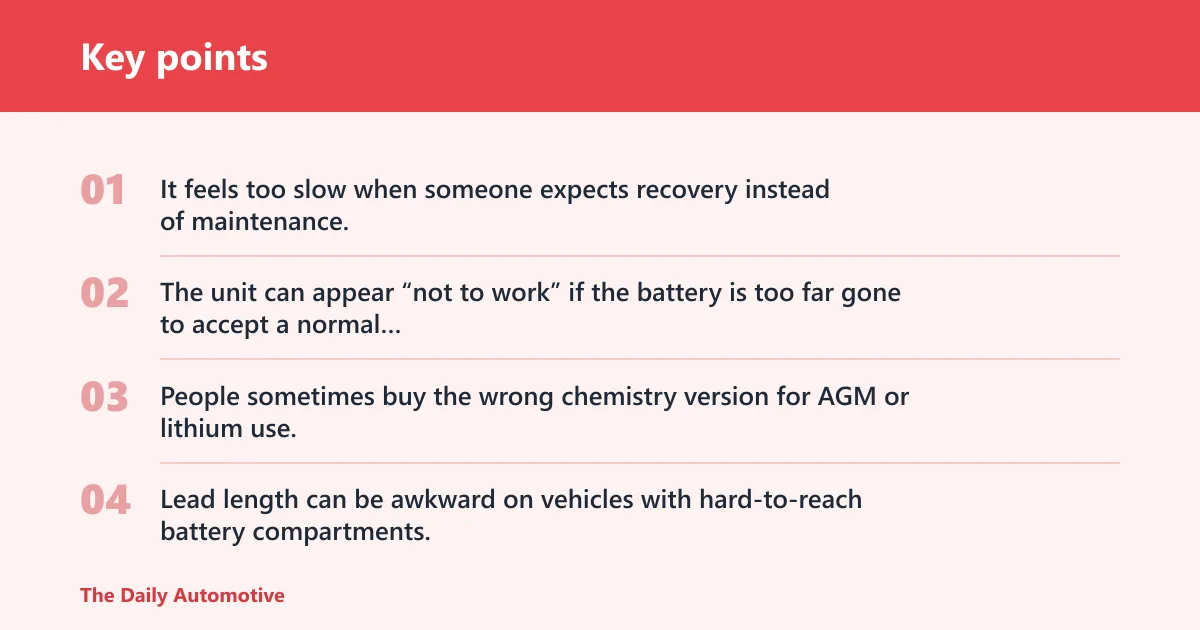
- It feels too slow when someone expects recovery instead of maintenance.
- The unit can appear “not to work” if the battery is too far gone to accept a normal maintenance charge.
- People sometimes buy the wrong chemistry version for AGM or lithium use.
- Lead length can be awkward on vehicles with hard-to-reach battery compartments.
Battery maintainer decision table
| Vehicle type and storage duration | Battery condition and chemistry | Fits well | Too slow | Risk if misused | What to buy instead |
|---|---|---|---|---|---|
| Motorcycle, 1 to 8 weeks parked | Healthy flooded lead-acid or AGM | Battery Tender Junior | No, if the battery is already charged | Leaving a wrong chemistry setting on the battery | Junior if you want a maintainer; a smarter higher-output charger only if recovery is needed |
| ATV or lawn equipment, seasonal storage | Healthy flooded lead-acid | Battery Tender Junior | Yes, for recovery from deep discharge | Expecting it to revive a flat battery | Battery Tender Plus or a faster smart charger for recovery work |
| Classic car, weeks to months parked | AGM or flooded battery in good condition | Battery Tender Junior for storage only | Yes, if the battery is large or weak | Slow top-off on a battery with parasitic draw | Battery Tender Plus for more headroom; NOCO Genius 1 if you want a compact alternative with similar low-output intent |
| Second car, occasional use | Healthy flooded, AGM, or gel battery | Junior if the battery already starts cleanly | Yes, for a weak or neglected battery | Believing maintenance can solve a drain problem | 3-amp smart charger for faster charging; diagnose the draw before buying anything else |
| Boat on winter storage | AGM or flooded lead-acid | Junior if the battery stays healthy and the draw is low | Yes, if multiple batteries need attention | Using the wrong mode on LiFePO4 or AGM | Battery Tender Plus or a chemistry-specific smart charger |
| Lithium-equipped powersports vehicle | LiFePO4 battery, switchable version only | Only if the charger has the lithium setting | Yes, if you want recovery from a severely low pack | Using a lead-acid mode on lithium | A lithium-capable smart charger or the switchable Junior version with the correct mode selected |
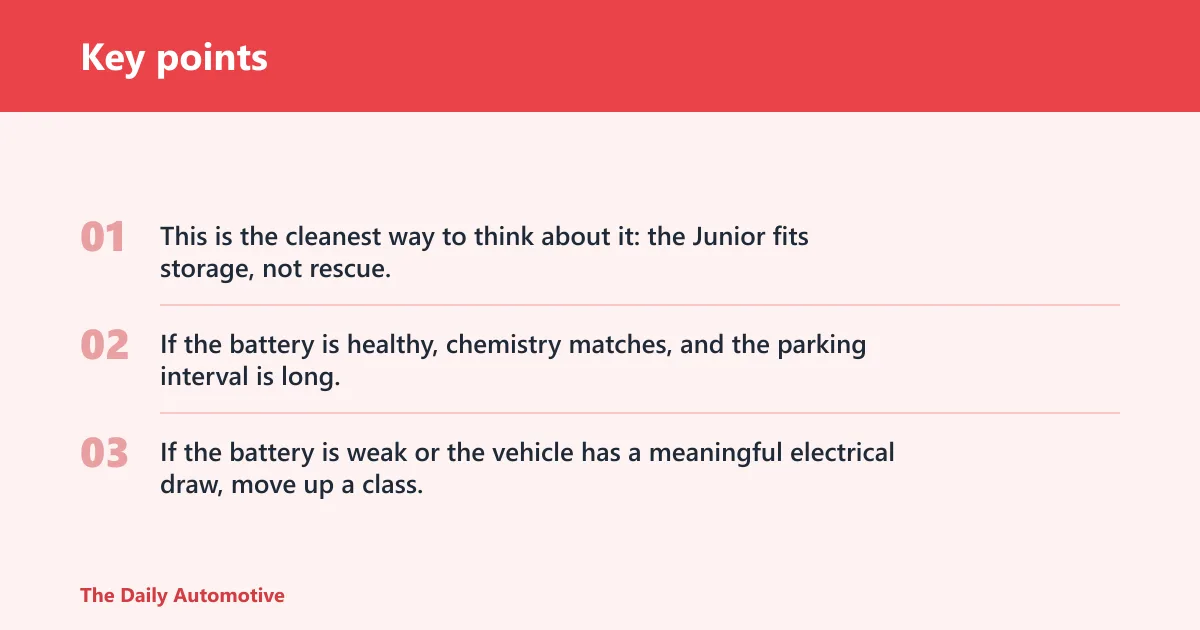
This is the cleanest way to think about it: the Junior fits storage, not rescue. If the battery is healthy, chemistry matches, and the parking interval is long, it is a sensible buy. If the battery is weak or the vehicle has a meaningful electrical draw, move up a class.
Alternatives

Mighty Max Battery 12V 7Amp Battery Smart Charger Maintainer is the better choice when the battery needs more charging current than the Junior can provide. Based on the listed specs and buyer feedback, the drawback is size and intent: more output helps with recovery, but it is less of a set-it-and-forget-it storage tool for tiny batteries.
Battery Tender Plus sits above the Junior in output and is the more natural step up if you like the Battery Tender approach but need more charging headroom. The tradeoff is cost and, depending on battery size, more charger than a small motorcycle battery really needs.
NOCO Genius 1 is the close competitor buyers cross-shop most often for low-output maintenance. It is a better comparison than a faster charger if your main need is storage maintenance, but it still does not change the basic rule: low-output maintainers are for keeping batteries healthy, not reviving dead ones.
The Battery Tender 3-Amp charger is the option to consider when you need a faster refill and still want a smart charger rather than a dumb trickle unit. If your battery regularly falls far enough behind that an 800mA maintainer feels painfully slow, 3 amps makes more sense.
Should you buy it?
Buy the Battery Tender Junior if you own a motorcycle, ATV, lawn tool, boat battery, classic car, or second car that sits for long periods and still starts reliably when healthy. It earns its keep as a storage tool with automatic float maintenance and simple connection options.
Pass on it if you want to repair a battery that is already deeply discharged, if you need faster charging, or if your vehicle has enough parasitic draw to outpace a low-output maintainer. In that case, a Battery Tender Plus, a NOCO Genius 1, or a 3-amp smart charger is the better spend.
Price matters too. The Drive lists the Junior at $49.95 and says it can be on sale for less, which keeps it in the affordable range for a purpose-built maintainer. That price only makes sense if you need maintenance, though, not emergency charging. (Thedrive)
Frequently asked questions
Is the Battery Tender Junior worth it for a motorcycle battery?
Yes, if the motorcycle battery is healthy and the bike sits for days or weeks at a time. That is the Junior’s best-case use. It maintains a 12V battery well, but it is not a recovery tool for a battery that is already weak or deeply discharged.
Is Battery Tender Junior 800 good for a car battery?
It can be, but only for a healthy car battery in storage, and mostly for smaller or modestly sized batteries. It is not the right choice when the battery is weak, large, or fighting parasitic draw. In those cases, a higher-output charger is a better fit.
Can you leave a Battery Tender Junior plugged in all the time?
Yes, that is the point of a maintainer with float mode. It is built for long-term storage, so leaving it connected is normal when the battery is in good condition and the chemistry setting is correct. It is not a cure for a bad battery, though.
What is the difference between a trickle charger and a battery maintainer?
A trickle charger generally keeps pushing current without the same automatic control, while a maintainer charges and then drops to float to hold the battery safely. The Battery Tender Junior belongs in the maintainer category, which is why it suits storage better than recovery.
How long does it take to charge a battery with Battery Tender Junior?
That depends on battery size and starting state, but the 750mA to 800mA output is slow enough that a deeply discharged battery can take a very long time. It is practical for topping off a healthy battery, not for fast turnaround after a flat battery event.
Does the Battery Tender Junior work with AGM and lithium batteries?
Yes, depending on the version and settings. Published details say it is built for lead-acid and AGM batteries, and the switchable version also has a lithium (LiFePO4) mode. Use the correct mode, because the wrong setting can create problems quickly.
What are the common complaints about the Battery Tender Junior?
The main complaints are speed and expectation mismatch. Buyers sometimes expect it to revive a dead battery, but it is a maintainer. Other complaints involve using the wrong chemistry setting, finding the leads short for a specific installation, or mistaking a weak battery for a charger problem.
Products related to this article
Sponsored / affiliate links. As an Amazon Associate I earn from qualifying purchases. I may earn additional commission from eligible campaigns.