How Much Does a Car Detailing Kit Cost?
A usable car detailing kit usually costs about $50 to $150, while a complete DIY setup with wash tools, microfiber, wheel cleaners, and protectants often lands in the roughly $150 to $300 range. Spend too little, and you end up buying missing pieces later or using weak products that leave streaks, scratches, and unfinished results. This guide maps each budget tier to what it actually covers and the hidden add-on costs that change the total.
Must-have detailing kit
The three basics are wash tools, an interior cleaner set, and an exterior protectant. A car wash kit is the cheaper subset: soap, a mitt, and drying support. A detailing kit goes further by adding interior cleaners, wheel care, and some form of paint protection for a more complete result.
Wash soap, mitt, and drying towels

GALSLIKE’s 56-piece kit is a broad wash starter, and its foam gun plus long-handle extension make it more useful than a bare soap-and-bucket bundle. The drawback is the usual one for large kits: piece count does not guarantee quality towels, so you may still need better microfiber for drying and paint-safe wiping.
Wash tools do the first and most important job. Soap loosens grime, the mitt lifts it away, and drying towels help prevent water spots. If a bundle does not include enough soft towels, you should budget for them separately. A cheap kit often leaves that cost hidden.
Interior cleaner for trim, fabric, and glass

Viewsun’s 17-piece interior kit is aimed at cabin cleaning, with a handheld vacuum, brush set, windshield cleaner, and cleaning gel. The drawback is that interior kits can be heavy on accessories but light on true deep-clean chemistry, so stained seats, neglected fabric, or greasy trim may still need stronger products.
Interior detailing products cover clean fabrics, leather, trim, and glass. A regular clean removes dust and fingerprints. A deeper clean targets embedded dirt in cloth seats, touch points on leather, and film on glass. Cheap bundles often include a spray and a brush, but not the stronger cleaner or extra towels needed for a full reset.
Exterior protection: wax, sealant, or spray ceramic
Exterior protection is what keeps the clean from disappearing right away. Wax usually gives short-term protection and easy gloss. Sealant generally lasts longer. Spray ceramic is the quickest route to a slick finish, though durability varies by product and prep work. None of them matters much if the paint is not washed well first.
Protection products should cover paintwork, trim, tyres, and wheels in some form. A cheap kit may include only a quick spray dressing. A better one adds a true paint protectant, and that changes how long the finish holds up between washes.
Nice-to-have extras
These items are optional, but they move a kit from basic cleaning to more complete detailing. Wheel tools, foam equipment, and a machine polisher increase the total fast. They also expand what the kit can do on dirty wheels, neglected paint, and stubborn contamination.
Wheel brushes and dedicated wheel cleaner

oesee’s 4-pack wheel brush kit is a focused add-on for rims and tires. Based on the published specs, the metal-free design is a smart safety point, but the set is narrow: it does not replace wheel cleaner, and it will not solve brake dust on its own.
Wheels are often the dirtiest part of the car, so they need separate tools. A dedicated wheel cleaner and the right brushes make the job easier and reduce the chance of smearing grime onto paint or trim. This is one of the first places a cheap bundle falls short.
Foam lance or foam cannon
A foam lance or foam cannon is a wash accessory, not a must-have. It helps lay down pre-wash foam and can loosen dirt before contact washing. That said, it adds cost, takes setup time, and is easiest to justify when you wash often or want a more methodical exterior routine.
For a beginner, this is usually a comfort upgrade, not a necessity. If the goal is a low-cost maintenance wash, soap, mitt, and towels matter more. If the goal is a fuller exterior routine with pre-wash steps, foam equipment starts to make sense.
Machine polisher and pads
A machine polisher is the priciest add-on in a beginner setup because it changes the job from cleaning to paint refinement. Chemical Guys TORQ 10FX Polisher Kit costs $160–$220, which means it can equal or exceed the cost of an entire starter bundle before pads and compounds are added.
It matters because hand polishing is slow and limited. A machine polisher can remove oxidation and improve gloss more thoroughly, but only if the user understands pad choice, pressure, and product selection. For many owners, it belongs in a serious setup rather than the first basket of supplies.
Consumables and spares
These costs are easy to miss because they do not look like major purchases. Buckets, grit guards, mitt replacements, microfiber towels, applicators, brushes, and trigger sprayers add up quickly. They also determine whether a kit feels complete or frustrating after the first wash.
Buckets, grit guards, and wash mitt replacements
Two buckets are common in safer wash routines, and grit guards help keep dirt at the bottom instead of back on the mitt. Replacement mitts matter too, since worn wash media can drag grit across paint. These are small purchases that quietly raise the real kit price.
Microfiber towel counts by task
One towel often is not enough. Drying, glass, interior wipe-downs, and final buffing each benefit from separate microfiber towels. A bare-bones kit may include a few cloths, but a complete setup usually needs more than that for streak-free work and safer paint contact.
Applicators, brushes, and trigger sprayers
Applicators spread wax, sealant, and dressing more evenly. Small brushes help on badges, vents, emblems, and wheel lug areas. Trigger sprayers make diluted cleaners easier to use. None is expensive by itself, but each one fills a gap cheap kits often leave open.
Most buyers are really choosing between a starter bundle and a full setup. A starter kit can look complete at first glance, but the cost rises once you add the missing towels, buckets, wheel tools, and protection products. That is where the budget changes from simple to realistic.
Starter kit around $100
A $100 kit is described as washing, drying, dressing, and protecting a daily driver. That is enough for maintenance cleaning on a single car if you already own a few basics. It is not enough for a fully rounded setup unless the bundle is unusually complete.
Midrange kit around $200
The $200 kit adds foaming pre-wash, clay decon, and real protection. That is the point where a kit starts to move beyond basic wash duty and into fuller exterior care. It is a stronger fit for owners who want both routine cleaning and occasional paint prep.
Complete setup around $500
A $500 setup is where a beginner can cover wash, interior, exterior, wheels, and machine polishing without constant gaps. At this level, the spending shifts from “some products” to a system: cleaner, towel, protection, tools, pads, and replacements are all part of the math.
Car detailing kit true-cost table
The real cost is not the sticker price on the bundle. It is the bundle plus the missing pieces that make it usable for your car, your wash routine, and your skill level. This table shows where the cheap option turns into a fuller setup.
| DIY kit tier | Likely missing items | Estimated add-on spend | What it can do in practice | Break-even versus one pro detail | Break-even versus a full-detail service |
|---|---|---|---|---|---|
| $100 starter | Extra microfiber towels, two buckets, grit guards, wheel brush, drying aid, interior glass cleaner, better protectant | $75 to $175 | Wash and dry a daily driver; light interior wipe-down; basic dressing; limited exterior protection | Usually cheaper than professional detail appointments can cost $150 to $400 after one use if you plan to wash regularly | Less complete than a standard full detail costs $200 to $350 |
| $200 midrange | Wheel-specific chemicals, more towels, applicators, clay lube or decon aid, foam accessory, better interior tools | $50 to $125 | Wash, decontaminate, protect, and handle interior and wheel cleanup more fully | Often pays back after one or two pro appointments if you maintain more than one vehicle | Can approach the output of a single standard full detail, but still depends on skill and time |
| $500 complete setup | Few essentials missing, but pads, compounds, extra consumables, and storage still add cost | $0 to $100 | Wash, interior clean, wheel care, decon, protection, and machine polishing for more serious paint work | Typically cheaper than repeated professional detail appointments after a small number of uses | Can replace multiple standard full detail costs if the owner actually uses it |
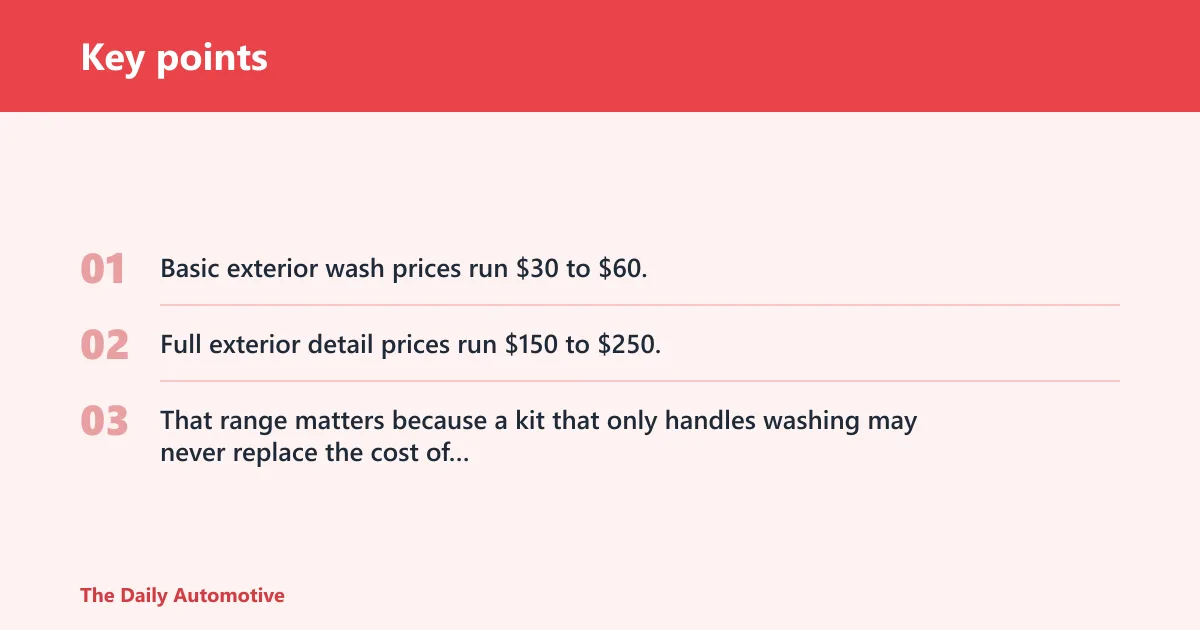
Basic exterior wash prices run $30 to $60, while standard exterior detail prices run $75 to $150. Full exterior detail prices run $150 to $250. That range matters because a kit that only handles washing may never replace the cost of a proper exterior detail.
What a detailing kit really costs
The smartest way to price a kit is by what it lets you do, not by item count. A $50 wash-only bundle can work for maintenance, but a full DIY setup usually needs more towels, better cleaners, wheel tools, and one protectant. That is why the final total often lands higher than the box suggests.
Suppose a compact sedan gets washed every two weeks. A cheap wash kit may handle the first few sessions, but once towels wear out and the wheels need attention, extra purchases follow fast. The “cheap” route becomes a series of small buys.
A common first-timer mistake is treating a 20- or 30-piece bundle as a finished system. Many of those pieces are duplicates, tiny accessories, or low-value brushes. What matters more is whether the kit includes the right categories: wash, dry, clean, and protect.
Is a cheap kit enough?
A cheap kit is enough only for basic maintenance cleaning on an already tidy car. It is not enough for a full interior reset, wheel-specific cleaning, or a durable exterior protection routine. The lower price often means fewer towels, weaker chemicals, and more missing tools.
What cheap bundles usually leave out
Cheap bundles commonly miss quality drying towels, a second bucket, grit guards, a dedicated wheel brush, and a real protectant. They may include one interior spray and a few cloths, but not the separate tools needed for paint-safe washing and a fuller finish.
Why piece count can mislead
High piece counts often repeat the same type of accessory. Two extra sponges do not replace a proper drying towel or a paint-safe mitt. One solid cleaner and one good towel can be more useful than a bag full of low-value extras.
When a wash-only kit makes sense
Wash-only kits make sense for lightly driven cars, garage-kept vehicles, or owners who mainly want to remove dust and road film. If the vehicle already looks clean and the goal is maintenance, a cheaper bundle can be the right choice.
How much does a full detail cost?
A full detail usually costs more than a kit because it includes labor, products, and skill. A standard full detail costs $200 to $350, and a full interior detail costs $175 to $300. Buying a kit only starts to pay back when you plan to use it repeatedly.
One professional detail versus buying a kit
Professional detail appointments can cost $150 to $400, while the industry itself is large enough to support a broad spread in pricing. The U.S. Car wash and auto detailing industry is valued at $18.7 billion in 2026, and the global car detailing products market sits at $6.19 billion. Those numbers reflect a market with a wide price spread and many service levels.
When DIY ownership starts to pay back
DIY starts to pay back once the same kit is used across multiple washes or multiple vehicles. If a beginner setup costs about $150 to $300 in total, it can undercut a single professional visit quickly, especially if the owner washes monthly or keeps more than one car clean.
How wash frequency changes the math
Higher wash frequency makes DIY ownership more attractive. A car washed every week benefits more from a dedicated kit than a car cleaned once or twice a year. The more often you use the kit, the lower the cost per wash becomes.
- Choose a wash-only kit if you mainly need maintenance cleaning.
- Choose a midrange kit if you want wash, wheel, and basic protection coverage.
- Add a machine polisher only if paint correction is part of your plan.
- Budget for towels, buckets, and wheel tools before judging the price.
- Compare the full setup cost against one professional detail, not just the sticker price of the bundle.
Frequently asked questions
How much does a car cleaning kit cost?
A car cleaning kit can cost $20 to $150 depending on whether it is a wash-only bundle or a fuller detailing set. Basic kits cover soap, a mitt, and a few cloths. Larger kits add interior tools, wheel brushes, and protection products.
How much does a full car detailing cost?
A full car detailing cost commonly lands in the $200 to $350 range for a standard full detail. Professional appointments can run $150 to $400, and more involved interior or exterior work can push higher depending on vehicle size and condition.
How much does getting a car detailed cost?
The exact bill depends on location, condition, and service depth.
What should a basic car detailing kit include?
A basic car detailing kit should include wash soap, a wash mitt, drying towels, an interior cleaner, and some form of exterior protection. If it also includes a wheel brush, glass cleaner, and a second microfiber set, it is closer to a true starter setup.
What’s the difference between a cheap kit and a premium kit?
A cheap kit often covers only the basics and leaves out the useful extras that make cleaning easier and safer. A premium kit usually adds better towels, more complete interior and wheel products, and stronger protection options. The difference is completeness, not just item count.
Is it cheaper to buy a kit or pay for a detail?
Buying a kit is usually cheaper if you plan to detail more than once. A $150 to $300 DIY setup can undercut a single professional detail, but the savings only show up if the kit is used regularly. One-off owners may prefer a pro service.
Products related to this article
Sponsored / affiliate links. As an Amazon Associate I earn from qualifying purchases. I may earn additional commission from eligible campaigns.