Does Manual Cars Have Cruise Control: A Shocking Essential
Yes, many manual cars absolutely have cruise control. It works by maintaining your speed just like in an automatic, but it will automatically disengage if you press the clutch pedal to change gears. This feature is more common than you might think and makes long highway drives much more comfortable.
Driving a manual car is a joy. You feel connected to the road and in total control of your vehicle. But on a long, straight highway, that joy can turn into a chore. Holding the gas pedal steady for hours can make your foot and leg ache. This often leads drivers to wonder, “Can I get a break? Do manual cars even have cruise control?
It’s a fantastic question, and the answer might surprise you. Many people assume this convenient feature is only for automatic cars. The good news is that this is a myth! Cruise control is available on many manual transmission vehicles, and it works wonderfully. In this guide, I’ll show you exactly how it works, when to use it, and why it’s a shocking essential you’ll be glad to have.
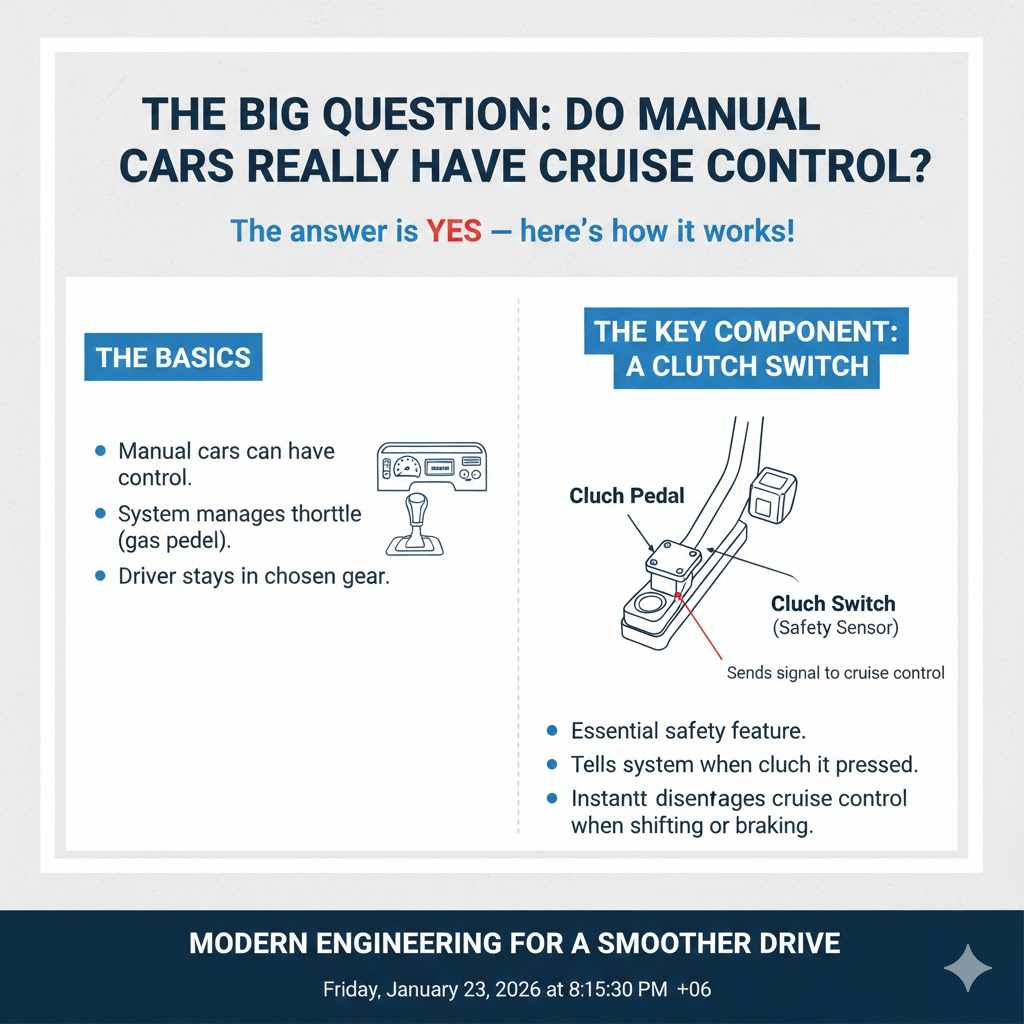
The Big Question: Do Manual Cars Really Have Cruise Control?
Let’s clear this up right away: Yes, they absolutely do. For decades, manufacturers have been equipping manual cars with cruise control systems. From small hatchbacks to powerful sports cars, if it has a manual gearbox, there’s a good chance cruise control was offered as a standard or optional feature.
The confusion is understandable. The whole point of a manual car is that you are in control of the gears. So how can a computer take over the speed without being able to shift? It’s a clever piece of engineering that revolves around one key component we’ll discuss in a moment.
Think of it this way: Cruise control’s only job is to manage the throttle (the gas pedal) to keep a steady speed. It doesn’t need to change gears to do this on a relatively flat road. As long as you are in the right gear for the speed you want to maintain, the system can handle the rest.
How Does Cruise Control Work in a Manual Transmission Car? The Magic Behind the Scenes
The technology behind cruise control in a manual car is nearly identical to an automatic one, with one crucial addition. Here is a simple breakdown of how it maintains your speed on the open road.
- You Set the Speed: You accelerate to your desired speed, let’s say 65 mph, while in the highest gear (usually 5th or 6th).
- Engage the System: You press the “Set” button on your steering wheel or stalk.
- The Computer Takes Over: The car’s main computer, called the Engine Control Unit (ECU), records your current speed. It then takes control of the electronic throttle body.
- Maintaining Speed: The ECU makes tiny, constant adjustments to the throttle to keep the car at exactly 65 mph. If you start going up a slight incline, it gives a little more gas. If you go down a slight decline, it gives a little less.
But what happens when you need to shift? This is where the magic comes in.
The Clutch Switch: The Unsung Hero
The single most important part of a manual cruise control system is the clutch switch. This is a small sensor located at the top of the clutch pedal assembly. Its job is simple but vital.
When you press the clutch pedal, even slightly, this switch sends a signal to the ECU. This signal instantly tells the cruise control system to disengage, just as if you had tapped the brake pedal. This is a critical safety feature.
Why is it so important? Imagine if the cruise control stayed on when you pressed the clutch. The engine would be disconnected from the wheels, but the computer would still be trying to maintain speed by applying more and more gas. This would cause the engine to rev dangerously high. The clutch switch prevents this entirely, making the system safe and intuitive to use.
So, the three main ways to disengage cruise control in a manual car are:
- Tapping the brake pedal
- Tapping the clutch pedal
- Pressing the “Cancel” or “Off” button
A Simple Guide: How to Use Cruise Control in Your Manual Car
Using cruise control in a stick shift is just as easy as in an automatic. If you’ve never done it before, here’s a step-by-step guide to get you started on your next highway trip.
- Reach a Cruising Speed: Get on the highway and accelerate smoothly to the speed you want to maintain. For best fuel economy, this is typically between 55 and 70 mph.
- Select the Right Gear: Make sure you are in your highest gear (e.g., 5th or 6th). This keeps the engine RPMs low, which saves fuel and reduces engine noise. The car should feel comfortable and not strained.
- Turn the System On: Press the main “On/Off” button for your cruise control. A light will usually appear on your dashboard to show that the system is ready.
- Set Your Speed: Once you are at your desired speed, press the “Set” button. You can now take your foot completely off the accelerator pedal. The car will maintain its speed on its own.
- Making Adjustments: You can use the “Accel/Res” (Accelerate/Resume) and “Coast” buttons to make small speed adjustments without having to use the pedals.
- Disengaging the System: When you need to slow down or take control, simply tap the clutch or the brake pedal. The cruise control will instantly turn off, but the system will remember your set speed.
- Resuming Your Speed: After slowing down, if it’s safe to return to your previous speed, you can press the “Resume” button. The car will automatically accelerate back to the last speed you had set.
Why Cruise Control in a Manual is a Game-Changer
You might be wondering if it’s even worth it. The answer is a resounding yes! For anyone who drives on the highway, cruise control offers some fantastic benefits.
- Reduces Driver Fatigue: On long trips, keeping your foot in one position can cause cramps and fatigue. Cruise control lets you relax your right leg, making the journey much more comfortable.
- Improves Fuel Economy: A computer is much better at making tiny, smooth throttle adjustments than a human foot. By avoiding unnecessary acceleration and deceleration, cruise control can improve your gas mileage on the highway by up to 7-14%, according to studies referenced by the U.S. Department of Energy.
- Helps Avoid Speeding Tickets: It’s easy for your speed to creep up without you noticing. Setting the cruise control at the speed limit ensures you stay there, helping you avoid costly tickets.
- Smoother Ride for Passengers: The smooth and steady speed provided by cruise control makes for a more pleasant and less jerky ride for everyone in the car.
To see how these systems compare, let’s look at a table breaking down the differences.
| Feature | Manual Transmission Cruise Control | Automatic Transmission Cruise Control |
|---|---|---|
| Core Function | Maintains a set speed by controlling the throttle. | Maintains a set speed by controlling the throttle. |
| Disengagement | Brake pedal, clutch pedal, or cancel button. | Brake pedal or cancel button. |
| Handling Hills | Maintains speed on slight inclines. On steep hills, the driver may need to downshift, which disengages the system. | Can automatically downshift to maintain speed on steep hills without disengaging. |
| Gear Selection | Driver must be in the correct gear before engaging. | The transmission automatically selects the best gear. |
| Best Use Case | Flat, open highways with consistent traffic flow. | Highways, including those with rolling hills. |
When to Avoid Using Cruise Control in a Manual Car
While it’s a fantastic tool, cruise control isn’t meant for every situation. Knowing when not to use it is just as important for your safety.
- In Heavy Traffic: Constant changes in speed make cruise control impractical and unsafe. You need to be in full control to react to the cars around you.
- On Winding or Hilly Roads: On curvy roads, you need to adjust your speed for turns. On steep hills, your car may not have enough power to maintain speed in top gear, forcing you to downshift and disengage the system anyway.
- In Bad Weather: Never use cruise control in rain, snow, or icy conditions. If your car were to hydroplane or skid, the cruise control would try to maintain speed by spinning the wheels, which could make you lose control. For more information on safe driving in adverse conditions, you can consult resources from the National Highway Traffic Safety Administration (NHTSA).
- When You Are Tired: While cruise control reduces physical fatigue, it can also make a tired driver less attentive. If you feel drowsy, the best solution is to pull over and rest, not to rely on an automated system.
The Next Level: Adaptive Cruise Control in Modern Manuals
Technology never stands still, and that includes cruise control. Many modern manual cars are now available with Adaptive Cruise Control (ACC). This is a more advanced system that uses radar or cameras to monitor the vehicle in front of you.
ACC in a manual car works like this:
- You set your desired speed and a following distance (e.g., three car lengths).
- The system will maintain your speed, but if the car ahead slows down, your car will automatically slow down too to maintain the set distance.
- If the car ahead speeds up, your car will accelerate back to your set speed.
The only limitation is gear changes. If the traffic slows down so much that your engine’s RPMs drop too low, the car will display a message on the dashboard prompting you to downshift. If you don’t, or if you have to come to a complete stop, the system will disengage. It’s a brilliant fusion of driver engagement and modern convenience.
What if My Older Manual Car Doesn’t Have Cruise Control?
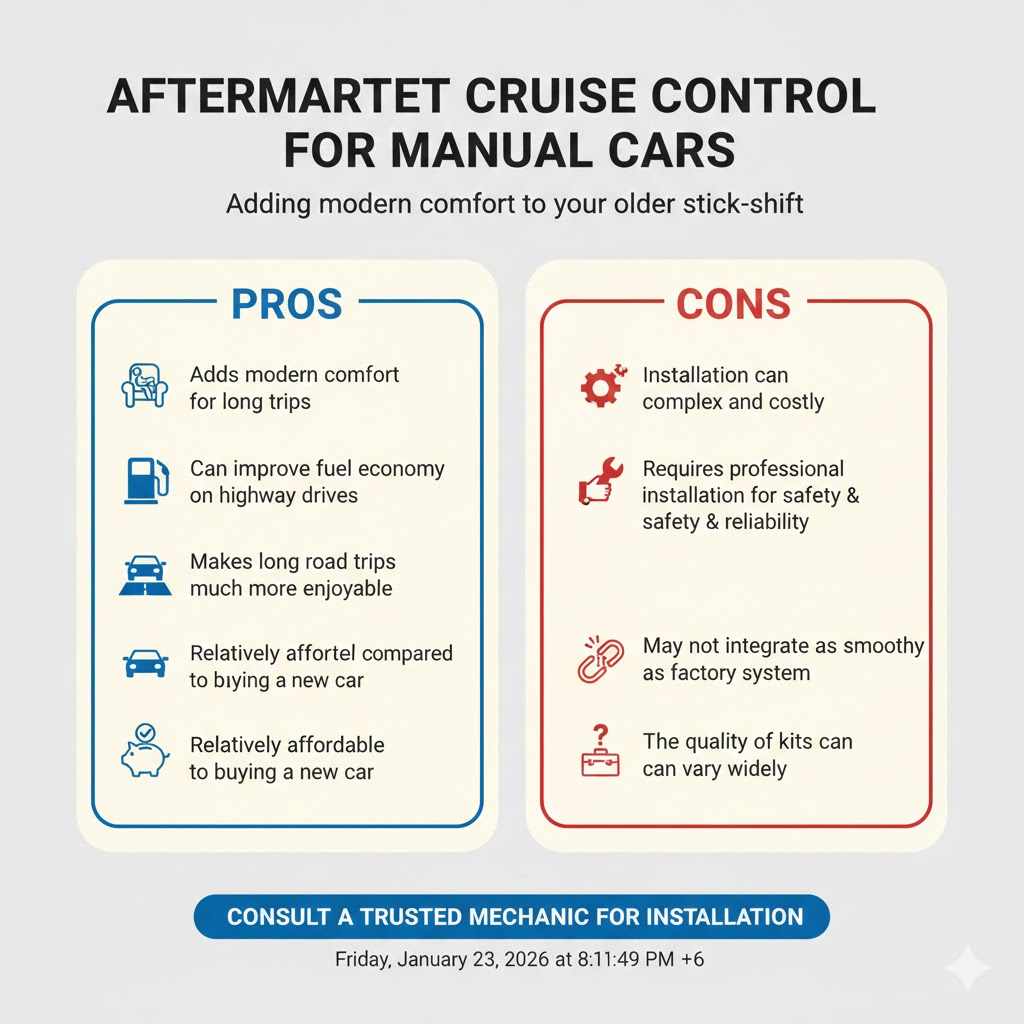
Do you love your older manual car but wish it had cruise control for long trips? You might be in luck. There are aftermarket cruise control kits available that can be installed on a wide variety of vehicles that didn’t come with it from the factory.
However, this is not a simple DIY project for beginners. Installing an aftermarket kit involves working with your car’s electronic throttle, wiring, and installing the crucial clutch switch. It’s a job best left to a professional mechanic to ensure it is installed safely and correctly.
Here are the pros and cons of going the aftermarket route:
| Pros | Cons |
|---|---|
| Adds modern comfort to an older vehicle. | Installation can be complex and costly. |
| Can improve fuel economy on highway drives. | Requires professional installation for safety and reliability. |
| Makes long road trips much more enjoyable. | May not integrate as smoothly as a factory system. |
| Relatively affordable compared to buying a new car. | The quality of kits can vary widely. |
If you decide to explore this option, talk to a trusted local mechanic. They can recommend a quality kit and provide a quote for the installation.
Frequently Asked Questions About Manual Cruise Control
1. What happens if I press the clutch to shift while cruise control is on?
The moment you press the clutch pedal, the cruise control system will instantly and automatically disengage. This is a safety feature to prevent the engine from over-revving. You will have to press “Resume” or “Set” to re-engage it after you complete your shift.
2. Can using cruise control damage my manual transmission or clutch?
No, not at all. When used correctly on the highway in the proper gear, cruise control is perfectly safe for your engine, transmission, and clutch. The system is designed to work harmoniously with your car’s components.
3. Why don’t all manual cars have cruise control?
Historically, manual cars were often the base models of a vehicle lineup, and features like cruise control were reserved for higher, automatic-equipped trims to save on costs. Additionally, some performance-focused sports cars omit it to save weight and emphasize a “pure” driving experience.
4. Can I use cruise control in the city with a manual car?
It’s not recommended. City driving involves constant starting, stopping, and speed changes. Cruise control is designed for steady-speed driving on open roads like highways and is not practical or safe for urban environments.
5. Does cruise control really save gas in a stick shift?
Yes, it does. By maintaining a consistent speed and eliminating the small, inefficient bursts of acceleration caused by your foot, it can significantly improve your fuel economy during highway driving.
6. Is it hard to install cruise control on a manual car yourself?
For most people, yes. It involves complex electrical wiring, connecting to the car’s computer, and properly installing the brake and clutch pedal switches. To ensure your safety, this is a job best left to a qualified automotive technician.
Final Thoughts: A Feature You Didn’t Know You Needed
So, do manual cars have cruise control? The answer is a clear and confident yes. It’s a simple, reliable, and incredibly useful feature that shatters the myth that convenience is only for automatics.
From the ingenious clutch switch that ensures safety to the real-world benefits of better fuel economy and a more relaxed drive, cruise control is a shocking essential for any manual driver who spends time on the highway. It allows you to enjoy the engaging fun of a stick shift in the city and on back roads, while also giving you a welcome break on those long, straight stretches of pavement.
Understanding how these systems work not only makes you a more informed driver but also builds your confidence. Now, on your next road trip, you can set the cruise, relax your foot, and enjoy the ride, knowing you have the best of both worlds.