Is Erie Auto Insurance Worth It?
Erie Auto Insurance is worth it for drivers who can use its limited-state coverage, value rate-lock protection, and want strong local-agent service; if you only chase the lowest first-year premium, it may not be the best fit. Ignoring the trade-offs can leave you paying more than expected after discounts expire, or missing coverage options you wanted. This guide compares Erie’s pricing, perks, and service so you can judge the value.
Erie is a regional insurer, founded in 1925, that sells policies in several states and Washington, D.C. It is a publicly traded company listed on NASDAQ under the ticker ERIE. That footprint matters first, because a strong rate is useless if you cannot buy the policy where you live.
Quick answer
The trade-off is simple: Erie often looks strongest when you value service, bundling, and rate stability more than the absolute cheapest day-one quote. If you move often, want nationwide convenience, or only shop on price, a broader carrier may fit better.
Who should keep reading? Drivers in Erie’s service area, households with more than one policy, newer-vehicle owners, and anyone comparing service quality against premium size. If you need a one-size-fits-all national option, Erie may fall short before price even enters the discussion.
Erie decision matrix
| Driver profile | Likely Erie fit | Expected value drivers | Likely dealbreakers | Best alternative if Erie is not a fit |
|---|---|---|---|---|
| Clean commuter | Often a strong fit | Rate Lock, competitive service reputation, possible bundle savings | Quote may still be higher than a bare-bones national carrier | A national insurer with a lower first-year quote |
| New driver | Possible, but price-sensitive | Stable pricing can help after the first policy term | New-driver premiums are usually high anywhere | State Farm, GEICO, or Progressive for comparison shopping |
| Teen household | Can be a good fit with bundling | Family policy bundling, add-ons, service support | Teen-driver pricing can be steep regardless of carrier | A large insurer that prices teen households aggressively |
| Rideshare driver | Good if you need rideshare coverage | Rideshare insurance plus local-agent guidance | Availability and pricing vary by location | Progressive or State Farm if Erie is unavailable |
| Low-mileage driver | Often a good fit | Lower exposure, possible discounts, rate stability | Low mileage does not always produce the lowest rate | USAA, Auto-Owners, or another low-mileage-friendly carrier |
| High-risk driver | Usually a weaker fit | Service quality can still matter | High-risk pricing often erases value fast | A carrier that specializes in nonstandard risk |
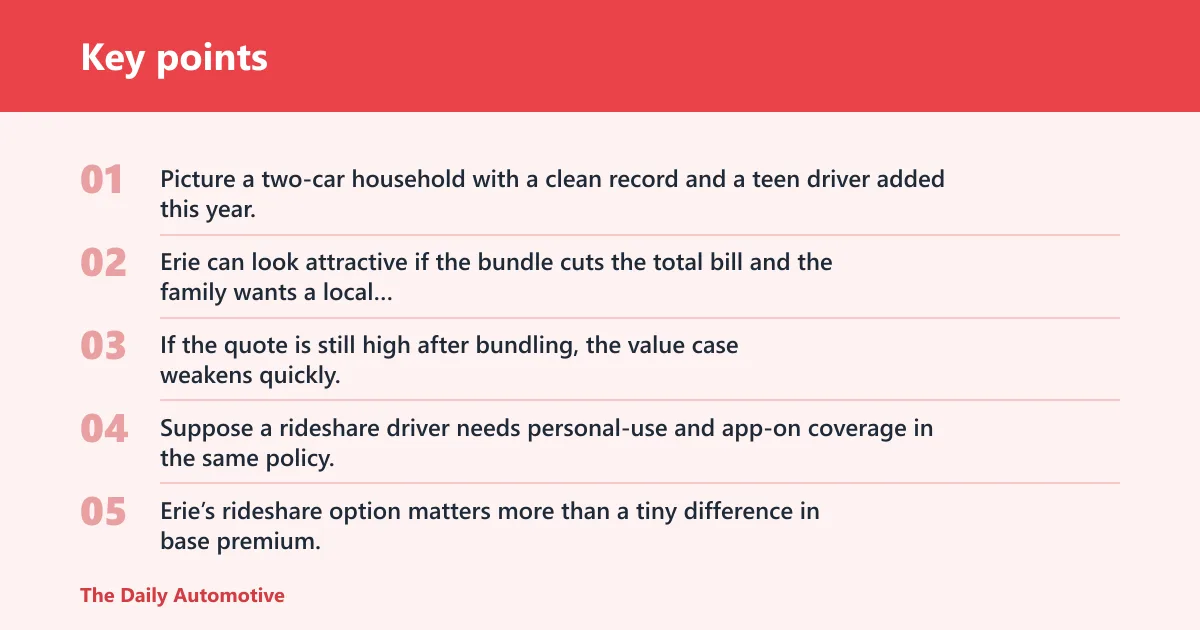
Picture a two-car household with a clean record and a teen driver added this year. Erie can look attractive if the bundle cuts the total bill and the family wants a local agent to handle changes. If the quote is still high after bundling, the value case weakens quickly.
Suppose a rideshare driver needs personal-use and app-on coverage in the same policy. Erie’s rideshare option matters more than a tiny difference in base premium, because the wrong policy gap can create a costly claim problem. If Erie does not offer that setup in the state, the decision is already made.
How Erie compares on price and value
Erie is not the cheapest insurer on every quote, and average pricing should not be treated as a promise. One competitor analysis lists Erie at $153 per month for full coverage and $38 per month for minimum coverage. Those figures help you frame value, not predict your own rate.
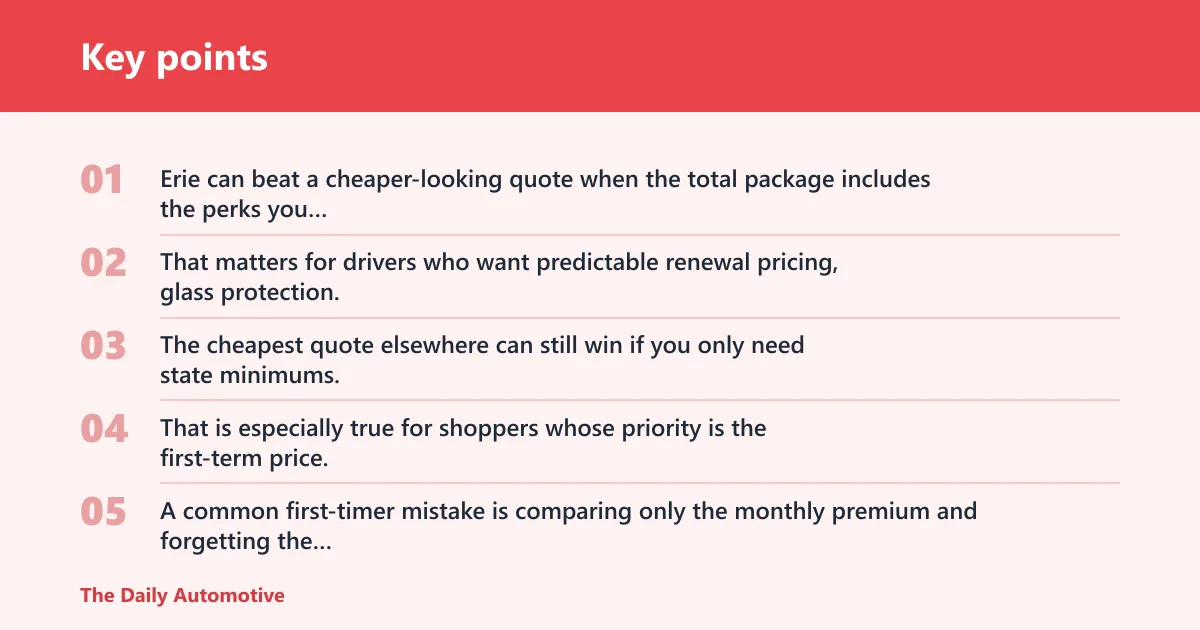
Erie can beat a cheaper-looking quote when the total package includes the perks you would otherwise add back through endorsements or another insurer. That matters for drivers who want predictable renewal pricing, glass protection, or a newer-car policy structure that fits their vehicle.
The cheapest quote elsewhere can still win if you only need state minimums, do not bundle, and do not care about extras. That is especially true for shoppers whose priority is the first-term price, not the policy after renewals and optional coverages are added.
| Comparison point | Erie | What to watch |
|---|---|---|
| Full coverage average | $153 per month | Useful as a benchmark, not a quote |
| Minimum coverage average | $38 per month | May be too thin for financed or newer cars |
| Rate stability | Rate Lock available | Availability can vary by location |
| Service reputation | Strong customer approval and claim support | Local experience still depends on the market |
| Coverage breadth | Strong add-on menu | Only useful where Erie sells policies |
A common first-timer mistake is comparing only the monthly premium and forgetting the extras. A driver may save $12 a month with another carrier, then pay more later for glass coverage, new-car protection, or an add-on that Erie already includes or makes easier to buy.
What coverage perks does Erie offer?
Erie’s best-known perks are Rate Lock, new car replacement coverage, gap insurance, rideshare insurance, and glass repair with no deductible. Those features matter most when they match the car and the driver, because an add-on that never gets used is not value; it is just another line on the policy.
Rate lock
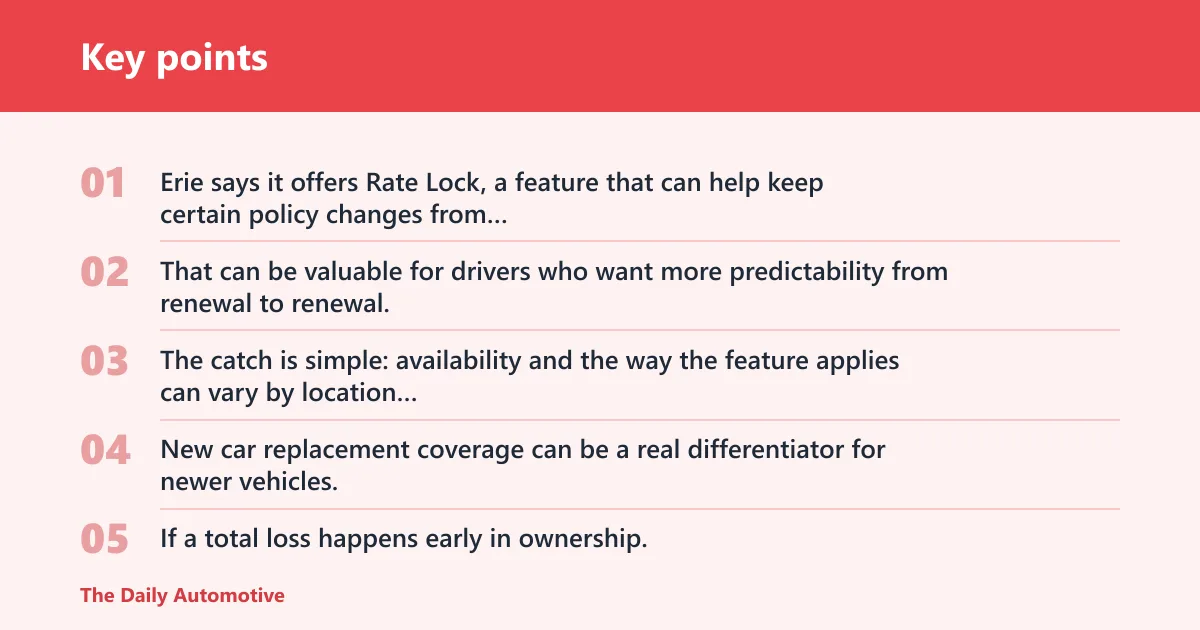
Erie says it offers Rate Lock, a feature that can help keep certain policy changes from automatically raising your premium. That can be valuable for drivers who want more predictability from renewal to renewal. The catch is simple: availability and the way the feature applies can vary by location and policy details, so you need to confirm it on your quote.
New car replacement coverage
New car replacement coverage can be a real differentiator for newer vehicles. If a total loss happens early in ownership, the gap between actual cash value and replacement cost can be painful. That is where this add-on matters most.
Gap insurance
Gap insurance is relevant for financed or leased cars, especially when depreciation outpaces the loan balance. If you owe more than the vehicle is worth after a loss, gap coverage can limit the shortfall. For shoppers with little or no loan balance, it may be unnecessary.
Rideshare coverage
Rideshare insurance is important for Uber and Lyft drivers because personal auto policies often exclude app-based work periods. Erie’s rideshare option gives drivers a reason to stay with one insurer instead of juggling separate policies. That is a real use-case benefit, not a generic sales feature.
Glass repair with no deductible
Erie may offer glass repair with no deductible in some policy and state combinations, usually tied to comprehensive or collision eligibility. That perk can save money on chips and cracks, but only if your policy actually qualifies. It is best viewed as a practical repair benefit, not a blanket promise for every driver.
Can Erie compete on service and stability?
Erie can compete on service and stability, but shoppers should verify current financial-strength, satisfaction, and complaint data before relying on reputation alone. A strong service reputation matters, but it is only one part of the buying decision.
Some comparison sites and consumer reviews describe Erie favorably, but those summaries are not a substitute for checking current primary-source information directly. A headline rating or review score does not guarantee a smooth outcome on every claim.
NAIC complaint data and other regulator-based checks can add another layer. They do not tell the whole story, but they can show whether an insurer draws more complaints than expected for its size. For Erie, that check is best used as a service signal, not as a final verdict.
Is Erie auto insurance good?
Erie auto insurance is good for drivers who value service, reasonable coverage options, and a policy relationship that feels more personal than mass-market. Its strengths show up most clearly in the states where it operates, especially if you want rate stability and a local-agent experience.
AutoInsurance.org lists Erie at 4.3 out of 5 overall, with a policy-options score of 5.0. NerdWallet gives Erie 4.5 stars out of 5. Those scores point in the same direction: Erie is a strong insurer for the right buyer, but not a universal best buy.
How good is Erie insurance for price shoppers? Good enough to quote, not good enough to assume. If the premium is close to competitors and the added coverage matters to you, Erie can be a smart choice. If another insurer is much cheaper and the differences are small, price should win.
Is Erie car insurance cheap?
Erie car insurance can be cheap for some drivers, but it is not automatically the lowest-cost choice. The average figures of $153 per month for full coverage and $38 per month for minimum coverage place it in a competitive range, not a guaranteed budget tier.
Cheap depends on the profile. A clean driver in a qualifying state may see a solid quote, while a teen household or high-risk driver may not. Erie’s bundle value often matters more than its base price, which means the final cost depends on what you actually need.
State minimum coverage may look inexpensive at $38 per month, but that level leaves wide gaps for many drivers. If your car is newer, financed, or heavily used, the cheapest policy can be expensive in the wrong way when a claim happens.
How good is Erie insurance?
Erie insurance is strong on the traits many shoppers care about most: service reputation, claims handling, and policy options. It also has a long operating history and useful add-ons that can make a policy easier to tailor to a driver’s needs.
The weak point is access. Erie’s 12-state plus Washington, D.C. footprint means many drivers cannot buy it at all. For the drivers who can, the question is less “Is Erie good?” and more “Is Erie the best fit for my car, my location, and my budget?”
What states is Erie available in?
Erie is available in 12 states plus Washington, D.C. NerdWallet also describes Erie as available in the Midwest and Appalachian regions. That limited footprint is the biggest filter in the buying process, because many comparison shoppers will be ruled out before service or price matters.
If you move often or split time across states, limited availability can become a real downside. Erie may be a poor fit for drivers who need broad nationwide access or expect frequent relocations, because local availability and policy flexibility matter more in those cases than a strong average rating.
Choose Erie Insurance if… / Choose a national insurer if…
Choose Erie Insurance if you want strong service and local availability. Choose a national insurer if you need broader state access or easier multi-state mobility. That split captures the real decision better than headline averages do.
- Choose Erie Insurance if… you live in one of its covered states and want a mix of service, add-on value, and rate stability.
- Choose Erie Insurance if… you can bundle auto with home or another policy and want the bundle to do real work on the total premium.
- Choose Erie Insurance if… you drive a newer vehicle and would use new car replacement, gap insurance, or glass repair benefits.
- Choose a national insurer if… you need coverage across state lines, are likely to move, or want one carrier with wider footprint convenience.
- Choose a national insurer if… you only care about the lowest first-term price and do not value Erie’s service or coverage extras.
Frequently asked questions
What does Erie auto insurance cost?
One competitor analysis lists Erie at $153 per month for full coverage and $38 per month for minimum coverage. Those are averages, not quotes. Your cost will depend on your state, vehicle, driving record, mileage, and whether you qualify for discounts or bundle pricing.
Does Erie have rate lock?
Yes. The same source says it offers a rate lock feature that can help with premium stability, but the way it applies can depend on location and policy details. It is useful for drivers who want predictable pricing, so you should confirm it on your quote before relying on it.
How does Erie insurance compare with other companies?
Erie compares well on service and coverage features, and less well on availability because it only operates in 12 states plus Washington, D.C. It can be a better value than a cheaper quote if you use its extras. It can also lose to a national carrier on raw price.
Products related to this article
Sponsored / affiliate links. As an Amazon Associate I earn from qualifying purchases. I may earn additional commission from eligible campaigns.