Best Auto Insurance for Law Enforcement
The best auto insurance for law enforcement is the policy that confirms your officer discount, credits low off-duty mileage, and still fits how you use the car. Police savings are often reported in the general range of about 5% to 15%, though each insurer sets its own rules. Skip the check, and you can overpay or end up with coverage that does not match commuting, side work, or family driving. This guide shows how to confirm eligibility, stack discounts, and compare coverage based on your off-duty driving pattern.
Top pick for law enforcement drivers
Why GEICO is the lead pick for digital quote shoppers
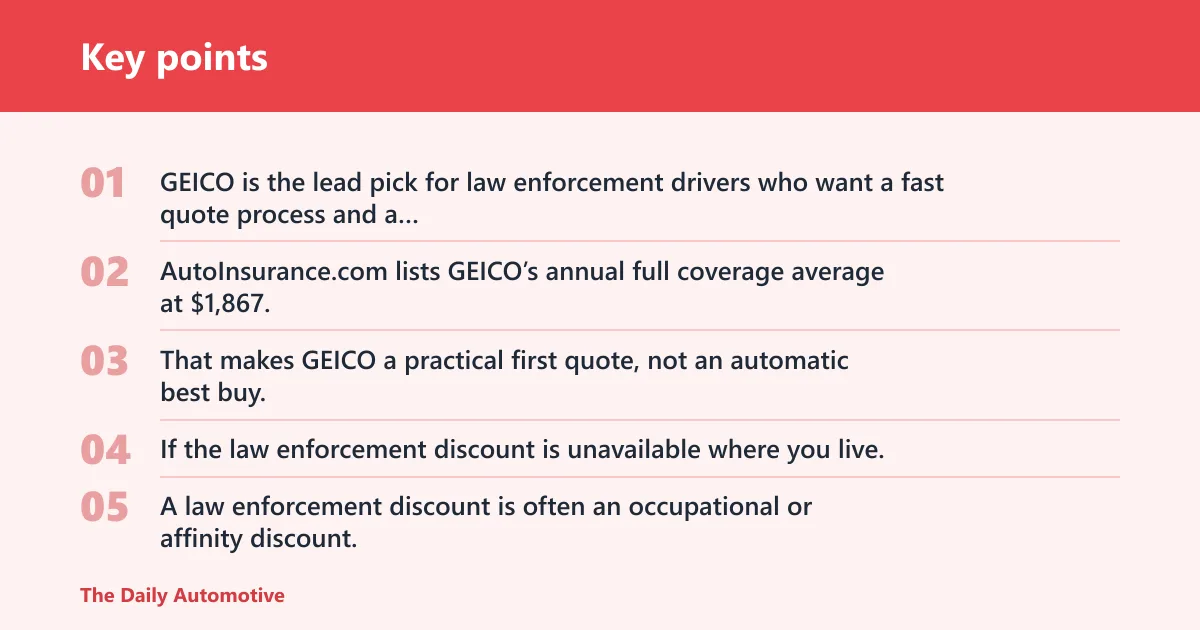
GEICO is the lead pick for law enforcement drivers who want a fast quote process and a lower opening price to compare against other carriers. AutoInsurance.com lists GEICO’s annual full coverage average at $1,867, and Clearsurance says GEICO starts at $36 per month and offers an exclusive 15% discount, though that discount may vary by state or eligibility rules.
That makes GEICO a practical first quote, not an automatic best buy. If the law enforcement discount is unavailable where you live, or if your vehicle use includes work-related travel that the policy rates differently, the final price can move enough to change the winner.
What to verify before assuming a law-enforcement discount applies
A law enforcement discount is often an occupational or affinity discount, and it is not automatic. Ask whether your state allows it, whether the carrier requires a specific employer, association, or credential, and whether you must keep membership active to keep the savings.
Also ask what proof the insurer wants. Some carriers accept an employee badge number or department ID, while others want a letter from HR, a pay stub, or an association card. If the company cannot say exactly what it accepts, the discount is not ready to count on.
Which driver profile this pick fits best?
GEICO fits a law enforcement driver who wants a straightforward online quote, a company with broad name recognition, and a chance to qualify for occupational savings without a lot of back-and-forth. It also fits drivers comparing a personal auto policy for off-duty use, not a patrol car policy or employer fleet coverage.
Quick picks by driver type
These picks separate savings style from coverage fit. A low quote is useful, but the right insurer also has to match your status, your vehicle, and how you drive off duty.
| Best for | Insurer | Why it stands out | Rate context |
|---|---|---|---|
| Digital quote shoppers | GEICO | Fast online shopping and a low starting price point | $1,867 annual full coverage average |
| Police partnerships or affinity programs | Nationwide | Presented as Best for Police Partnerships | $1,987 annual full coverage average |
| Eligible military families | USAA | Access is limited, but pricing is often competitive | $1,533 annual full coverage average; $49 per month minimum coverage for eligible drivers |
| Coverage customization | Travelers | Often chosen for policy options and new car replacement | MoneyGeek lists Travelers as best overall for police officers |
| Bundling and safe-driver pricing | State Farm | Common fit for multi-policy households and cautious drivers | Clearsurance names it among the best for law enforcement |
| Younger or newer drivers | Progressive | Usage-based tools and safe-driver programs can help | Clearsurance names it among the best for law enforcement |
Best for affinity or partnership discounts: Nationwide
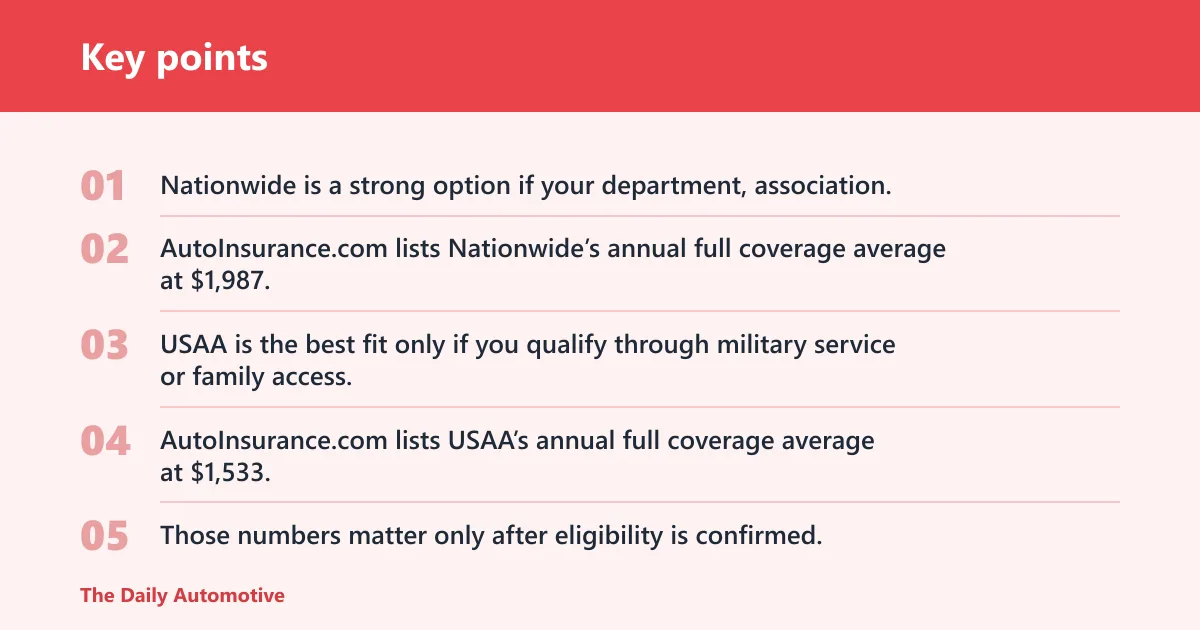
Nationwide is a strong option if your department, association, or employer is tied to a qualifying program. AutoInsurance.com lists Nationwide’s annual full coverage average at $1,987, and the carrier is presented as Best for Police Partnerships, which makes it useful when the discount depends on a specific relationship rather than a generic occupation code.
Best for eligible military families: USAA
USAA is the best fit only if you qualify through military service or family access. AutoInsurance.com lists USAA’s annual full coverage average at $1,533, and AutoInsurance.org says its minimum coverage is $49 per month for eligible drivers. Those numbers matter only after eligibility is confirmed, because police officers without military access generally cannot join.
Best for coverage customization: Travelers
Travelers works well for drivers who want more control over deductibles, add-ons, and vehicle protection. MoneyGeek says Travelers is best overall for police officers, which points to a balance of value and policy design rather than the cheapest sticker price alone.
Best for bundling and safe-driver pricing: State Farm
State Farm fits officers who want to stack auto with home or renters coverage and reward a clean driving record. Clearsurance names State Farm among the best car insurance companies for law enforcement, and its broad agency network can help if you want a local review of how discounts interact.
Best for younger or newer drivers: Progressive
Progressive is often the better fit for younger or newer law enforcement drivers because its safe-driver programs and usage-based tools can offset some of the price pressure that comes with limited driving history. Clearsurance includes Progressive among the best options for law enforcement, but any usage-based setup needs careful review if the car sees regular off-duty commuting.
GEICO for digital shoppers
GEICO can work well for officers who want an online-first quote and a clear price to compare. AutoInsurance.com lists GEICO’s annual full coverage average at $1,867, while Clearsurance says GEICO starts at $36 per month and offers an exclusive 15% discount. That discount is not universal, so the carrier’s quote still needs a state-by-state check.
Law-enforcement eligibility and documentation to confirm
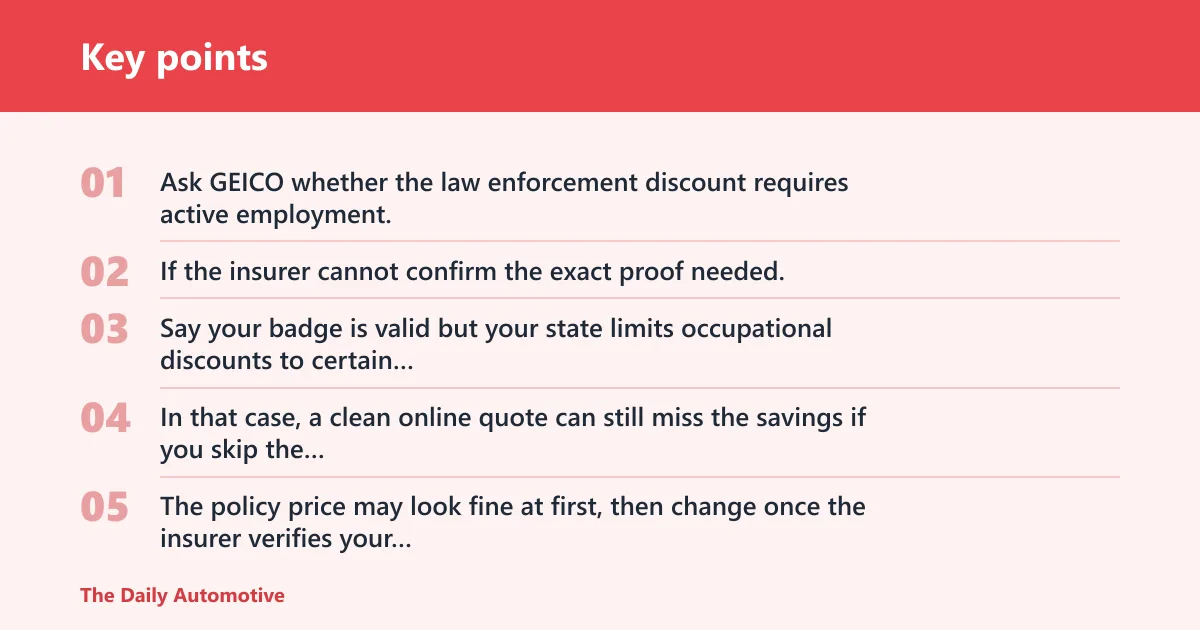
Ask GEICO whether the law enforcement discount requires active employment, retired status, union membership, or an affinity group. Then ask what documents it accepts. If the insurer cannot confirm the exact proof needed, treat the discount as unverified until the quote is finalized.
Say your badge is valid but your state limits occupational discounts to certain associations. In that case, a clean online quote can still miss the savings if you skip the association question. The policy price may look fine at first, then change once the insurer verifies your status.
FLEOA-related savings and where they may apply
Some GEICO law enforcement savings may be tied to affinity groups such as FLEOA-related memberships where available. That means the discount may depend on membership, employer partnership, or a similar eligibility path, not just the fact that you work in law enforcement.
Do not assume the same savings applies to every officer in every state. If a program is tied to a group, ask whether the group is required at quote time, renewal, or only for a one-time enrollment step.
Minimum and full coverage rate context
GEICO’s full coverage average gives a useful benchmark, but minimum liability and full coverage are not interchangeable. Full coverage costs more because it includes collision and comprehensive protection, while minimum coverage only meets the legal floor in your state.
Nationwide and affinity-based savings
Nationwide is worth a close look if your law enforcement savings depend on a partnership, association, or employer arrangement. AutoInsurance.com lists Nationwide’s annual full coverage average at $1,987, and the company is presented as Best for Police Partnerships, which makes it especially relevant for officers whose discount comes through a specific relationship.
Partnership or membership requirements to ask about
Ask whether the discount requires a police association, agency affiliation, or a named partner organization. Also ask whether the rule applies only to active officers or also to corrections officers, retired officers, or civilian public-safety employees.
That matters because some occupational offers are narrower than the marketing suggests. A law enforcement job title alone may not be enough if the carrier wants a partner code or a verified membership number.
Pay-per-mile caution for duty-related driving
Nationwide’s pay-per-mile option can look appealing for low-mileage drivers, but it is a poor fit if your vehicle sees regular commuting, court runs, training days, or take-home travel that is rated as normal use. Usage-based or distance-based pricing can penalize miles faster than a standard policy, and work-related driving may be rated differently.
Do not place a patrol pattern, take-home unit use, or regular work errands on a personal policy unless the policy terms clearly allow it. Personal auto coverage may exclude employer-owned use or rate it as a higher-risk exposure.
Minimum and full coverage rate context: nationwide’s annual full coverage average
Nationwide’s annual full coverage average sits above GEICO’s listed full coverage figure, which is a reminder that value is not only about the cheapest premium. If the partnership discount applies, the final rate can still become competitive, especially when you bundle home or renters insurance.
Is USAA an option for you?
USAA is an option only if you qualify through military service or family access. It is not open to all police officers. For eligible drivers, AutoInsurance.com lists USAA’s annual full coverage average at $1,533, and AutoInsurance.org says the minimum coverage rate is $49 per month.
Who qualifies for USAA access
USAA access usually depends on military status, veteran status, or eligible family membership. A police officer who is not also eligible through military or family ties should not assume access just because of the job title.
That restriction is important enough to ask first. If you are not eligible, move on to other insurers rather than spending time on a quote that will not complete.
Minimum coverage rate and claims satisfaction context
USAA often scores well on service measures, and claims satisfaction matters when you need help after a loss, not just when the premium looks low. AutoInsurance.com shows J.D. Power claims satisfaction scores on a 1,000-point scale, which helps compare service quality across carriers instead of chasing price alone.
What to do if you are not eligible
If you are not eligible for USAA, use the quote benchmark from GEICO, Nationwide, Travelers, State Farm, and Progressive instead. That is the faster path to a policy you can actually buy.
What coverage do law enforcement drivers need off duty?
Off-duty drivers usually need at least the state minimum liability coverage, but many officers should choose full coverage when the car is newer, financed, leased, or carries added equipment. Work-related use can change the answer, because a personal auto policy may not fully cover employer-owned gear or a vehicle used for job tasks.
Minimum liability versus full coverage
Minimum liability can be the right choice only if the vehicle is older, paid off, and inexpensive to replace. Full coverage is better when the car has higher replacement value or when you would struggle to pay for repairs after a collision or theft.
AutoInsurance.org identifies law enforcement monthly rates by coverage level and notes that full coverage is costlier than minimum. That is expected, but the higher premium may still be worth it if the vehicle is a daily commuter or a newer model.
Newer vehicles, loans, and added equipment
If the car is financed, the lender often requires collision and comprehensive coverage. If it carries light bars, communication gear, or other equipment, ask whether the policy covers those items as installed equipment or only as personal property with low limits.
A common first-timer mistake is assuming the car’s contents are covered at their full replacement cost. Many personal auto policies limit personal property coverage or exclude employer-owned gear entirely.
Why work-related use can change the answer
Driving from home to your normal duty station is one issue. Using the car for work errands, take-home response, or any employer-directed travel is another. The insurer may rate those uses differently, and some personal policies may not cover them the way you expect.
Law enforcement discount verification checklist
Use this checklist before you accept a police-related discount. It is the fastest way to see whether the offer is real in your state and whether it can be stacked with bundling.
| Insurer | Eligibility requirement to ask about | Documents to ask for | Stacks with bundling? | State restriction note |
|---|---|---|---|---|
| GEICO | Active law enforcement status, affinity group, or FLEOA-related membership where available | Badge ID, employee verification, association card, or HR letter | Ask before binding; rules can vary | May not be offered in every state |
| Nationwide | Police partnership, employer tie, or qualifying affinity membership | Membership proof, employee ID, or partner code | Often possible, but verify the order of discounts | Program terms may differ by state and partner |
| USAA | Military or eligible family access; not open to all officers | Service records or family eligibility documents | Bundling may apply if eligible | Access rules are eligibility-based, not state-based |
| Travelers | General occupational or safe-driver eligibility, if offered | Employer verification if requested | Usually ask about home and auto bundle savings | Availability can vary by state |
| State Farm | Agency review of occupation, driving record, and bundle status | Driver record and proof of occupation if requested | Common bundle candidate | Discounts and underwriting differ by state |
| Progressive | Safe-driver or usage-based program eligibility | Driving history and telematics enrollment details | Ask whether bundling changes the rate | Usage-based rules can vary by state |
- Confirm whether the law enforcement discount exists in your state.
- Ask what proof the insurer accepts.
- Check whether the discount requires association or partner membership.
- Ask if it can stack with bundling or safe-driver savings.
- Verify whether off-duty commuting, take-home use, or work errands change the rate.
Frequently asked questions
Does law enforcement get discounts on car insurance?
Yes, law enforcement drivers may qualify for an occupational or affinity discount, but it is not guaranteed. Eligibility, state rules, and documentation requirements vary by insurer. The discount can disappear if your carrier requires a specific association, employer partnership, or proof of active status.
Do police officers get cheaper car insurance?
Sometimes, yes. Police officers may see lower rates if the insurer offers a law enforcement discount or if their driving record, mileage, and vehicle profile already point to lower risk. A clean record and bundling can matter just as much as the job title.
Do police officers get a discount on car insurance?
They may, but the answer depends on the company and state. Some insurers offer occupational or affinity savings, while others require membership in a partner group or do not offer the discount everywhere. Always ask for the exact eligibility rule before assuming it applies.
What companies offer law enforcement auto insurance discounts?
GEICO, Nationwide, State Farm, Progressive, USAA, Travelers, Erie, Amica, and Liberty Mutual are commonly discussed by comparison sites, but the details differ. GEICO, Nationwide, USAA, Travelers, State Farm, and Progressive are the main carriers to check first because their programs and eligibility paths are more often discussed.
Which insurer is cheapest for police officers?
There is no single cheapest carrier for every officer. Compare quotes with the same limits and deductibles.
Which insurer is best for young or new law enforcement drivers?
Progressive is often the best starting point for younger or newer drivers because its safe-driver and usage-based tools can offset limited driving history. GEICO is also worth a quote if you want a lower starting price, but the best result depends on age, record, and how much you drive off duty.
Products related to this article
Sponsored / affiliate links. As an Amazon Associate I earn from qualifying purchases. I may earn additional commission from eligible campaigns.