Car Decals for Dodge Charger: Best Stripes and Graphics
Match stripe width and layout to your Charger generation: wide hood-to-trunk kits suit modern widebody and Scat Pack cars, while narrower dual stripes fit classic second-gen and vintage-inspired builds. Wrong fitment or the wrong graphics can look off and waste money. This guide compares stripe styles, model-year fit, trim cues, and finish choices so you can pick the right decal kit.
Which Charger decals fit your body style?
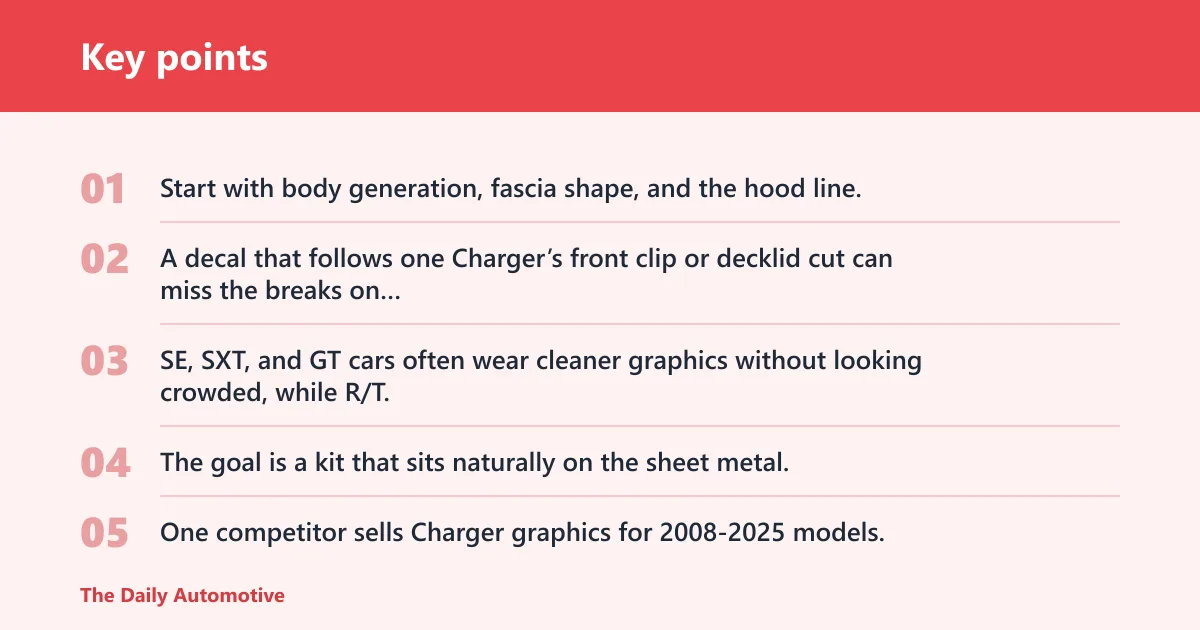


Start with body generation, fascia shape, and the hood line. A decal that follows one Charger’s front clip or decklid cut can miss the breaks on another year range, even if the listing says “Charger.” That matters most on cars with updated bumper openings, different grilles, or a changed hood center section.
Trim and stance matter next. SE, SXT, and GT cars often wear cleaner graphics without looking crowded, while R/T, Daytona, Scat Pack, Hellcat, and SRT trims can carry broader, more aggressive stripes without fighting the car’s factory attitude. The goal is a kit that sits naturally on the sheet metal, rather than one that feels added on after the fact.
Body generations and fascia changes to check first
Catalog coverage varies by seller. One competitor sells Charger graphics for 2008-2025 models, while Fast Car Decals says it offers Dodge Charger stripes from 2006-2024. Another stripe page appears to cover 2015-2023 Hellcat body style fitment, and several individual kits are listed for 2015-2024 Chargers. That spread is a warning: year range alone is not enough.
Check the hood length, headlamp shape, bumper cutouts, and rear deck transition before ordering. A stripe that lands cleanly on a 2020 car may need a different cut line on a 2024 model, especially around the nose and rear band area.
Trim and stance cues to check first
Trim changes the visual target. SE and SXT owners often want a cleaner OEM-style accent, while Daytona, Scat Pack, Hellcat, and SRT buyers usually lean toward stronger center-striping or side graphics that match the car’s performance image. GT owners often sit in the middle, where subtle hood or rocker accents can work well.
Also check wheel size, hood vents, and any factory badging package already on the car. A busy decal set can clash with black wheels, hood scoops, or large badges. A narrow band may be the better call on a lower-key car.
When a stripe kit looks factory versus aftermarket
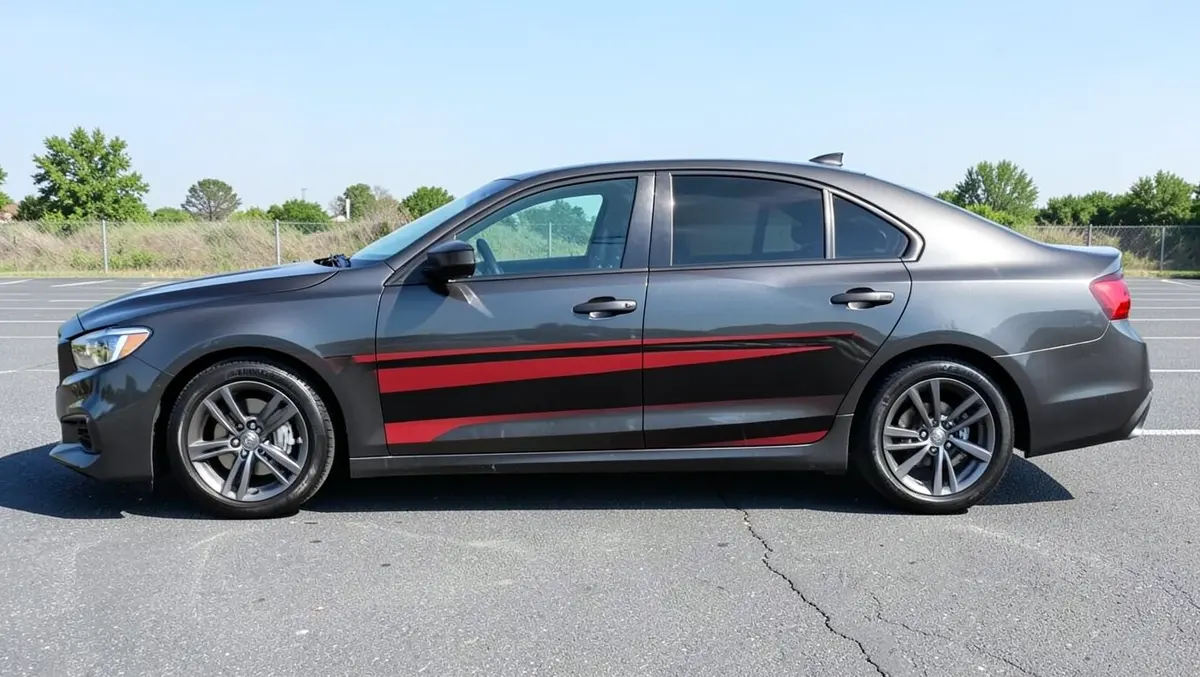
A factory-like graphic follows body contours, uses proportions that match the hood and trunk, and avoids awkward breaks at seams. OEM-inspired styling usually reads cleaner on Chargers because the body already has long, straight surfaces and a broad rear quarter. Custom graphics can work too, but only if they respect those lines.
Think of the goal as a visual fit, not just a panel fit. A stripe can fit the surface and still look wrong if it crowds the hood scoop, lands too far inboard, or stretches beyond the tail band.
Stripe kit types that work best
The best Charger decal choice usually comes down to where you want the eye to travel. Hood-to-trunk stripes give the strongest centerline statement. Side graphics add motion. Rear bands tie the tail together. Quarter-panel and rocker accents fill space without dominating the car.
Racing stripes and rally stripes
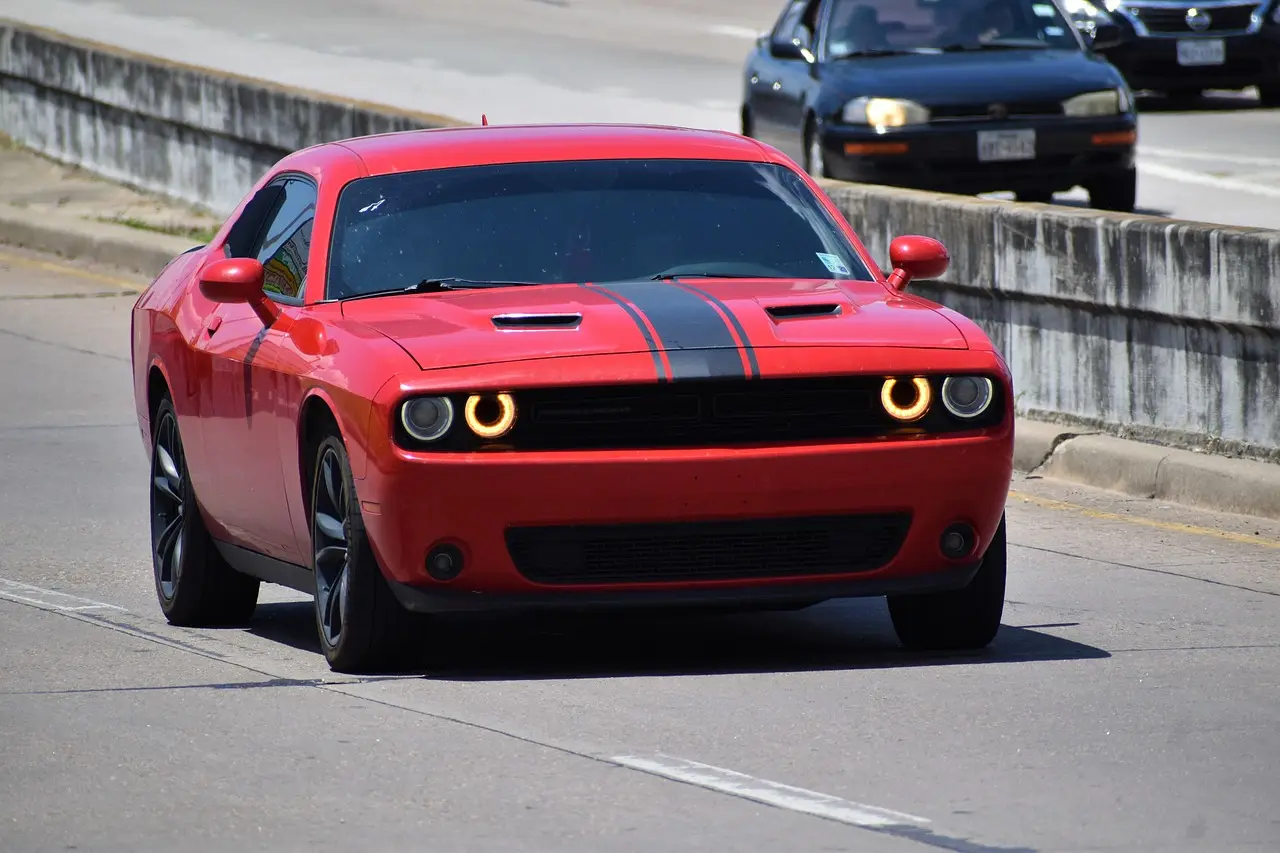
Racing stripes are the classic hood-to-trunk choice for a Charger. Rally stripes are often similar in spirit, but they can be narrower, offset, or paired with a center gap that changes the car’s stance visually. These work best when you want an obvious muscle-car appearance with a simple layout.
On a Daytona, Scat Pack, Hellcat, or SRT, broad dual stripes can feel natural. On SE and SXT cars, narrower stripes often look more balanced and less busy.
Hood stripes and rear tail band stripes
Hood stripes are a lower-commitment option if you want the front of the car to carry the graphic without running the full body length. One hood stripe product is listed for 2015-2024 Chargers, and one rear stripe product is listed for 2015-2024 Chargers, so buyers can separate the front and back treatment if they do not want a full set.
Rear tail band stripes work well when the goal is to frame the taillights and finish the back end. They suit cars that already have enough visual activity up front, or owners who want a cleaner side profile.
Side-body, quarter-panel, and rocker accents
Side-body graphics bring movement to the Charger’s long doors and quarter panels. Quarter-panel graphics can echo old-school performance packages without covering the whole side. Rocker panel accents sit lower and visually reduce the car’s height, which can help a tall stance look more planted.
These styles are often the best choice when the owner wants a subtle change instead of a full-width stripe package. They also make sense if the hood already has vents or a scoop that would fight a large center graphic.
Dodge Charger stripe decision table
Use this as a first-pass fitment guide, then verify the listing against your exact year, trim, and fascia. Small design changes at the front bumper or rear deck can change where a stripe lands and whether a pre-cut kit lines up cleanly.
| Model year range | Trim | Stripe location | Visual effect | Install difficulty | Best-use case | Fitment caution note |
|---|---|---|---|---|---|---|
| 2006-2008 | SE, SXT, R/T | Hood-to-trunk dual stripes | Classic muscle look with strong centerline presence | Moderate | Vintage-inspired builds and OEM-style replication | Check hood and deck seam positions; older-body graphics may not align with later fascia shapes. |
| 2008-2024 | R/T, Daytona, Scat Pack, Hellcat, SRT | Racing stripes | Bold, factory-performance appearance | Moderate to harder | Owners who want a visible, factory-like performance cue | One competitor’s catalog spans 2008-2025, but your exact nose and hood profile still need checking before ordering. |
| 2015-2023 | Hellcat | Side-body graphics | Modern, aggressive profile without a full roof-to-trunk band | Moderate | Drivers who want motion and trim emphasis | A page covering 2015-2023 Hellcat body style fitment does not guarantee every sub-trim panel break is identical. |
| 2015-2024 | SE, SXT, GT | Hood stripes | Cleaner front-end emphasis with less visual weight | Easy to moderate | Subtle OEM-style upgrades on daily drivers | A hood stripe listed for 2015-2024 Chargers may still need trim-specific centering and badge clearance checks. |
| 2015-2024 | R/T, Daytona, Scat Pack | Rear tail band stripes | Frames the tail and ties the rear lighting together | Easy to moderate | Clean rear detail without full-body coverage | One rear stripe product covers 2015-2024, but taillight spacing and spoiler shape can change the final look. |
| 2015-2024 | SE, SXT, GT | Quarter-panel graphics | Side profile movement with a period-correct feel | Moderate | Owners who want a custom but restrained look | Quarter-panel art can run into fuel-door placement or wheel-arch curvature if the kit was cut for another year. |
| 2015-2024 | Any listed trim | Rocker panel accents | Lower, longer stance with less visual height | Moderate | Black or dark-color Chargers that need a cleaner side break | Lower-body kits are more sensitive to door-sill length and jacking point locations. |
Say your Charger is a 2021 Scat Pack in white and you want a more factory look. A dual racing stripe in a moderate width can suit the car better than a side graphic that breaks the body line. On the other hand, a black SE with no other trim work may look sharper with a hood stripe only.
What materials should you look for?
Premium cast automotive vinyl is the material category to look for first. It conforms better than cheap calendared film on curves, seams, and raised edges. The listing should also call out outdoor durability and UV resistance if the car sits outside often.
3M and Avery material calls
Material names matter because they hint at consistency and outdoor use. The vendor says its vinyl uses 3M materials, and buyers will also see Avery material calls on some Charger graphics. Those names do not tell you everything, but they are better signals than an unbranded film with no specification.
Check whether the listing says cast automotive vinyl, pre-cut sections, or included transfer tape. Those details are more useful than broad marketing language when you are comparing kits for a daily-driven Charger.
UV resistance and outdoor durability claims
One vendor claims its kits last 5 to 12 years, and UV resistance is a common claim on exterior vinyl. Treat that lifespan as a claim, not a promise. Sun, washing frequency, and garage storage all affect how long a graphic keeps its color and edge adhesion.
Fast Car Decals and other catalog sellers place Charger stripes and graphics within a broader Dodge lineup, which helps with shopping, but the material listing still matters more than the storefront label. Outdoor durability should be backed by the film spec, not just the product title.
How do you choose OEM-style or custom graphics?
OEM-style graphics are the safer choice if you want the car to look as though the stripes came from the factory. Custom graphics give you more personality, but they can age faster visually if the proportions or colors fight the body. On a Charger, restraint usually ages better than novelty.
Factory look replication
Factory look replication works best when the stripe width, separation, and placement echo Dodge design language. That usually means straight runs, clean endings, and minimal interruption around badges or vents. It is the best answer for owners who want the car to look finished, not modified for attention.
1970s-inspired cues
1970s-inspired graphics fit Chargers well because the body already carries muscle-car proportions. Wider dual stripes, tail bands, and quarter-panel accents can reference that era without copying it exactly. This style works especially well on darker paint colors where the stripe contrast reads clearly.
Modern performance styling
Modern performance cues are cleaner and more restrained. Thin center stripes, hood-only graphics, and rocker accents fit newer Chargers that already have large grilles, sculpted hoods, and strong wheel stance. Dodge’s 2026 Charger design page explicitly includes racing stripes, and Dodge says the 2026 Charger offers an available dual Fratzog stripe, which points to a factory-approved stripe direction for the new body style.
That matters for shoppers planning ahead. A graphic that feels native on the 2026 body will likely be more geometric and integrated than an older, vintage-copy stripe set.
Can you install Charger decals yourself?
Yes, many Charger decal kits are DIY-friendly if the panel is clean, the kit is cut for your year, and you can keep the vinyl aligned during application. Wet application gives you more float time. Dry application locks sooner and usually rewards careful masking and a patient hand.

Wet application versus dry application
Wet application is useful on long hood stripes and large side graphics because it lets you reposition the vinyl before it grabs. Dry application can be faster on smaller pieces, but it leaves less room for correction. The listing should tell you which method the kit expects.
For a full hood-to-trunk set, wet install is often the easier path for a first-timer. For a small rear band or rocker accent, dry install may be practical if the panel shape is simple.
Pre-trimmed cut-to-fit kits
Pre-trimmed cut-to-fit kits reduce the guesswork around panel edges and badges. They are not a substitute for checking the year range, but they can help the kit sit in the right place on the hood, roof, and trunk. That is useful on Chargers with strong body breaks.
Suppose the kit is cut for 2015-2024 but your car has a different spoiler or fascia. The stripe may still be close, yet the rear section could need adjustment. Do not assume one pre-cut template covers every sub-variant.
Bubble-free install guidance and prep checks
- Wash the panels with a non-wax cleaner and dry them fully.
- Check badge placement, hood scoops, and seam lines before peeling anything back.
- Use masking tape to dry-fit the kit and confirm centerline alignment.
- Apply slowly, pushing air out as you go to avoid trapped bubbles.
- Let the vinyl settle before washing the car again.
A common first-timer mistake is centering the stripe on the hood bulge instead of the actual panel center. On a Charger, those are not always the same thing, and the error becomes obvious once the stripe reaches the windshield or trunk.
How much do Dodge Charger decal kits cost?
Prices vary by stripe style, material, and whether the kit covers the hood only or the full body. Simple hood stripes and rear bands usually cost less than full racing-stripe sets or multi-piece side graphics. Custom colors, longer coverage, and model-specific cutting generally increase the price.
Expect OEM-style or factory-style kits to cost more than generic vinyl strips because fitment work is built into the design. If a listing emphasizes fast shipping or competitive pricing, still check the model-year range and material spec first. A cheap kit that misses the fascia is no bargain.
Frequently asked questions
What are the best car decals for a Dodge Charger?
The best Charger decals match the car’s year, trim, and visual goal. Wide racing stripes suit performance trims, while hood-only or rocker accents suit cleaner builds. For most buyers, the safest choice is an OEM-style kit cut for the exact generation and fascia, not a universal graphic.
Which Dodge Charger stripe kit fits my model year?
Check the exact year range on the listing and then verify fascia, hood, and spoiler shape. Trim and body style still decide the final fit.
Are Charger racing stripes available for R/T, Scat Pack, and Hellcat trims?
Yes. Those trims are common targets for Charger racing stripes because the long hood and performance stance suit a centerline graphic. The key is matching the stripe width and cut to the trim’s body details, especially on Hellcat and Scat Pack cars with more aggressive front-end cues.
What vinyl materials are best for Dodge Charger decals?
Premium cast automotive vinyl is the best starting point. Look for 3M or Avery material calls, plus UV resistance and outdoor durability language. One vendor says its vinyl uses 3M materials and claims a 5 to 12 year life, but those are listing claims, not guarantees.
Can I install Dodge Charger decals myself?
Yes, if the kit is cut for your year and you take your time. Wet application helps with large stripes, dry application suits smaller accents, and pre-trimmed kits reduce layout errors. Clean panels, careful centering, and slow squeegee work matter more than speed.
What style of decals matches the 2026 Dodge Charger design?
Factory-looking racing stripes fit the 2026 Charger best, especially a dual stripe that echoes Dodge’s available dual Fratzog stripe. The new design language points toward integrated, performance-focused graphics rather than busy add-ons. Clean, centered stripes will likely look most native on that body style.
Products related to this article
Sponsored / affiliate links. As an Amazon Associate I earn from qualifying purchases. I may earn additional commission from eligible campaigns.