FH Group Seat Cover Review: Is It Worth It?
FH Group seat covers are worth buying only if your seats are simple, low-contour, and you can accept a loose fit; on many vehicles, the low price buys convenience, not a close match to factory upholstery. A bad fit can block airbags, bunch at the hips, and waste money on returns or replacements. This guide sorts FH Group by fit risk, install effort, and where a cheaper universal cover still makes sense.
This guide draws on manufacturer listings, product specifications, and published buyer feedback. The goal is to judge fit risk first, then price.
Worth it for budget buyers with simple seats
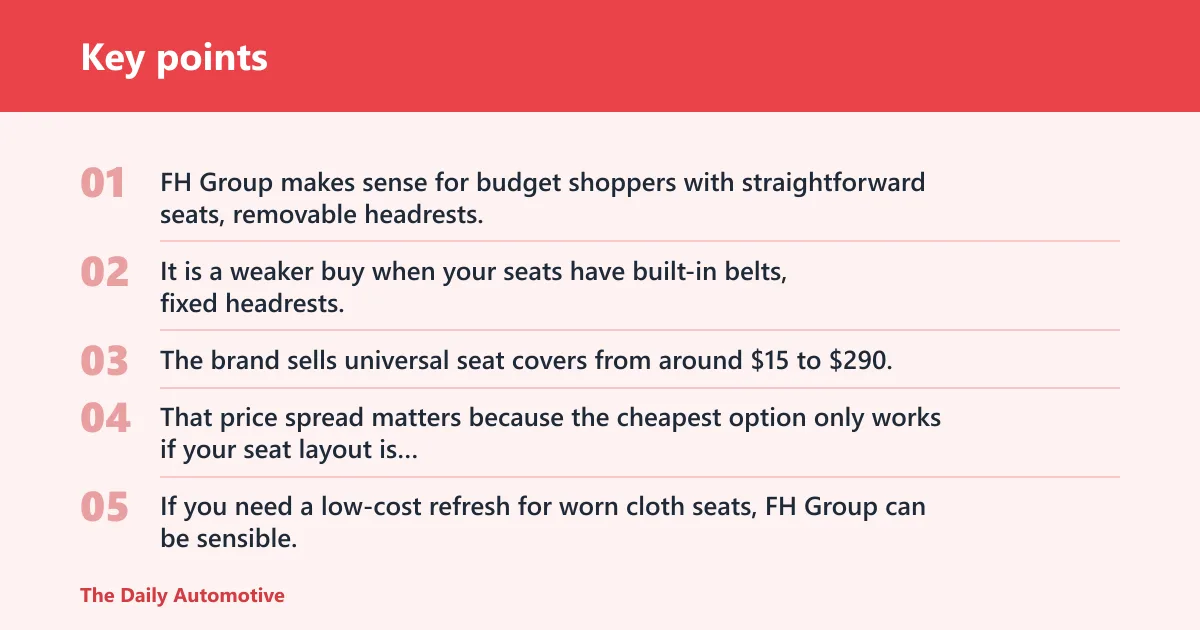


FH Group makes sense for budget shoppers with straightforward seats, removable headrests, and a willingness to trim openings after installation. It is a weaker buy when your seats have built-in belts, fixed headrests, split rear benches with armrests, or side airbags that need the right SKU.
The brand sells universal seat covers from around $15 to $290, and a full set of front covers can cost less than a tank of fuel. That price spread matters because the cheapest option only works if your seat layout is simple enough for a universal pattern to sit properly.
Bottom line for budget shoppers
If you need a low-cost refresh for worn cloth seats, FH Group can be sensible. If you need exact contouring, clean rear-bench access, or a snug airbag-safe fit, the savings may disappear fast once you factor in returns, extra trimming, or a second purchase.
When the low price makes sense
Simple front seats are the best match. A sedan or compact SUV with removable headrests, no integrated belts, and minimal seat bolsters gives a universal cover its best chance of looking acceptable. That is where the lower price can still feel fair.
When fit risk cancels the savings
Complex seat layouts change the math. Fixed headrests, built-in seat belts, split rear benches, and child-seat use all add friction. In those cases, a low sticker price does not matter much if the cover needs cutting, slips out of place, or blocks access.
Pros and cons
FH Group’s main advantage is breadth. The catalogue is huge, with over 2,700 products, and the brand covers many common interior layouts. The main drawback is that “universal” often means “requires compromises.”
What FH Group does well
- Low entry price across much of the range.
- Universal and custom-fit lines for different budgets.
- Material options that include flat cloth, 3D air mesh, velour, Neosupreme, Ultraflex neoprene, and PU leather with foam padding.
- Dedicated options for airbag compatibility and built-in seat belt layouts.
Where buyers run into fit and install problems
- Some universal covers only work with removable headrests and armrests.
- FH Group says universal covers do not come with pre-cut holes for headrests or seat belts.
- Split rear benches need the correct pattern, or the cover can fight the seat fold.
- Airbag-compatible stitching is not on every SKU.
What to check before you order
Check whether your front seats have removable headrests, whether the rear bench splits 40/60, 50/50, or 40/20/40, and whether the car has integrated seat belts. If you use child seats, check how the cover affects LATCH or ISOFIX access before you buy.
Are FH Group seat covers worth it?
They are worth it for buyers who want cheap protection and can live with a less tailored result. They are less worth it for anyone whose seats need precise openings, neat edge alignment, or quick access to child-seat anchors, belts, and fold-down rear sections.
Best fit for simple seat layouts
FH Group works best on ordinary front seats with removable headrests and little side bolstering. In that setup, adjustable straps can hold the cover in place well enough for daily use, especially if your goal is to hide wear rather than mimic factory upholstery.
Poor fit risk on complex seats
Picture a minivan with a 40/20/40 second row, a center armrest, and built-in shoulder belts. A universal cover can force too much trimming and leave awkward gaps around the belt path, which defeats the point of buying a cheap set in the first place.
Value depends on your vehicle details
The value case changes with the seat layout, not with the price alone. For a straightforward commuter car, a lower-priced FH Group set may be enough. For a family vehicle with split benches and child seats, the risk of poor access can outweigh the savings.
What FH Group sells
FH Group sells both universal-fit and custom-fit seat covers. The universal line is the budget entry point, while the custom-fit line is the higher-price tier with vehicle-specific applications and may include a neosupreme option. Some custom-fit front-seat designs may also use side airbag-safe construction.
Universal-fit and custom-fit lines
The universal line uses a one-size approach, with some products needing removable headrests and some allowing armrests. The custom-fit line is shaped for specific vehicles, which can improve fit but also narrows the number of models it covers.
Material choices across the range
FH Group materials include flat cloth, premium fabric, 3D air mesh, velour, Neosupreme, Ultraflex neoprene, and PU leather. The practical difference is feel, cleaning effort, and how much structure the cover has when it is strapped down.
Where the brand is sold
FH Group sells through its own site, and Walmart lists the brand among a large interior seat-parts marketplace with many alternatives. That matters because price comparison is easy, but it also means the same brand can appear in very different versions across channels.
Do FH Group seat covers fit most cars?
They fit many cars in the broadest sense, but “most” does not mean “most without compromise.” FH Group’s universal covers depend heavily on removable headrests, usable belt paths, and a seat shape that does not fight the cover. Fixed headrests and built-in belts are the biggest warning signs.
Removable headrests versus fixed headrests
Some FH Group universal covers only work with removable headrests and armrests. If the headrest is fixed, the cover may not slide on cleanly, and the headrest opening may not land where it should after installation.
Cut-your-own openings and strap hardware
FH Group says universal covers do not come with pre-cut holes for headrests or seat belts. That means the installer often has to position the cover first, then cut openings after the fabric is in place, using the straps to keep it centered.
Front set versus full set differences
A front set is simpler because it avoids rear-bench splits, armrest gaps, and child-seat access issues. A full set adds more parts, more matching problems, and more chances for the rear cushion to interfere with seat folding or access points.
Seat cover decision matrix
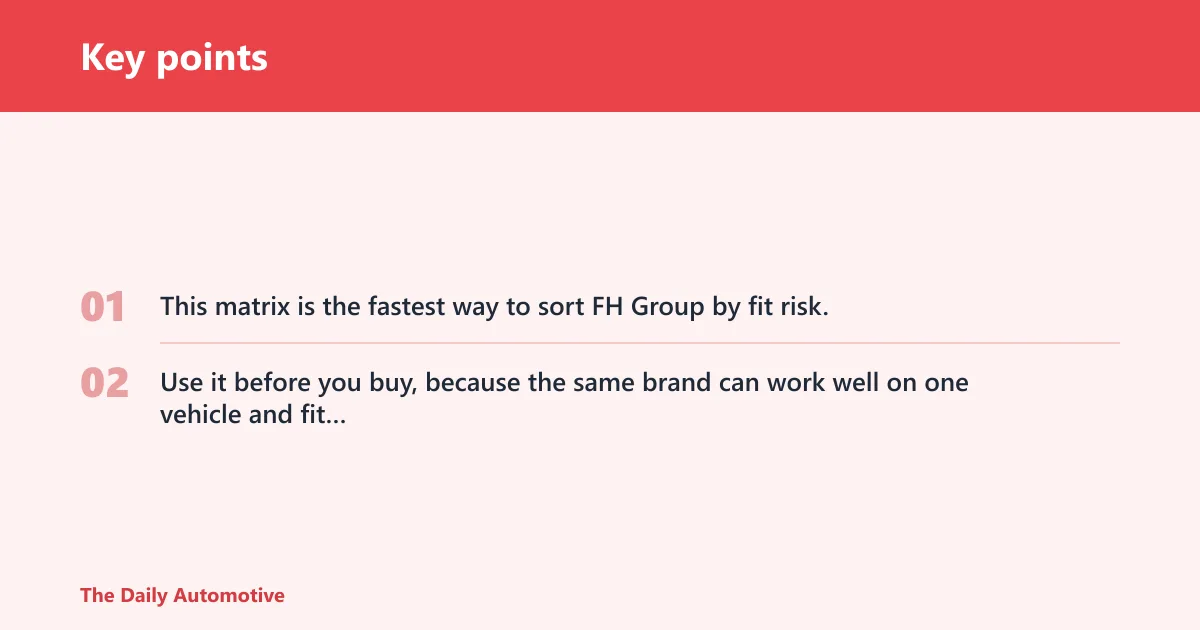
This matrix is the fastest way to sort FH Group by fit risk. Use it before you buy, because the same brand can work well on one vehicle and fit poorly on another.
| Fit scenario | Verdict | Why |
|---|---|---|
| Removable headrests | Works well | Universal covers have a much better chance of sitting correctly when the headrest can come off and the opening can be positioned after install. |
| Fixed headrests | Risky | FH Group says some universal covers only work with removable headrests, so fixed posts can force awkward fitment or extra cutting. |
| Integrated seatbelts | Risky | FH Group sells a dedicated built-in seat belt line, so the standard universal cover is the wrong choice unless the product filter matches that layout. |
| Split rear bench | Risky | 40/60, 50/50, and 40/20/40 seats need the correct pattern or the cover can block folding sections and leave loose fabric at the split. |
| Armrest or cupholder bench | Risky | Armrest cutouts and console access need specific accommodation; otherwise the rear cover can trap the armrest or cover the pass-through. |
| Airbag seats | Works well | FH Group claims special stitching enables side airbag deployment, but only on selected airbag-compatible SKUs that are officially tested. |
| Family and child-seat use | Avoid | Child-seat anchors, belt access, and rear-bench folding matter here, so a loose universal fit can block LATCH or ISOFIX clearance. |
| DIY-install tolerance | Works well | If you are comfortable trimming openings, adjusting straps, and redoing a section that sits crooked, FH Group is easier to accept. |
How hard are FH Group seat covers to install?
Installation is usually manageable, but it is not plug-and-play. Expect adjustable straps, possible headrest removal, and cutouts that you create after the cover is on the seat. Front seats are simpler than rear seats, and the rear can become frustrating if the bench splits.
Adjustable straps and anchoring
Some FH Group covers use adjustable straps. That helps with basic centering, but straps do not fix the wrong pattern. If the seat contour is too aggressive or the lower cushion is too wide, the straps only hold a bad fit in place.
Rear seat install versus front seat install
Front covers usually take less time because there are fewer moving parts. Rear installs need more patience because split sections, belt buckles, armrests, and child-seat access all compete for the same space.
Where cutting and trimming can go wrong
A common first-timer mistake is cutting the headrest opening before the cover is fully seated. That can leave the hole too high, too low, or too wide. Say your front seat has a tall fixed backrest and a narrow belt pass-through; one bad cut can make the cover look unfinished and expose the seat below.
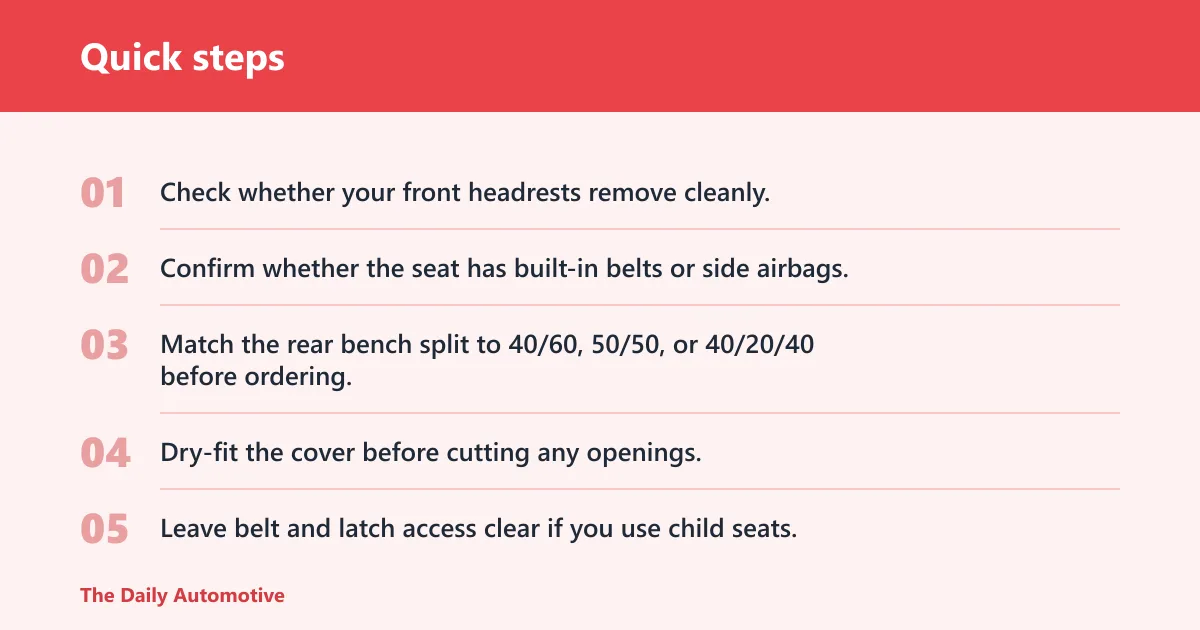
- Check whether your front headrests remove cleanly.
- Confirm whether the seat has built-in belts or side airbags.
- Match the rear bench split to 40/60, 50/50, or 40/20/40 before ordering.
- Dry-fit the cover before cutting any openings.
- Leave belt and latch access clear if you use child seats.
- Only trim once the cover is centered and strapped down.
Suppose your SUV has a 40/20/40 rear bench and you use one child seat on the passenger side. If the cover blocks the center fold or hides the buckle stalk, the problem is not cosmetic. It is a functional miss, and that is the kind of miss universal covers create most often.
How do FH Group seat covers compare on Walmart?
Walmart usually makes FH Group easy to price-check against other budget covers, and that is useful because the brand sits in a crowded seat-parts marketplace. FH Group’s appeal on Walmart is mainly low price and variety, while the tradeoff is that you still need to verify fit details on each SKU.
Price range and product breadth
FH Group’s own pricing runs from around $15 to $290, so the brand spans basic universal kits and higher-priced custom-fit options. That spread helps shoppers, but it also means the low-cost listings are not equivalent to the more tailored ones.
What the price spread means in practice
Walmart’s listings can make a full search feel cheaper than buying from a specialty store, but the buyer still has to sort through fit notes carefully. BDK PolyPro full set pricing at $29.99 gives a useful reference point for the lower end of the budget aisle.
Where can I buy FH Group seat covers?
You can buy FH Group seat covers on the brand’s own site and through Walmart. The better choice depends on whether you want the broadest selection or the easiest price comparison. For fit-sensitive vehicles, the product page matters more than the checkout channel.
Best place to shop for simple seats
If your vehicle is straightforward, the cheapest channel may be fine. Look for the exact SKU that matches removable headrests, airbag compatibility, or built-in belt needs rather than assuming the same name covers every layout.
Best place to shop for complex seats
For split benches, integrated belts, and airbag seats, shop where the listing details are clearest. FH Group’s own product pages usually make it easier to check the exact fit notes, while Walmart is useful when you want to compare pricing quickly.
Frequently asked questions
Are FH Group seat covers actually worth it?
They are worth it for budget buyers with simple seats and low expectations for factory-like fit. They are less attractive when your car has fixed headrests, built-in belts, or a split rear bench that needs clean access. In those cases, the savings can vanish in fit problems.
Are FH Group seat covers airbag compatible?
Some are, but not all. FH Group claims special stitching for side airbag deployment and says the design has been officially tested. The catch is that airbag compatibility is SKU-specific, so you need to verify the listing rather than assume every cover in the line will work.
Which FH Group seat cover material is best?
The best material depends on how you use the vehicle. Neoprene and Neosupreme make sense for a more structured feel, while 3D air mesh and flat cloth are simpler budget choices. PU leather with foam padding gives a different look, but it still needs a good seat shape to fit well.
Do FH Group seat covers work with split rear benches?
Some do, and FH Group specifically offers covers for 40/60, 50/50, and 40/20/40 splits. The fit still depends on whether the listing matches your exact rear layout and whether you need armrest or console access. A mismatched split can make the rear cover awkward to use.
Products related to this article
Sponsored / affiliate links. As an Amazon Associate I earn from qualifying purchases. I may earn additional commission from eligible campaigns.
 FLORICH Leather Seat Cover, Car Seat Covers Front Set, Waterproof Car Seat Protectors, Front Seat Covers 2 Pack, Breathable Automotive Seat Covers Protector Fit for Most Cars Trucks SUV
 FH Group Car Seat Cover Front Set Striking Striped Car Seat Covers with Front Seat Covers and Rear Split Bench, Universal Fit Interior Accessories for Cars, Trucks, and SUVs – Gray