How Late Can You Be on a Car Payment Before Repo?
Repo risk can start after one missed payment if your contract treats that as default, even though many lenders allow a 10- to 15-day grace period. Miss the payment and the lender can add repo fees, take the car, and report the delinquency to the credit bureaus. This guide explains the grace period, contractual default, and credit-reporting clocks so you know when the risk becomes real.
Repo risk decision table
| Days past due | Likely lender action | Late-fee risk | Credit-reporting risk | Best next move |
|---|---|---|---|---|
| Missed payment with active grace period | Account may still be treated as current if payment arrives within the contractual window | Usually lower until the grace period ends | Usually none yet if the account is still within the grace window | Pay before the grace period ends and confirm the lender posted it |
| 1 day | Some lenders treat the account as late right away; others wait for the grace period to end | Possible if your contract has no grace period | Usually not yet reported | Call the lender and make the payment right away |
| 10-15 days | Grace period often ends here; the account may move into delinquency | Late-fee risk rises | Usually still below the 30-day reporting mark | Bring the account current before the fee posts |
| 30 days | Collection pressure often increases; some lenders begin repo review | Late fees may already apply | Common credit-reporting threshold | Pay immediately or ask about a temporary solution |
| 60 days | Higher risk of default notices and repossession steps | Likely already in play | Likely reported if still unpaid | Call the lender the same day and ask about deferment or another fix |
| 90+ days | Many lenders are close to or at repossession action | Ongoing fee risk | Serious negative reporting likely already recorded | Consider voluntary surrender, selling the car, or a formal workout plan |
How late before a car payment is late?
A car payment is usually late the day after the due date if the contract says so, but many lenders add a 10- to 15-day grace period. That grace period is part of the contract, not a legal requirement, and it may stop late fees without stopping default.
Due date versus grace period
The due date is the first deadline. The grace period is a second window some lenders add to avoid an immediate fee or delinquency mark. If your contract gives that window, use it, but do not assume it protects you from default or repo risk.
Why the contract controls the first deadline
Every loan contract is different. The payment becomes late based on the agreement you signed, not on a universal state rule. That matters because some contracts treat a missed due date as delinquency right away, while others wait until the grace period ends.
When a late fee can start
Late fees may begin after the grace period ends, and the amount depends on the lender and contract. A late fee is separate from repossession risk. You can owe a fee without being close to a tow truck, and you can also be in default before a fee appears.
When does default start?
Default starts when the contract says it starts, and that can happen after a single missed payment. A lender may also treat an insurance lapse or another contract breach as default. Repossession risk begins at default, not only after a fixed number of days late.
A missed payment can trigger default
F1 and F2 matter here: California law does not set a specific number of missed car payments before repossession can begin, and a single missed payment can put you in default. That does not mean a lender always repossesses right away, only that it may have the right to act.
Other contract breaches that matter
Default is not limited to missed payments. An insurance lapse, failure to keep the vehicle insured, or another violation written into the contract can trigger the same problem. That is why the payment clock and the contract-breach clock need to be kept separate.
Why default is different from repossession
Default gives the lender a legal opening. Repossession is the action that follows. Many lenders wait before taking the car, and most lenders build in a grace period of 10 to 15 days, but neither step is a guarantee that the account will be left alone.
Can one missed payment lead to repossession?
Yes, one missed payment can lead to repossession if the contract says that missed payment is default, but many lenders do not move that fast. Many wait until the account is about 90 days behind, yet they may still begin internal collections or repo review much earlier.
How lenders decide whether to wait
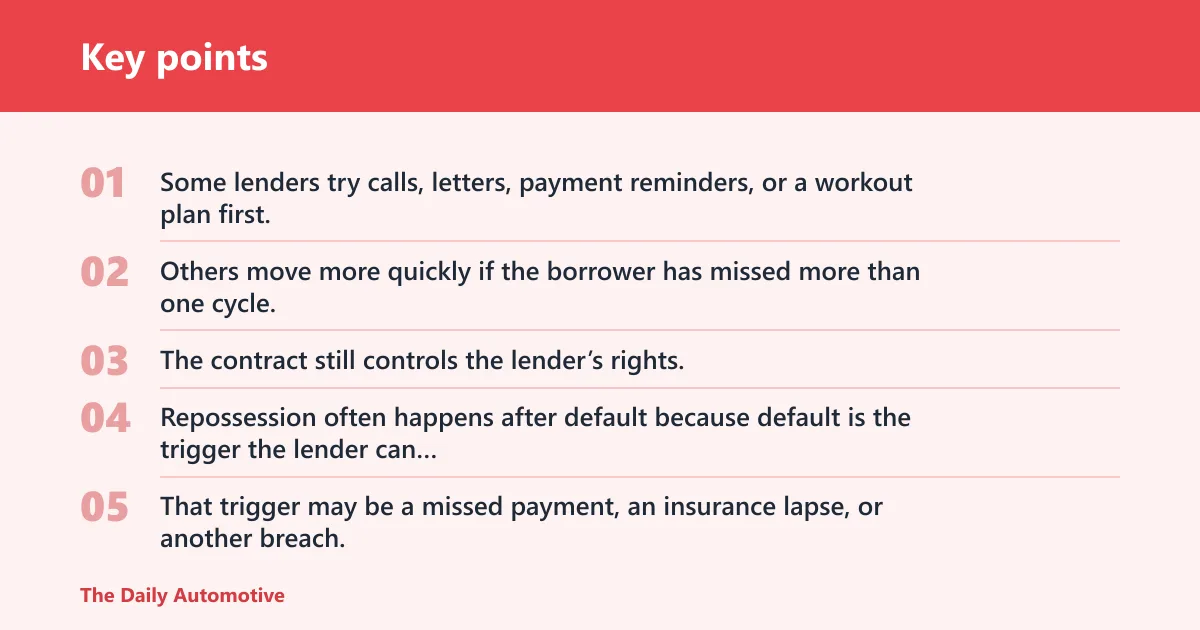
Some lenders try calls, letters, payment reminders, or a workout plan first. Others move more quickly if the borrower has missed more than one cycle, the account is already underwater, or the vehicle is hard to track. The contract still controls the lender’s rights.
Why many repos happen after default
Repossession often happens after default because default is the trigger the lender can act on. That trigger may be a missed payment, an insurance lapse, or another breach. A lender does not need to wait until the account is 90 days behind if the contract allows earlier action.
Why advance warning is not guaranteed
A lender can repossess without filing a lawsuit or getting a court order first, and in many states the tow can happen without advance warning if the lender stays within the law. California follows self-help repossession if there is no breach of peace. That means the car can be taken quickly once default exists.
Say your payment is due on the 1st and your contract gives a 10-day grace period. If you pay on the 8th, you may avoid a late fee and stay current. If you let the bill slide past the grace period, the account can turn delinquent before a tow truck gets involved.
What happens at 30 days late?
Thirty days late is the common credit-reporting threshold. Credit reporting generally starts at 30 days past due, and a 30-day late payment can hurt your credit. If you bring the account current before that point, you may avoid the bureau hit altogether.
Credit bureau reporting timing
At about 30 days past due, many lenders notify the credit bureaus. That first reported late payment can lower scores significantly. Late payments can stay on a credit report for seven years, so the damage can follow the account long after the balance is paid.
Score damage and the 7-year mark
F10, F11, and F12 are the key numbers here: a 30-day late payment can hurt your credit, credit reporting generally starts at 30 days past due, and late payments stay on a credit report for seven years. A single mark can matter, but repeated late marks usually do more damage.
How paying before 30 days can help
If you can bring the account current before day 30, you may avoid the first report to the bureaus. That does not erase a late fee if the grace period already ended, but it can keep the payment from becoming a major credit event.
What if you are already behind?
If you are already behind, call the lender first and ask about a temporary fix before the account gets deeper into default. If the payment problem is short-term, deferment may help. If the payment is simply too high, refinancing, selling the car, or surrendering it may be the cleaner answer.
Ask about deferment or a temporary pause
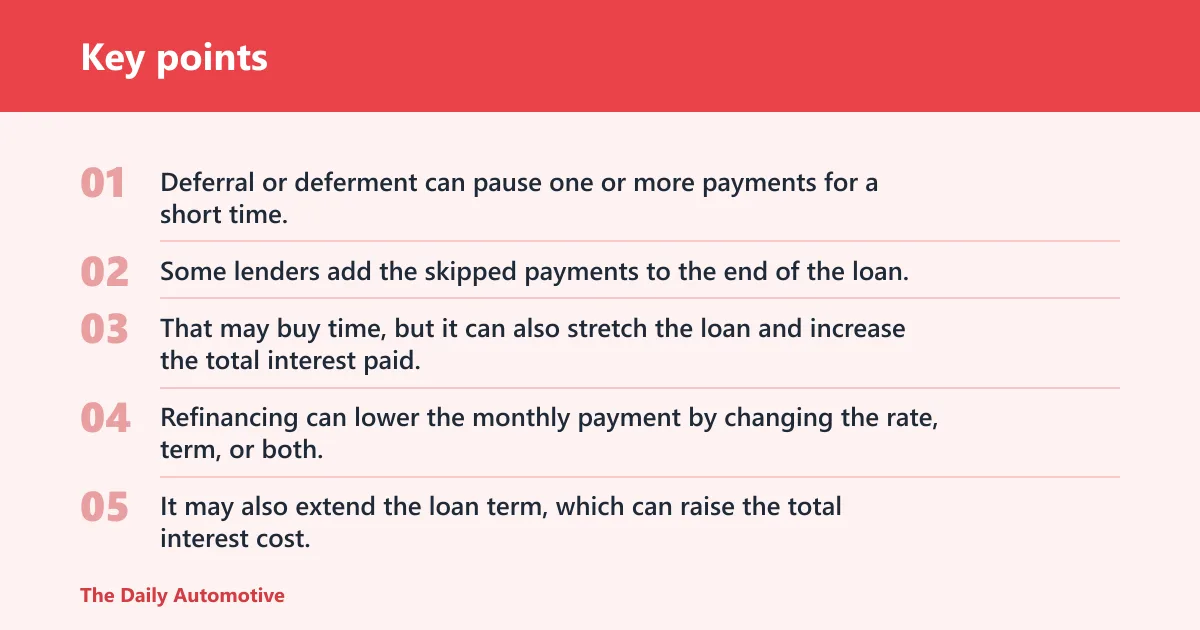
Deferral or deferment can pause one or more payments for a short time. Some lenders add the skipped payments to the end of the loan. That may buy time, but it can also stretch the loan and increase the total interest paid.
Refinance if the payment is too high
Refinancing can lower the monthly payment by changing the rate, term, or both. It may also extend the loan term, which can raise the total interest cost. It works best if the vehicle still has enough value and your credit still qualifies you for a better offer.
Sell or surrender the vehicle if the problem will last
If the payment gap is permanent, selling the car before repossession may reduce losses. Voluntary surrender is another option, but it should be arranged with the lender. It can limit some chaos, yet you may still owe a deficiency balance after the vehicle is sold.
Picture a borrower who is 60 days behind and the lender keeps returning calls to voicemail. Ignoring the account does not stop the clock. It usually removes options, because missed payments can stack up, late fees can grow, and repo review can move forward without much notice.
After repossession: your options
After repossession, the main options are usually voluntary surrender, reinstatement, or dealing with the deficiency balance. Reinstatement can be possible in some cases, but it depends on state law and the contract. The earlier you contact the lender, the more options you are likely to have.
Voluntary surrender versus involuntary repo
Voluntary surrender means you turn in the vehicle before a tow happens. It should be arranged with the lender. Involuntary repossession means the lender takes the car without your agreement. Either way, the lender may still sell the vehicle and pursue what remains owed.
Reinstatement and what it can cost
Reinstatement means getting current again after repossession. It can involve missed payments, repo fees, storage charges, and other related costs. Availability depends on state law and the contract, so there is no single national rule that guarantees you can get the car back.
Why quick contact still matters
F14 points to the most practical move: if you cannot afford your car payment, talking to your lender is the first step. A lender is more likely to consider a payment plan, deferment, or another fix before the account turns into a tow and sale process.
Frequently asked questions
How late can you be on a car payment before repo?
There is no universal day count. A missed payment can put you in default if the contract says so, and repossession can begin after default. Many lenders wait longer in practice, often until you are about 90 days behind, but the contract controls the legal trigger.
How many late payments before car repo?
There is no fixed number. One missed payment can be enough under some contracts, while other lenders wait through multiple missed payments before acting. The key question is not how many in the abstract, but whether your account has entered default under the loan terms.
When can a car be repossessed for late payments?
A car can be repossessed after default, and default can begin before 30 days late if the contract allows it. Many states allow self-help repossession without a court order if there is no breach of peace. That is why the contract matters more than a calendar rule.
Do lenders have to warn you before repossessing a car?
Not always. Some lenders send notices, but a lender can repossess without filing a lawsuit or getting a court order first, and advance warning is not guaranteed. State law can affect notice and cure rights, so the safest assumption is that repossession can happen quickly after default.
What happens if you are 30 days late on a car payment?
At 30 days late, the account is often reported to the credit bureaus, which can hurt your score and stay on the report for seven years. The lender may also step up collection efforts. If you can pay before that point, you may avoid the first reported late mark.
What are my options if I am already behind on my car loan?
Start by calling the lender and asking about deferment, a temporary payment pause, or another hardship option. If the loan is simply too expensive, refinancing may lower the payment. If the problem will not go away, selling the car or arranging voluntary surrender may be the next step.
Products related to this article
Sponsored / affiliate links. As an Amazon Associate I earn from qualifying purchases. I may earn additional commission from eligible campaigns.