Should You Get Pre-Approved for a Car Loan?
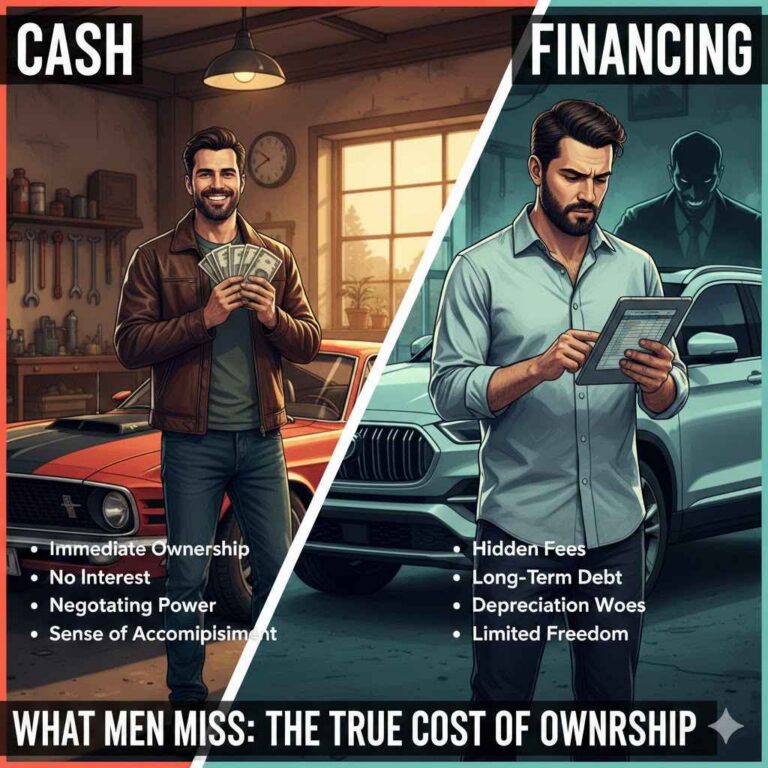
Yes, get pre-approved before you visit a dealer if you want a real financing benchmark and more room to push back on a marked-up rate. Skip it, or compare loans loosely, and you can miss dealer fees, a worse APR, or a longer term that raises total interest. This guide shows when pre-approval helps, how to compare offers on the same amount financed, APR, term, and fees, and when manufacturer promo financing may beat both.
Should you get pre-approved before a dealer visit?

For most buyers, yes. Pre-approval gives you a conditional lender commitment with a maximum borrow amount, an estimated APR, and a loan term, so you can compare the dealer’s finance offer against a real outside benchmark before you sign anything.
That matters because monthly payment alone can hide a higher APR, a longer term, dealer add-ons, or fee differences that raise the total of payments. Experian recommends shopping for car loans before visiting a dealership, and Credit Karma notes that preapproval can help you avoid dealership financing when the outside offer is better.
When pre-approval gives you a stronger starting point
Pre-approval helps most when you have time to compare offers, a stable income file, and enough credit strength to qualify for a decent rate. The same source says a good auto-loan credit score is generally at least 661, and shoppers with prime credit often get the clearest spread between lenders and dealer quotes.
It also helps if you plan to buy within a short window and want to keep the dealer focused on the vehicle price instead of the payment pitch. A pre-approval letter tells the store that you already have outside financing ready, which can discourage a padded rate.
When waiting for dealer or promo financing can make sense
Do not treat pre-approval as mandatory for every purchase. If the manufacturer is offering promotional financing, that rate may beat your outside offer even after you include fees and term differences. Dealer financing can also win when the lender tied to the store has a special program for the exact model or trim you want.
Waiting can also make sense if you are early in the process and your file is thin. In that case, a pre-qualification may be a better first step, because it can help screen lenders without the stronger application impact of a full pre-approval.
What is the difference between pre-approval and pre-qualification for a car loan?
Pre-approval is a stronger lending step. It usually means a lender has reviewed your application and issued a conditional commitment with an estimated rate, term, and amount you can borrow. Pre-qualification is usually lighter screening, often with a soft credit check, and it gives you an earlier read rather than a firm lending offer.
What a pre-approval letter usually includes
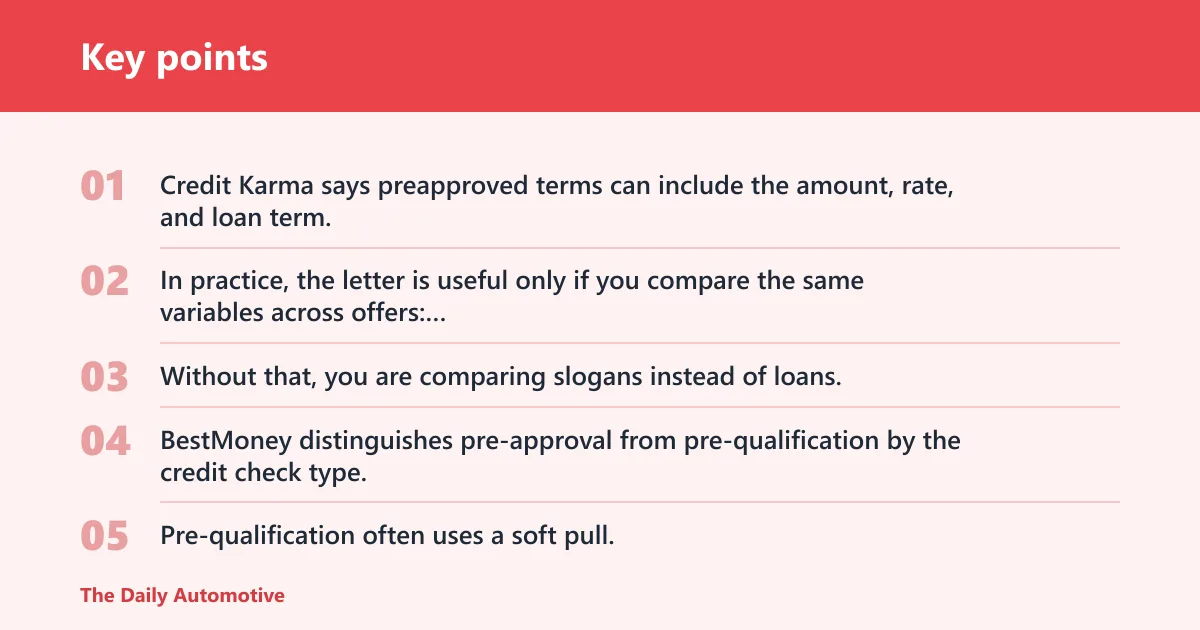
Credit Karma says preapproved terms can include the amount, rate, and loan term. In practice, the letter is useful only if you compare the same variables across offers: APR, term, amount financed, fees, and total of payments. Without that, you are comparing slogans instead of loans.
How pre-qualification differs on credit pull and certainty
BestMoney distinguishes pre-approval from pre-qualification by the credit check type. Pre-qualification often uses a soft pull, which is typically used for early screening and has less immediate score impact. Pre-approval usually involves a hard credit inquiry and carries more weight because the lender is closer to a final decision.
Say your score is in the high 600s and you want to know whether a $28,000 SUV fits your budget. A pre-qualification may tell you the likely range. A pre-approval can tell you whether a lender will actually commit to that amount, at a stated estimated APR and term.
How pre-approval affects your credit
A hard credit inquiry from auto financing may lower a score by a few points, but the effect is usually modest. The more important issue is timing: auto lenders commonly group multiple applications inside a short rate-shopping window, so you can compare offers without every inquiry hitting as a separate credit event.
Hard inquiry impact and the auto rate-shopping window
One application is not the same as many random applications across a long stretch. If you spread lender applications over several weeks, credit scoring models may treat them as unrelated shopping. If you apply within a short period, the scoring effect is often treated more favorably for rate shopping.
That is why you should not start with one lender this week, another next month, and a dealer offer later. Focus the applications close together, then compare the actual APR, fees, and term side by side. Keep the shopping window tight and the comparisons clean.
How to keep multiple applications inside one shopping period
- Gather your documents first so each lender gets the same facts.
- Apply to the lenders you are seriously willing to use within a short window.
- Use the same requested loan amount, down payment, and term for each quote.
- Save each approval or counteroffer so you can compare APR and total of payments.
- Bring the best outside offer to the dealer and ask it to match or beat the terms.
What should I compare besides the monthly payment?
Compare APR, term, fees, amount financed, down payment, add-ons, and the total of payments. The monthly payment can look attractive because the lender stretched the term, rolled in fees, or changed the down payment. HonestCredit says dealer and outside financing should be compared on the same variables.
APR, term, and fees
APR matters because it captures the borrowing cost. Term matters because a longer loan can lower the payment while increasing interest over time. Fees matter because they change the amount financed even when the sticker rate looks competitive.
That is especially important when comparing new-car and used-car financing. Rates can differ by vehicle type and by credit tier, and the spread can be large. Experian is reported to cite a 2024 average new-car loan rate of about 4.77% for scores in the 781 to 850 range and about 13.08% for scores in the 501 to 600 range. The credit tier matters.
Down payment, add-ons, and total of payments
A bigger down payment can shrink the amount financed and reduce total interest, but only if the lender is comparing the same structure. Watch for add-ons buried in the contract, such as protection packages or service products, because they can raise the financed balance fast.
Picture a shopper who likes a $520 monthly payment on a 72-month loan. If a shorter-term outside offer is $565 a month but cuts thousands from the total of payments, the lower payment may be the worse deal. Use an auto loan calculator to test APR, term, and down payment before you commit.
Car loan preapproval checklist
Lenders usually want identity, residence, income, and employment details before they issue preapproval. Some also ask for vehicle information if you already have a target car. Have the basics ready so you can move through the application without changing numbers after the quote arrives.
Identity, residence, and income documents
- Government-issued proof of identity
- Proof of residence, such as a recent utility bill or lease document
- Proof of income, such as recent pay stubs or tax documents if requested
- Employment verification details, especially if the lender wants to confirm job stability
Employment and vehicle details lenders may ask
Some lenders want your employer name, time on the job, and monthly housing expense. Others ask for the vehicle’s year, make, model, mileage, or VIN if you have already picked a car. If your income recently changed, tell the lender before the dealer submits a different set of numbers.
Can dealer financing beat your pre-approval?
Yes. Dealer financing can beat an outside pre-approval when the dealer has access to a manufacturer promo rate, a lender-specific special, or a structure that better fits the car and your file. It can also lose badly if the store adds a rate markup, extra fees, or a longer term.
How rate markups and manufacturer promos can change the math
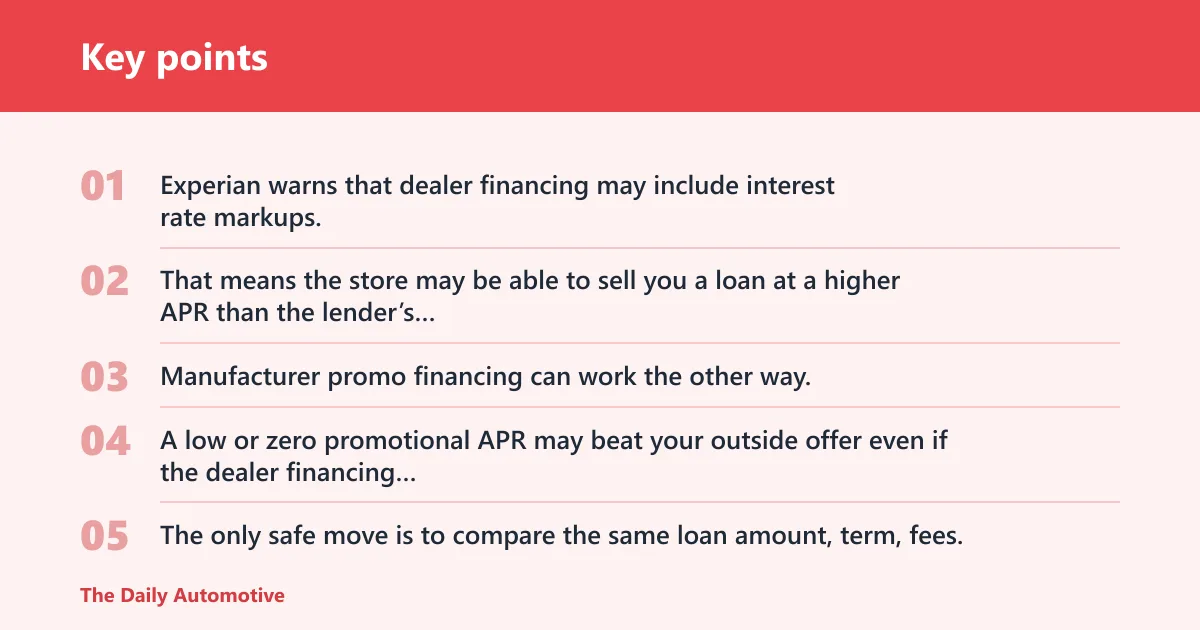
Experian warns that dealer financing may include interest rate markups. That means the store may be able to sell you a loan at a higher APR than the lender’s base offer, and the difference can cost real money over the full term.
Manufacturer promo financing can work the other way. A low or zero promotional APR may beat your outside offer even if the dealer financing desk is usually more expensive. The only safe move is to compare the same loan amount, term, fees, and down payment before deciding.
When to accept the dealer offer and when to walk away
Accept the dealer offer if it is truly better on the full cost of credit, not only on the payment line. Walk away if the dealer raises the APR, extends the term to hide the cost, or adds items you did not agree to finance. Also walk away if the store cannot match the outside lender’s key terms.
A common first-timer mistake is saying yes to a lower payment without checking the contract. If the dealer trims $20 off the monthly bill by stretching the term by 12 months, the total of payments may rise anyway. Do the math before you sign.
Pre-approved table
| Decision item | Outside preapproval | Dealer financing | Manufacturer promo financing |
|---|---|---|---|
| APR | Use as your benchmark rate | Accept only if equal to or better than outside offer | Often the lowest when a promotion is active |
| Term | Set before shopping | Compare the same term, not a longer one | May be tied to a specific term |
| Fees | Check any origination or lender fee | Review doc fees and finance add-ons | Check whether promo terms require other tradeoffs |
| Down payment | Use the same amount in every quote | Do not let the dealer change it silently | Confirm it matches the promo rules |
| Add-ons | Usually excluded unless you choose them | Review for paint, warranty, or protection products | Promo may limit what can be financed |
| Total of payments | Your comparison baseline | Must be compared on the same amount financed | May be lowest if APR is subsidized |
| Credit pull | Usually hard inquiry | May require another hard inquiry | Usually tied to a lender review |
| Acceptance trigger | Choose if it is the best full-cost offer | Accept only if it beats the outside deal on the same terms | Accept if the promo APR and restrictions still win on total cost |
| Final recommendation rule | Choose the offer with the lowest total of payments on the same vehicle, same term, same down payment, and same fees. If two offers are close, use the lower APR and fewer add-ons as the tie-breaker. | ||
What if the lender or dealer says no?
A denial or conditional approval does not always mean the deal is dead. It may mean the vehicle does not fit lender rules, your income changed since preapproval, or the final underwriting found a detail that was not clear in the first application. Thin files can also make approvals more fragile.
Vehicle eligibility, income changes, and final underwriting issues
Some lenders limit age, mileage, or model type. Others can change their decision if your pay stub, job status, or housing expense no longer matches the file. Final underwriting can also tighten the approved amount, shorten the term, or raise the APR before funding.
What to do if your file is thin or your approval is conditional
If your credit file is thin, start with pre-qualification from a few lenders, then move to preapproval only after you know which ones are realistic. If your approval is conditional, ask exactly what condition still needs to be satisfied: income proof, residence proof, vehicle details, or a smaller loan amount.
Suppose a lender approves about $24,000 for 48 months, but the dealer’s vehicle costs about $26,500 before taxes and fees. That is not a small mismatch. You either need a different vehicle, a larger down payment, or a lender that will finance the higher amount on acceptable terms.
Frequently asked questions
Should I get pre-approved for a car loan before going to the dealer?
Usually yes, because pre-approval gives you a real comparison point for APR, term, fees, and amount financed. It also strengthens your position if the dealer tries to steer you toward a longer loan or a marked-up rate. Use it as a benchmark, not as a final target.
Does getting pre-approved for an auto loan hurt my credit score?
A hard credit inquiry may lower your score by a few points, but the effect is usually small. The key is to keep multiple auto applications inside a short shopping window so the score impact is less likely to stack up as separate, repeated pulls.
How long does a car loan pre-approval last?
BestMoney says pre-approval usually lasts about 30 days. That window matters because vehicle availability, rates, and your own income details can change. If the approval expires, you may need to refresh the application and repeat the comparison process.
Will dealer financing ever beat my pre-approval offer?
Yes. Dealer financing can beat an outside offer when a manufacturer promo rate is available or when the store’s lender has a better fit for your file. Compare on the same APR, term, fees, and total of payments before you decide, because a lower monthly payment alone can mislead you.
What documents do I need for car loan pre-approval?
Bring proof of identity, proof of residence, proof of income, and employment verification details. Some lenders may also ask for vehicle information if you already have one in mind. Having those documents ready helps you avoid a delay right when you are trying to compare offers.
Products related to this article
Sponsored / affiliate links. As an Amazon Associate I earn from qualifying purchases. I may earn additional commission from eligible campaigns.