How Much Does It Cost to Refinance a Car?
Refinancing a car is often reported to cost about $0 to $500, and it generally makes sense only if the monthly interest savings recover those fees before you sell the car or pay off the loan. Skip the math, and you can pay closing costs for little or no net savings. This guide breaks down lender fees, DMV charges, prepayment penalties, and the break-even test you can use on your own loan.
Break-even math for refinancing
This worksheet shows the pieces that matter most: rate, balance, term, fees, and the monthly savings needed to recover those fees. Bankrate says auto refinancing is a new loan that pays off the old one, and it can change the rate, payment, or repayment period. The example below uses a real break-even calculation, so the payoff decision is clear.
| Line item | Example value | What it means |
|---|---|---|
| Current APR | 12.4% | Rate on the loan you already have |
| New APR | 8.1% | Rate on the refinance offer |
| Remaining balance | $11,500 | Unpaid principal on the current loan |
| Remaining months | 54 | Months left if you keep the current loan |
| Total upfront fees | $425 | Application, title, and filing costs charged at closing |
| Estimated monthly savings | $25.30 | Difference between the old and new monthly payment |
| Break-even months | 16.8 months | $425 ÷ $25.30 = 16.8 |
| Refinance before payoff? | Yes | Fees are recovered before the loan ends |
To read the worksheet, divide total upfront fees by estimated monthly savings. If the answer is lower than the time you expect to keep the car, the refinance may pencil out. If not, the lower APR may look good on paper while the fees erase the gain.
What does car refinancing cost?
Auto loan refinancing can involve several costs at once, not one flat charge. The biggest items are lender fees, title or lien filing costs, and any penalty tied to the old loan. Because lenders and states handle these charges differently, the real out-of-pocket total depends on the contract and where the car is titled.
The main fee types to expect
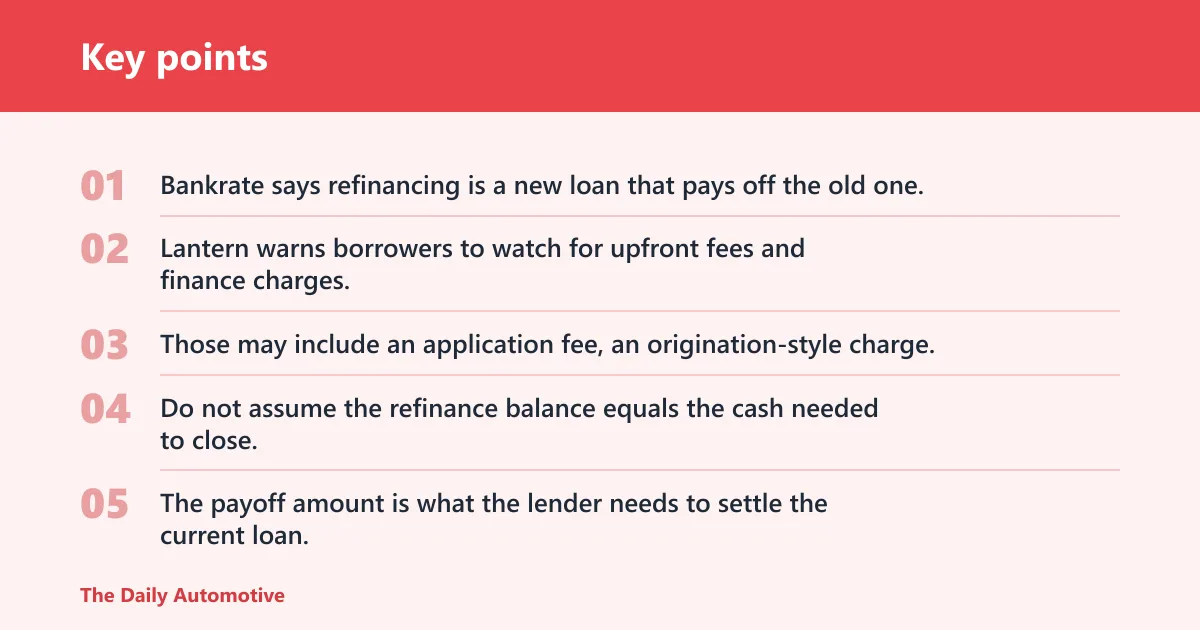
The same source says refinancing is a new loan that pays off the old one, so the process can bring fresh closing costs even if the original loan had none. Lantern warns borrowers to watch for upfront fees and finance charges. Those may include an application fee, an origination-style charge, and any required lien or title paperwork cost.
Do not assume the refinance balance equals the cash needed to close. The payoff amount is what the lender needs to settle the current loan, and it can differ from the remaining balance because daily interest keeps running until the loan is paid off. Lantern notes that a borrower may need a 10-day payoff amount from the current lender.
When the lender may add finance charges or title-related costs
Some lenders fold fees into the loan amount. Others collect them at signing. You may also see title transfer fees, lien recording charges, or state DMV filing costs where local rules require them. Those charges are small compared with the loan balance, but they still count in the break-even math.
Say your current balance is $9,800, but the payoff quote comes back at $9,915 because interest has accrued since the last statement. That extra $115 is part of the refinance cost stack, even though it is not a fee in the usual sense.
How much do refinance fees usually add up to?
The total can be low or fairly steep, depending on the lender and the state. A refinance may come in near $0 with a lender that charges little beyond required filing costs, or it may reach several hundred dollars once application, title, and finance charges are added. The only safe answer is to total every line item before you sign.
Application or origination-style fees
Some lenders charge an application fee or an origination-style fee to process the new loan. Others do not. If the lender rolls that cost into the loan, it still affects the true cost because you pay interest on it over time. NerdWallet says refinance applications can be compared without multiple credit hits, so you can shop these fees before you commit.
Title transfer and lien recording costs
When the new lender takes over the lien, a title transfer or lien recording fee may apply. The amount varies by lender and state, and it is often modest, but it belongs in the total. Those charges matter more on smaller refinance balances, where even a few hundred dollars can change the math.
State DMV or similar filing charges
Some states require DMV or motor vehicle filing fees during the refinance. In others, the lender handles the paperwork and charges you for it. Because those costs are state-specific, ask the lender for an itemized list before you apply.
Prepayment penalty risk on the old loan
A prepayment penalty is less common on auto loans, but it can exist if your contract allows it. If the old lender charges one for paying off the loan early, add it to the refinance total. That one line item can wipe out the gain from a lower APR.
Will refinancing save you money?

Refinancing can save money when the new APR lowers both the monthly payment and the total interest enough to beat the fees before payoff. The same source says a longer loan term can lower payments without saving money, which is why the term matters as much as the rate. The cheapest deal is the one that wins after fees, not the one with the lowest advertised APR.
How APR changes monthly payment and total interest
APR is the key comparison point because it reflects the interest rate used to price the loan. On the worksheet above, moving from 12.4% APR to 8.1% APR on a $11,500 balance over 54 months lowers the payment from about $279.00 to about $253.70. That is about $25.30 in monthly savings.
Over the full 54 months, the current loan would cost about $3,566 in interest, while the refinance would cost about $2,200 in interest. That is about $1,366 in interest savings before fees. Subtract the $425 in upfront costs, and the net gain is still positive if you keep the loan long enough.
When fees erase the benefit of a lower rate
The break-even rule is simple: total upfront fees divided by monthly savings equals the number of months it takes to recover the cost. If the result is longer than the time left on the loan, the refinance loses its edge. In the worksheet, $425 divided by $25.30 equals 16.8 months, so the refinance beats the fees before payoff.
A common first-timer mistake is focusing only on the payment drop. A shorter remaining term can make the payment look only slightly lower, which means it can take too long to recover the fees. A lower APR still helps, but only if the savings arrive fast enough.
How to read the break-even point
Use the payoff quote, not the statement balance, when you judge savings. Then compare the new payment against the old payment using the same remaining term if possible. If the refinance extends the term, the payment may fall while the total cost rises, which is why the break-even test should come first.
What affects your refinance rate?
Lenders price auto refinancing based on risk. Credit score, debt-to-income ratio, equity in the vehicle, and loan term all affect the offer. Better credit or a lower market rate can improve the quote, and a better financial profile can also make approval easier.
Credit score and recent credit changes
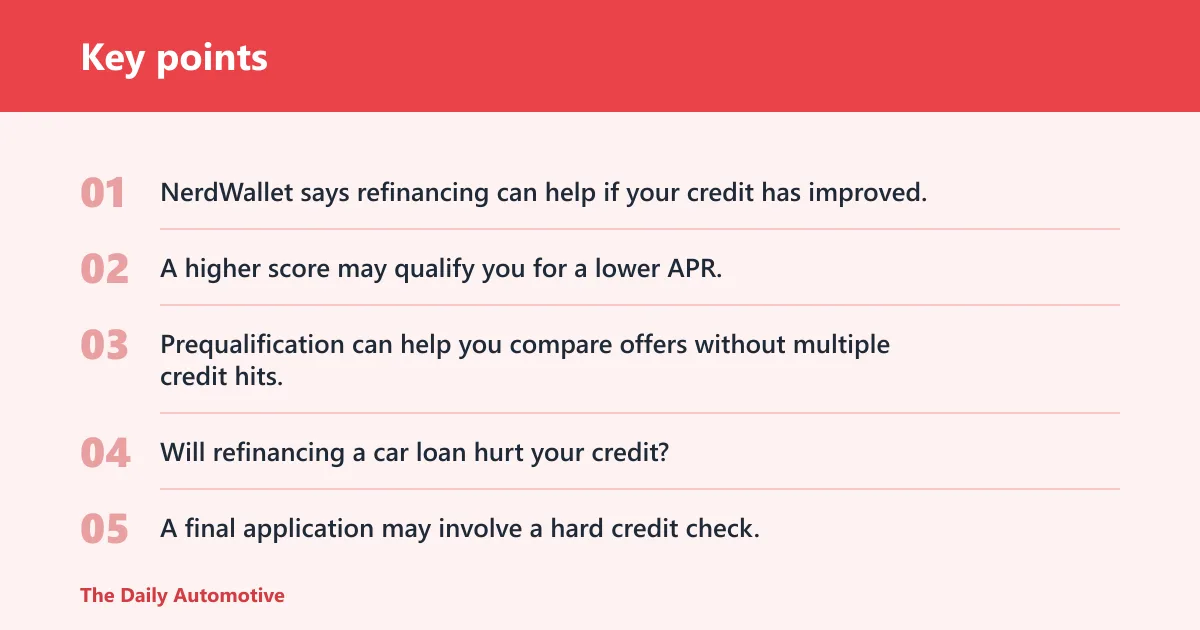
The same source says refinancing can help if your credit has improved. A higher score may qualify you for a lower APR, especially if your original loan was priced when your credit was weaker. Prequalification can help you compare offers without multiple credit hits, which makes rate shopping less risky.
Will refinancing a car loan hurt your credit? A final application may involve a hard credit check, and that can cause a small temporary dip. The timing matters, so use prequalification first when possible and reserve the hard pull for the lender you are most likely to choose.
Debt-to-income ratio
DTI matters because lenders want to see that your income can support the new payment and your other monthly debts. A lower DTI can help if your income rose or other debts fell since the original loan. It does not guarantee a better rate, but it can help you qualify.
Vehicle equity and loan-to-value
Vehicle equity is the difference between what the car is worth and what you owe. Positive equity usually makes refinancing easier because the lender has more cushion. Negative equity means the car is worth less than the payoff amount, which can limit approval or push the rate higher.
How much can you refinance your car loan for? Lenders usually refinance up to the payoff amount they are willing to lend against the vehicle and its value, not whatever balance appears on your last statement. If the payoff amount is higher than the car’s value, some lenders may decline the deal or require cash to cover the gap.
Loan term length
Shorter terms usually save on total interest because the balance is paid down faster. Longer terms can lower the monthly payment, but they can also raise the total cost even when the APR improves. That is why the monthly payment alone is not enough to judge the offer.
What do you need to apply?
Lenders usually ask for basic identity, income, and vehicle paperwork before they can price a refinance. The same source says applying can take less than an hour, but only if your records are ready. The same source says refinancing applications may require a VIN, and lenders often ask for a payoff quote from the current loan before closing.
Documents lenders usually ask
- Driver’s license
- Proof of residence
- Income verification, such as pay stubs or tax documents
- Vehicle registration
- VIN
- Insurance documents
- Current lender payoff quote
Prequalification versus final application
Prequalification is the faster shopping step. It can help you compare lenders and estimate rate ranges without a hard inquiry, although the final approved offer may differ. That is useful when you want to shop the market before you decide whether the refinance is worth the fees.
When a hard credit check usually happens
A hard inquiry usually happens when you submit the final refinance application and the lender reviews you for approval. That is the point where the lender confirms income, equity, and payoff details. If you are rate shopping, use prequalification first and save the hard pull for the best offer.
When refinancing makes sense
Refinancing makes sense when the lower APR produces enough monthly savings to beat the fees before payoff, and when the term length still fits your plan. It also makes more sense if your credit improved, market rates fell, or your payoff amount is close to the car’s value. If the deal depends on a longer term that raises total cost, be careful.
Lower APR with enough remaining term
The more months you have left, the easier it is to recover fees. A small rate drop on a loan with only a few payments left may not be enough. On the other hand, a larger rate cut on a loan with years remaining can produce real savings even after fees.
Better credit or lower market rates
If your credit score improved since you signed the original loan, your refinance offers may improve too. Lower market rates can help as well. That is one reason people revisit car loans after their credit changes or after rates move down.
Shorter term versus lower payment tradeoff
If you shorten the term, the payment may rise even as total interest falls. If you lengthen the term, the payment may drop even as total interest rises. Decide which outcome matters more before you sign, because the cheapest monthly payment is not always the cheapest loan.
Negative equity caution
If the car is underwater, refinancing can be harder. Some lenders will not refinance a loan when the payoff amount is higher than the vehicle value. Others may approve it but charge a less favorable rate. That is why checking equity before you apply matters.
Suppose your car is worth $10,000, but the payoff quote is $11,200. That negative equity gap can change the lender’s decision more than the APR drop does. In that case, it may be smarter to pay down the loan first and revisit refinancing later.
Frequently asked questions
How much does it cost to refinance a car loan?
It often costs $0 to $500, but the exact total depends on lender fees, title or lien filing charges, and any penalty on the old loan. The right way to judge cost is to total the upfront charges and compare them with the monthly savings you expect from the new APR.
Does refinancing a car loan cost money?
Yes, it can. Some lenders charge application or origination-style fees, and state filing or title costs may also apply. Even if a lender advertises no closing fee, the old loan may still have a payoff amount that is higher than the statement balance because interest keeps accruing.
Is it worth refinancing a car if the fee is high?
It can be, but only if the monthly savings recover the fee before you plan to pay off or sell the car. Use the break-even test: upfront fees divided by monthly savings. If the result is longer than your remaining ownership period, the refinance is probably not worth it.
What fees should I expect when I refinance my car?
Expect possible application or origination-style fees, finance charges, title transfer or lien recording costs, and sometimes state DMV fees. If your current loan contract allows a prepayment penalty, add that too. Ask for an itemized quote before you apply so you can compare lenders on the full cost.
How do I get good car refinancing rates?
Start by improving the factors lenders price: credit score, DTI, and vehicle equity. Then shop more than one lender, including your current lender. The same source says you can compare refinance applications without multiple credit hits, which makes prequalification the safer first step.
Will refinancing a car loan hurt my credit?
A final application may trigger a hard credit check, which can cause a small temporary dip. That is usually why borrowers prequalify first. If you apply with several lenders through prequalification, you can compare offers with less credit impact before the final pull.
What documents do I need to refinance a car loan?
Most lenders ask for your driver’s license, proof of residence, income verification, vehicle registration, VIN, insurance documents, and a payoff quote from the current lender. Having those ready can speed up the application, which Bankrate says may take less than an hour once the paperwork is in hand.
Products related to this article
Sponsored / affiliate links. As an Amazon Associate I earn from qualifying purchases. I may earn additional commission from eligible campaigns.