How Much Does Interior Car Detailing Cost? Pricing Guide
Interior car detailing is commonly around $125 to $300 for a standard sedan, with SUVs and heavily soiled interiors often running about $175 to $450. Skipping a proper detail can leave stains, odors, pet hair, and trim wear that weaken resale value or trigger lease-end charges. This guide breaks down pricing by package level, vehicle size, condition, and common add-ons so you can judge a fair quote.
Interior detailing prices
Most quotes land in a few broad bands, but the final bill depends on time, cabin size, and how much correction the interior needs. A basic package can cost far less than a restoration-style clean because labor rises fast once stains, pet hair, or odor treatment enter the job.
Typical price bands by vehicle size
A sedan usually lands at the low end because there is less carpet, fewer seat surfaces, and less time spent moving around the cabin. SUVs, trucks, and vans can cost more because the work takes longer and the cleaner has more square footage to cover.
| Vehicle type | Common interior detail range | What pushes it higher |
|---|---|---|
| Sedan | $125 to $225 | Heavy soil, pet hair, stain extraction |
| SUV | $150 to $300 | Third row, cargo area, larger carpet area |
| Truck | $150 to $275 | Work-truck dirt, vinyl wear, crevices |
| Van | $175 to $350 | Large cabin, sliding doors, family use buildup |
What a basic package usually includes
A standard interior car detailing package usually includes vacuuming, a surface wipe-down, console and dashboard cleaning, carpet and seat cleaning, light stain removal, and basic odor removal. Some shops also include door panels, cupholders, vents, and glass, but confirm those items before you book.
Where the price starts climbing
The price rises when a cleaner has to spend extra time on deep carpet work, scrubbing textured trim, or using a steam cleaner or extractor. Heavy soil, sticky spills, smoke odor, mildew, and pet hair can turn a routine cleaning into a much longer job with higher labor and chemical costs.
What changes the price?
The biggest drivers are labor time, vehicle condition, vehicle size, location, and service level. A fast wipe-down costs less than a true deep clean because the latter needs more tools, more passes, and more drying time. Provider type matters too, since overhead and staffing models differ.
Vehicle size and cabin layout
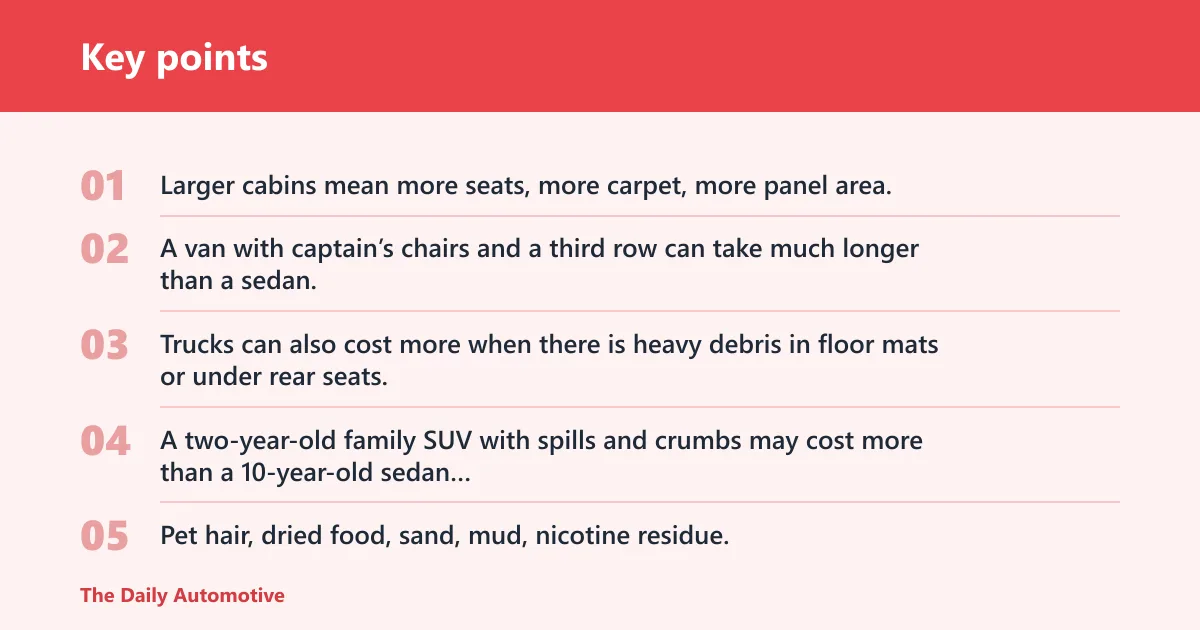
Larger cabins mean more seats, more carpet, more panel area, and more seams where dirt collects. A van with captain’s chairs and a third row can take much longer than a sedan, even if both appear equally dirty at first glance. Trucks can also cost more when there is heavy debris in floor mats or under rear seats.
Condition, soil level, and stains
Condition often matters more than age. A two-year-old family SUV with spills and crumbs may cost more than a 10-year-old sedan that has been kept clean. Pet hair, dried food, sand, mud, nicotine residue, and mold or mildew all add labor because they need more agitation, more vacuuming, or chemical treatment.
Suppose a compact sedan only needs crumbs removed, the dash wiped, and mats vacuumed. That job may stay near the base package. Now suppose the same car has a spilled coffee stain, dog hair in the fabric seats, and a sour smell. The quote can climb quickly because each issue takes a separate step.
Local labor rates and provider type
Prices also reflect the shop’s hourly labor rate and business model. A mobile detailer may charge less overhead but may have limited water, power, and drying setup. An independent shop often offers the widest middle range. Dealership detail departments may price higher for convenience, while premium boutique detailers usually charge more for time-intensive work and stricter finish standards.
How pricing models work
Detailers do not all price the same way. Some quote a flat package, others bill by the hour, and many add fees for specific problems. You need to know the pricing model before you compare quotes, or a cheap headline price can turn into a larger final bill.
Flat-rate packages
A flat-rate package gives you one price for a defined list of tasks. This is easiest to compare, but only if the list is clear. If the package says “interior detail” without naming vacuuming, cleaning of panels, seat treatment, and stain work, ask what is included before you approve the job.
Hourly labor and minimum charges
Hourly pricing is common for severe interiors or older vehicles that need more correction. Some providers also use a minimum charge, which means a small vehicle still starts at a set floor even if the actual job would take less time. That can be fair when the shop has to set up equipment and chemicals for any visit.
Bundled interior-exterior deals
Bundled packages can offer a better rate than buying interior and exterior work separately, but only if you need both. If your paint is fine and you only want the cabin cleaned, a bundle may hide extra cost you do not need. Compare the interior portion on its own before taking the bundle price at face value.
Interior service add-ons
Many quotes look reasonable until add-ons appear one by one. Pet hair removal, shampooing, stain extraction, odor treatment, leather conditioning, and mold remediation can each change the total by a meaningful amount because they add labor, materials, or drying time. These are not minor extras on a very dirty cabin.
Pet hair removal and shampooing
Pet hair removal often adds $20 to $75, and sometimes more for thick woven fabric or cargo-area buildup. Shampooing carpet and cloth seats commonly adds $30 to $100, depending on the size of the cabin and whether the provider must do multiple wet passes and drying steps.
Stain extraction and spill cleanup
Stain extraction can add $25 to $100 per problem area when the cleaner uses an extractor or targeted chemistry. Spill cleanup is similar if the stain has already set into the fibers. Fresh spills are easier and cheaper than old ones, especially when they have soaked through to padding.
Odor treatment, leather conditioning, and mold remediation
Odor treatment often adds $25 to $100, depending on whether the shop uses ozone, enzyme treatment, or only a basic deodorizer. Leather conditioning may run about $15 to $50 when seats need moisture and protection after cleaning. Mold remediation is often a higher-risk add-on and may cost about $100 to $300 or more because it may require deep extraction, sanitizing, and careful drying.
How much interior car table
Use this table to compare line items side by side. A low headline price is not helpful if the quote leaves out stain work, pet hair removal, or odor treatment that your car clearly needs. The benchmark column below is a simple screen, not a universal rule.
| Line item | Likely price impact | Fair | High | Investigate |
|---|---|---|---|---|
| Vacuuming | $0 to $25 if included; $10 to $30 add-on if separated | Included in base package | More than $25 for basic vacuuming | If vacuuming is listed but no detail package explains what else is included |
| Shampooing | $30 to $100 | Near the low end for a sedan | Above $100 without a large cabin or heavy soil | If the quote does not say whether seats, carpet, or both are treated |
| Stain extraction | $25 to $100 per area | Lower end for one small spot | Above $100 for one small stain | If the provider cannot say whether extraction is included or quoted separately |
| Pet hair removal | $20 to $75 | Near the middle for moderate hair | Above $75 without severe buildup | If the quote ignores thick fabric, cargo areas, or full-seat coverage |
| Odor treatment | $25 to $100 | Matches a basic deodorizing step | High if only a simple spray is used | If smoke, mildew, or spill odors are present and no method is named |
| Leather conditioning | $15 to $50 | Small fee for seat care | Above $50 unless the cabin is large or heavily worn | If the quote treats conditioning as mandatory after every clean |
| Mold remediation | $100 to $300+ | Only at the low end for limited spots | Above $300 can be fair for widespread contamination | If the provider gives a low flat price without inspecting moisture source or growth extent |
How to compare quotes side by side
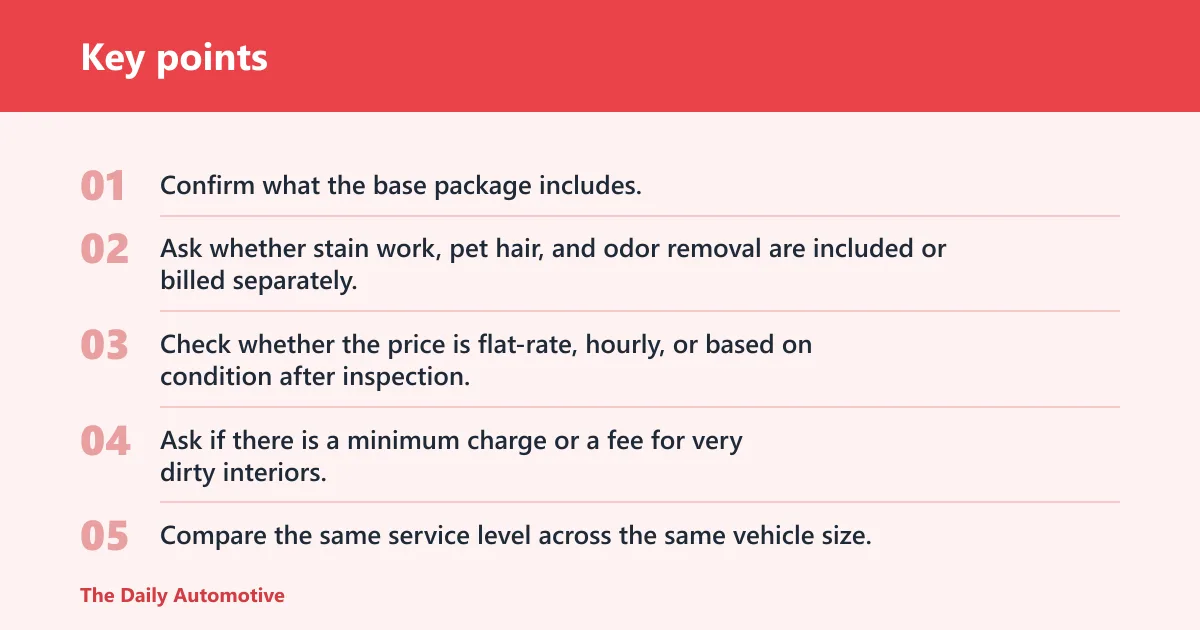
- Confirm what the base package includes.
- Ask whether stain work, pet hair, and odor removal are included or billed separately.
- Check whether the price is flat-rate, hourly, or based on condition after inspection.
- Ask if there is a minimum charge or a fee for very dirty interiors.
- Compare the same service level across the same vehicle size.
When to pay more
Pay more when the interior needs more than a reset. Family cars with spilled snacks, rideshare vehicles with frequent passenger turnover, lease turn-ins with visible wear, and resale prep on older interiors often justify a deeper service. The cost is easier to defend when the car’s condition affects comfort, chargebacks, or sale price.
Family cars and daily drivers
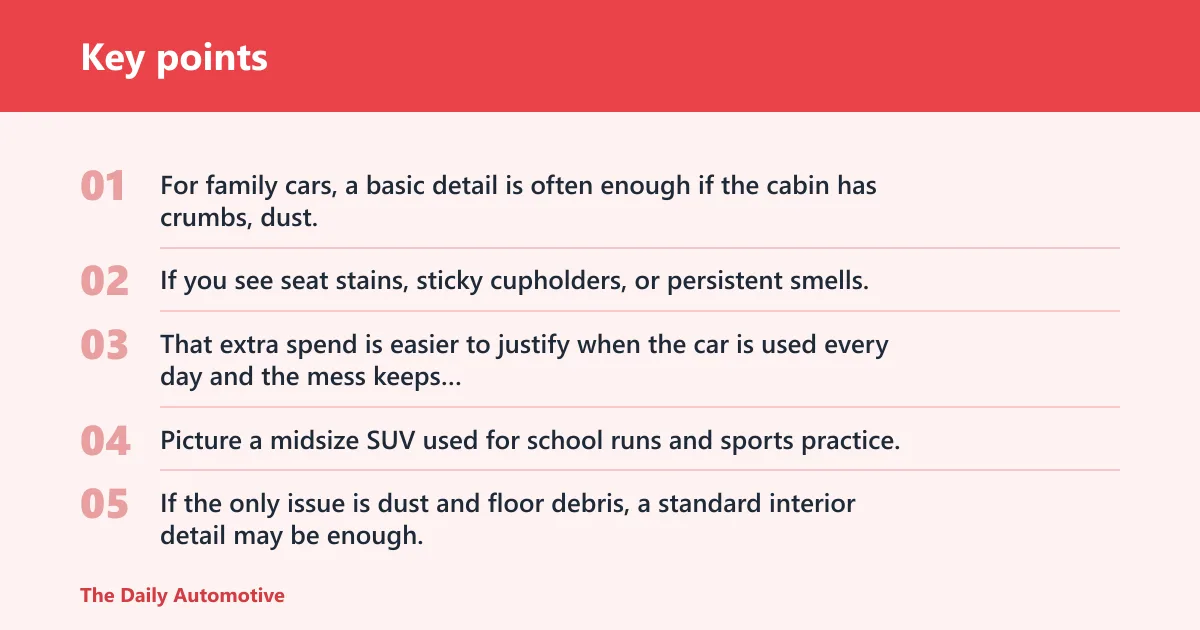
For family cars, a basic detail is often enough if the cabin has crumbs, dust, and light scuffs. If you see seat stains, sticky cupholders, or persistent smells, step up to shampooing or odor treatment. That extra spend is easier to justify when the car is used every day and the mess keeps returning.
Picture a midsize SUV used for school runs and sports practice. If the only issue is dust and floor debris, a standard interior detail may be enough. If there are melted snacks, muddy footprints, and a juice spill under a booster seat, a deeper package makes more sense than the cheapest option.
Rideshare cleanup and lease turn-ins
Rideshare vehicles often need faster turnaround and stronger odor control because the cabin sees more passengers and more wear. Lease turn-ins are different: you may pay more to avoid excess-wear or cleanliness charges. A quote that covers stain extraction and odor treatment can be cheaper than a lease-end penalty.
Resale prep and older interiors
Older interiors can still be worth detailing if the cabin is headed for sale or trade-in. Buyers react quickly to odors, stained seats, cloudy plastics, and worn trim. A clean cabin will not hide every flaw, but it can improve first impressions and help the vehicle present as well cared for.
Is interior detailing worth it?
Yes, if the cabin has visible dirt, odors, stains, or material that could hurt resale or trigger lease charges. Basic cleaning is enough when the interior is lightly dirty and you mainly want a reset. Pay for a deeper service when grime, odor, or pet hair requires more than a quick vacuum and wipe-down.
When basic cleaning is enough
Basic cleaning works when the car only needs dust removal, vacuuming, and a surface wipe-down. That is a sensible choice for a clean sedan, a lightly used commuter car, or a vehicle that gets regular upkeep. You do not need to overpay for extraction or odor treatment if the cabin is already in good shape.
When a deeper service makes sense
A deeper service makes sense when stains have set, the car smells stale, or the seats and carpet need restoration-style attention. If you see pet hair woven into fabric, mold after a water leak, or food spills that have dried into the carpet, a cheaper package may only hide the problem for a short time.
How often to book it
A practical cadence is every 3 to 6 months for daily drivers, sooner for family vehicles, rideshare cars, or anyone with pets. If the car stays clean and lightly used, once or twice a year may be enough. The right interval is the one that keeps buildup from turning into a larger labor bill.
Frequently asked questions
How much does interior car detailing cost?
Most sedans fall between $125 and $300, while SUVs, trucks, and vans often run higher because they take more labor. Heavily soiled cabins, pet hair, stains, and odor work can push the total into the $300 to $450 range or beyond if the interior needs restoration-style cleaning.
What is included in an interior car detailing service?
A typical interior detail includes vacuuming, a surface wipe-down, console and dashboard cleaning, carpet and seat cleaning, stain removal, and odor removal. Many providers also clean door panels, cupholders, vents, and interior glass, but you should confirm those items before booking so you can compare quotes accurately.
Why do interior detailing prices vary so much?
Prices vary because labor time, cabin size, condition, location, and provider type all change the job. A clean sedan in a low-cost area is much easier to detail than a large SUV with pet hair, stains, and odor treatment. The quote should reflect the actual work, not just the vehicle type.
How much should I expect to pay for a full detail?
A full detail that includes interior and exterior work often costs more than an interior-only service, especially if the cabin needs deep cleaning. Many owners see higher totals once shampooing, stain extraction, and odor treatment are added. Ask for an itemized quote so you can see where the money goes.
Do SUVs and trucks cost more to detail than sedans?
Yes, often. SUVs and trucks usually cost more because they have more cabin area, more seat surface, and more crevices to clean. A van can cost even more than an SUV when there is a third row, a large cargo area, or heavy family-use buildup that takes extra time.
How often should I get my car’s interior detailed?
For many daily drivers, every 3 to 6 months is a practical schedule. Cars with children, pets, or rideshare use may need attention more often. If the cabin starts collecting odors, stains, or deep dirt before that point, move the next appointment up rather than waiting for the mess to set.
Products related to this article
Sponsored / affiliate links. As an Amazon Associate I earn from qualifying purchases. I may earn additional commission from eligible campaigns.