How Much Does a Starter Replacement Cost?
Starter replacement usually costs about $300 to $800, and many cars are often quoted around $400 to $600 once parts and labor are included. A bad quote can leave you paying for the wrong fix, or for a starter that was never the problem. This guide shows which costs are normal, which line items are red flags, and how to judge whether the estimate is fair.
Typical cost range
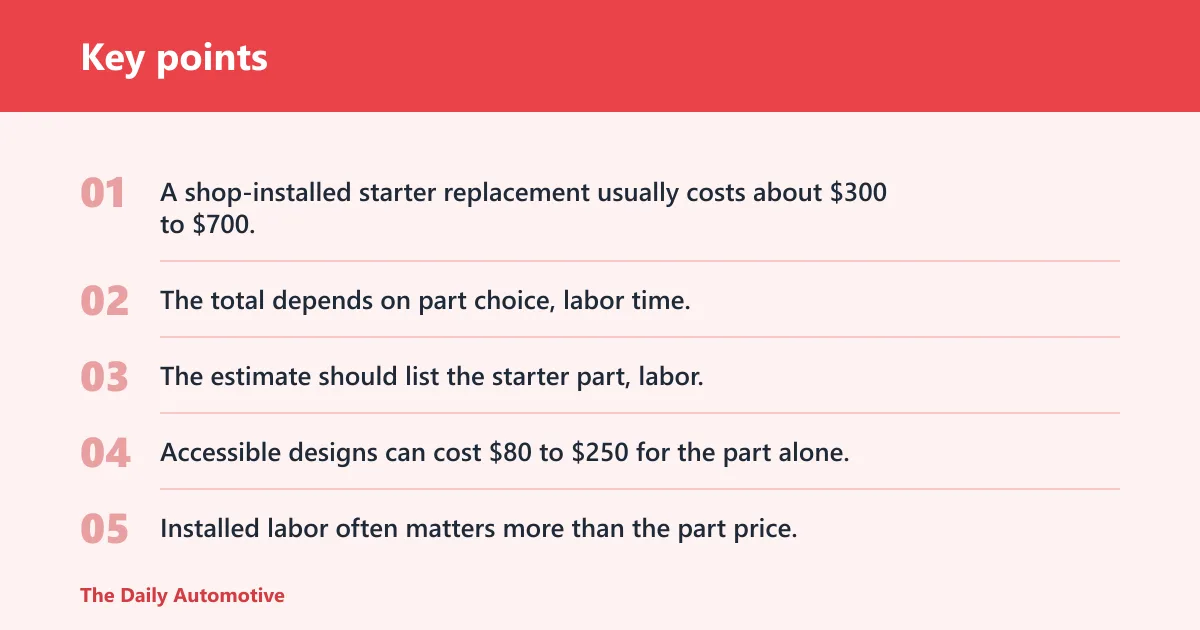


A shop-installed starter replacement usually costs about $300 to $700, and many drivers often see a quote near $400 to $600. The total depends on part choice, labor time, and whether the starter is easy to reach or buried under intake parts or other components.
What the bill usually includes
The estimate should list the starter part, labor, and any diagnostic fee on separate lines. Accessible designs can cost $80 to $250 for the part alone, while the average starter motor often runs $100 to $400 for the part only. Installed labor often matters more than the part price.
If the quote is much higher than expected, check whether the car has a buried starter, whether intake removal is needed, or whether the shop has added related parts such as cables, gaskets, or a remanufactured unit with a core charge.
When a quote looks high
High quotes are not always inflated. A difficult-access layout can push a job from a few hundred dollars to $600 to $1,000+ installed, and difficult-access vehicles can cost $300 to $2,000 installed. The question is whether the labor time matches the access problem.
Say your compact car has a side-mounted starter with open access. A quote near the lower end is normal. Suppose the same symptoms appear on a V6 with the starter under the intake manifold. The part may be similar, but labor and gaskets can double the bill.
Starter quote decoder
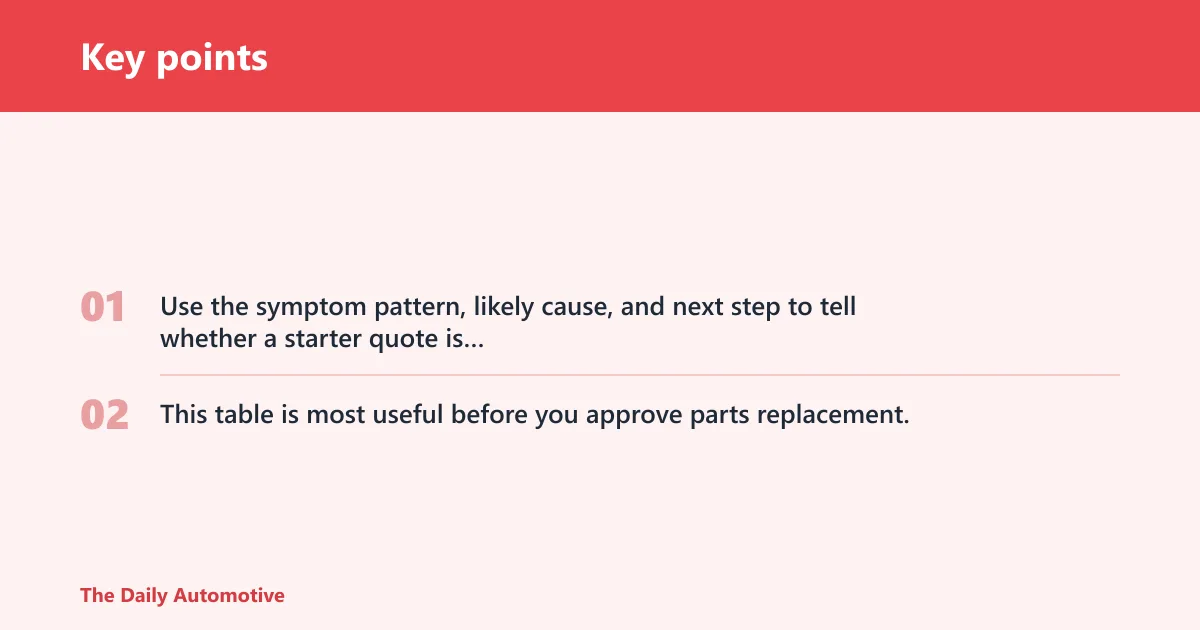
Use the symptom pattern, likely cause, and next step to tell whether a starter quote is normal, inflated, or aimed at the wrong fault. This table is most useful before you approve parts replacement.
| Symptom pattern | Likely cause | Probable cost range | Next best diagnostic step |
|---|---|---|---|
| Rapid clicking | Weak battery or poor connection, not necessarily the starter | Often diagnostic fee only at first | Test battery state and clean terminals before condemning the starter |
| One solid click | Starter solenoid, relay, or a battery that cannot deliver current | Diagnostic fee, then part cost if confirmed | Check battery load and starter command voltage |
| Slow crank | Weak battery, corroded cables, or a worn starter | Varies by fault found | Measure battery voltage drop and inspect cable ends |
| No crank, no lights | Dead battery, open cable, or major power loss | Can stay at diagnostic level if the starter is not the issue | Check battery, main grounds, and fuses first |
| Buried starter access | Packaging drives labor time | $600 to $1,000+ installed is common in harder jobs | Ask whether intake, exhaust, or axle parts must come off |
| OEM vs aftermarket quote spread | Part brand difference, not always a labor difference | OEM usually costs more than aftermarket | Ask for both part numbers and warranty terms |
| Diagnostic fee | Testing billed separately at some shops | May add an hour or so to the total cost | Ask whether the fee is credited to the repair |
| Core charge | Remanufactured or exchange starter pricing | Added deposit that may be refunded after return | Confirm whether the core charge is included or separate |
| Intake-manifold removal | Starter sits under the intake on some engines | Can push the bill into the upper range | Ask which gaskets and fluids are required |
| Battery-terminal corrosion | False-positive starter diagnosis | Cleaning or cable repair may cost far less than a starter | Inspect terminals and grounds before approving replacement |
How much does a starter repair cost?
A true starter repair is less common than a full replacement because modern starters often fail as complete units. If the problem is an internal electrical fault, a bench rebuild, remanufactured exchange, or full replacement may be the practical path. The bill usually depends on whether the part can be repaired or must be swapped.
Repair versus replacement
In plain terms, starter repair means fixing the starter itself. Starter replacement means removing the old unit and installing another one. Starter motor replacement usually means the same thing on most modern cars, because the motor and solenoid are commonly built as one unit.
That design matters for cost. A single bad internal piece can turn into a full assembly replacement, especially when the labor to reach the unit is the expensive part of the job.
What a starter does
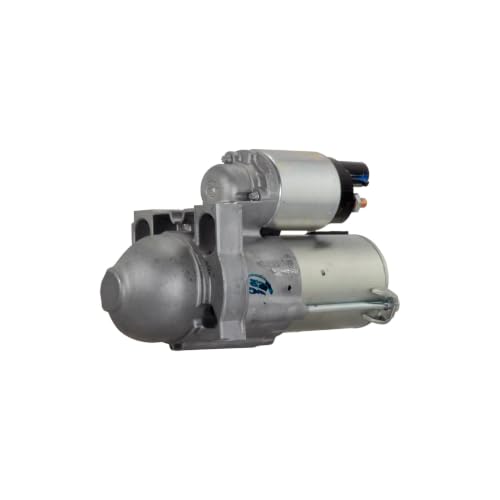
The starter motor cranks the engine so it can begin running on its own. On modern vehicles, the starter motor and solenoid are often one unit, which is why a failed starter is usually replaced as a complete assembly rather than repaired piece by piece.
Why the solenoid matters
The solenoid acts like the starter’s switch and engagement mechanism. If it fails, the driver may hear a click, a weak crank, or nothing at all. Because the motor and solenoid are commonly packaged together, many shops replace the whole unit instead of opening it up.
Why replacement often means a full unit
That single-unit design is common in current vehicles. It simplifies installation, but it also means the part price reflects the entire assembly. A cheaper aftermarket unit can lower the bill, while an OEM unit can raise the total.
Why labor changes the bill
Labor usually separates an average quote from an expensive one. Easy-access starters can take about 30 minutes to 2 hours, while buried starters can take 6 to 8 hours. The labor rate also varies by shop and region, so two identical parts can produce very different installed prices.
Easy-access starters
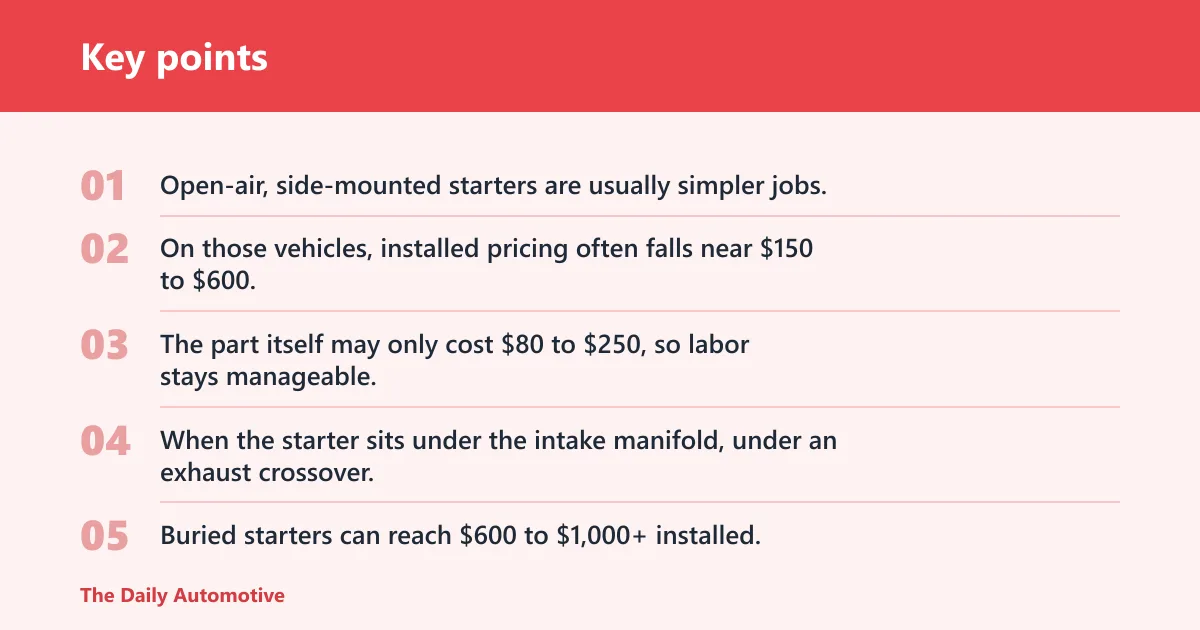
Open-air, side-mounted starters are usually simpler jobs. On those vehicles, installed pricing often falls near $150 to $600, and accessible shop installs are about $300 to $550. The part itself may only cost $80 to $250, so labor stays manageable.
Buried starters
When the starter sits under the intake manifold, under an exhaust crossover, or behind other hardware, the quote climbs quickly. The part may be ordinary; the access is not.
Vehicle class and packaging
Compact cars with open access usually land lower. Trucks may cost more when packaging is tight. Luxury imports and stop-start vehicles often carry a higher parts price and more labor because the starter layout is tighter, the part can be brand-specific, and access can require more disassembly.
Could it be the battery instead?
Yes. A weak battery, corroded terminals, loose cables, a bad relay, an ignition switch fault, or an immobilizer issue can all mimic starter failure. That is why battery and connection checks should come before starter replacement, not after the part is already ordered.
What should be checked first?
Look at battery condition, terminal corrosion, main grounds, and cable tightness. Then verify starter command and relay operation. Some shops bill this testing separately, while others credit the diagnostic fee toward the repair if the starter is replaced there.
- Check battery voltage and load condition.
- Inspect positive and negative terminals for corrosion or looseness.
- Confirm main cables and grounds are secure.
- Test the relay, ignition switch signal, and starter command.
- Only then approve the starter if the fault points there.
A common first-timer mistake is replacing the starter because the engine will not crank, while the real fault is a corroded battery terminal. That can turn a simple cleanup into an unnecessary parts bill.
When diagnostics should come before parts
If the car has no lights, intermittent clicking, or a slow crank after sitting, the battery and cables deserve close attention. Diagnostic testing may add an hour or so to the total cost, but that fee can be cheaper than paying for the wrong part.
Parts choices that change price
Part choice can swing the estimate even when labor stays the same. OEM starters cost more than aftermarket units, remanufactured starters can save money, and warranty or fitment differences can matter as much as the sticker price.
OEM starters
OEM parts usually cost more, but they offer factory fitment and the warranty structure tied to the original equipment channel. They are common on luxury or limited-production vehicles where exact match matters and aftermarket availability may be thinner.
Aftermarket starters
Aftermarket starters usually lower the part cost and can reduce the total repair bill. The tradeoff is that fitment and warranty terms vary by brand, so the cheapest part is not always the best quote if the installer expects a comeback risk.
Remanufactured starters and core charges
Remanufactured starters are a common budget option. They are often priced lower than new parts and may include a core charge, which is a refundable deposit for the old unit. That core charge should be listed clearly so the final bill is not a surprise.
Is a starter replacement worth it?
For an older car, the answer depends on the vehicle’s value, the total repair total, and whether the rest of the car is in decent shape. A starter replacement can still make sense when the car is otherwise sound and the quote reflects access, not inflated pricing.
When repair still makes sense
If the installed price is near the common range and the car has no major transmission, engine, or rust problems, the repair may be worth it. If the quote is high because the starter is buried, compare that labor to the car’s value before deciding.
When to slow down
If the estimate includes intake removal, new gaskets, cable replacement, or a remanufactured unit with a core charge, ask for an itemized breakdown. That helps separate a fair hard-access job from a padded estimate. Multiple quotes are worth it when labor hours differ by a lot.
Picture a mid-size truck with a starter under the intake and a cracked battery terminal on top of it. The starter quote may look high, but a large part of that number can be real labor and related cable work rather than markup.
Frequently asked questions
How much should a starter replacement cost?
Easy-access jobs can stay lower, while buried starters, luxury imports, and vehicles needing intake removal can move well above that range.
How much does a car starter replacement cost?
Car starter replacement cost depends on access more than part price.
How much does it cost to get a starter replaced?
To get a starter replaced, expect parts, labor, and possibly diagnostics on the invoice. A shop may charge separately for testing, then apply that fee to the repair. Ask for an itemized quote so you can compare labor hours and part brand.
How much does a starter motor replacement cost?
A starter motor replacement cost is usually the same thing as starter replacement on modern cars, since the motor and solenoid are often one unit. That means the bill is driven by labor access, brand choice, and any related work more than by the motor alone.
How do I know if it’s the starter or the battery?
Start with the battery, terminals, and cables. Rapid clicking, slow cranking, or no-crank symptoms can come from a weak battery or corrosion. A proper test should also check the relay and starter command before anyone orders a replacement starter.
Products related to this article
Sponsored / affiliate links. As an Amazon Associate I earn from qualifying purchases. I may earn additional commission from eligible campaigns.