OBD2 Scanner vs Mechanic Diagnostics
Buy an OBD2 scanner for check-engine lights and simple fault codes. Pay for mechanic diagnostics when the problem needs live data, smoke testing, pressure checks, or circuit testing. Guessing burns parts money and can leave the car broken. This guide shows what each tool can confirm, what it cannot, and when shop labor is the cheaper move.
| Decision factor | OBD2 Scanner | Mechanic Diagnostics | Winner |
|---|---|---|---|
| Upfront cost | Low entry cost for a basic code reader or Bluetooth dongle | Pay-per-visit labor, often higher than a simple tool purchase | OBD2 Scanner |
| Depth of diagnosis | Reads and clears DTCs, with live data on some models | Live data, reset functions, bidirectional tests, and physical inspection | Mechanic Diagnostics |
| System coverage | Often engine-focused; system access depends on model and vehicle support | Can cover engine, ABS, airbag, transmission, service functions, and more | Mechanic Diagnostics |
| Best fit for quick checks | Good for confirming a fault code fast | Better when the code is only the starting point | OBD2 Scanner |
Key factors: cost, depth, and system coverage
Use an OBD2 scanner when you need to confirm a fault code quickly. Use mechanic diagnostics when the code is only a clue and the real question is which part, circuit, or system failed. The line is simple: code reading is fast; diagnosis proves the cause.
Upfront cost
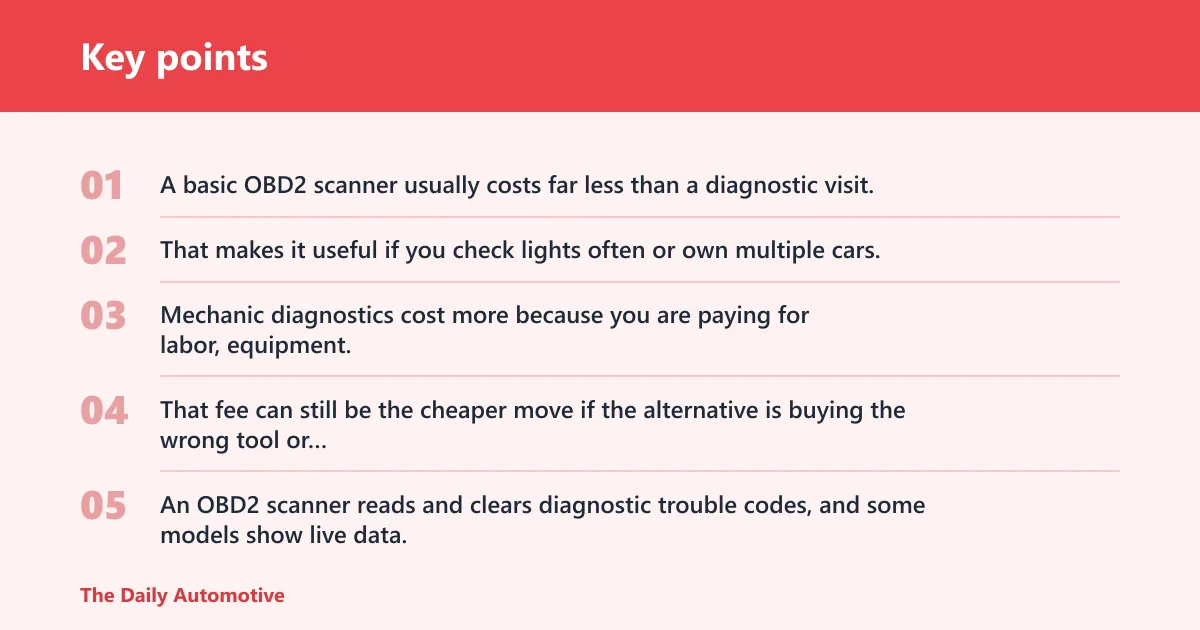
A basic OBD2 scanner usually costs far less than a diagnostic visit. That makes it useful if you check lights often or own multiple cars, especially when the issue is simple enough to verify with code reading and live data.
Mechanic diagnostics cost more because you are paying for labor, equipment, and interpretation. That fee can still be the cheaper move if the alternative is buying the wrong tool or replacing parts without proof.
Depth of diagnosis
An OBD2 scanner reads and clears diagnostic trouble codes, and some models show live data. That is enough to point you toward a sensor, a misfire count, or a fuel-trim clue, but it does not prove the failed part by itself.
Mechanic diagnostics add physical testing, system checks, and confirmatory steps. A shop can compare live data with wiring checks, pressure tests, smoke tests, and bi-directional commands before parts are replaced.
System coverage
Basic readers often focus on engine codes through the OBD2 port. Better handheld tools and professional scan tools can reach more systems, but coverage still depends on the vehicle and the tool.
Professional scan tools may access ABS, airbag, transmission, oil reset, DPF, parking brake, ECU coding, and active tests. That wider reach matters when the warning light is not the check engine lamp.
What mechanics add beyond the scan
Mechanic diagnostics combine scan results with hands-on checks. That matters because a stored code can be caused by a wiring fault, vacuum leak, weak battery, low fuel pressure, or failed module communication.
In other words, the scanner gives the clue. The shop proves the cause.
How OBD2 scanners and mechanic tools differ
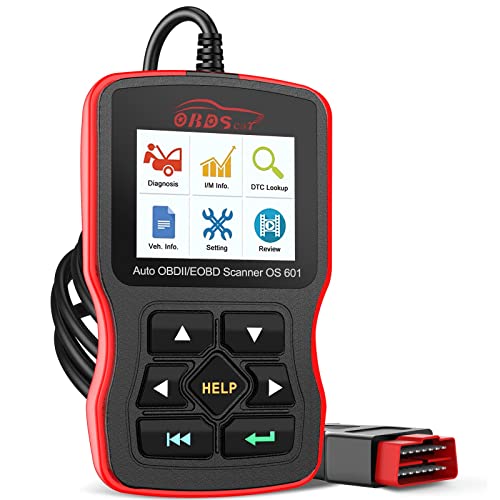
OBD2 scanners, Bluetooth adapters, and professional scan tools all plug into the car, but they do different jobs. A basic reader tells you what the computer stored; a shop tool can go deeper into multiple systems and command components on and off for testing.
Basic code readers
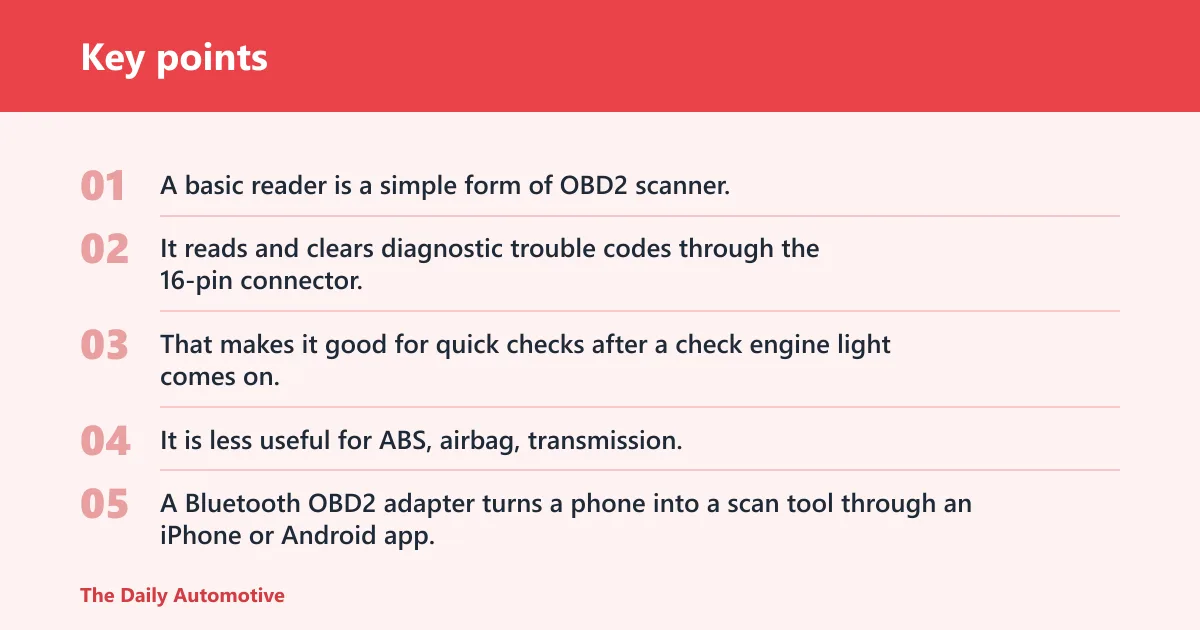
A basic reader is a simple form of OBD2 scanner. It reads and clears diagnostic trouble codes through the 16-pin connector, which is often under the steering wheel or driver-side dashboard, and many units also draw power from that port.
That makes it good for quick checks after a check engine light comes on. It is less useful for ABS, airbag, transmission, or electrical faults that need more than code reading.
Bluetooth OBD2 adapters
A Bluetooth OBD2 adapter turns a phone into a scan tool through an iPhone or Android app. This setup is often sold as an entry-level option and can be convenient for live data, code reading, and clearing simple faults.
The tradeoff is limits. App support, vehicle compatibility, and system access vary, and a phone-based tool is usually weaker than a dedicated handheld or professional scan tool for deeper work.
Professional scan tools
Professional scan tools are built for broader system access. They may support all-system diagnostics, reset functions, bidirectional coding, and active tests that a basic reader cannot run.
That is why mechanics rely on them. They can confirm whether a command reaches a component, whether the module responds, and whether the fault is electrical, mechanical, or software-related.
What a scan can and cannot prove
Diagnostic trouble codes are stored by the vehicle computer when a fault is detected. They may be stored, pending, or permanent, and they still need interpretation because a code is not always the failed part.
Live data and freeze-frame data help, but they are still clues. They narrow the search; they do not replace physical testing when the symptom is intermittent or system-specific.
What an OBD2 scanner can tell you
An OBD2 scanner can confirm that the computer saw a fault, show the code, and sometimes display live data from sensors and systems. That is enough for many check engine lights, but not enough to confirm every cause behind the code.
DTCs, pending codes, and permanent codes
OBD2 scanners read diagnostic trouble codes through the OBD2 port. Depending on the fault, the code may be stored, pending, or permanent, and each type gives a different level of certainty about the problem.
A pending code can mean the fault happened but has not repeated enough to set the lamp. A permanent code can remain after the issue seems gone, so clearing the light is not the same as fixing the car.
Live data and freeze-frame data
Some OBD2 scanners can show real-time data streaming. That lets you watch sensor values, fuel trims, coolant temperature, or misfire counts while the engine runs.
Freeze-frame data shows the conditions the computer saw when the fault set. That context is valuable, but it still does not tell you whether the root cause is wiring, vacuum, fuel, or a failed component.
What a basic reader cannot confirm
A basic reader cannot confirm every system fault, especially on cars with deeper coverage gaps. It also cannot prove an intermittent no-start, battery drain, or communication issue without further testing.
That is where misdiagnosis starts. A code can point at an oxygen sensor, for example, while the real problem is a vacuum leak or wiring issue upstream.
Can all cars use an OBD2 scanner?
No. In the U.S., OBD2 became mandatory in 1996 for cars and light trucks, but older vehicles may use OBD1, which was manufacturer-specific. Even on newer vehicles, a generic tool may not support every system, protocol, or special function.
OBD1 vs OBD2
OBD1 was manufacturer-specific. OBD2 uses a standardized connector and protocol set, which is why most modern scanners can read basic engine codes across many brands.
That said, the presence of a connector does not guarantee full support. Older cars may have a port shape or adapter access without generic OBD2 coverage that a reader can use meaningfully.
Connector location and power
The OBD2 connector is a standardized 16-pin port, often under the steering wheel or driver-side dashboard. Many scan tools power up through that port, so the car itself may power the reader during a quick check.
Modern vehicles may use OBD2 requests through the connector near the steering wheel, which makes access easy. But location is not the same as full compatibility.
CAN bus and protocol support?
ISO 15765, also called CAN bus in this context, is the OBD2 protocol used in most vehicles today. That protocol support matters because a scanner that cannot speak the right language may not talk to the car correctly. (Motortrend)
Compatibility depends on vehicle year, protocol, and system coverage. If the scanner does not support the car’s communication method, it may read nothing even though the port is present.
When a mechanic visit is the better move
Pay for mechanic diagnostics when the fault is intermittent, electrical, or tied to a system that needs more than code reading. If the issue could be wiring, pressure, vacuum, module communication, or a safety system, the shop’s labor is often cheaper than buying the wrong parts.
Intermittent no-start and battery drain
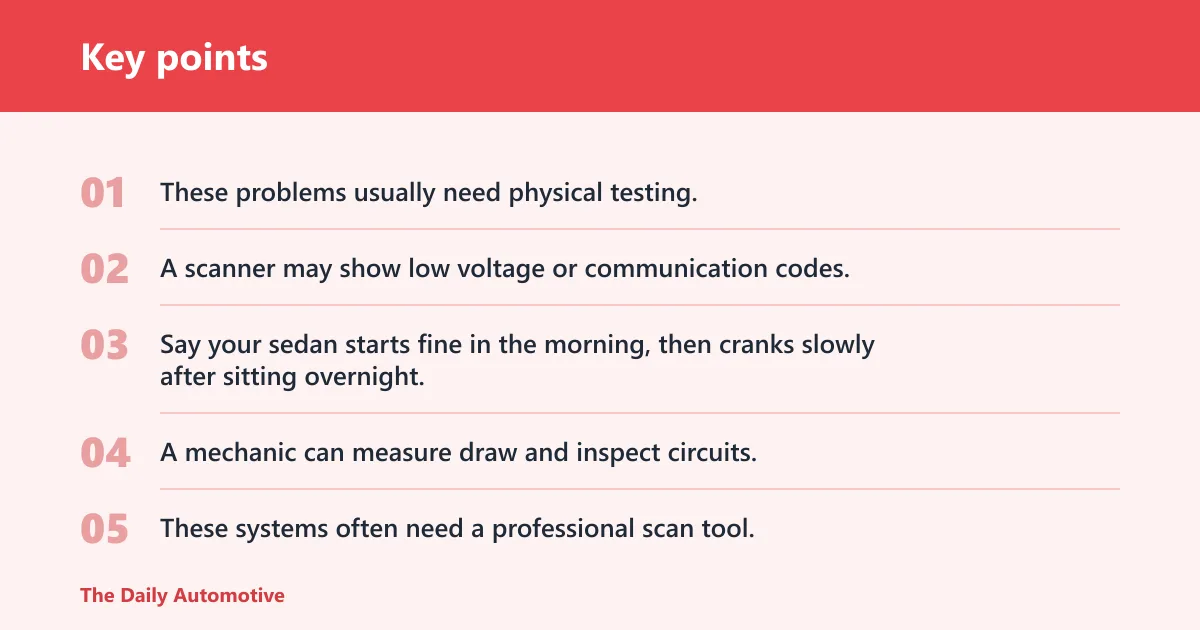
These problems usually need physical testing. A scanner may show low voltage or communication codes, but it cannot trace parasitic draw, bad grounds, or a failing relay on its own.
Say your sedan starts fine in the morning, then cranks slowly after sitting overnight. A mechanic can measure draw and inspect circuits; a basic reader may only show the symptoms after the battery is already weak.
ABS, airbag, and transmission faults
These systems often need a professional scan tool. A basic engine-code reader may not access ABS, airbag, or transmission data, and some faults in those systems may never turn on the check engine light.
If the warning light is for safety systems, a deeper scan is usually the right first step. That is especially true when the issue could affect braking, restraint, or drivability.
Misfires and EVAP leaks that need confirmation
Some misfires and EVAP faults are simple. Others need live data, smoke testing, or coil and injector checks before the part is replaced. A code is a clue, not a verdict.
Suppose the car logs a P0302 misfire code and shakes only at idle. The scanner can point to cylinder 2, but the shop still has to confirm spark, fuel, air, and compression before naming the failed part.
When labor is cheaper than buying the wrong tool
If the problem is a one-off repair, paying for diagnostics is often the better economics. A scanner purchase makes more sense when you will use it again, such as on an older car that triggers occasional faults or a household with multiple vehicles.
If the vehicle needs a single deep diagnosis, shop labor can cost less than buying a tool that still will not reach the needed system.
OBD2 scanner decision matrix
This matrix shows the decision line in common fault cases. The basic scanner column tells you what you can confirm quickly; the mechanic column shows what deeper diagnosis adds; the next step column points to the likely cost tier.
| Fault scenario | What a basic OBD2 scanner can tell you | What mechanic diagnostics add | Likely next step / cost tier |
|---|---|---|---|
| Check engine light | Reads the DTC and may show live data or freeze-frame | Confirms whether the code points to the true cause | Start with a scanner; shop only if the code is unclear or returns |
| Misfire | Shows misfire-related codes and counters on some models | Checks coils, plugs, fuel delivery, vacuum leaks, and compression | Scanner first, then shop if the misfire is repeat or cylinder-specific |
| EVAP leak | Can point to an EVAP code and pending status | Uses smoke testing and cap, valve, and hose checks | Shop diagnosis is often the cheaper path |
| ABS light | May not access ABS data on a basic reader | Reads ABS module data and tests wheel-speed signals | Mechanic diagnostics |
| Airbag light | Usually limited or no useful access on basic tools | Reads restraint codes and checks clockspring, sensors, and wiring | Mechanic diagnostics |
| Intermittent no-start | May show no helpful code at all | Tests spark, fuel, cranking voltage, relays, grounds, and communication | Mechanic diagnostics |
| Battery drain | Often only shows low-voltage side effects | Measures parasitic draw and isolates the offending circuit | Mechanic diagnostics |
| Transmission issue | May read a stored code if the transmission is OBD2-accessible | Checks solenoids, fluid condition, module data, and commanded response | Shop visit if the symptom affects shifting or safety |
Choose OBD2 Scanner if… / Choose Mechanic Diagnostics if…
Choose OBD2 Scanner if you mainly want to read check engine lights, clear codes after a verified repair, or check a car you work on often. It also makes sense if your vehicle is newer, your faults are usually simple, and you want live data without paying for a full visit every time.
Choose Mechanic Diagnostics if the symptom is intermittent, the warning light is for ABS or airbag, or the car needs circuit, pressure, smoke, or compression testing. It is also the better move when the code is only the first clue and the repair decision depends on proof.
- Check the warning light and symptom type.
- Read the code and note whether it is stored, pending, or permanent.
- Match the problem to the tool level needed.
- Buy a reader only if the fault is simple and repeatable.
- Book a shop if the repair needs physical testing or deeper system access.


Frequently asked questions
Obd vs obd2 scanner
An OBD2 scanner is the modern choice for 1996-and-newer U.S. cars and light trucks. OBD1 was manufacturer-specific, so older vehicles may not work with a generic reader. If you own a newer car, OBD2 is the right baseline; if you own an older one, check the vehicle’s actual diagnostic system first.
Fixd vs obd2 scanner
FIXD is one example of a Bluetooth OBD2 adapter style tool, while “OBD2 scanner” is the broader category. The phone-based route can be handy for code reading and live data, but it may be limited versus a dedicated handheld or professional scan tool for deeper system access.
Are all obd2 scanners the same?
No. Some are basic code readers, some connect by Bluetooth or Wi-Fi to a smartphone, and some are professional scan tools. They differ in system coverage, live data access, reset functions, and whether they can do bidirectional tests or coding.
Obd2 scanner vs reader
A reader is usually the simplest kind of OBD2 scanner, built mainly to read and clear DTCs. A fuller scan tool may show more live data and more system access. If you only need to confirm a check engine code, a reader can be enough; for deeper faults, you need more tool depth.
Do obd2 scanners work on all cars?
No. In the U.S., the cutoff is 1996 for cars and light trucks, but older vehicles may use OBD1. Even on OBD2 cars, support varies by year, protocol, and system, so a scanner can work for basic engine codes yet still miss other modules.
Are obd2 scanners compatible with all cars?
They are not universally compatible. The 16-pin connector is standardized, but the protocol and module coverage still matter. ISO 15765, used in most vehicles today, is common, yet the right scanner still needs to match the car’s year and diagnostic support.
How to use the obd 2 scanner
Plug it into the 16-pin OBD2 connector, usually under the steering wheel or driver-side dashboard, then turn the ignition on as the scanner instructs. Read the stored codes, check freeze-frame or live data if available, and avoid replacing parts until you verify what the code actually points to.
Are obd2 scanners worth it?
Yes, if you check lights more than once or own a car long enough to face repeat faults. They can save money by avoiding diagnostic fees, but only when the problem is simple enough for code reading. For intermittent, electrical, or system-specific faults, a shop visit is often the better spend.
Products related to this article
Sponsored / affiliate links. As an Amazon Associate I earn from qualifying purchases. I may earn additional commission from eligible campaigns.