How to Charge a Car Battery: Safe Steps, Amps and Hours
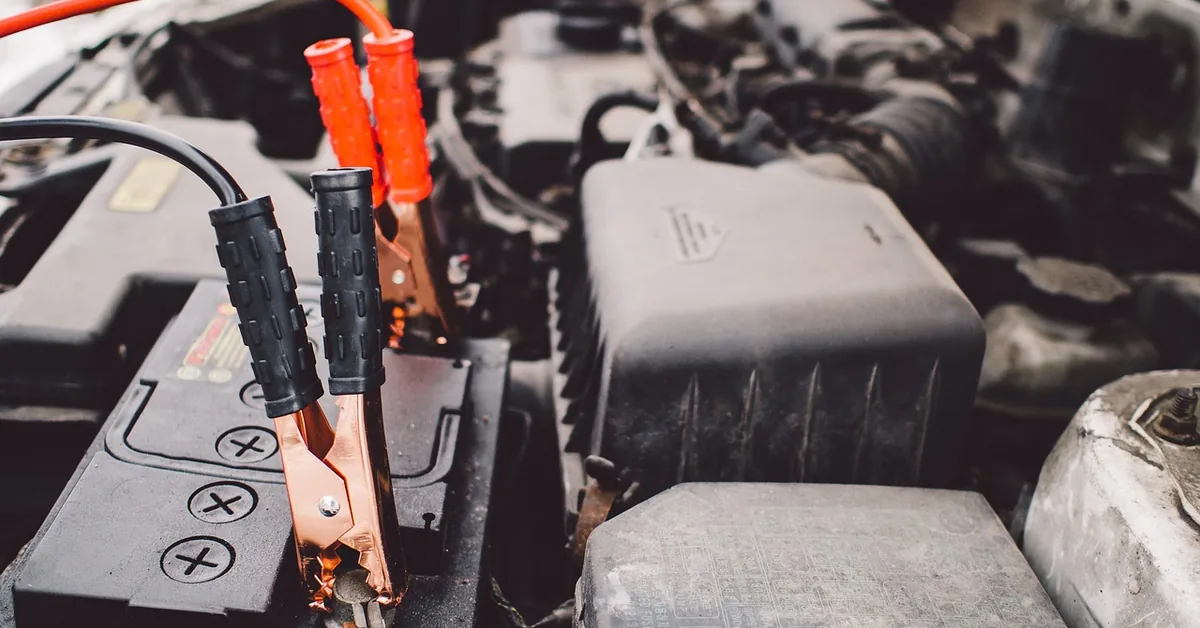
To charge a car battery, read the label to confirm the chemistry (flooded, AGM or lithium), pick a charger mode that matches, clamp the red lead to the positive terminal, clamp the black lead to the negative terminal or bare metal as your manuals allow, and plug the charger into the wall last. At 5 amps, a half-empty 50 Ah battery needs roughly 6 hours by our arithmetic; the table below shows the other amp settings. This guide covers the connection order, the safety limits, and the cases where you should not charge the battery at all.
Quick Answer
Charge in a ventilated space with no sparks or flames nearby. Connect red to positive, then black to the negative terminal or clean chassis metal, then plug in the charger. Use the AGM or lithium mode if your battery is one of those, and unplug the charger before you remove the clamps. Hours needed is roughly the amp-hours to refill, divided by charger amps, plus about 25 percent. Check your owner’s manual first, because it overrides this article.
What You Need to Charge a Car Battery
| Best Garage Battery Charger Pick | |
 |
Battery Tender 5 Amp 12V Battery Charger and Maintainer
|
| View Our Pick on Amazon | |
As an Amazon Associate we earn from qualifying purchases. This is a spec-based pick from the product listing, not a hands-on test.
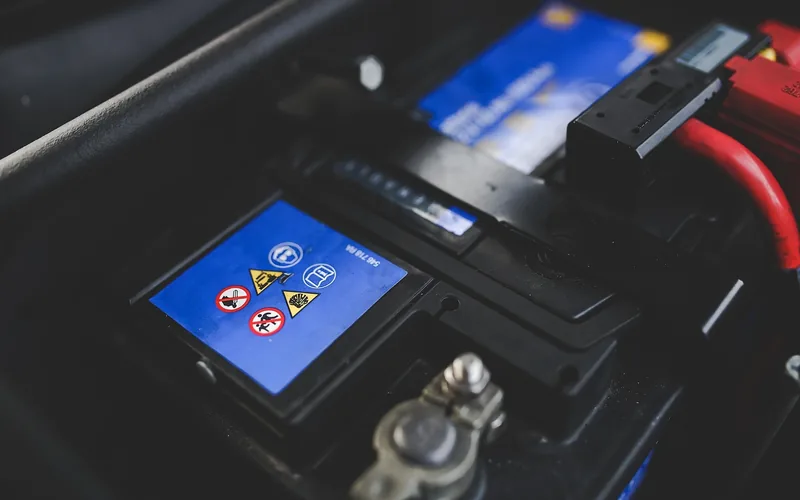
You need three things: a charger that matches the battery chemistry, a ventilated place to work, and eye and hand protection. The label on the battery tells you the voltage and usually the type. NOCO’s manual for its Genius G3500 charger says to determine the voltage and chemistry of the battery from the battery owner’s manual before charging, and to read the battery maker’s own precautions and recommended charge rates. That is the single most skipped step.
- Charger: a 12V charger with a mode that matches your battery. See the charger types table below.
- Protection: safety glasses and gloves. Lead-acid batteries contain sulfuric acid.
- Place: an open garage door or outdoors. Per the Exide safety data sheet, batteries release hydrogen and should always be treated as containing it, and a spark or flame can ignite it.
- Paperwork: your vehicle owner’s manual, because some cars name specific charging points under the hood.
Why Ventilation and Sparks Matter
A charging lead-acid battery gives off hydrogen. Canada’s occupational safety agency CCOHS (battery charging guidance) lists the explosive limits of hydrogen as 4.1 to 72 percent in air, and tells workers to keep batteries away from heat, flames and sparks, including welding and burning cigarettes. That is why the order of the steps below is written to keep the last connection, and the first disconnection, away from the battery itself.
How to Charge a Car Battery Step by Step
These steps follow the connection sequence in the NOCO Genius G3500 user guide for a negative-ground vehicle, which covers nearly all modern cars. If your owner’s manual or charger manual says something different, follow those instead.
- Turn everything off. Switch off the ignition, lights and accessories. Kia’s owner’s manual says to turn off all accessories and stop the vehicle before charging.
- Keep the charger unplugged. NOCO says not to connect the AC power plug until all other connections are made.
- Find the terminals. Positive is typically marked POS, P or +, and negative is typically marked NEG, N or -.
- Red clamp to positive. Make sure the clamp is biting metal, not corrosion. If the terminal is crusty, see our guide to car battery corrosion before you clamp on.
- Black clamp to negative. NOCO’s guide allows the negative battery terminal or the vehicle chassis, and warns against connecting to a carburetor, fuel lines or thin sheet metal parts. Where your car has marked jump posts, use those if the manual says so.
- Select the mode. Pick the setting that matches your chemistry and temperature (see the AGM and lithium section).
- Plug in last. NOCO adds that you should not face the battery when making this connection.
- To finish, reverse the order. Unplug the charger, take off the negative clamp, then the positive clamp.
One disagreement is worth knowing about. Many guides, including an earlier version of this page, say the black clamp must never touch the negative terminal. The maker manuals we read do not say that. NOCO accepts either the terminal or the chassis, and Kia’s manual lists the front jumper posts or the battery itself as charging points. Clean chassis metal away from the battery is a common precaution against a spark near the vent gases, but it is a convention rather than a rule from the manuals we read. Follow your own manual.
How Long Does It Take to Charge a Car Battery?
Time depends on how many amp-hours (Ah) the battery has lost and how many amps the charger delivers. The table is our own arithmetic for a 50 Ah battery, assuming about 80 percent of the charger current ends up stored. Real smart chargers slow down near full, so treat each figure as a minimum. Your battery label shows its actual capacity, so scale the numbers up or down in proportion.
| Charger current | Half empty (25 Ah to refill) | Nearly flat (50 Ah to refill) | Typical use |
|---|---|---|---|
| 1.25 A (maintainer) | 25 hours | 50 hours | Storage and top-ups only |
| 2 A | 16 hours | 31 hours | Overnight, slow and gentle |
| 4 A | 8 hours | 16 hours | Small chargers, small batteries |
| 5 A | 6 hours | 13 hours | Typical garage smart charger |
| 10 A | 3 hours | 6 hours | Faster, check the battery maker allows it |
The sums are simple: hours = amp-hours to refill, divided by amps, divided by 0.8. A 50 Ah battery that is half empty needs 25 Ah, so at 5 A that is 25 / 5 / 0.8, or about 6 hours. For a deeper look at picking an amp setting, see our guide on what amp to charge a car battery.
One trap in the numbers: sulfation can raise the open-circuit voltage of a weak battery so it looks full while delivering little capacity, according to the NOCO manual. A charger that says full and a car that still cranks slowly means the battery has lost capacity, not that it needs more hours. Our car battery health guide explains how to tell the difference.
Which Charger Do You Need? Smart, Trickle, Maintainer or Jump Starter
The words are used loosely. NOCO’s own Genius listings call the same smart charger a battery charger, a trickle charger and a maintainer. What matters is what the unit does, and what its manual says about leaving it connected.
| Type | What it does | Leave it connected? | Caution |
|---|---|---|---|
| Smart (multi-stage) charger | Charges in stages, then holds the battery on float. NOCO describes an 8-step process on its G3500 | NOCO says that model can stay connected indefinitely without overcharging | Match the mode to the chemistry |
| Maintainer (float charger) | Low current, around 1 to 2 amps, to hold a stored battery full | Yes, that is its job, per the Battery Tender listing | Too slow to revive a flat battery |
| Charger with no automatic shutoff | Keeps pushing current until you stop it | No. Watch the clock and the case temperature | Check the manual for a time limit |
| Jump starter | Delivers a burst to start the engine | Not applicable | It starts the car but does not recharge the battery. See our charger versus jump starter comparison |
If you do not yet own a charger, our best car battery chargers roundup compares options. Our overnight charging article covers unattended use.

Charging AGM, Start-Stop and Lithium Batteries
Chemistry decides the charger setting. Three cases come up most often.
- AGM (including most start-stop cars): Kia’s owner’s manual says to use only fully automatic chargers specially developed for AGM batteries. NOCO’s G3500 gives a COLD/AGM mode at 14.8 V versus 14.5 V in its normal mode, and recommends the COLD/AGM mode for AGM batteries or for temperatures below 50 F (10 C).
- Flooded, gel, EFB and maintenance-free: NOCO lists these under its normal 12V mode, so a basic automatic charger is usually fine.
- Lithium (LiFePO4) starter batteries: use a lithium mode only. NOCO warns that lithium batteries are built in different ways, that some may not have a battery management system, and to ask the battery maker for recommended charge rates and voltages before charging.
NOCO’s G3500 also lists an ambient operating range of 0 C to 40 C, so a frozen garage in January is a charger limit as well as a battery one.
Charging a Car Battery in the Vehicle
Both approaches appear in maker manuals. Kia’s manual advises removing the battery and charging it in a well-ventilated area, or connecting a fully automatic regulated charger to the engine compartment jumper posts. NOCO’s guide connects clamps to the battery terminal or chassis. The practical rule is to read your car’s manual: on cars with stop-start or battery-monitoring systems, it may name the exact points. If the manual says to disconnect the battery before using a repair or recovery mode, do so. NOCO says to disconnect the battery before using its 12V Repair mode, because some electronics are sensitive to the higher charging voltage.
Driving is not a substitute for a charger on a flat battery. Kia’s manual, as one example, says a discharged battery needs at least 60 minutes of driving or idling, and a charger is the alternative. For disconnect order on a car without a charger, see which battery terminal to disconnect first.
How to Charge a Dead Car Battery
Many smart chargers will not start on a deeply discharged battery. NOCO lists 2 V as the low-voltage detection threshold for its G3500 in 12V mode. If your charger refuses to start, look in its manual for a repair or recovery mode. NOCO says its 12V Repair mode can take up to four hours, uses a high charging voltage, and cannot recover every battery.
Do not improvise by wiring a second battery in parallel with the dead one to wake the charger. The manuals we read do not suggest it, and connecting two batteries with a charger attached adds spark and short-circuit risk. If the charger will not recognise the battery after the manual’s recovery steps, the battery is likely finished.
When Not to Charge a Car Battery
- The case is cracked, bulging or leaking. Stop and replace it, wearing gloves and eye protection.
- You smell rotten eggs or see the case getting hot or swelling while it charges. Unplug the charger and let it cool.
- You are in a closed room, near a pilot light, welding, or anywhere a spark could occur.
- The battery is lithium and you do not know whether it has a management system. Ask the maker first.
- The terminals are heavily corroded. Clean them before clamping on, or the charger may not make good contact.
- You have a hybrid or EV. Use only the 12V procedure in your owner’s manual and never touch the orange high-voltage cables.
When in doubt, stop and ask a professional. A shop can load-test the battery and charge it safely.
Frequently Asked Questions
What is the proper way to charge a car battery?
Turn everything off, keep the charger unplugged, connect red to positive and black to the negative terminal or clean chassis metal as your manual allows, select the mode for your battery type, then plug in the charger. To finish, unplug first, then remove negative, then positive.
Can I charge a car battery without removing it?
Often yes, but follow your manual. NOCO’s charger guide connects to the battery terminal or chassis, while Kia’s manual says to remove the battery or use the front jumper posts. Keep the area ventilated and the ignition and accessories off.
How long does it take to charge a car battery at 10 amps?
By our arithmetic, a 50 Ah battery that is half empty needs about 3 hours at 10 amps, and a nearly flat one about 6 hours. Real times are longer because smart chargers taper off near full.
Is it safe to leave a battery charger on overnight?
With a smart charger or maintainer, usually yes. NOCO says its G3500 can stay connected indefinitely without overcharging. A charger with no automatic shutoff should not be left unattended.
Does driving recharge a dead car battery?
Partly. Kia’s manual says a discharged battery needs at least 60 minutes of driving or idling, and a charger is the alternative. Short trips may not restore a flat battery.
Conclusion
Charging a car battery safely comes down to ventilation, the right mode for the chemistry, the right order for the clamps, and stopping when something looks wrong. Use the hours table to plan the time, and let the manuals for your car and charger overrule any general guide, including this one.
Products related to this article
Sponsored / affiliate links. As an Amazon Associate I earn from qualifying purchases. I may earn additional commission from eligible campaigns.