How to Defog Car Windows Fast Using AC and Heat
Turn on the front defroster, set the fan to high, choose warm air, and switch AC on; if the glass is fogged inside, this often clears it fastest in roughly the first 30 seconds. Ignore it, and visibility can shrink to only a few feet, leaving lane lines, signs, and pedestrians hard to read. This guide gives the exact AC-and-heat sequence for three common winter fog cases, plus what to check if the windows still fog up.
This guide is part of our Winter Car Care: The Complete Cold-Weather Guide series.
Fast defogging sequence
The fastest fix is front defrost with AC on, fresh air selected, and strong airflow aimed at the windshield. Consumer Reports says defrost mode will often engage AC and a high fan speed, while the system warms and dries the air as it blows toward the glass. That is the core move for the first half minute. (Consumerreports)
First 30 seconds
- Press front defrost.
- Turn AC on.
- Switch to fresh-air mode, not recirculation.
- Set the fan to high.
- Set the temperature to warm, then adjust toward comfortable warmth if needed.
That sequence removes moisture from the cabin and raises the glass temperature at the same time. The same source recommends fresh-air mode, and it warns that recirculation will make the fog condition worse. Once the windshield clears, you can turn the fan down and trim the heat to stay comfortable.
Say your windshield is hazy after a cold start and the cabin feels damp from wet coats. Defrost, AC, fresh air, and high fan usually help first because the air over the glass is warmer and drier. If the fog thins quickly, keep the setting in place for another minute before changing anything.
Why windows fog up inside
Fog forms when moist cabin air meets cold glass and turns to water. That is why the inside of the windshield often clouds first in winter: the glass is cold, the cabin air is warm and humid, and the moisture lands on the coolest surface. The result is windshield condensation, not outside weather on the glass.
Why passengers and wet mats make it worse
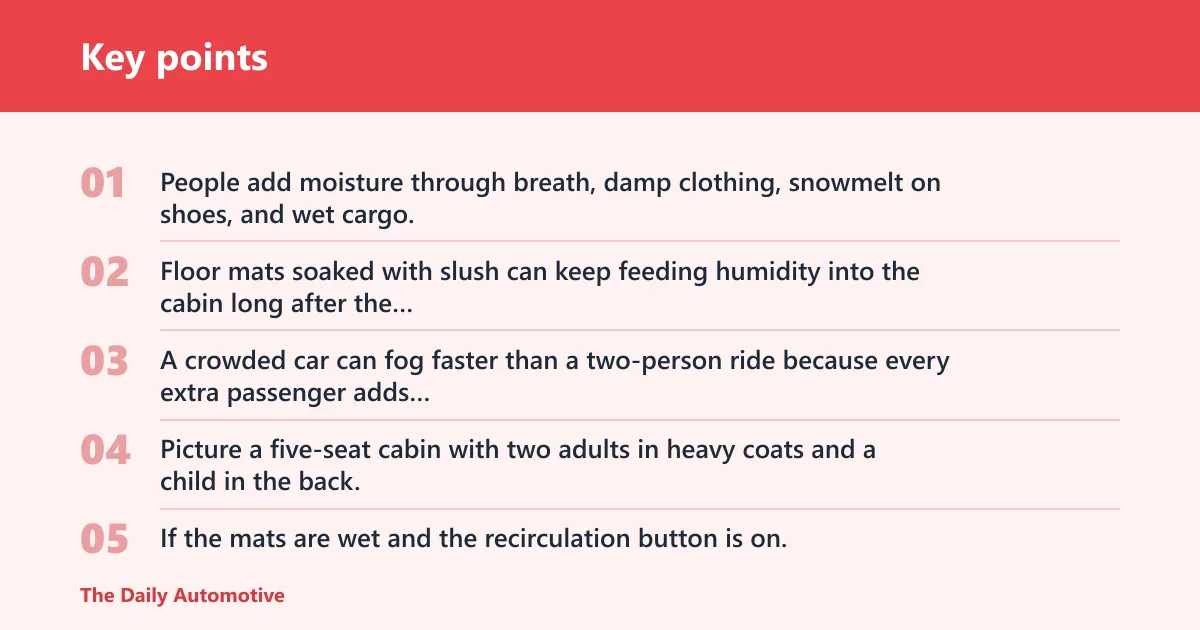
People add moisture through breath, damp clothing, snowmelt on shoes, and wet cargo. Floor mats soaked with slush can keep feeding humidity into the cabin long after the doors close. A crowded car can fog faster than a two-person ride because every extra passenger adds more moist air.
Picture a five-seat cabin with two adults in heavy coats and a child in the back, all coming in from snow. If the mats are wet and the recirculation button is on, the fog can return within seconds after you wipe it away. Fresh air and heat usually work better than trying to trap that moisture inside.
Why winter can fog the windshield and freeze the outside at the same time
Winter can create a split situation: the inside of the windshield fogs while the outside stays icy or frosty. That means the cabin air needs drying, but the glass also needs warming. Defrost mode helps because it directs air to the windshield and often engages AC automatically while the fan runs high.
How AC and heat work together
AC helps in winter because it removes moisture from the cabin air. Warm air alone can speed clearing by raising the glass temperature, but dry air clears condensation faster. Used together, AC and heat make the windshield less likely to stay below the dew point inside the car.
What AC does to cabin humidity
Air conditioning removes water from the air, even in cold weather. That is why it helps with fogged glass when the complaint is inside condensation, not frozen spray outside. If the system is on defrost, the AC may already be running; if not, turn it on manually.
When heat helps more than cold air
Heat matters when the windshield itself is cold-soaked. Warm air raises the glass temperature, which helps stop new condensation from forming. Max heat is not always necessary. Comfortable warmth is usually enough if the fan is high and AC is drying the air already moving across the glass.
Why defrost mode usually sends air to the glass first
Defrost mode directs air at the windshield, often with AC and high fan speed engaged. That is why it is the first button to press when visibility drops. It does the most important job first: clear the main forward view.
Which setting should you use?
Use fresh air for fast clearing, recirculation only for limited situations after the glass is clear, and a slightly opened window when the cabin is crowded or very humid. The front defroster remains the main setting because it directs air where fog matters most. Fan speed can be lowered after visibility improves.
Fresh air vs. recirculation
Fresh-air mode brings outside air into the cabin and helps reduce humidity buildup. Recirculation reuses cabin air, which can worsen fogging. The same source describes recirculation as the opposite of fresh air and says it makes the fog condition worse. For quick clearing, fresh air is the safer starting point.
When to use a slightly opened window
Opening a window slightly may be enough when the cabin is packed or the humidity is very high. It gives moist air an escape path while the defroster works. This is especially useful if several passengers are breathing into a small cabin and the windshield keeps clouding after each wipe.
When to turn the fan down
Turn the fan down after the windshield clears enough to drive safely. High fan speed clears faster, but it is not always needed once the glass is readable. Lowering the fan can reduce noise and keep the cabin from feeling too dry without giving up visibility.
Car windows using ac decision table
Use this table when you need a fast choice without guessing. It separates the three most common fogging situations and gives the first HVAC setting to try, the expected clear time, and the most likely reason the fix is slow or fails.

| Starting condition | Exact HVAC settings | Expected clear time | Likely failure cause |
|---|---|---|---|
| Cold-soaked windshield | Front defrost, AC on, fresh air, fan high, temperature at comfortable warmth | About 30 to 60 seconds for a noticeable change | Heat too low, fan too weak, or recirculation still on |
| Humid passenger cabin | Front defrost, AC on, fresh air, fan high, slight window crack if needed | Usually under 60 seconds once moist air starts leaving the cabin | Wet floor mats, too many passengers, or dirty glass causing streaks |
| Recurring fog while driving | Keep defrost on, keep AC on, stay in fresh air, fan medium-high after the first clear | Often a few seconds to stabilize, then ongoing management | Recirculation left on, weak heat output, or a blocked cabin filter |
60-second checklist
- Press front defrost.
- Turn AC on.
- Choose fresh-air mode.
- Set the fan to high.
- Raise the temperature to warm, not necessarily maximum.
- Crack a window slightly if the cabin is very humid.
- Wait for the center of the windshield to open up first.
- Turn the fan down only after the view is clear enough to drive safely.
What to check if fog returns
If the windshield fogs again after the first clearing, something in the airflow or humidity control is not doing its job. Start with the easy checks: recirculation may still be on, the heat may be weak, the glass may be dirty, or the floor mats may be wet. If those are fine, look at the cabin filter or blend door.
Weak heat output
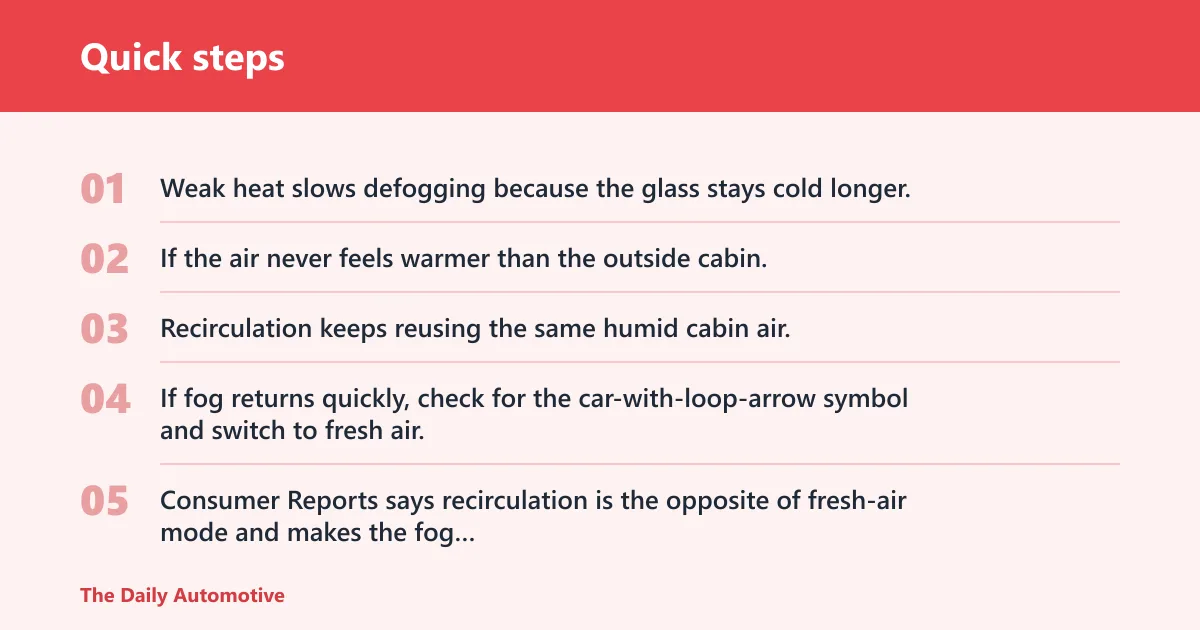
Weak heat slows defogging because the glass stays cold longer. If the air never feels warmer than the outside cabin, the heater may not be delivering enough output, or the blend door may not be sending enough warm air to the windshield. That is a common reason fog clears slowly.
Recirculation left
Recirculation keeps reusing the same humid cabin air. If fog returns quickly, check for the car-with-loop-arrow symbol and switch to fresh air. The same source says recirculation is the opposite of fresh-air mode and makes the fog condition worse.
Dirty glass
Dirty glass holds moisture and streaks more easily, so the windshield can look foggy even after the water is gone. Clean the inside glass when you are parked. For emergency cleanup only, use a microfiber cloth; it is better than a sleeve or a paper towel, which can leave lint and streaks.
Wet floor mats
Wet mats keep feeding moisture into the cabin, especially after snow, slush, or rain. If they are soaked, pull them out when you stop and dry them separately. That one step can reduce repeat fogging more than changing fan speed again and again.
Suppose the windshield clears in 40 seconds, then clouds again at the next traffic light. The likely issue is ongoing humidity, not the defroster setting itself. Check for wet mats first, then confirm that fresh air is still selected and that the fan has not been turned down too early.
Blend door or cabin filter issues
A stuck blend door can keep the system from sending enough warm air where it is needed. A clogged cabin filter can also slow airflow, which makes the defroster feel weak. If the sequence above works only partly, those are the next mechanical checks.
Frequently asked questions
How to defog car windows fast using AC and heat
Press front defrost, turn AC on, select fresh air, and set the fan to high. Then add warm air until the windshield clears. That combination dries the cabin air and warms the glass at the same time, which is the fastest way to clear inside fog in the first 30 seconds.
How to defog windshield without heat
Use front defrost, AC, fresh air, and high fan speed even if you do not want heat. AC removes moisture from the cabin air, which can clear condensation without maximum warmth. This works best for mild fog, but cold glass may still clear more slowly until the windshield warms up.
How to defog windshield quickly
Use the front defroster first, because it aims air at the glass and often turns on AC automatically. Keep the fan high, choose fresh air, and use warm air to help the windshield temperature rise. Once visibility improves, lower the fan to a more comfortable setting.
Does AC help defog windows in winter?
Yes. AC helps in winter because it removes moisture from the cabin air. That dried air clears interior condensation faster, even when the outside temperature is low. It is often paired with heat, which helps the glass warm up and stop new moisture from forming.
Should I use recirculation or fresh air to defog windows?
Use fresh air. Recirculation reuses cabin air and can make fogging worse, especially when people are breathing in the car or the floor mats are wet. Fresh air moves humid air out and brings drier outside air in, which helps the windshield clear faster.
Products related to this article
Sponsored / affiliate links. As an Amazon Associate I earn from qualifying purchases. I may earn additional commission from eligible campaigns.