Top 2 How to Dry Car Carpets
For wet car carpets, use a Top 2 triage: blot and air-dry surface dampness, but if the padding is soaked or the leak is still active, remove trim and dry from underneath first. Leave it alone and you risk mildew, electrical corrosion, lingering odor, and a carpet that never fully dries. This guide shows how to tell surface dampness from soaked padding or leak-fed water, then match the drying method to each case.
Quick comparison
| Product | Badge | Best for | Price | ||
|---|---|---|---|---|---|
 |
Blower Fan – 3-Speed Heavy-Duty Floor and Carpet DryerStalwart | Our pick | $69.95
Price as of 2 Nov 2026
|
View | |
 |
VEVOR 5 Gallon 6.0 Peak HP Wet and Dry Shop Vac, PortableVEVOR | Pair with it | 5 gallon shop vac · 6.0 peak HP · portable | $56.99
Price as of 2 Nov 2026
|
View |
 |
Klein Tools ET140 Pinless Moisture MeterKLEIN TOOLS | Also great | Pinless moisture meter · leak detection · non-destructive | $49.95
Price as of 2 Nov 2026
|
View |
If the carpet feels damp only at the surface, a wet/dry shop vacuum is the faster first step because it removes liquid before airflow starts doing the real work. If the carpet is already flattened, cool to the touch below the surface, or smells stale after drying, the fan belongs in the plan too, but only after extraction.
Use the vacuum for water removal. Use the fan for evaporation. Those jobs are different.
How we chose
The picks below are based on manufacturer specs, the listing details, and published buyer feedback, with the goal of matching the tool to the drying stage instead of repeating the same advice twice.
We favored tools that fit a car-cabin workflow: liquid extraction first, then airflow across the damp area. We also looked for one honest drawback for each product so you can tell where it helps and where it does not.
VEVOR 5 Gallon Wet and Dry Shop Vac: best for extraction
- Strong suction for wet carpet cleanup
- Includes filters and attachments
- Long reach with easy maneuverability
This is the better first buy if you need to pull liquid out of carpet fast. A wet/dry shop vac is used in the “Wet” setting to vacuum carpet moisture, and that matters because towels alone usually leave too much water behind in the fibers and underlay.
Its strength is the cleanup stage. It can also be the right choice for repeated passes, since deep carpet moisture often needs more than one empty-and-return cycle. That is especially useful when the padding under the carpet is holding water below the surface.
The drawback is simple: suction does not finish the job by itself. After extraction, you still need airflow, and the canister may need to be emptied repeatedly as the carpet gives up more water.
Stalwart blower fan: best for airflow drying
This is the better buy when the carpet is already extracted and you need to move air across the floor area. The guide recommendation is a fan blowing directly across the damp area, aimed low so the air skims the carpet instead of circling above it.
It helps most after you have removed standing water. Open cabin airflow can help too, but only in a secure location where the doors, windows, trunk, or sunroof can stay open safely. That setup speeds evaporation instead of trapping humid air inside the car.
The drawback is that airflow alone cannot rescue soaked underlay quickly. If the padding is still wet, the surface can feel dry while the hidden layer stays damp and starts smelling stale later.
Which one should you buy?
If you can only buy one tool, start with the wet/dry shop vac. It fixes the first bottleneck, which is liquid sitting in the carpet and padding. Airflow matters, but extraction comes first.
If the carpet is only lightly damp from shoes, a spill, or a short window leak, the fan becomes more valuable after you blot and vacuum what you can. For a flood-level event, the vacuum is still the lead tool, but you may need both tools plus trim removal.
Say your rear footwell took on rainwater from a blocked drain and the top feels damp while the foam still feels cool underneath. That is not a fan-only problem. Vacuum first, then use airflow and dehumidification if the cabin can be kept closed enough to dry the air instead of feeding it with outdoor humidity.
Suppose the carpet in the front passenger footwell is damp after a coffee spill and there is no leak source. That is a surface case. Blot, vacuum, and then run the fan across the floor area. If odor returns the next day, the underpadding probably stayed wet.
Car carpet triage table
| Severity | Symptom checklist | Fastest safe drying method | Estimated risk | Stop DIY and seek professional extraction when |
|---|---|---|---|---|
| Surface damp | Carpet feels damp on top only; no squish underfoot; no pooling; odor is faint or absent | Wet/dry vacuum first, then microfiber towel blotting and a fan aimed low across the carpet | Low if dried quickly | It still smells musty after the first drying cycle, or the carpet feels cool and damp the next day |
| Underpadding wet | Top layer feels close to dry, but the carpet feels soft, cool, or uneven; the floor still smells stale; water may have soaked into foam underlay | Vacuum the surface, then remove trim as needed so air can reach the underlayer; use fan plus dehumidifier in a controlled cabin | Moderate to high | You cannot dry from underneath, or the damp area keeps reappearing after a few hours |
| Leak-fed saturation | Water returns after drying; carpet is soaked near a drain, seal, heater core, or sunroof path; odor keeps coming back | Stop surface drying and find the source first; extract water, then repair the leak before final drying | High | The leak is active, the cabin keeps getting wet after rain, or trim removal reveals broad hidden saturation |
How do you dry wet car carpet fast?
The fastest safe sequence is to remove liquid first, then move air across the carpet, then dry the cabin air. Start with a wet/dry shop vacuum because it removes moisture more effectively than towels alone for deep wet carpet. After that, use a microfiber towel to blot what remains on the surface.
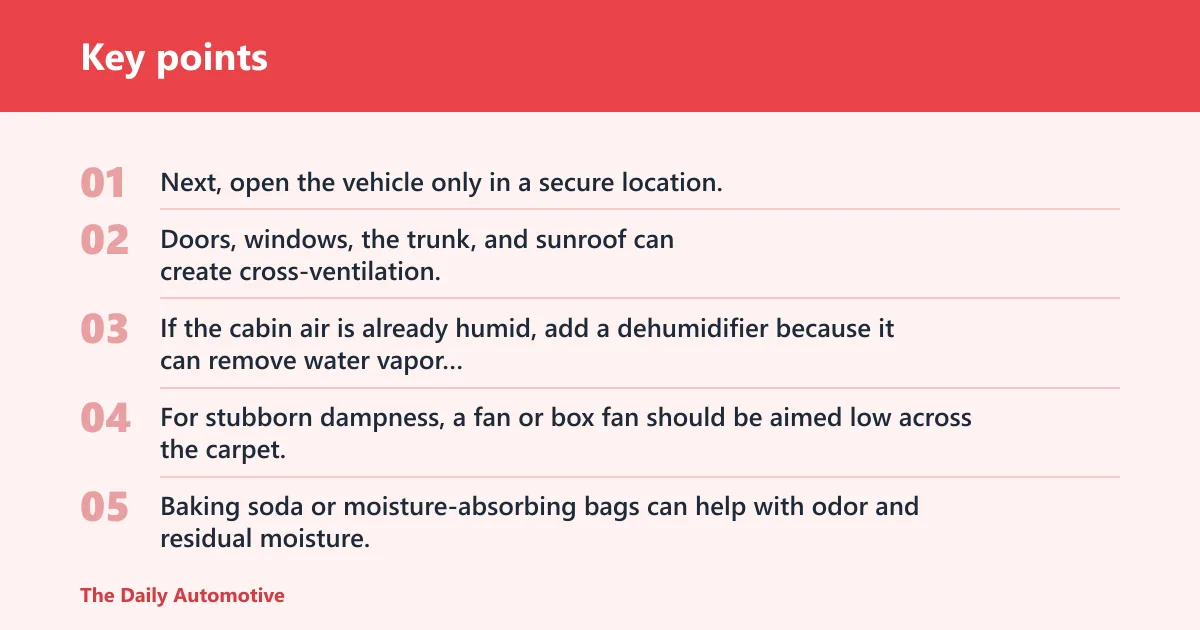
Next, open the vehicle only in a secure location. Doors, windows, the trunk, and sunroof can create cross-ventilation, but they are not a fix by themselves. If the cabin air is already humid, add a dehumidifier because it can remove water vapor from the air more effectively than heat alone in a closed vehicle.
For stubborn dampness, a fan or box fan should be aimed low across the carpet. That is where evaporation happens. Baking soda or moisture-absorbing bags can help with odor and residual moisture, but only after extraction. They are not water removal tools.
Surface damp: first 15 minutes
Blot, vacuum, and keep the airflow low and direct. Refold the microfiber towel often so you are using a dry side, not just moving the same moisture around. If the carpet dries on top but stays cool underneath, stop treating it like a surface-only spill.
Underpadding wet: what changes
The hidden risk is the car carpet padding or foam underlay. It can hold several times its weight in water, which is why the top can look fine while the lower layer stays wet. At this stage, the drying plan has to reach below the carpet surface, not just over it.
Leak-fed saturation: when to stop DIY
If the water comes back after rain, or if you can trace it to a blocked AC evaporator drain hose, sunroof path, heater core, or bad seal, do not keep drying the symptom. Fix the source first. Otherwise the carpet will keep rewetting, and the odor problem will return.
When should you call a professional?
Call for professional extraction when the padding still feels wet after the surface has dried, when the leak keeps coming back after rain, or when the cabin still smells musty after drying. Mold can begin to grow on damp car carpet within 24 to 48 hours, so the time window matters.
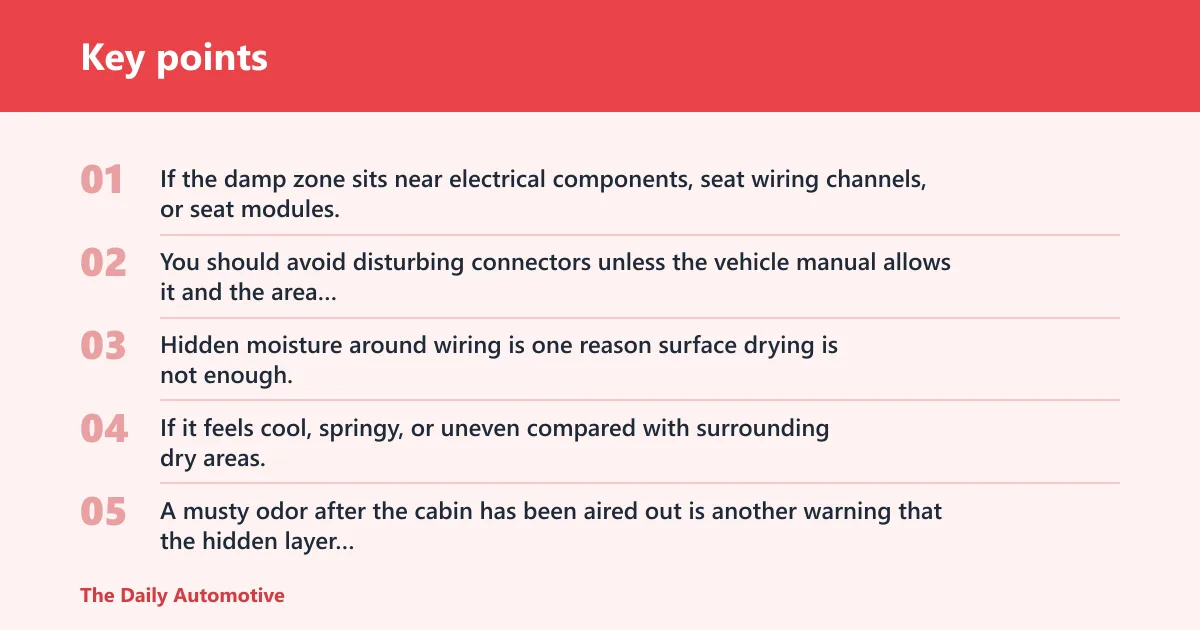
If the damp zone sits near electrical components, seat wiring channels, or seat modules, the caution level goes up. You should avoid disturbing connectors unless the vehicle manual allows it and the area is safely de-energized. Hidden moisture around wiring is one reason surface drying is not enough.
Signs the padding is still wet
Press the carpet with a clean hand or towel. If it feels cool, springy, or uneven compared with surrounding dry areas, assume the underlay is still wet. A musty odor after the cabin has been aired out is another warning that the hidden layer did not dry fully.
A wet spot that reappears after a few hours is a stronger clue than a single damp touch. That usually means the foam underlay is still releasing moisture upward.
Recurring leaks after rain
If the carpet gets wet again after each storm, drying without repair is wasted effort. Check likely leak paths: door seals, sunroof drains, trunk seals, and blocked drain hoses. A blocked AC evaporator drain hose is a common cause of wet car floor carpet, and it can keep refilling the same area.
Do not keep adding absorbent bags or baking soda to a leak-fed floor and call it done. Those products can help with smell, but they cannot stop water from entering the cabin.
Musty odor that returns
A returning musty odor means moisture is still present somewhere in the carpet stack, padding, trim channel, or air path. Drying the surface again may reduce the smell for a day, then it comes back. That is the point to move from drying to diagnosis.
If the odor has a sweet edge, especially near the dash or passenger footwell, a leaking heater core is a possibility. That is not a DIY drying problem alone.
How do you dry out a car carpet without removing it?
You can dry minor dampness without full carpet removal if the water has not soaked the foam underlay. Use extraction first, then airflow across the floor, then dehumidification in the cabin. The key is to keep the air moving over the carpet while the cabin humidity drops.
This approach works best when the wet area is small and the source is already fixed. It is less effective when water has reached the padding, because the top layer can dry while the hidden layer stays wet.
Can you use heat and A/C together to dry car carpet?
Yes, in some conditions. The “automotive sauna” method uses maximum heat, A/C, and slightly cracked windows. The idea is to dry the air while moving it through the cabin. The window crack recommended for this method is about 1 cm, and it is suggested for about 20–30 minutes per cycle.
Use it as part of a controlled drying plan, not as a substitute for extraction. It works best after liquid has been removed and when the vehicle can be kept in a secure location. If the cabin is humid outside, dehumidification often helps more than heat alone in a closed vehicle.
Direct the airflow toward the floor area. Heat rises, but the wet carpet sits low. If the cabin starts fogging or the moisture smell gets stronger, stop and return to extraction and dehumidification.
How do you dry wet carpet in a car overnight?
Overnight drying works only if the cabin is already mostly extracted and the air can keep moving. Leave the vehicle open only where it is safe, then run a fan across the carpet and, if possible, a dehumidifier inside or near the closed cabin. This keeps the air drier instead of trapping moisture.
For light dampness, that may be enough. For soaked padding, overnight drying without trim access can still leave hidden moisture behind. If the carpet is not clearly improving by morning, treat it as a deeper wet-underlay problem.
How long does wet car carpet take to dry completely?
There is no single number that fits every car, because moisture level, padding thickness, climate, and ventilation all change the result. Surface dampness may clear quickly after extraction and airflow, while soaked underlay can stay wet much longer even if the top layer feels dry.
The practical rule is to treat the first 24 to 48 hours as the danger window for odor and mold risk. If the carpet still smells stale, feels cool below the surface, or keeps rewetting, it is not dry enough yet.
How do you remove the musty smell after drying car carpet?
Start by finishing the drying job, because odor usually means moisture remains somewhere in the floor stack. Then ventilate the cabin, run a fan across the carpet, and use a dehumidifier if the vehicle must stay closed. Baking soda or moisture-absorbing bags can help after extraction, but they are secondary aids.
If the smell returns, check for hidden wet padding or a leak that is still active. Odor that comes back after rain is usually a source problem, not a scent problem.
Frequently asked questions
How do you know if the padding under car carpet is still wet?
If the surface looks nearly dry but feels cool, springy, or uneven, the padding may still be wet. A musty smell after airing out is another clue. Pressing the carpet and finding moisture rebound is a stronger sign than the top layer alone.
What is the quickest way to dry out wet carpet in a car?
The quickest safe path is extraction first, then airflow. A wet/dry shop vac removes liquid better than towels alone, and a fan blowing directly across the damp area speeds evaporation. If the water source is still active, fix that before trying to finish the dry-down.
When should a wet car carpet be professionally dried?
Get professional help when the padding stays wet, the carpet keeps rewetting after rain, or the smell returns after drying. Saturation from a leak, flood, or blocked drain often needs trim removal and deeper extraction. That is especially true if wiring or seat-area moisture is involved.
Products related to this article
Sponsored / affiliate links. As an Amazon Associate I earn from qualifying purchases. I may earn additional commission from eligible campaigns.