3 Best Wet Vacuums for Car Detailing (2026): We Compared
The best wet vacuum for car detailing depends on how you clean: choose a compact 2.5-gallon unit for quick interior cleanup, a stronger shop vac for embedded grit, or a longer-reach setup if hose length matters most. Pick the wrong one and you waste time fighting crumbs, sand, and wet spills instead of removing them. This guide compares three setup types and gives a simple rule for choosing between portability, suction, and reach.
Quick comparison
| Product | Badge | Best for | Price | ||
|---|---|---|---|---|---|
 |
WECLEAN Shop Vac 4 Gallon 5.5 Peak HP Commercial Wet DryWECLEAN | Our pick | 4 gallon · 5.5 peak HP · wet/dry | $79.99
Price as of 24 Oct 2026
|
View |
 |
VEVOR 5 Gallon 6.0 Peak HP Wet and Dry Shop Vac, PortableVEVOR | Also great | $52.49
Price as of 24 Oct 2026
|
View | |
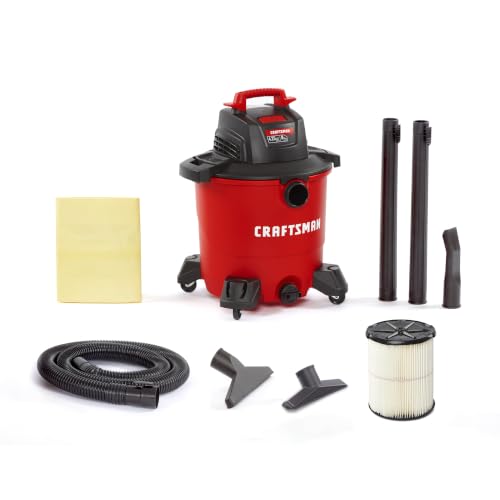 |
CRAFTSMAN CMXEVBE17590 9 Gallon 4.25 Peak HP Wet Dry ShopCRAFTSMAN | Also great | $99.99
Price as of 24 Oct 2026
|
View | |
 |
Shop-Vac 12 Gallon 6.0 Peak HP Stainless Wet/Dry Vacuum,Shop-Vac | Upgrade pick | 12 gallon · 6.0 peak HP · stainless | $209.99
Price as of 24 Oct 2026
|
View |
 |
Shop Vac Extractor Hose Kit with Stainless Extractor WandSMZTools | Our pick | $95.99
Price as of 30 Oct 2026
|
View |
The table below keeps the decision to three things that matter in a car: how far the hose reaches, how much debris the tank can handle before you stop to empty it, and how much friction you add when switching from dry debris to wet pickup. Those details matter more than marketing language.
How we chose
Wet/dry vacuums can handle dry debris and liquid, which makes them a better fit for car interiors than a carpet extractor when your main job is cleanup rather than deep fabric washing. A carpet extractor is the better tool for flushing and recovering cleaning solution from upholstery, but it is not the same job.
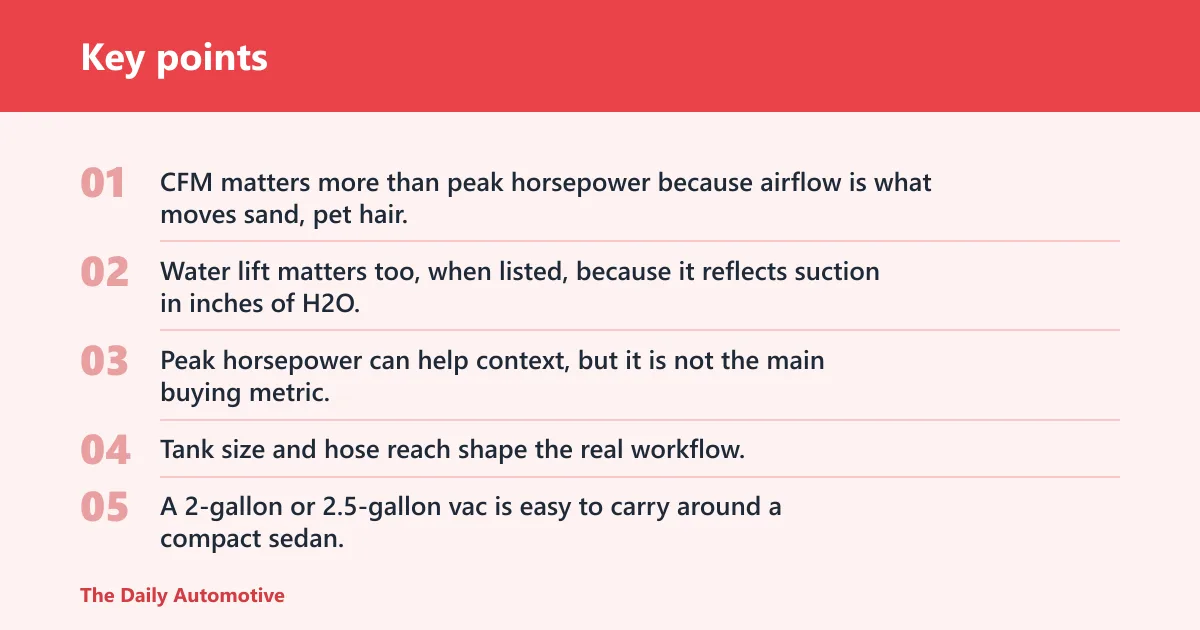
CFM matters more than peak horsepower because airflow is what moves sand, pet hair, and lint through the hose. Water lift matters too, when listed, because it reflects suction in inches of H2O. Peak horsepower can help context, but it is not the main buying metric.
Tank size and hose reach shape the real workflow. A 2-gallon or 2.5-gallon vac is easy to carry around a compact sedan, while a 5-gallon or 6-gallon unit is more comfortable in an SUV or a heavily soiled family car. Hose reach in the roughly 6- to 20-foot range can determine whether the whole cabin can be cleaned without dragging the unit across the floor.
Accessory strategy matters as much as the motor. A crevice tool helps at seat rails and console gaps, a brush nozzle helps on floor mats and trunk carpeting, and a wider upholstery nozzle saves time on seats. Filter swaps and clog risk also matter, because fine dust and pet hair punish a vac that looks good on paper but is annoying to maintain.
What is the best wet vacuum for car detailing?
The best wet vacuum for car detailing is the one that matches your main mess: the WECLEAN 4-gallon unit is the best all-around compact choice, VEVOR is the stronger pick for embedded dirt and pet hair, and CRAFTSMAN is the more practical budget-to-capacity step-up if you want more tank room than a small portable without moving into a huge shop vac.
Best overall compact pick
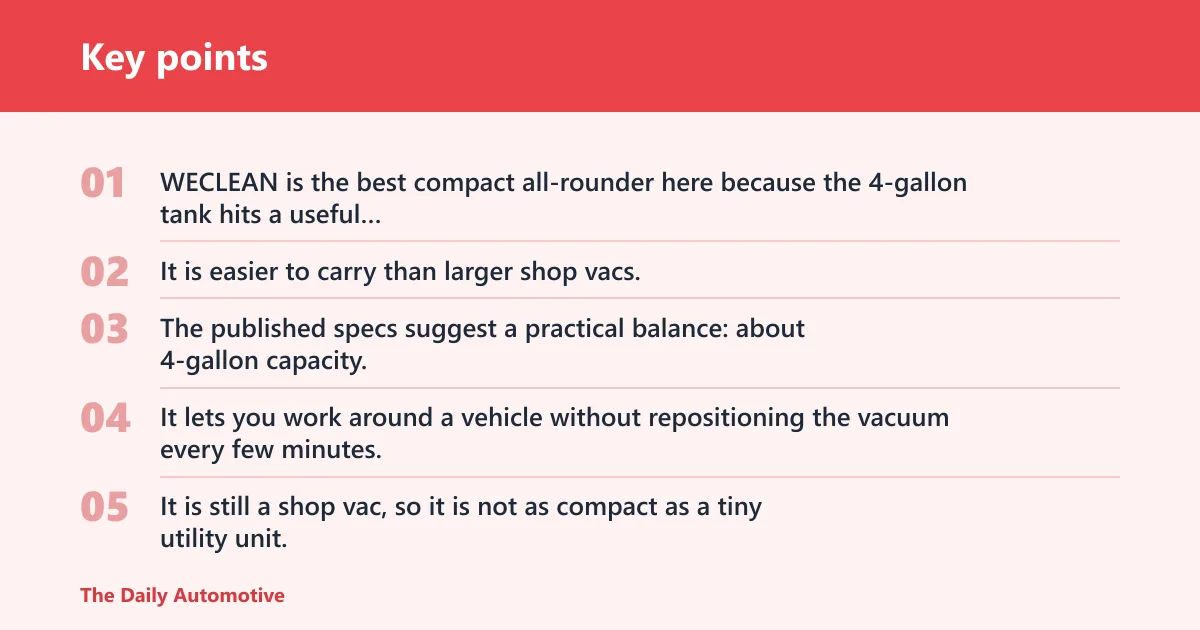
WECLEAN is the best compact all-rounder here because the 4-gallon tank hits a useful middle ground for car interiors. It is easier to carry than larger shop vacs, but it still gives you enough capacity for a full sedan or a normal SUV cleanup before you need to empty it.
The published specs suggest a practical balance: about 4-gallon capacity, about 5.5 peak HP, and over 24 feet of cleaning reach. That reach matters. It lets you work around a vehicle without repositioning the vacuum every few minutes, which is a real advantage when you are cleaning rear seats, cargo areas, and front footwells in one session.
The drawback is also clear. It is still a shop vac, so it is not as compact as a tiny utility unit, and it is not the right choice if your main goal is the shortest possible carry between rooms and vehicles.
Best for embedded dirt and pet hair
VEVOR is the better fit when the interior has sand in carpet pile, pet hair in seat seams, or a mix of dry debris and tracked-in grit. A 5-gallon tank gives you more tolerance for repeated passes, and the 6.0 peak HP listing puts it in the stronger end of the portable category.
That extra capacity is useful in family cars and SUVs, where the debris load rises quickly. It also helps when you are cleaning mats, trunk carpeting, and the areas around seat rails, because those spots often need multiple passes with a crevice tool and a brush nozzle.
The tradeoff is bulk. A 5-gallon vac is less convenient for quick touch-ups in a compact sedan, and it can be more awkward to store than a smaller unit if your garage space is tight.
Best budget pick
CRAFTSMAN is the best lower-cost step-up if you want a larger tank without jumping into a premium price tier. The 9-gallon size gives you lots of room for dry debris, and that can help if you are cleaning a heavily used family vehicle, a cargo area, or a car that collects a lot of grit between full details.
The drawback is obvious: it is bigger than the compact picks, and for many users that extra size is more than they need. It can be harder to store, harder to move around a crowded garage, and less pleasant for quick interior jobs where a smaller vac would be faster.
Use it when capacity matters more than portability. If you want the cheapest unit in this comparison, VEVOR’s listed price is lower, but CRAFTSMAN gives you the bigger tank.
Which one should you buy?
Choose by vehicle size first. For a compact sedan and routine cleanup, WECLEAN is the easiest all-around fit. For an SUV, a minivan, or a car that regularly picks up dirt and hair, VEVOR gives you more room to work. If you are cleaning a larger family vehicle and want fewer dump stops, CRAFTSMAN is the capacity play.
Choose by mess type second. Fine sand and pet hair push you toward the stronger unit because those materials move better with stronger airflow and more consistent hose pickup. Wet spills do not need a giant tank, but they do punish weak filtration and cramped cleanup paths.
Choose by reach last. If you hate moving the vacuum mid-clean, a longer hose and fewer hose swaps matter more than a small bump in peak horsepower. For tight storage and fast carry, compact wins. For wide reach across the garage or back row, longer hose wins.
Wet vacuum comparison matrix
| Pick | Vehicle size | Mess type | Hose reach | Capacity | Filter-change friction | Best-use scenario |
|---|---|---|---|---|---|---|
| WECLEAN 4-gallon | Compact sedan to midsize SUV | Mixed crumbs, light sand, quick wet spills | Over 24 feet of cleaning reach | 4 gallon | Moderate; still easier than a large fixed setup | General interior detailing with a strong balance of carry and reach |
| VEVOR 5-gallon | SUV, minivan, or heavily used family car | Embedded dirt, pet hair, trunk debris, repeated passes | Depends on the included hose kit; use the longest setup you can store | 5 gallon | Moderate to higher; stronger cleanup needs more filter attention | Best when sand and hair are the main problem |
| CRAFTSMAN 9-gallon | Larger cars and multi-vehicle garage use | Heavy dry debris, less frequent dump cycles, broader cleanup jobs | Good for garage work when paired with a long hose | 9 gallon | Higher; bigger tank can still mean more cleanup after liquid pickup | Capacity-first buyer who wants fewer interruptions |
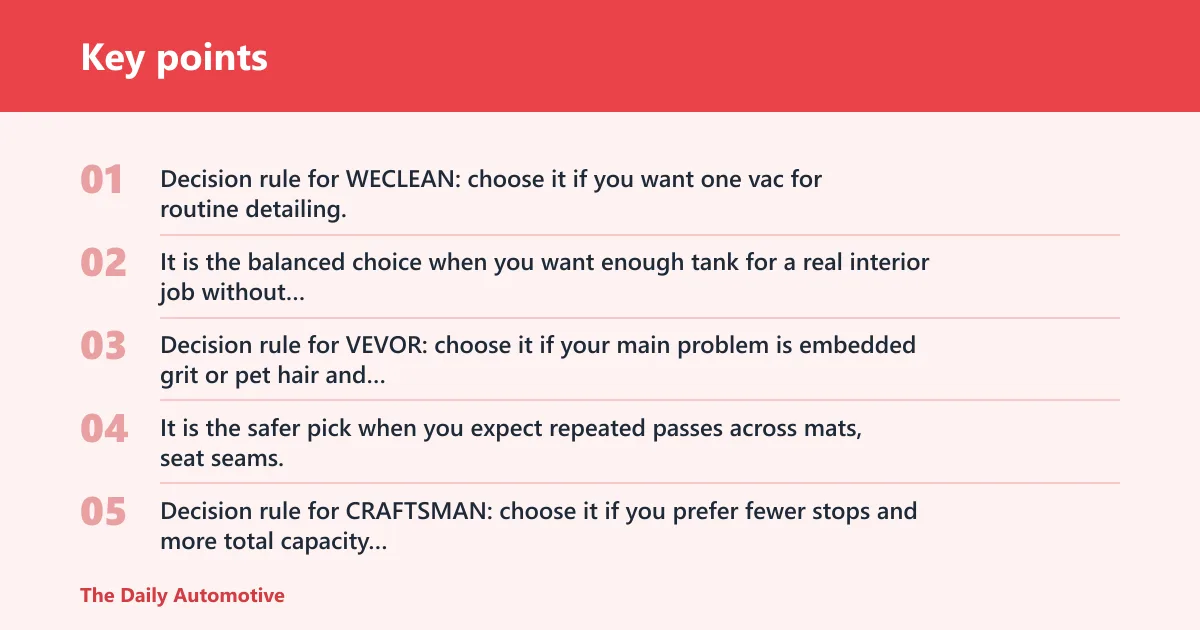
Decision rule for WECLEAN: choose it if you want one vac for routine detailing, you clean a mix of compact cars and SUVs, and you care about moving less often than emptying. It is the balanced choice when you want enough tank for a real interior job without carrying a bulky unit.
Decision rule for VEVOR: choose it if your main problem is embedded grit or pet hair and you clean vehicles that accumulate more debris than average. It is the safer pick when you expect repeated passes across mats, seat seams, and cargo carpet, even if the unit is less compact than a smaller vac.
Decision rule for CRAFTSMAN: choose it if you prefer fewer stops and more total capacity over portability. It makes the most sense for a larger family car or for garage detailing where the vacuum can stay parked and the hose does the moving.
How to read detailing specs
Peak horsepower looks simple, but it can mislead. CarMechan’s comparison lists Stanley SL18116P at 4 horsepower, and other comparison sites note that 6.0 PHP can be less meaningful than airflow. That is why CFM and water lift deserve more attention than the motor badge alone.
CFM is the airflow number that helps you judge whether a vac will pull sand and lint through the hose instead of leaving it behind in carpet fibers. Water lift, when listed, helps you compare suction strength in a more practical way than marketing horsepower. If a listing gives you CFM and water lift, that is a better sign than a huge PHP number with no context.
Hose reach is not a minor spec. A unit with 6 feet of hose may force you to move it mid-clean, while a 20-foot setup can stay parked while you work around the cabin. That changes how long a detail takes and how annoying the process feels.
Suppose you are cleaning a compact sedan with crumb buildup under the front seats. A short hose and a tiny tank may work, but you will stop often. Now picture the same cleanup in an SUV with cargo carpet and rear cupholders involved. Longer reach and a bigger tank save time because the unit does not need to move every few minutes.
What attachments do I need for detailing seats and crevices?
You need three basics: a crevice tool for seat rails, console gaps, and door pockets; a brush attachment for floor mats and textured plastics; and a wider upholstery nozzle for seat cushions and trunk carpet. Those tools cover the places where crumbs, pet hair, and sand collect most often.
For seats and seams, a narrow nozzle matters more than raw suction because it concentrates airflow where debris hides. For mats, a brush head helps loosen grit before the vacuum pulls it free. For trunk carpeting, a wider head saves time and covers more area per pass.
A common first-timer mistake is to buy a strong vac and ignore the nozzle shape. That leads to repeated passes on seat tracks and under-edge carpet, even though the motor is fine and the attachment is the real bottleneck.
Can a wet/dry vac pick up liquid from car carpets and mats?
Yes, a wet/dry vac can pick up liquid from car carpets and mats, which is one of its main advantages over a dry-only vacuum. It handles spills, tracked rainwater, and damp residue after spot cleaning. It is still not a carpet extractor, though, so it does not replace a machine built for washing and recovering cleaning solution from upholstery.
Use the correct filter setup before switching from dry debris to liquid pickup, and empty the tank promptly afterward. Fine dust and wet debris can make cleanup messier if you leave the machine sitting full.
Which wet/dry vacuum is best for pet hair in cars?
For pet hair, the stronger option is the better bet because hair clings to fabric and carpet fibers. VEVOR is the strongest fit in this comparison for that reason. It has the bigger tank, the stronger peak horsepower listing, and the kind of capacity that makes repeated passes less frustrating.
Pet hair is one of the jobs where a brush attachment matters as much as suction. A soft brush loosens hair from upholstery, and a crevice tool helps at seams and seat rails where hair piles up.
How important is hose reach for detailing a car interior?
Hose reach matters a lot because it changes how often you have to move the vacuum. In car detailing, that affects time, fatigue, and whether you can stay focused on the cabin instead of relocating equipment. A 20-foot hose setup behaves very differently from a short portable vac.
For a compact sedan, a moderate hose may be enough. For an SUV or a garage detail where the unit stays parked, longer reach is a real advantage. It is one of the specs that determines whether a vacuum feels convenient or annoying after the first few minutes.
Frequently asked questions
Do I need a wet/dry vac or a carpet extractor for car detailing?
Use a wet/dry vac for debris, spills, and general interior cleanup. Use a carpet extractor when you need to wash fabric and recover cleaning solution from seats or carpet. If your routine is crumbs, sand, and wet messes, the wet/dry vac is the more useful first buy.
What size wet/dry vacuum is best for car interiors?
For a compact sedan or light cleanup, 2.5 to 4 gallons is usually enough. For an SUV, minivan, or a car that sees a lot of dirt and pet hair, 5 to 6 gallons is easier to live with. Bigger tanks reduce dump stops, but they also add bulk.
Is peak horsepower or CFM more important for car detailing vacuums?
CFM matters more because it measures airflow, which is what actually moves debris through the hose. Peak horsepower can be useful context, but it is a marketing number that does not always translate into better pickup. Water lift is also worth checking when a manufacturer lists it.
Products related to this article
Sponsored / affiliate links. As an Amazon Associate I earn from qualifying purchases. I may earn additional commission from eligible campaigns.