How to Tell If a Car Rental Company Is Legit
Treat any rental company as suspect until you verify a real local address, a card-only deposit policy, and clear fees before you pay. Miss those checks and you can lose money to hidden charges, fake bookings, or a denied pickup. This guide shows the fastest contract, payment, and identity checks to use before you book or hand over your card.
Rental legitimacy checklist
Use this page as a five-minute screen before you book. A legit rental setup gives you a traceable business identity, a contract that names the operator, fee terms you can read before payment, and pickup-day rules that match the booking page. If those pieces do not line up, stop.
| Signal | What a legit company shows | Red flags |
|---|---|---|
| Company identity | Full legal business name, real local address, working phone or support channel, and a booking confirmation that matches the operator name | Only a brand name, vague mailbox address, no support number, or different names on the site, voucher, and counter |
| License and insurance | Clear license rules, age limits, country-of-use restrictions, and third-party liability coverage terms | Missing country rules, unclear driver requirements, or insurance language that hides the actual excess or deductible |
| Payment and deposit | Deposit amount, card type accepted, refund timing, and any conditions that raise the hold are stated before pickup | “Pay on arrival” claims that turn into a large hold, cash-only pressure, or surprise fees added at the desk |
| Booking source | You can tell if you are booking with the rental operator or a broker, and know who handles disputes | Broker and operator names are mixed together, or no one will say who supplies the car and who refunds extras |
| Pickup-day checks | The contract matches the car class, mileage, fuel policy, and return location you booked | Different car category, new fuel rule, unexplained charges, or staff refusing to explain the signed terms |
- Match the legal business name on the website, voucher, and counter sign.
- Find the physical address and a working support channel.
- Read the deposit, fuel, mileage, and cancellation lines before you pay.
- Check if you are dealing with a broker or the operator.
- At pickup, confirm the license rules, deposit hold, and add-ons in writing.
Is the rental company really licensed?
A real rental company should be traceable to a legal business name, a physical location, and a support channel that reaches a person or service desk. If the company cannot match its own booking confirmation to a street address and an operator name, treat that as a warning sign and keep looking.
Business name and ownership match
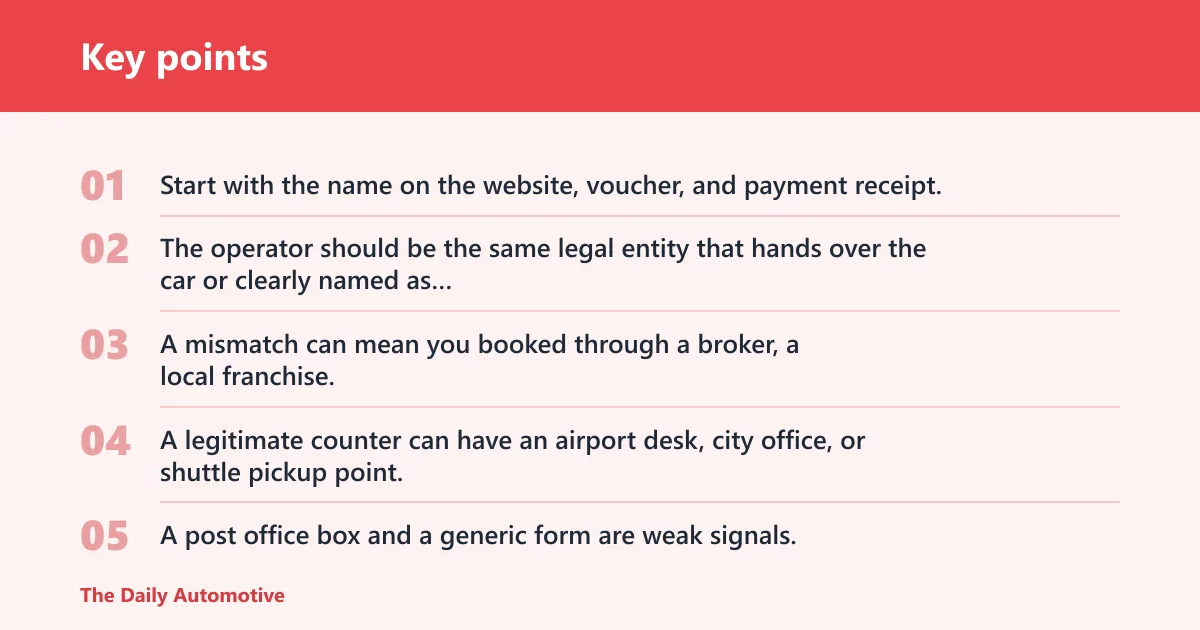
Start with the name on the website, voucher, and payment receipt. The operator should be the same legal entity that hands over the car or clearly named as the supplier on the booking page. A mismatch can mean you booked through a broker, a local franchise, or a shell brand that is hard to challenge if something goes wrong.
Physical address and contact details
A legitimate counter can have an airport desk, city office, or shuttle pickup point, but it still needs a real address and working contact details. A post office box and a generic form are weak signals. You want a phone number, email, or chat path that is listed before payment and still works after booking.
Regulator, airport, or trade listing checks
For commercial transport firms, one verification model is to look for official operating markers. AWZ says legitimate transport companies have USDOT and MC numbers, and to verify operating status as Active on the federal database. Car rental operations use different rules by country, but the principle is the same: find an official record, not just a logo.
Complaint patterns to review
Star ratings alone do not tell you much. Look for repeated complaints about surprise deposits, denied pickups, or charges that appear after return. A few angry reviews are normal. A pattern of the same issue across months is a stronger warning than a glossy site or a high average score.
Say your airport booking shows one brand name online, but the voucher names a different local company and a different return address. That is the sort of mismatch that can turn a cheap quote into a dispute at the counter. The safe move is to verify the operator before you pay.
What to check in the rental agreement
The agreement should spell out pickup and return terms, fuel policy, mileage included, cancellation rules, and any one-way fee or location charge. Rental terms should describe mileage included and deposit requirements. If those items are missing, vague, or buried in extra pages, the booking is not ready for your card.
Pickup and return terms
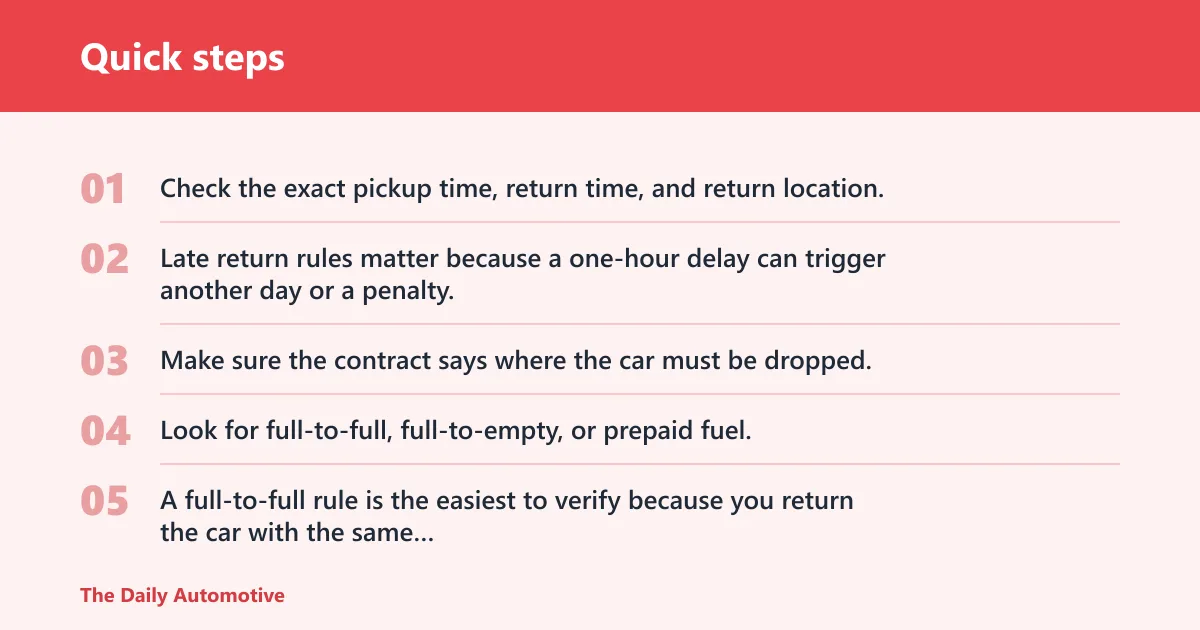
Check the exact pickup time, return time, and return location. Late return rules matter because a one-hour delay can trigger another day or a penalty. Make sure the contract says where the car must be dropped, whether after-hours return is allowed, and what condition counts as returned on time.
Fuel policy and refueling rules
Fuel terms can change the real price fast. Look for full-to-full, full-to-empty, or prepaid fuel. A full-to-full rule is the easiest to verify because you return the car with the same level. Under a prepaid plan, confirm whether unused fuel is refundable and whether refueling charges apply if the tank is not empty.
Mileage limits and one-way fees
The booking should say if mileage is unlimited or capped. If a cap exists, the overage rate needs to be visible before payment. One-way fees should also appear in the total price. Under EU rules, prices must include all charges in the total booking price at booking time, and optional extras must be itemised.
Cancellation and modification terms
Check whether cancellation is free, partially refundable, or nonrefundable after a deadline. A weak sign is a bargain rate that can disappear once you try to change the pickup time. EU car hire is not covered by a 14-day cooling-off period, so the booking terms matter even more.
Suppose you book a compact car for three days with 300 miles included, then the contract at pickup might show about 150 miles and a separate one-way charge. That is not a small detail. It is a different deal, and you should walk away if the desk will not honor the booking page.
Can they verify your license and payment?
Yes. Rental companies commonly verify the validity of your driver’s license, your age, and the payment method you present. They may also check whether your license is valid for the country of use and whether your card meets their deposit rules. That does not prove fairness, only that the pickup rules are being enforced.
Driver’s license status and age rules
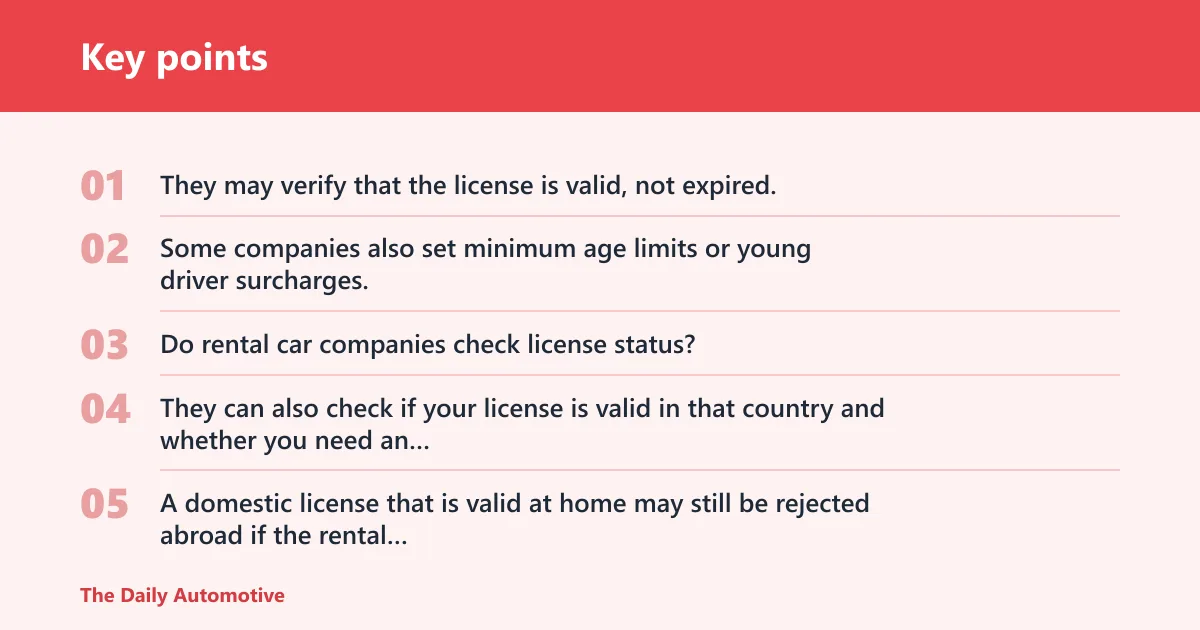
Do rental car companies check your license? Often, yes. Do rental companies check license status? They may verify that the license is valid, not expired, and acceptable for the class of car you booked. Some companies also set minimum age limits or young driver surcharges, so check both the booking page and the counter policy.
Country-of-use and license-type restrictions
Do rental car companies check license status? They can also check if your license is valid in that country and whether you need an International Driving Permit or a specific license format. A domestic license that is valid at home may still be rejected abroad if the rental terms require a translation, Latin characters, or a second document.
Credit card or debit card acceptance
Do rental car companies check credit? In practice, they often check whether the card can support the security hold, not your credit score. Many desks prefer a credit card in the main driver’s name. Some accept debit cards with extra rules, but those rules can mean higher holds, more proof of travel, or tighter insurance requirements.
Deposit amount and refund timing
Deposit or security hold terms should say the amount, the card type accepted, and when the hold is released after return. Booking.com says rental company coverage can reduce the security deposit to zero in some cases. It also notes third-party insurance usually requires paying the rental company first. That distinction matters at the desk.
A common first-timer mistake is assuming a “zero deposit” line means no money can be blocked. The desk may still take a card verification or hold if the driver is young, the route crosses borders, or the car class is upgraded. Read the exact hold rule, not just the headline offer.
Broker or rental operator: who is selling the car?
A broker or comparison site may sell the booking while a different company supplies the car and handles the counter handoff. That split affects disputes, refunds, and add-ons. KAYAK searches rental car deals on hundreds of sites, and KAYAK says you can compare discount car rentals. Useful, but the site is not always the operator.
How to tell who is responsible
Look for the supplier name on the voucher, the payment receipt, and the airport desk sign. If the booking page names one company and the pickup desk uses another, you are likely dealing with a broker arrangement. In that case, the broker may control the reservation while the operator controls the vehicle and local terms.
Who handles the contract and extras
Optional extras must be itemised. That means GPS, child seats, toll packages, and extra drivers should appear as separate lines. If the broker says “all-inclusive” but the operator adds extras at pickup, you need to know which company sold the booking and which company can change the final bill.
Who takes disputes and refunds
Ask who handles a late charge, a damage claim, or a cancellation refund. Broker bookings can slow dispute handling because the broker may say the operator must approve the refund, while the operator may say the broker collected the money. That split is one of the biggest reasons cheap third-party deals go bad.
When third-party sites raise risk
Third-party sites are not automatically bad. The risk rises when the booking page hides the supplier name, buries the fee rules, or shows one insurance package while the counter sells another. Booking.com says there are four main options for rental car insurance, and says a company-provided waiver is not technically insurance and is unregulated. That difference matters.
Insurance, fees, and pickup-day checks
Good rental paperwork separates coverage from fees. In the EU, rental cars must have third-party liability insurance. Booking forms should also explain collision damage waiver, theft coverage, excess or deductible, and any admin fee tied to damage handling. Airport and location charges should be visible before you arrive, not discovered at the desk.
Liability, CDW, and theft coverage
Third-party liability covers harm to other people or property. Collision damage waiver and theft coverage address the rental vehicle itself, but the wording matters. Booking.com says rental company coverage can reduce the security deposit to zero in some cases, yet a waiver is not the same as insurance. Do not assume the label matches the protection.
Deductibles, excesses, and admin fees
Watch for the amount you would still owe after a claim. A low daily rate can hide a large excess, then add an admin fee for any damage file. If the contract does not show the deductible, excess, and claim-handling fee in plain language, ask for the full total before signing.
Airport and location surcharges
Airport fees, one-way fees, young driver surcharge, and location-specific charges can change the total quickly. Prices must include all charges in the total booking price at booking time. If a fee is only mentioned on the final payment screen or at the counter, treat that as a warning sign and compare another supplier.
What to inspect before you leave
At pickup, inspect the car body, tires, windshield, fuel level, mileage, and warning lights before you leave the lot. Photograph any damage and make sure it is marked on the form. Confirm the return time, fuel rule, and deposit hold. If the desk will not put those details in writing, do not drive off.
Frequently asked questions
Is car rentals.com legit?
Check if the site names the actual supplier, shows a real business address, and explains who handles refunds and claims. A legitimate booking site can still be a broker, so the real test is whether the operator, contract terms, and deposit rules are clear before you pay. If they are not, keep looking.
Is Booking.com legit for car rentals?
Booking.com can be a real booking channel, but that does not make every car offer simple. The key is whether the supplier name, insurance choice, and fee lines are itemised. Booking.com says there are four main options for rental car insurance, which is useful only if the contract says which one you are buying.
What should I look for in a rental car review?
Look for repeated complaints about the same issue, especially denied pickups, surprise deposits, added insurance, or hidden fuel charges. One bad review is not enough. A pattern across many reviews is more useful, especially if the company never answers complaints or shifts blame between the broker and the operator.
What to check when renting a car?
Check the legal name, pickup and return terms, mileage, fuel policy, deposit amount, license rules, and cancellation terms before you book. Then verify the same details at pickup. If the desk changes the car class, adds a charge, or changes the fuel rule, stop and ask for the written agreement.
Do rental car companies check credit?
They often check if your card can support the security hold, which is different from checking your credit score. A credit card is commonly preferred, while debit card rules can be stricter. The contract should say what form of payment is accepted and what hold amount may be blocked.
What are legit car rental companies?
Legit car rental companies show a traceable business identity, a physical address, real contact details, clear fee rules, and a contract that matches the booking. They explain deposit timing, fuel policy, and license requirements before payment. If those details are hidden or inconsistent, treat the company as high risk.
Products related to this article
Sponsored / affiliate links. As an Amazon Associate I earn from qualifying purchases. I may earn additional commission from eligible campaigns.
 4G GPS Tracker Car Anti-Theft Long Battery Life 20000mAh Real Time GPS Tracking Device Magnet No Geographic Restriction Car Tracker with Alerts, Geo Fence, History Playback TK905C
 Large Car Windshield Cover for Ice and Snow - Automotive Windshield Snow Covers with Side Window & Rearview Mirror Protector, Winter Magnetic Car Anti-Snow Cover, Universal for Most Cars,Sedan,SUV